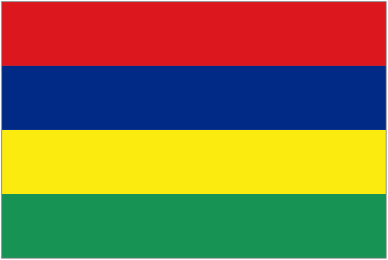
Datos Comparados —
Aller au contenu.
|
Aller à la navigation
Recherche du site
Recherche avancée…
English
Español
العربية
नेपाली
Français
Accueil
Encyclopédie
Données comparatives
Documents électoraux
Conseils électoraux
Régions et Pays
Au sujet du projet ACE
Outils personnels
Se connecter
Espacio de intercambio
Vous êtes ici :
Accueil
→
Datos Comparados
Réseau d'experts
Français
’S’abonner au bulletin d’information ACE
Encyclopédie
Administration électorale
Cadre juridique
Délimitation des circonscriptions
Inscription des électeurs
Gros plan Sur Le Financement des Campagnes Électorales
Intégrité électorale
Lois électorales : Une perspective macroscopique
Médias et élections
Opérations de vote
Partis politiques et candidats
Regard sur les élections et la sécurité
Rendre efficace l'assistance électorale
Systèmes de gestion des résultats
Systèmes électoraux
Éducation civique et électorale
Élections et handicapées
Élections et technologie
Pays
Ressources
Encyclopédie
Documents électoraux
Données comparatives
BRIDGE
Avis d'experts
Se connecter au Réseau d’experts ACE
Consulter les experts
Explorer les réponses collectives
Trouver un expert
À propos
À propos d'ACE
Partenaires d'ACE
Réseau d'experts
Info
Actions sur le document
Systèmes électoraux
Maurice
ES001
Chef de l’État
Question
Comment est sélectionné le chef de l’État?
Réponses
d
.
Indirectement élu par le pouvoir législatif
Réponses
The President is the ceremonial Head of State and is elected by Parliament.
Source
Constitution: Constitution of the Republic of Mauritius, art. 28
Vérifié
2012/02/25
ES002
Chef du gouvernement
Question
Comment est choisi le chef du gouvernement?
Answer:
e
.
Nommé
Réponses
The President appoints as Prime Minister the member of the National Assembly who appears to him best able to command the support of the majority of the members of the Assembly. The Prime Minister may be forced from office by a vote of no confidence by the National Assembly.
Source
Constitution: Constitution of the Republic of Mauritius, art. 59
Vérifié
2012/02/25
ES003
Président
Question
Le pays a-t-il un président?
Answer:
a
.
Oui
Réponses
The President is the ceremonial Head of State and is elected by Parliament.
Source
Constitution: Constitution of the Republic of Mauritius, art. 28 & 29
Vérifié
2012/02/25
ES004
Nombre de chambres
Question
Le corps législatif national est composé de (une/deux chambres):
Answer:
a
.
Une chambre
Réponses
Mauritius has a unicameral Parliament consisting of the President and the National Assembly.
Source
Constitution: Constitution of the Republic of Mauritius, art. 31
Vérifié
2012/02/25
ES005
Système électoral (chambre 1)
Question
Quel système électoral est utilisé pour la chambre 1 du corps législatif national?
Réponses
c
.
Vote en bloc
Réponses
The National Assembly consist of up to 70 members, 62 of which are elected by universal adult suffrage in a secret ballot from multi-member constituencies by a plurality. Up to eight seats can be allocated by the Electoral Supervisory Commission according to a complex formula to "best losers" to ensure "a fair and adequate representation of each community, members serve five year term.
Source
Constitution: Constitution of the Republic of Mauritius, art. 31, First Schedule, art. 1 & 5
Vérifié
2012/02/25
.
ici
Contact
Politique sur la protection de la vie privée
Terms of Use
Accessibilité
Plan de site
Droit d'auteur et Responsabilité
©
1998-2026 ACE project