
Post-Transitional Elections in the Democratic Republic of Congo
Last year the DRC successfully conducted its first democratic poll in almost four decades.
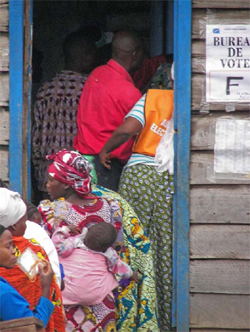 Last year, the Democratic Republic of the Congo (DRC) completed its transition from war to peaceful democratic rule. Because the DRC is the third largest country in Africa and is populated by as many as 250 ethno-linguistic groups, it was no easy feat to overcome the challenges of voter registration and mounting elections there. However, despite some initial disputes over election results, the DRC successfully conducted its first democratic poll in almost four decades.
Historical Background
The DRC is emerging from decades of dictatorship and misrule, which has been worsened by years of civil war. It gained independence from Belgian rule in 1960, but its early days as a sovereign state were marred by political and social instability, which saw Colonel Joseph Mobutu seize power in a 1965 military coup. For 32 years, the Mobutu regime ruled a single-party state characterised by violent repression of any form of political opposition. In 1996, Laurent Kabila began a rebellion (backed by Rwanda and Uganda) that toppled Mobutu from power the following year.
Despite the popular acclaim that greeted their accession to power, Kabila and his government did not meet the democratic aspirations voiced by the Congolese people. In 1998, the regime was challenged by an insurrection again backed by Rwanda and Uganda (whose governments had fallen out with Kabila). Other neighbouring states, including Zimbabwe, Angola, Namibia, and Chad, entered the conflict militarily in support of the Kabila administration. In 2001, Laurent Kabila was assassinated, and his son Joseph Kabila replaced him as head of state.
The new president successfully negotiated the withdrawal of foreign forces occupying the eastern DRC and adopted a more conciliatory approach to the conflict, one based on dialogue. In 2002, the Pretoria Accord (which resulted from the negotiations of the Inter-Congolese Dialogue) was signed by all belligerent parties, the political opposition, and civil society to end the fighting and establish a government of national unity. Known as the “Global and All-Inclusive Agreement on the Transition,” the accord was a roadmap for the DRC’s transition to a stable, peaceful, and democratic state. It provided that political, military, and economic power be shared by the former belligerents, civil society, and the political opposition during a two-year transition period, with two possible six-month extensions. Within this time, a referendum on the post-transition constitution and general elections were to be held.
The Transitional Political Dispensation
The DRC transition process formally started on 30 June 2003 with the installation of a transitional government, which was a political compromise between the five main armed groups. With regard to the executive branch of government, the transitional agreement established a political system known as “1+4.” In this system, President Kabila was supported by four vice presidents, each responsible for a particular commission. Legislative powers were vested in the transitional parliament, which was inaugurated in Kinshasa on 22 August 2002 and consisted of the 500-seat National Assembly and the 120-seat Senate. Seats in these chambers were allocated according to a quota agreed upon by all signatories to the Pretoria Accord. The primary mandate of the transitional institutions was to bring the country to a democratic dispensation through competitive multiparty elections
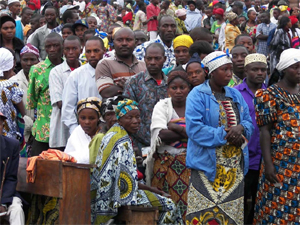 The transition was initially scheduled to be completed by 30 June 2005. But at the request of the electoral commission (the Commission Electorale Indépendante or CEI), the Parliament extended the transition period to 30 June 2006. The resulting electoral schedule allowed the CEI to call for a constitutional referendum on 18 December 2005, to be followed by legislative and presidential elections before the end of June 2006.
Voter Registration
With the electoral schedule set, the next challenge was to establish a voter registry. The last population census had been conducted in 1981, making existing demographic records unreliable and outdated. This situation was made more complicated by the fact that there was no system in place to control the flow of refugees, caused by the region’s recurring wars, across the DRC’s borders.
As a result, during the transition, it was debated whether or not voter registration should be preceded by a national census. Although it was recognised that conducting a general census before voter registration would be ideal, technical and financial challenges (as well as the relatively short duration of the transition period) forced the CEI to opt instead for voter registration using strict criteria to identify and register prospective voters. To register, a person had to be a Congolese citizen and reside in the DRC during the registration process. As dual citizenship is prohibited in the DRC, only people holding Congolese citizenship (and no other) were allowed to register. The minimum voting age is 18.
Out of an initial estimate of 28 million potential voters, a total of 25,021,703 citizens registered to participate in the referendum and the general elections.
The Constitutional Referendum
The first electoral exercise was the constitutional referendum, which was held over two days, on 18 and 19 December 2005. The vote passed with relatively few security incidents, despite fears that the opposition’s call for a boycott and the volatile security situation in the eastern DRC would lead to disturbances. It is worth mentioning that opposition parties, particularly the Union pour la Démocratie et le Progrès Social (UDPS), had called for a boycott not only of the referendum and elections but also of the voter registration exercise, claiming fraud and irregularities in the electoral process.
The polling was generally free of major problems, although some technical flaws and voter intimidation were observed in the process. The size of the country posed great challenges given the lack of effective logistical, communication, and transport facilities. The final results indicated that the people of the DRC endorsed the new constitution, thus laying the foundation for the country’s first democratic elections since independence. The CEI released results that showed that 12,461,001 (84 percent) of the 15,505,810 Congolese who took part in the poll voted in favour of the post-transition constitution, while 2,319,074 (16 percent) voted against it. The post-transition constitution was subsequently promulgated on 18 February 2006.
The referendum was a momentous step towards the organisation of general elections in the country. Its success marked a significant turning point in the history of the DRC by giving the Congolese the opportunity to democratically choose their system of governance. It also gave the CEI and other electoral stakeholders the chance to test their capacity and improve their ability to deliver success in the forthcoming elections.
Post-transition Electoral System
The DRC’s post-transition constitution establishes a system in which the president is directly elected by an absolute majority for a five-year term. That is, for a candidate to be elected president of the DRC, he/she must secure at least 50 percent plus one of the total valid votes cast by registered Congolese citizens. If no candidate receives a simple majority in the first round, a run-off is scheduled between the top two candidates.
The members of the DRC’s bicameral parliament are elected through a proportional electoral system for five-year terms. They are elected from open lists, i.e., a party’s list of candidates or a list of independent candidates from which voters can select their favourite. (The DRC considered but decided against using closed lists, where votes are cast for parties rather than individuals.)
According to the electoral law, the 500 members of the National Assembly are directly elected from 169 districts by proportional representation. However, over a third of the electoral districts have only one seat. As a result, these districts elect Assembly members on a winner-take-all basis. With regard to the Senate, the electoral law stipulates that the 108 senators are elected by provincial assemblies from 25 newly designed provinces (four senators from each) and from Kinshasa (eight senators). Given that the 25 new provinces will take three years to establish, it was agreed that provincial and senatorial elections would be held on the basis of the current provincial configuration.
The General Elections
The first round of presidential elections was held concomitantly with parliamentary elections on 30 July 2006. Of the 269 political parties formally registered in the country, only 197 were able to put candidates forward. A list of 33 presidential candidates and 9,584 parliamentary candidates for the National Assembly was approved by the CEI and confirmed by the Supreme Court of Justice. Given the country’s huge size and its virtually non-existent infrastructure, this was obviously a major operation by all standards. Only President Kabila’s party, the Parti du Peuple pour la Reconstruction et la Démocratie (PPRD), managed to field candidates all 169 constituencies, while the Mouvement pour la Libération du Congo (MLC) had candidates in 160 constituencies and the Rassemblement Congolais pour la Démocratie (RCD-Goma) in 156. As for gender representation, only four of the 33 presidential candidates and 13.5 percent of legislative candidates were women.
The results of the July 2006 presidential elections indicate that of the 33 candidates, 26 received less than 1 percent of the total valid votes, while seven received votes ranging between 1 percent and 44 percent of the total. Therefore, the poll was inconclusive, with no outright winner with 50 percent +1 votes. Consequently, a second round pitting President Kabila against his main challenger, Vice President Jean-Pierre Bemba, was scheduled.
With respect to the parliamentary elections, President Kabila and his party failed to win a majority in the National Assembly; final results indicated his PPRD secured only 111 of the 500 seats. However, the broader political coalition backing him held a total of 224 seats. In contrast, Jean-Pierre Bemba’s alliance won approximately 100 seats. The Unified Lumumbist Party (PALU) garnered 34 seats, the former rebel movement RCD-Goma earned 15, and 63 seats went to independent candidates. Given that no political party or coalition won an absolute majority, small coalitions and independent candidates would join one of the two main coalitions. In the new Assembly, only 42 women held seats, making it an institution dominated by men, who held 92 percent of the seats.
The second round of the presidential election was held on 29 October 2006 at the same time as the provincial assembly elections. Incumbent President Kabila finally won the presidential race, and his arch-rival Jean-Pierre Bemba conceded defeat after several legal challenges to the validity of the results. Kabila’s election and the establishment of democratically elected assemblies at both the national and provincial levels have brought a formal end to the transition phase initiated after the Inter-Congolese Dialogue.
It is hoped that these historic elections will lead to a genuine democratic dispensation in the DRC and that they will contribute to restoring sustainable peace and achieving democracy in the Great Lakes region.
Dieudonné N. Tshiyoyo is the Senior Programme Officer of Elections and Political Processes at EISA.
