
Sierra Leone's 2007 Elections
UNIOSIL-UNV
Parliamentary elections saw additional victory for the APC, which obtained 59 of the 112 “ordinary” seats, while the SLPP and the People’s Movement for Democratic Change (PMDC) received 43 and 10 seats, respectively. The 12 remaining seats were allocated to representatives of the Paramount Chiefs, elected in a separate election.
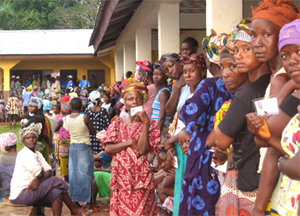
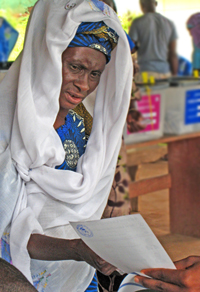
The elections were largely considered “peaceful, transparent and credible” by national and international observers,[1] notwithstanding isolated clashes between political party supporters, irregularities in some areas, logistical difficulties due to weather conditions and poor infrastructure. The 75 percent turnout rate on Election Day demonstrated the determination of the citizens of Sierra Leone to participate in free and fair elections as well as their confidence in the institution in charge of the electoral process. Earlier this year, 91 percent of the 2.8 million eligible voters (of which 49 per cent were women) turned out to register during the voter registration exercise.
Under the leadership of NEC Chairperson Ms. Christiana Thorpe, the professionalism and dedication of NEC staff, including 37,243 polling staff, were the determining factors of success in this election. Other entities, such as the Political Parties Registration Committee (PPRC), the national and district Political Parties Code of Conduct Monitoring Committees (DCMC) and the Sierra Leone Police (SLP) played a crucial role in mitigating intra- and inter-political party disputes and diffusing election-related tensions. These actions greatly contributed to the level of peace during elections.
The single biggest setback, however, was the failure of political parties to nominate an equitable number of female candidates. As a result, out of 556 candidates for the parliamentary election, only 64 were women and no female candidate participated in the presidential race. This situation directly contributed to a 12 percent decrease in the number of elected women, with only 16 deputies in the current Parliament.
UNIOSIL-UNV
Following a request from the Government of Sierra Leone, the United Nations (UN) provided assistance in preparation and execution of the elections. This was provided through the UN Integrated Office in Sierra Leone (UNIOSIL), the UN Development Programme (UNDP) and the UN Electoral Assistance Division (EAD).
A team of 51 UN electoral advisers provided technical assistance to the NEC and to the PPRC throughout the electoral process. This assistance included:
- Advisory services for the electoral budget
- Operational plans and procedures for different phases of the process
- Design and procurement of voter education, training and polling materials.
- Delivery of voting materials to polling centers located in remote areas, via UN helicopters
- Training for NEC staff, PPRC Commissioners, polling centers managers, presiding officers and polling agents
In addition, UNDP-Sierra Leone managed a basket fund aimed at supporting the electoral process. This mechanism was used by several of Sierra Leone’s development partners to channel their financial contributions to the electoral process.
Throughout the electoral process, the Executive Representative of the Secretary-General, Mr. Victor Angelo, and the NEC Chairperson jointly chaired meetings bringing together domestic and international stakeholders. During the electoral campaign, the UN radio produced election-related programmes and provided equal access and airtime to all political contestants.
The Way Forward
Although Sierra Leonean electoral institutions demonstrated their ability to successfully run major electoral events, the NEC recently expressed the need for a certain degree of technical assistance from the international community for its 2008 local elections. The local elections will be instrumental in strengthening local democracy and governance in the country. To ensure sustained peace, the new government, in collaboration with international partners, should devise a programme for long-term, sustainable national electoral capacity building in Sierra Leone for the NEC and other institutions.
[1] Some 8,980 domestic observers from 53 organizations and 447 international observers from 26 organizations (including the ECOWAS, the European Union, the Commonwealth, NDI, the African Union and the National Election Watch) monitored the elections.
