Personal tools

"Focus On..." Series
The "Focus on..." series aims to explore in greater detail cross-cutting issues referenced in the ACE Electoral Knowledge Network. A subject matter specialist introduces each topic, highlights issues and sample materials in ACE and identifies additional online resources for users to research more information.
by Tova Wang by André Blais and Agnieszka Dobrzynska by Domenico Tuccinardi, Paul Guerin, Fabio Bargiacchi, Linda Maguire by Sean Dunne
Measuring Electoral QualityMeasuring electoral quality is like chasing a moving target. Just as election management professionals improve their skills, other factors change and evolve, impacting the quality of elections. The introduction of new technologies (including voting machines and the internet), the use of social media, the role of private sector service providers, public tender, and procurement processes, are only a few of the ever-changing factors. Measuring electoral quality assesses the integrity of an elections' adherence with international standards as the baseline. The tools and methodologies used for measuring the quality of elections are many and diverse; election observer methodologies, the electoral cycle, performance indicators, and election integrity assessment methodologies are all common practice when measuring electoral quality. The electoral cycle, for example, offers a framework for measuring electoral quality that is universally agreed upon and which organizes all the components of an electoral process into three phases: the pre-election period, the election period and the post-election period. Various scoring systems, both quantitative and qualitative methods are utilized to assess distinct elements of electoral processes. The findings of the various assessments and evaluations of elections are used by election management professionals, political parties and candidates, voters, and election observers to improve their skills and inform their experiences. The practice of supporting and measuring the quality of elections remains a central act in democratic life. The Measuring Electoral Quality Encyclopedia topic is an introduction to existing methodologies used to assess the conduct of elections under the rubric of “measuring electoral quality.” Although most of the techniques examined here are well known, they will be grouped into several basic typologies to distinguish the qualities they share, how their methodologies differ and the range of findings they produce. The topic will also introduce the range of individual, national and international actors involved in measuring electoral quality, as well as the various approaches they implement in doing so. Introduction1.1 Changing Terminology and Contested DefinitionsMost people have a personal understanding of democracy and a ‘good’ election but these terms are often difficult to describe, imprecisely defined, and often subjects of disagreement. The United Nations Universal Declaration of Human Rights refers to “genuine elections” but does not provide a working definition of the phrase nor does it provide a breakdown of the indicators or means to achieve them. There is an extensive set of international public law dedicated to giving expression to the fundamental human rights bound in the phrase genuine democratic elections but its application varies considerably by country. Yet, while nearly all countries in the world describe themselves as democratic and defend the quality of their elections there are many different frameworks for evaluating the quality of elections. [1] “Free and fair elections” is a common phrase employed to judge the quality of an election but it too is subject to a range of definitions and a lack of consensus as to its components and sub-indicators. In the absence of a shared definition or codification of a “good” election, various other phrases have been adopted in efforts to shape a definition (e.g. “open and transparent” or “credible”). The phrase “electoral integrity” has also emerged as a concept to define electoral quality. [2] The Kofi Annan Foundation defines electoral integrity as "any election that is based on the democratic principles of universal suffrage and political equality as reflected in international standards and agreements, and is professional, impartial, and transparent in its preparation and administration throughout the electoral cycle.” [3] The term “standards” is often misunderstood, suggests an imposition of external criteria, or is subject to multiple definitions. [4] In this article, the phrase international legal obligations is used. The absence of consensus on the definition of democracy, electoral integrity and indicators or benchmarks to measure them does not invalidate elections and democracy as development goals, but their intangible and contestable terms make it challenging to offer measures that will be accepted (and meaningful to the country and institutions and individuals within it) and applied. 1.2 Framework for Measuring Electoral QualityThe concept of the electoral cycle helps to organize our thinking about elections since it locates election day within the full context of the many moving parts of an election, reminding us of the importance of electoral indicators such as election management, boundary delimitation, voter registration, the role of political parties, media and security forces and the judicial system as well as the participation of women, minorities or other marginalized groups and so on.
Many individuals who study democracy and elections opt for a procedural definition of democracy with strong emphasis on the electoral aspects and in particular the administration of elections. A procedural definition of democracy simplifies the task of measuring electoral quality since it is can be broken down into constituent parts, phases, events and specific actors. However, elections remain a complex political activity contingent not only on election procedures but also a bundle of human and political rights, the activities of civil society, the functioning of political parties, the administration of rule of law and justice and so forth. The use of performance indicators - measures of inputs, processes, outputs, outcomes, and impacts – to assess elections holds appeal for many election stakeholders, especially for those with technical or managerial responsibilities in the electoral process. [5] Establishing performance measures helps individuals and organizations (especially EMBs and technical assistance providers) to set performance targets and assess their progress toward achieving them and to remedy problems when they are identified. For example, IFES has developed an "Election Integrity Assessment Methodology" that innovatively blends qualitative analysis with a scoring system to measure a range of vulnerabilities and their possible impact in the conduct of elections. The methodology assesses distinct elements of the electoral process (e.g. voter registration, voter education, electoral dispute resolution) and provides assessments of the potential for fraud, malpractice or systemic manipulation. The resulting report can become a planning and management tool for an election management body, technical assistance provider, donor or other electoral stakeholders. [6] Bridging this set of concerns – the full context of an election as summarized in the electoral cycle, the procedural breakdown of the sub-components of an election and an appreciation for the political context within which an election takes place – to arrive at an overall measure of electoral quality is perhaps beyond the reach of any single methodology. But before reviewing the prevailing approaches, there are other dimensions that bear mention. First, democracy and governance, including the conduct of elections, have become important foreign policy goals for individual states and multilateral and regional organizations. For example, following the 2009 Lisbon Treaty, the EU is committed to “define and pursue common policies and actions, and shall work for a high degree of cooperation in all fields of international relations, in order to consolidate and support democracy, the rule of law, human rights and the principles of international law.” Many other regional and multilateral organizations share similar goals and may provide various types of election assistance as well as deploy election observation missions. Assessment of democratic governance and the quality of elections has therefore become an important element of statecraft and foreign policy. Second, international organizations, diplomats, donors and electoral assistance providers also have an interest in monitoring and evaluation of electoral quality to make judgments about how their time and money is being spent. These two concerns indicate that political and technical considerations are both at play and not only tend to influence one another but they may be difficult to reconcile within a single methodology. A final consideration is the degree to which an approach to measuring electoral quality balances the twin (and often competing) demands of being comprehensive and being concise. An election observer checklist with 10 questions is likely too few, while 100 questions may be too many to yield data that can be analyzed in the time when observation findings are most effective.
[1] For a useful effort to develop a more rigorous analysis in this regard see, Jorgen Elklit and Andrew Reynolds, “A Framework for the Systematic Study of Election Quality,” Democratization. 12:2, 2005. [2] For a detailed ongoing research project on electoral integrity see The Electoral Integrity Project. See also Pippa Norris, Why Electoral Integrity Matters, Cambridge UP, 2014, Pippa Norris, Richard W. Frank, and Ferran Martinez i Coma, eds. Advancing Electoral Integrity, Oxford UP, 2014, Daniela Donno, Defending Democratic Norms: International Actors and the Politics of Electoral Misconduct, Oxford UP, 2013. [3] Report of the Global Commission on Elections, Democracy and Security, Deepening Democracy: A Strategy for Improving the Integrity of Elections Worldwide [4] See Nils Meyer-Ohlendorf, “Forget Standards: Why Election Observers Should Talk About ‘International Obligations and Commitments When Evaluating an Election” Democracy Reporting International, 2010. [5] For a critical discussion of the uses and misuses of data in democracy promotion see Gerardo Munck, Measuring Democracy: A Bridge Between Scholarship and Politics, Johns Hopkins University Press, 2009. Available online at Google Books. [6] IFES has conducted electoral integrity assessments in Afghanistan, Georgia, and Pakistan. Who Measures Electoral QualityBefore surveying the various approaches used to measure electoral quality it is useful to identify some of the primary actors interested in these measurements and their objectives.
Approaches to Measuring Electoral QualityAt its most basic level, there are two fundamental approaches to measuring electoral quality, which may be implemented in combination or separately by the distinct methodologies described in further detail below:
Quantitative measures are often perceived as definitive or objective judgments (rightly or wrongly) and tend to be presented in a numeric scale of score. An election that receives a score of 7.5 out of 10 may be more convincing as a firm judgment than phrases such as “somewhat free and fair” or “largely met international obligations.” Yet both approaches require an understanding of the methodology and data, whether numeric or descriptive, and how the underlying analysis has been applied to arrive at a statement of measure. Quantitative measures that use properly applied statistical principles are persuasive because the methodology is derived from scientific principles that are demonstrable and universal. If the indicators and the measures are reliable, then different observers watching the same process and using the same tool and data will evaluate that event in the same way. Thus statistical principles can generate more reliable statements about what is being observed. [7] A properly conducted statistical audit of the voter register, for example, can identify finite variations in the accuracy and completeness of the register. For many quantitative methods, the use of a random sample survey produces quantifiable data that can be statistically analyzed with the aim of measuring, aggregating, modelling and predicting human behavior and relations. A random sample is smaller than the total population or number of cases but it replicates the characteristics of that population. A random sample could be useful to an election official who wishes to test the reliability of the voter register or election observers who wish to verify the vote count. Qualitative methods typically use narrative analysis, sometimes based on case studies of varying degrees of specificity and may range from the national level to more detailed levels of analysis. Thus while qualitative methods may lack the statistical generalizability of quantitative methods they may be able to provide more in-depth and contextual understanding of the meaning and importance of human behavior, drawing on a range of social science and other disciplines. Qualitative research tools include analysis of various documentary sources, direct observation and participant observation, questionnaires and interviews and other means. These methods seek to capture not only a record of events per se but also judgments and perceptions of these events. The following survey of approaches to measuring electoral quality includes tools and activities that may be of relatively limited value to assess the conduct of a specific election. For example, while an annual country report might conclude that power has been increasingly concentrated in the executive it might not indicate if that dynamic has affected the conduct of the election management body. Conversely, a technical report that assesses the introduction of a communications system for polling station officials to report the tally of votes may not necessarily include comments on tensions between two dominant political parties. Yet both perspectives – one that is broad and generalized another that is detailed and specific – can contribute to an overall measure of electoral quality. 3.1 Public Opinion PollsAn opinion poll is an application of statistics that elicits responses to questions posed to a randomly selected sample of the population. Opinion polls are usually conducted on the telephone or through in-person interviews. While larger samples are generally preferable to smaller ones (to reduce the margin of error) polls can be expensive and logistically complex activities, limiting their size. 3.1.1 National opinion polls
National opinion polls are often conducted throughout the electoral process with a strong emphasis on voter preferences for candidates and parties. Political parties and the media focus particularly on identifying and tracking these preferences over the course of an election campaign. Such polls may also include questions that capture the views of individuals on electoral quality such as public confidence in the EMB, whether or not the individual has experienced voter intimidation or if they have been exposed to voter information about where and how to get on the voter register. [8] Opinion polls can therefore be useful to track popular perceptions of the electoral process and be combined with other approaches to measure electoral quality. Two ongoing initiatives are:
3.1.2 Exit polls
In an exit poll, interviewers ask voters how they have voted as they leave polling stations and this data can serve as a form of vote count verification. Exit polls are often used by the media as a means to report early unofficial results and to predict or ‘call’ the election results. In some environments these efforts may help to build public confidence in the official results. However, as a means of verifying or predicting the election results, an exit poll also relies on the assumption of truthful responses from voters. Exit polls may also be controversial, ill-advised or even disallowed for multiple reasons, including:
3.2 Democracy Assessment3.2.1 Global Democracy Surveys Several global democracy surveys that score and/or rank countries on a number of indicators are conducted on a regular (often annual) basis. These assessments provide cross-country data, often with a score or ranking associated with them. Democracy and governance, including political rights and the functioning of government, are generally components of these surveys. Some of them are well publicized and though they may bear only indirectly on measures on electoral quality, their prominence suggests they may influence overall perceptions of countries, including the quality of their elections. In addition, there are many indices that measure specific elements that relate to parts of the electoral cycle such as the Mo Ibrahim African Governance Index or the Civicus Civil Society Index that assess the four dimensions of structure of civil society; the external environment in which civil society exists and operates; the values practiced and promoted in the civil society arena; and the impact of the activities undertaken by civil society actors. The Polity IV Project is an annual assessment of the authority characteristics of states, ranging from hereditary monarchy to consolidated democracy. The Fragile States Index uses political, social and economic indicators to score and rank countries according to the level of stability – useful for understanding a country’s political, social, and security context for elections. There are also tools that assess a specific element of democracy such as the functioning of legislatures which may be helpful to understand a country’s legislative or institutional environment. [11] Two of the overall political surveys are described in more detail below: The Economist Intelligence Unit Democracy Index is an annual index that rates countries based on five categories: electoral process and pluralism; civil liberties; the functioning of government; political participation; and political culture. Each category has a rating on a 0 to 10 scale, and the overall country score is the simple average of the five category indices. The index values are used to place countries within one of four types of regimes: full democracies, flawed democracies, hybrid regimes and authoritarian regimes.
Freedom in the World is an annual survey conducted by the non-profit Freedom House based on a methodology that generates a comparative assessment of global political rights and civil liberties. [12] Each country is assigned two numerical ratings—one for political rights and one for civil liberties—based on a 1 to 7 scale. The ratings are derived from detailed country assessments based on a 40-point scale for political rights and a 60-point scale for civil liberties. The survey also defines the study countries by one of three overall scores of free, partly free, not free. 3.2.2 National Democracy Assessment A national democracy assessment is another approach to gathering data on democratic progress and the quality of democracy. In an effort to move away from scores and rankings, International IDEA has developed a framework for democracy assessment that works from fundamental principles of democracy and the mediating values related to those principles and a range of questions about democratic performance. [13] Multilateral and regional organizations have significant interest in the conduct of elections and democracy among their members. Aside from election observation missions (described below), these organizations may employ other forms of assessment of progress in democracy and governance. The use of peer review among member states is an opportunity to assess the national state of political rights, establish objectives for political and electoral reform and monitor progress through regular follow-up. Peer review therefore has the potential to move individual countries and fellow member states along the path of democratic development. Although the country reports generated by the mechanism may not always yield specific measures of electoral quality (especially when conducted outside of the immediate context of an election), they are guided by shared objectives to advance political rights, strengthen the functioning of government institutions and other areas that have a direct bearing on the electoral cycle and the conduct of elections. For example, the African Peer Review Mechanism (APRM) was established in 2003 by the African Union guided by the framework of the New Partnership for Africa’s Development (NEPAD). [14] Any AU member state can join the APRM and may launch this regional self-monitoring exercise through an initial base review followed by periodic updates every two to four years or at other times for its own interests. The base document for the APRM provides detailed objectives, methodologies, and indicators for the review and directs members to meet codes and standards established by international and regional agreements including democracy and governance. [15] For example, the 2013 Zambia country report includes comments that relate directly to the quality of elections including, the absence of legal provisions to regulate political parties and associations, the failure to enforce the Electoral Code of Conduct, the curtailment of the public’s right to political participation, the abusive use of state resources by the ruling party during elections, and unfair media coverage for opposition parties. 3.3 Election Management Assessment3.3.1 Post-Election Review A post-election review (also called a lessons learned activity, audit, or after action review) is an important evaluation activity especially for an EMB but may also be conducted by other actors such as election technical assistance providers or foreign donor agencies if applicable. [16] For the EMB, not only is a post-election review an important self-assessment of the conduct of the elections, it may also include consultation with political parties, civil society organizations and election observers and may receive verbal and written reports. [17] The review may also convene focus groups or workshops or a large conference. Most EMBs also produce annual reports which summarize their activities for the year and may include the content and recommendations of their self-assessment. Post-election audits conducted by the EMB routinely check voting system performance, regardless of how close margins of victory appear to be. Post-election audits that detect errors might lead an EMB to conduct a recount or other remedy. For example, in the Afghanistan 2014 presidential election the two leading presidential candidates (Ashraf Ghani and Abdullah Abdullah) agreed to an international audit of all 8 million ballots cast for president candidates to determine the victor (and thereafter form a national unity government). If audits are to be used to increase the quality of elections, just as with election observation and other assessment methodologies, predetermined audit standards should be established, uniform application of the rules must be applied throughout, rights of appeal must be respected and the entire audit process must be conducted transparently. An EMB may also adopt practices for ongoing monitoring and evaluation of its operations to ensure that its performance matches its responsibilities and the legal framework for elections. In one useful monitoring effort, IFES has generated a set of tools to encourage a range of electoral actors to adopt strategies to assess, deter, and mitigate fraud, malpractices and systemic manipulation throughout the electoral process. [18] Post-election reviews of all types are challenging for several reasons, including the need for an EMB to plan for the activity before the conduct of the election, to collect data throughout its activities, and manage complex political relations that may need to be considered as part of an EMB’s operating environment. 3.3.2 Certification of Elections Certification is a third-party review of the conduct of an election. On rare occasions, the United Nations Security Council or General Assembly may ask the Secretary-General to play a certification role in which the UN certifies the credibility of all or specific aspects of an electoral process. Given the obvious sensitivities of a sovereign state sharing or even handing over such responsibility, the UN undertakes this role with caution. UN guidelines state that certification could include one or both of the following:
Recently, the UN has been mandated by the Security Council to certify elections in two countries: Timor-Leste in 2007 and Cote d'Ivoire in 2010. In each case the UN was broadly involved in peace keeping and/or state-building activities in these countries and the holding of credible elections was an integral part of these processes (the UN Integrated Mission in Timor Leste, UNMIT and UN Operation in Cote d’Ivoire, ONUCI). In Timor Leste, the Security Council mandated the UN "to support Timor-Leste in all aspects of the 2007 presidential and parliamentary process, including through technical and logistical support, electoral policy advice and verification or other means.” In Cote d‘Ivoire, the UN was to certify "that all stages of the electoral process provide all the necessary guarantees for the holding of open, free, fair, and transparent presidential and legislative elections in accordance with international standards". In recognition of the inherently political nature of the electoral process, the UN guidelines call on the relevant mission to develop the tools to apply such mandates and explain how the certification findings will be determined. Although the specific methodology is to be crafted for the country in question, basic guidelines indicate that the certifying authority should be present in the country throughout the entire electoral process, collect data from all available sources, refer to relevant legal and procedural documents and conduct field visits throughout the country.
3.4 Election ObservationElection observation is perhaps the most widely known effort to measure electoral quality. Though it takes many forms and includes many different approaches, a useful definition of election observation is “the purposeful gathering of information regarding an electoral process, and making informed judgments on the conduct of such process.” [19] In practice, there are many variations in how those judgments are made. [20] A strong community of practice has developed around election observation; both international and national (often called domestic observers and more recently “non-partisan citizen observers”). These communities have sought to better explain how and why they conduct election observation as a means of improving not only their own transparency (by being clear about their methodology) but also to bolster the credibility of their findings. [21] Many national legal frameworks for elections provide for the presence of observers, both domestic and foreign, in addition to representatives of the media, political parties and candidates, to ensure transparency. EMBs have also established specific conditions for the conduct of election observation, with best practice emerging for access to all parts of the electoral process. An important provision includes the need to be invited to observe elections which is especially important for international election observation missions (EOMs) which otherwise may lack standing in the country. It is notable, that in certain established democracies, the legal basis for observers is not established or not applied in all jurisdictions. It is often assumed that the United Nations plays a principal role in election observation though this is rarely the case (the last UN election observation mission was in Fiji in 2001). The UN does provide a wide range of electoral assistance and generates a great deal of findings related to elections and democracy. Other multilateral and regional intergovernmental organizations observe elections (generally among their member states or in the case of the EU only outside its member states), including (with hyperlinks to respective election observer handbooks or sample observer mission reports):
Many individual governments, regional associations of parliamentarians and election administration officials also conduct international election observation as do many international NGOs and national civil society organizations (on their own or in collective associations). [22] The following sections describe the basic methodological components of EOMs, including direct observation, legal analysis and procedural assessment. [23] Special thematic assessments follow as a separate approach to measure electoral quality. 3.4.1 Direct Observation Most EOMs aim to provide assessment through direct observation of one or more elements of the electoral process through some or all of the following approaches:
The observers may be joined by additional election experts with specific expertise such as legal framework for elections, voter registration, boundary delimitation, gender, media, or other areas (described below in section 3.5). Most EOMs have one or a small number of individuals to serve as the delegation leader (chief of mission, chief observer or other designation) and principal spokesperson for the mission. The leader(s) may conduct multiple visits to the country before during and after the election but are seldom present on a full-time basis. They meet with national political and civic leaders, and present public findings of the EOM. The public assessment of EOMs generally pertains to the electoral process only and not to the outcome of the voting. As observers and not supervisors of the electoral process, their judgments are not legally binding on election authorities. 3.4.2 Rights-based Assessment A growing number of EOMs have adopted the use of relevant international legal obligations, to provide the basis for independent and impartial assessment of a country’s electoral process by reference to the principles to which the country has already agreed (in contrast to imposing foreign or other standards with which the country disagrees). [24] This analysis generally requires at least one or more experts to collect and review all laws relevant to the electoral process, including the constitutional and regulatory framework for the election, and any other relevant laws (e.g. media regulations, judicial system, etc.). [25] Important distinctions should also be made clear to differentiate among the various sources used to identify a state’s obligation to a particular principle, including:
Take, for example, the right to vote from the Universal Declaration of Human Rights: "The will of the people shall be the basis of the authority of government; this will shall be expressed in periodic and genuine elections which shall be by universal and equal suffrage and shall be held by secret vote or by equivalent free voting procedures.” This right is further expressed and included in many other international treaties and agreements as well as in cultural norms across the world, which therefore apply along with the country’s constitution, electoral legislation and procedures. In this way, the right to vote thus achieves the status of a universal principle as it is supported many times over by multiple sources of international and national law. The list of legal obligations enshrined in international public law is extensive, including not only the fundamental freedoms (e.g. freedoms of assembly, association, opinion, and movement) and various rights associated with elections (e.g. universal suffrage, secret ballot, right to vote, etc.) but also the right to participate in public affairs, the right to security, the absence of discrimination and the right to a fair and public hearing, among others. [26] While international benchmarks are helpful, those of multilateral and regional organizations may be more persuasive to member states and hold greater detail about the national means to achieve those principles. Regional commitments may in turn help to sustain sub-regional or other institutional expressions of democratic rights and obligations. [27] For example, the Organization of American States Inter-American Democratic Charter illustrates the way in which declarations of principle can generate obligations for the state vis-à-vis its citizens and member states. The Charter affirms that democracy is and should be the common form of government for all countries of the Americas, and it represents a collective commitment to maintaining and strengthening the democratic system in the region. Many regions of the world have adopted democratic obligations for themselves, bolstering the overall regime of international public law (e.g. AU, African Charter on Democracy, Elections and Governance, OSCE, Existing Commitments for Democratic Elections in OSCE Participating States). Moving from the general to the specific is an obvious challenge for this approach. To become an effective basis for measuring electoral quality, a rights-based approach must establish the links between a principle, the state’s obligation to uphold that right, the specific elements of the national legal framework for elections, the election procedures or rules, and specific indicators to measure the quality of performance in each step.  In other words, the rights need to be applied to the procedural steps in the electoral process in order to arrive at a measure of how well the state obligations have been met. Specific indicators need to be developed so that an observer can link the general principle (e.g. secrecy of the vote) to the performance of a specific practice (e.g. polling station layout and other measures to protect vote secrecy). 3.4.3 Procedural Assessment As noted above, the use of a procedural definition of elections provides a methodical and chronological template against which one can measure electoral quality. It is listed separately here as not all EOMs who adopt this approach will necessarily ground their assessment in a rights-based approach. The breakdown of an election into its constituent parts has proved useful not only for election administrators who must match human, financial and logistical resources to each part of an election but also to election observers who can develop checklists to evaluate the conduct of each element. Although some categorizations may vary, a list of key areas to be taken into consideration in this evaluation could include:
Cross-cutting themes such as gender can also be applied throughout a procedural assessment, say for example, applying a gender analysis to the EMB itself and how it conducts its operations. [28]
3.5 Specialized Missions: Technical Assessment/Study Mission/ Election PanelA technical assessment (sometimes called limited EOM, study mission, expert panel, etc.) generally involves the deployment of a small team of experts to conduct an in-depth analysis of one or more elements of the electoral process (e.g. political violence, media, women’s political participation, etc.). These teams may apply one or more of the methodologies used by EOMs (e.g. direct observation, questionnaires and checklists, interviews, rights-based and/or procedural approaches to structure their assessment. Many of the themes of a technical assessment may also be a component of a broader EOM or a technical assistance provider to the election working in that particular area (for example, developing civic education materials and facilitating public workshops). It is likely that a technical team will provide in-depth and detailed assessment with a limited scope of inquiry. It may also be the case that a technical assessment’s terms of reference closely resemble the broader scope of an EOM. For example, the EU Electoral Assessment Team to Libya in 2010 used the following criteria during its assessment of the electoral process:
The technical assessment team may receive accreditation as election observers but it is important for all types of these missions to explain their limited mandate and refrain from commenting on the overall electoral process. Should a technical or expert team be deployed to a country where the organization is conducting other activities (e.g. UN Women deploys a gender assessment mission to a country where UNDP is also conducting other election assistance) it is important for such missions to explain the intent and scope of their mission to avoid the perception of a conflict of interest. Unlike election observation missions, some technical teams may choose not to make their findings public, rendering close examination of their methodology more difficult. Examples of technical or thematic focus in measuring electoral quality (links to methodologies for the assessment) include:
[7] NDI, The Quick Count and Electoral Observation: An NDI Handbook for Civic Organizations and Political Parties, 2002. [8] See, for example, Polling Report, a site that aggregates opinion poll findings in the US on a range of political topics. [9] For example, in Botswana, the survey has asked “On the whole, how would you rate the last general election?” over the course of 3 elections in a ten-year cycle. [10] Latinobarometer has asked the same set of questions for nearly 20 years in each country in Central and South America and the Caribbean, including questions of confidence in state institutions such as the judiciary, satisfaction with political parties and the the performance of politicians. [11] UNDP Benchmarking and Self-Assessment for Democratic Legislatures, and SADC PF Benchmarks for Democratic Legislatures in Southern Africa [12] See Freedom House, Freedom in the World for detailed survey methodology. [13] IDEA, Assessing the Quality of Democracy: A Practical Guide, 2008. [14] As of 2013, 33 of 55 countries have joined the APRM and 17 have submitted to a peer review. [15] For more detail on the assessment principles and methodology, see “Objectives, Standards, Criteria and Indicators for the African Peer Review Mechanism.” [16] Jorgen Elklit and Andrew Reynolds, “The Impact of Election Administration on the Legitimacy of New Democracies: A New Comparative Politics Research Agenda,” Commonwealth and Comparative Politics, 40:2, 2010. [17] See OAS, Quality Management Systems for Election Authorities in Latin America, 2012. At the time of writing, IDEA and the SADC Election Commissions Forum are drafting a guide to audit methodology. [18] For a useful series of papers on electoral fraud from IFES, see Chad Vickery and Erica Shein, Assessing Electoral Fraud in New Democracies: Refining the Vocabulary, IFES, 2012, Staffan Darnolf, Assessing Electoral Fraud in New Democracies: A New Strategic Approach, 2011 and Rafael Lopez-Pintor, Assessing Electoral Fraud in New Democracies: A Basic Conceptual Framework, 2010. See also Chad Vickery, ed., Guidelines for Understanding, Adjudicating and Resolving Disputes in Elections, IFES, 2011. [19] International IDEA, The Basics of Election Observation. [20] For analysis of election observation, see Eric Bjornlund, Beyond Free and Fair: Monitoring Elections and Building Democracy, Woodrow Wilson Center Press, 2004, and Judith Kelley, Monitoring Democracy: When International Election Observation Works and Why It Often Fails, Princeton UP, 2012. [21] Declaration of Principles for International Election Observers and Code of Conduct for International Election Observers and Declaration of Global Principles for Non-partisan Election Observation and Monitoring by Citizen Organizations. [22] International NGOs who conduct international election observation include the National Democratic Institute (NDI), The International Republican Institute (IRI), The Carter Center, Electoral Institute for Sustainable Democracy in Africa (EISA), the Asian Network for Free Elections (ANFREL), European Network of Election Monitoring Organizations (ENEMO) and others. [23] There are many handbooks outlining election observation methodology and these tend to echo one another – reflecting the community of practice. Examples include NDI, How Domestic Organizations Monitor Elections, SADC Parliamentary Forum Election Observation Guide for Members of Parliament, and multiple resources on election observation from the EU and OSCE/ODIHR. [24] Avery Davis-Roberts and David Carroll, “Using International Law to Assess Elections,” Democratization, 2010 describes the use of a rights-based approach to measure electoral quality and includes an extensive list of references for further reading. [25] For a detailed review of the legal framework for elections see, IDEA, International Obligations for Elections: Guidelines for Legal Frameworks and NDI, Promoting Legal Frameworks for Democratic Elections. [26] See The Carter Center website for a comprehensive and searchable database of obligations and commitments that cross-references legal sources with principles and elements of the electoral process. See also IDEA, International Obligations for Elections: Guidelines for Legal Frameworks. [27] For example, see SADC Parliamentary Forum, Norms and Standards for Elections in the SADC Region and EISA and Electoral Commissions Forum of Southern Africa, Principles for Election Management, Monitoring and Observation in the SADC Region. [28] IFES Gender Equality and Election Management Bodies: A Best Practice Guide, 2014. At the time of writing UN Women has drafted Inclusive Electoral Processes: A Guide to Electoral Management Bodies and Women’s Participation. [29] See NDI, The Quick Count and Election Observation and Democracy International, Vote Count Verification. [30] For example, in the US state of Arizona, the law requires a random sample of voting precincts to be hand counted by election officials after the elections (ballots are machine counted). A Vote Count Verification Committee sets the acceptable variance rate between the machine and hand counts as well as early ballots (advance voting by mail). [31] IDEA, Atlas of Electoral Gender Quotas and IDEA, The Implementation of Quotas Assessment of Strengths and Weaknesses of Approaches to Measuring Electoral Quality4.1 Comparative Assessment of ApproachesThis section will provide a summary analysis of the approaches to measuring election quality described in the previous section and assess them based on a set of common questions. As with the review of approaches to measuring election quality this will not be an exhaustive assessment but will highlight several key elements to consider for all approaches. Figure 3 classifies the approaches according to their strength as measures of electoral quality and their scope of inquiry. “Strength” is understood as the degree to which an approach follows a robust methodology, is focused on one or more aspects of an election, and includes a specific rationale for its findings. “Scope” relates to the degree of focus and detail related to electoral quality.  Table 1 provides a summary comparison of the approaches to measuring electoral quality described above against the following key points:
 4.2 Summary Conclusions About Approaches4.2.1 Public Opinion Polls Opinion polls of all types have value in that they report on a range of perceptions on important issues related to democracy and electoral quality. At the global level they may offer useful comparative insights and at the national level signal key areas of achievement or concern. Their specific value with regard to measuring electoral quality is relatively limited but they can serve as one of several tools that can capture important data about public perceptions. They may capture general public attitudes about democracy and the electoral process but also more specific feedback, for example, to a political party about how well their messages are being received by the public or indicate to an EMB that voter information is being disseminated and understood. 4.2.2 Democracy Assessments Global democracy indices provide a macro and comparative perspective on the broad questions of democracy and governance. They also offer the confidence associated with numerical scores and ranking even if those scoring systems rely on a great deal of qualitative (and subjective) analysis. While a score based on a numeric figure may provide the impression of a solid value, it should also be interrogated. An obvious challenge for any such framework is deciding on which factors to consider and how to weight them against the other factors included or excluded from the framework. The number of indicators included in a democracy survey (e.g. 10 vs 80) may also affect the level of detail and timeliness of the survey results. A second challenge is the level of detail captured by the index. A generalized democracy survey may include measures of fundamental human rights and political freedoms, but relatively few specific measures of electoral quality. National level democracy assessments hold more potential to provide in-depth measures of the strength of government institutions, the rule of law and operation of the judiciary, respect for individual political rights, the operation of civil society organizations and political parties and the like. However, it is possible but unlikely for a national democracy assessments (whether conducted by intergovernmental organizations, national governments, or non-governmental organizations and scholars) to offer detailed assessment of electoral quality or electoral actors. This may be a thematic area in which further work could occur. It is notable that democracy and elections are key elements of so many intergovernmental and regional organizations. In terms of electoral quality, the value of either their EOMs or other forms of periodic review and assessment they may conduct rests with the degree to which they follow a clear methodology and commit themselves to holding one another accountable through follow up on reform and implementation. 4.2.3 Election Management Assessment Post-election reviews by EMBs, election assistance providers, and national stakeholders hold a great deal more potential than is currently the case and if fully implemented by for example, not only the EMB but also the judiciary and other government structures they could serve as effective platforms for electoral reform. In the case of donors and election assistance providers, they can provide incentives for policy changes and improvements. Certification is a tool used infrequently and only in special circumstances such as transitional elections in which an outside actor (e.g. the UN) is involved in a range of peacekeeping and/or state-building activities. The methodology for certification is thus highly contextualized and perhaps unsuited to broader generalization. It draws however on other existing methodologies used by other actors. 4.2.4 Election Observation Election observation is subject to many variables that may affect its ability to render a clear and compelling judgment about electoral quality. EOMs require financial backing to mount a long-term, multi-faceted, comprehensive election observation mission with a sufficient number of observers to provide good country coverage. There is a long and familiar list of criticisms of EOMs – too long to be detailed here – but it includes questions about the duration of missions, which parts of the electoral process they observe, what training is received by observers, how many observers are present and where they are deployed, what specific methodologies are used for data collection and analysis. The absence of a common set of practices or consistently used measures and use of a common set of openly defined indicators for quality also complicate the picture. Even where multiple EOMs share a consensus judgment, the comparability of their reports may be weak. Many observer groups have responded with an effort to better systematize and to explain how they assess elections (re: Declaration of Principles for International Election Observers and Code of Conduct for International Election Observers and Declaration of Global Principles for Non-partisan Election Observation and Monitoring by Citizen Organizations). Establishing a more formal community of practice enhances the credibility and transparency of election observation methodology and allows for more informed examination of its practices and means to improve them. The use of international public law to inform awareness of a state’s international obligations and commitments to democratic elections adds greater rigor to efforts to assess the quality of elections from within a framework of human rights in which the obligations and terms have already been agreed by member states. It provides a set of benchmarks that can be pointed to objectively but they can only be applied when clear lines are drawn that link obligations to national law, practice and implementation through careful data collection. Most EOMs do not score or weight the different constituent parts of an election nor do they explicitly state that one element – voter registration, for example – is more important than another (e.g. vote counting) and would predominate in the judgment of electoral quality. While EOMs will assign an informal relative value to the different elements of an election, their methodology has generally avoided assigning weighted or priority values to these elements nor have they provided overall scores. While a checklist may help an observer to follow the voting procedures and allow the EOM to ensure all observers are reporting on the same elements, arriving at an overall evaluation of the conduct in an individual polling station as well as the election overall continues to rely on a balance of observation and judgment. The use of electronic checklists holds promise to enable EOMs to capture more data more quickly and to subject it to a range of analyses (e.g. to correlate the presence of party witnesses with lodging of complaints and the polling station results). 4.2.5 Specialized Missions: Thematic Assessment / Expert Panels Thematic assessment (conducted within or outside an EOM) can provide excellent focus and detail on key indicators of electoral quality and can prove to be a valuable tool for many electoral practitioners. A specialized or technical focus holds the strength of digging very deeply into one or more core components of an election. By the same token, such approaches are unable to comment on the overall quality of the election or areas outside its scope of study. For electoral assistance providers, donors, and beneficiaries such as EMBs, the findings of a technical or specialist mission can identify whether goals have been achieved, what worked and what might need to be changed for the next election. Finally, the findings of thematic and expert or technical missions can provide effective inputs to future policy development. It is not easy to arrive at the conclusion that the will of the people was reflected in the results without the application of several forms of vote count verification and assessment of the relevant steps in the electoral process. A PVT is an important tool but may not be conducted in all elections. Moreover, a PVT will be unable to account for changes that may occur during the official tabulation (e.g. individual polling station results are disqualified in case tally sheets show signs of alteration, official tally forms are lost or damaged in transit, or there may be political interference by EMB officials or others). Careful assessment and observation in practice of the legal framework and procedures to ensure that ballot counting is accurate and free from manipulation are needed. Questions for Further DiscussionThe following section suggests a small handful of the many questions for further discussion. How can voters and their candidates for elected office be better served by measuring electoral quality?Even if an assessment of election quality appears to be “correct” or enjoys consensus among a segment of election stakeholders are there ways to better include voter perceptions of the quality of an election? Services such as Ushaidi show some promise to harness open source software and provide the expertise to moderate and filter large data flows (e.g. public comments on quality of an election or reports of alleged post-election violence). Some EMBs have expanded their public outreach through social media such as Facebook and Twitter and they can now offer relatively low cost platforms for individuals to register their comments (e.g. Facebook accounts for EMBs in South Africa or India). These types of platforms need to be tested in more country circumstances. Observation of all types, including technical or study missions, should continue to publicize their methodologies and especially take care to define not only how they assess but also to be clear about the scope of what they can and cannot measure. Political parties and candidates present their own challenges since they tend to be primarily interested in what happens during polling and counting and therefore have a direct interest in real time reports of large scale rigging or other irregularities. While party agents may be trained and present at polling stations, candidates and parties in many countries are unable to make fully effective use of their presence in a systematic manner (e.g. compile reports to confirm a victory or dispute a part of the electoral process). Parties and candidates face the challenge of collecting and making sense of a large amount of data in a short time period and compiling it into a legally compelling case should they choose to submit an election petition. How can we improve the development of a community of practice in election assessment?Just as the flow of data and findings about the quality of elections has grown, so have the number and type of actors involved in the conduct and assessment of elections. The proliferation of tools and methodologies makes election assessment an ever-evolving field. As noted above, development of declarations of principles from observers is a useful step to clarify their methodology and establish the grounds for a community of practice. This process needs to continue and reach more EMBs and political parties and other key electoral actors with whom EOMs interact. From their side, EMBs should plan for and manage observer access to the full electoral process noting that it can be to the EMB’s benefit to have observers. Scholars and practitioners have demonstrated interest throughout the world in learning more about the conduct and assessment of elections. Many online resources are available such as the ACE Practitioners Network, an online network of more than 1,000 election professionals and experts where expertise, experience and information may be shared. There is also a growing number of training opportunities for election management and election observation, including:
Associations of EMBs and election officials exist on a global, regional and national scale, and offer a range of services such as conferences and workshops, election observation, skills exchanges, and assistance, including:
Many other formal and informal associations, training course and other forms of information exchange and support are available through social media such as Facebook and LinkedIn. What is the impact of efforts to measure the quality of elections?While election observers offer rapid preliminary findings in the days after an election, followed by a more complete public final report, they are not responsible for the implementation of their recommendations. Measures of electoral quality may shape perceptions of election quality but their ability to effective follow-up is limited. In the case of some inter-governmental organizations there may be debate and even repercussions at a regional level (e.g. in an extreme case a country holding irregular elections could see its membership suspended) but successful follow-up may require domestic election reform and international assistance. Even when an opposition party gains power, their pre-election complaints about the electoral law may not be followed up with electoral reform. ContributorsDavid S. Pottie ContentElection observation is fundamentally an exercise in support of democracy. Election observers serve as impartial watchdogs who can assess whether the results of an election truly reflect the will of the people. Genuine democratic elections do not guarantee democratic governance, but are a prerequisite for it. They provide political legitimacy for elected leaders and a foundation from which to govern, reducing the scope for non-democratic challenges to power. They serve to resolve competition for political power peacefully and are more likely to lead to stability than non-democratic forms of succession. The ACE Encyclopaedia covers both international observation and citizen observation. International and citizen election observation are activities that have emerged over the last few decades in an effort to promote transitions to democratic forms of governance. The objectives and impact of observers must not be overstated. While often attributed a wide range of aims and objectives, election observation’s core goals are modest but important. They are to; provide accurate and impartial reporting on the quality of elections to the public, media, and international community; and demonstrate the interest of the international community and the civil society in the host country’s elections and democratization. IntroductionBy Chloe Bordewich, Avery Davis-Roberts & David Carroll, The Carter Center I. Introduction“Genuine democratic elections are an expression of sovereignty, which belongs to the people of a country, the free expression of whose will provides the basis for the authority and legitimacy of a government,” begins the 2005 Declaration of Principles for International Election Observation. [1] Election observation is fundamentally an exercise in support of this principle. International observers serve as impartial watchdogs who can assess whether the results of an election truly reflect the will of the people. Genuine democratic elections do not guarantee democratic governance, but are a prerequisite for it. They provide political legitimacy for elected leaders and a foundation from which to govern, reducing the scope for non-democratic challenges to power. They serve to resolve competition for political power peacefully and are more likely to lead to stability than non-democratic forms of succession. International election observation is one of several activities that have emerged over the last few decades in an effort to promote transitions to democratic forms of governance. From the mid-1980s to 2004, the proportion of elections in “non-established democracies” monitored by international observers rose from less than 10 percent to 85 percent. [2] By another measure, 80 percent of elections worldwide were monitored in 2006. [3] As Susan Hyde notes, the public now views with suspicion elections from which international observers are barred, and leaders of semi-democratic or transitional regimes are more eager than ever to win international observers’ imprimatur. The observation norm has spread beyond Western democracies. In 2009, for example, The Bangkok Post and the Iranian League for the Defense of Human Rights, as well as U.S. President Barack Obama, expressed grave doubts about Iran’s election results based on the absence of observers. [4] The objectives and impact of observers must not be overstated. While often attributed a wide range of aims and objectives, election observation’s core goals are modest but important. They are to:
International election observation in the interest of promoting genuine democratic elections ultimately should strive to make itself unnecessary. For the foreseeable future, however, international observation will continue to play an important role. One observed election that upholds a country’s international commitments does not consolidate democratic governance and backsliding to authoritarianism, with or without elections, is not uncommon. Observers must continue to innovate in order to meet the challenges brought by the emergence of new topic areas and the evolving use of technology. In addition, international election observers must maximize the mutual benefits of working side-by-side with citizen observers. This Focus On provides an analysis of the factors that guide, influence, and challenge international observation organizations and individual observers. Part II, “What is International Election Observation?” introduces the field. It defines international election observation and its goals, and outlines conditions for observation. Part III, “Origins and Evolution of International Observation,” surveys the birth and growth of monitoring from its roots in the mid-20th-century to the streamlining of methodology and proliferation of practitioners in the 2000s. Part IV, “Approaches to Observation: Methodology and Tools,” examines efforts to reach consensus on assessment standards, compares mission models across observation organizations, and reviews tools developed to aid observers in their work. Part V, “Stakeholder Relationships,” explores international observers’ interactions with host governments, citizen observers, political parties, media, donors, and each other. Part VI, “Challenges to International Observation,” outlines unresolved questions and obstacles to the field, and Part VII, “Conclusion,” speculates on its future.
[1] United Nations, Declaration of Principles for International Election Observation and Code of Conduct for International Election Observers (New York: United Nations, 2005), 1. [2] Judith G. Kelley, Monitoring Democracy: When Election Observation Works, and Why It Often Fails (Princeton: Princeton University Press, 2012), 16. [3] Susan D. Hyde, The Pseudo-Democrat’s Dilemma: Why Election Observation Became an International Norm (Ithaca: Cornell University Press, 2011), 3. [4] Hyde, Pseudo-Democrat’s Dilemma, 1-2. What is International Election Observation?The Declaration of Principles for International Election Observation and Code of Conduct for International Election Observers form the framework shared by all major organizations engaged in observation. Adopted in 2005 at the United Nations (U.N.) in a ceremony co-chaired by former U.S. President Jimmy Carter, U.N. Secretary-General Kofi Annan, and former U.S. Secretary of State Madeleine Albright, the Declaration sets forth guidelines for the conduct of professional and impartial observation. Initially, 22 nongovernmental (e.g., The Carter Center, National Democratic Institute (NDI), International Foundation for Electoral Systems (IFES)) and intergovernmental (e.g., UN Electoral Assistance Division, Organization of American States (OAS), Council of Europe (CoE)) organizations endorsed the Declaration of Principles and accompanying Code of Conduct. Since then, the Declaration of Principles community has grown to 49 organizations. The Declaration of Principles defines three components of international election observation, carried out as “organized efforts of intergovernmental and international nongovernmental organizations”: [5] (1) “The systematic, comprehensive, and accurate gathering of information concerning the laws, process, and institutions related to the conduct of elections and other factors concerning the overall electoral environment; (2) The impartial and professional analysis of such information; and (3) The drawing of conclusions about the character of electoral processes based on the highest standards for accuracy of information and impartiality of analysis.” [6] Observers, in other words, are responsible for gathering data, analyzing it, and providing an assessment of an electoral process. Based on that assessment, they provide recommendations for improving the integrity and effectiveness of future elections to bring them better into alignment with a country’s international commitments. The observers who carry out this work, according to the Declaration of Principles, must be “free from any political, economic, or other conflicts of interest,” that would influence their ability to conduct an assessment impartially. This precludes citizens of a country from participating in observation missions there that are, by definition, international. It also rules out the possibility of a mission accepting funds or support from a host government and requires transparency regarding sources of funding. [7] In addition to demonstrating international interest in and support for elections that meet international standards, observation amplifies the efforts of civil society and citizen observer organizations to improve the electoral process and can lend credibility to their findings. The watchful presence of observers also can discourage electoral stakeholders from engaging in violence and can promote instead public confidence in the process (as warranted) and political participation. Finally, it aims to enhance international understanding of elections and their context by making key electoral data and mission reports publicly accessible. Conditions for observationWhile more than 100 national elections take place worldwide each year, not all are ripe for observation. [8] Observation organizations must invest resources where they are most valuable -- usually not in established democracies or clearly authoritarian contexts -- and weigh practical concerns such as availability of funding and the security of those they deploy. Most importantly, however, specific conditions for observation, spelled out in the Declaration of Principles, should be met for observers to conduct their work “effectively and credibly.” Absence of these conditions may serve as justification for a mission’s withdrawal. They include:
A memorandum of understanding (MoU) between a host government and observer group can help solidify mutual understanding of these principles. A clear enumeration of government assurances and observer responsibilities may be necessary especially in countries that are hosting international observers for the first time. Although observation has spread across all continents, transitional regimes still may wish to maintain more influence over a mission’s activities than agreed upon principles allow.
[5] U.N., Declaration of Principles, para. 4. [6] Ibid. [7] Ibid., para. 4 [8] “IFES Election Guide,” IFES, accessed July 15, 2014, http://www.electionguide.org. [9] U.N., Declaration of Principles, para. 12. Origins and Evolution of International ObservationDemocracy promotion after World War IIDemocracy promotion as an interest of Western governments stretches back to the reordering of the international community following World War II. In 1948, the Universal Declaration of Human Rights (UDHR) made democratic principles a foundation of the new prevailing system. “The will of the people shall be the basis of the authority of the government,” it proclaimed, and “this will shall be expressed in periodic and genuine elections which shall be by universal suffrage and shall be held by secret vote or by equivalent free voting procedures.” [10] The same year, the Charter of the Organization of American States stated as one of the body’s essential purposes: “to promote and consolidate representative democracy,” [11] as did the Council of Europe’s founding statute in 1949, thus reinforcing the emergence of this new prerogative. Eighteen years after the adoption of the UDHR, the U.N. codified its aspirational language on democratic elections in a binding international treaty, the International Covenant on Civil and Political Rights (ICCPR). Drafters of the UDHR recognized immediately the need to give weight and concreteness to their document, but the U.N. General Assembly’s adoption of the ICCPR was delayed for 12 years due to hesitation on the part of both the United States and the Soviet Union. [12] An idealistic wave of former colonial states achieving self-determination in the 1950s and 1960s, however, pushed the ICCPR to the fore. In this environment the first small election observation missions were deployed. The U.N., in particular, began overseeing referenda on independence in territories under U.N. trusteeship as a precursor to accepting countries into the international community of sovereign states. The early missions included elements of supervision or assistance as well as assessment. In 1948, a special Temporary Commission on Korea supervised and monitored the country’s by-elections in the U.S.-controlled South following an attempt by the General Assembly to unite the two Koreas under one government. [13] The U.N. Plebiscite Commissioner in British Togoland’s 1956 referendum on integration with an independent Gold Coast (Ghana) similarly played this dual role. This report marked the first use of the language “free and fair” to certify the integrity of a vote. [14] In its 1958 mission for French Togoland’s Legislative Assembly elections, the U.N. deployed 21 observers and 12 staff to ensure the legitimacy of a legislature that could achieve independence. [15] Despite the small mission and its short time-frame (two months), as well as flawed electoral laws, the U.N. Commissioner ultimately certified that, “the outcome of the elections faithfully reflects the wishes of the people of Togoland.” [16] The OAS was also an early pioneer of observation, launching its inaugural mission in 1962 to Costa Rica. Framed as a technical assistance project, the OAS mission to Costa Rica nevertheless reported on the integrity of the election and established a precedent for future missions to six Latin American countries in the 1960s and 1970s. Like the U.N. in this period, the OAS did not emphasize its independence or neutrality. Instead, it underscored its “moral support” for democracy. [17] The organization’s decision to shift from a firm position of nonintervention toward active support for democratization coincided with a U.S.-backed push to suspend Cuba’s membership. [18] Collapse of communism and new opportunitiesThe collapse of Communism and thaw of Cold War tensions in the 1980s provided a new impetus for election observation, enabling the field to grow. This spurred, in turn, reflection on its parameters and methodology. As new opportunities for international engagement appeared in Eastern Europe and Latin America, the salient motivation for monitoring elections shifted from supporting self-determination to advancing democratic values where authoritarian regimes were crumbling. The Cold War placed democratic elections into an economic context, linking them explicitly to the free market. Between 1989 and 1992, many of the largest providers of foreign aid, including the World Bank, International Monetary Fund (IMF), United States, Great Britain, France, and Organisation for Economic Cooperation and Development (OECD), had announced that funding decisions would tie good governance to capitalist reforms. [19] Multi-party elections came to be seen as a pre-condition of economic liberalism. [20] This approach led some critics to see financial and ideological aims in the decision of Western governments to fund observation missions. Increased demand for international monitors highlighted the need for standardization and the definition of a professional field with specific expertise. In 1984, the International Human Rights Law Group produced the first handbook for election observation, Guidelines for International Election Observing. Authored by Larry Garber and funded by USAID, the handbook recognized that international human rights instruments were vague on what constituted “free,” “genuine,” and “periodic” elections, and that this had led in part to inconsistent observer reports. Garber cited specifically the 1979 Zimbabwe-Rhodesia and 1982 El Salvador elections as demonstrating the need for clearer standards, noting that political agendas and divergent methodologies had resulted in harmful conflicting assessments. [21] Emphasizing the role of election observation missions in promoting human rights, Garber’s Guidelines addressed issues such as criteria for deciding where to observe, mission composition and length, reporting (including sample checklists), and minimum conditions for a “free and fair” election. The momentum of election observation during this period also was reflected in the U.S. Congress’s creation in 1983 of the National Endowment for Democracy. The National Democratic Institute (NDI) and International Republication Institute (IRI), two of its four original grantees, sought to develop significant election observation programs. The U.N. had continued to supervise and observe elections since Togoland in 1958 under mandates from the General Assembly, Security Council, or Trusteeship Council. [22] Yet by 1989, when it supervised elections in Namibia, it was inaugurating a new phase of engagement in democracy-building that was broader than its previous focus on decolonization. A year earlier, the U.N. General Assembly issued a resolution entitled “Efforts of Governments to Promote or Consolidate New or Restored Democracies.” U.N. observation in Nicaragua in February 1990 and in Haiti in 1991 solidified the reversal in the body’s previous position that it would only be involved elections where a threat existed to internal peace. Instead, it also would pursue democratization directly. [23] Growing U.N. and international interest led to the designation in 1991 of the Under-Secretary-General for Political Affairs as a focal point for electoral assistance and the creation of the U.N. Electoral Assistance Division (UNEAD) to support that work. [24] Simultaneously, the Conference for Security and Co-operation in Europe (CSCE), predecessor of the Organization for Security and Co-operation in Europe (OSCE), began discussions of deploying observers. Its 1989 Conference on the Human Dimension of Security precipitated an important precedent, whereby CSCE member states agreed in June 1990 to issue a collective standing invitation to observers for all future elections. [25] The following year, CSCE established an Office of Free Elections (now Office of Democratic Institutions and Human Rights (ODIHR)) to meet this demand. In the Western Hemisphere, the end of the Cold War provided an opening for the OAS General Assembly to recommend in 1989 that the body send observers to any member state that requested them. [26] At the same time, the Commonwealth Secretariat began monitoring elections with a new focus on national contests rather than on territories seeking independence, and the Organization of African Unity (now the African Union) made its first foray into observation during Namibia’s 1989 elections in concert with the U.N. [27] The growth of observation was not limited to international organizations. The first major citizen election observation organization, National Citizens’ Movement for Free Elections (NAMFREL), emerged in the mid-1980s in the Philippines with the aim of raising awareness of manipulation by the repressive military regime of Ferdinand Marcos. NAMFREL members initially organized for the 1984 Congressional elections, but it was their success fielding 500,000 volunteers for a snap presidential election in 1986 that helped allay skepticism about the utility of citizens observing their own elections and paved the way for the growth of the practice around the world in parallel with international observation. In this case, NAMFREL’s exposure of fraud on the part of the Marcos government contributed significantly to the ouster of the regime. [28] This formative period saw groups experimenting with closer collaboration, testing new methodologies, and setting precedents for observer conduct. In 1989, NDI and IRI, along with The Carter Center’s Council of Freely Elected Heads of Government, jointly deployed a mission to Panama led by former U.S. President Jimmy Carter. [29] This marked Carter’s debut in election observation, a field in which The Carter Center would become a leader over the next decade. In the run-up to the election, Carter resisted attempts by military strongman Manuel Noriega and his presidential designee, Carlos Duque, to restrict the mission to a symbolic delegation consisting of President and Mrs. Carter, former U.S. President Gerald Ford, and three staff. By threatening to skip the election altogether if the Panamanian government did not yield to the observer organizations’ conditions for a larger, professional mission, Eric Bjornlund notes, President Carter established a new standard of independence for election observation. [30] This autonomous model contrasted with the common practice in the 1980s of foreign governments sending official delegations to observe and reaffirm relations between countries. As Garber noted in his 1984 handbook, “their primary purpose often [was] to signify support for the electoral process.” [31] Carter’s position was also at odds with another partisan model, employed in Panama during the same election: A coalition of domestic opposition groups, the Committee to Support International Observers, hosted and even paid the stipends of 270 international observers. [32] The joint mission to Panama demonstrated observers’ growing influence over the international community’s perceptions of electoral processes. The mission’s widely publicized denunciation of the government’s falsification of results, followed by nullification of the elections, was based on a parallel vote tabulation (PVT), or “quick count,” of a statistically significant sample of polling stations that showed a substantial opposition victory. [33] “The effective repression of the democratic impulses of the Panamanian people,” the final report noted, “provides encouragement to those governments in the region and beyond who cling to power, despite the contrary aspirations of the majority of their people.” [34] While Carter was unable to broker a peaceful resolution to the electoral conflict, the mission’s findings helped catalyze global condemnation of Noriega’s rule. The 1990s: growth and professionalization of the fieldJudith Kelley demonstrates that the sharpest rise in number of missions conducted annually worldwide occurred between 1989 (30 percent of elections) and 1991 (46 percent). [35] The end of the Cold War provided an opening for election observation to boom and for more organizations to join the field, including the Organisation Internationale de la Francophonie (OIF) in 1992 and the European Parliament in 1994. And by the late 1990s, regional, non-Western actors were active, including the Asian Network for Free Elections (ANFREL), the Economic Community of West African States (ECOWAS), the South African Development Community (SADC), and the Electoral Institute of Southern Africa, later changed to the Electoral Institute for Sustainable Democracy in Africa (EISA). [36] The spread of observation and proliferation of groups put pressure on national leaders to allow monitoring in their countries or, in other terms, brought governments to realize the utility. As Susan Hyde notes, even undemocratic leaders (like Noriega in Panama) became willing to invite observers based on the benefits of foreign aid and relationships that could come after a positive assessment, at the risk of being caught red-handed at manipulation. [37] Kelley adds: “Election monitoring continued to spread because external actors increased democratic conditionality and because the stigma associated with not inviting monitors motivated even cheating governments to invite monitors to avoid an automatic stamp of illegitimacy.” [38] Yet, as more countries became open to observation, observer groups with increasing depth of expertise also demonstrated greater willingness to issue critical reports. In the 1980s, international observer groups only questioned seriously the legitimacy of an electoral process four times. In the 1990s, the number of negative reports rose sharply to a high of 16 elections in 2000. [39] Increased confidence in observers’ assertions of fraud could be due in part to the honing of statistical methods over the same period. Parallel vote tabulations (PVTs) can project results ahead of official announcements or verify their accuracy based on an independent count of a statistically significant sample. Following the successful detection of malpractice in Panama and Nicaragua, as well as NAMFREL’s innovative 1986 PVT in the Philippines, the technique was used in Africa during the 1991 Zambian national elections. NDI trained and oversaw Zambian counters whose data enabled the groups to confirm an opposition victory on election night – results that were not officially announced until significantly later. [40] NDI continued to develop PVT methodology throughout the 1990s, emphasizing international support to national civil society organizations with the capacity to field thousands of volunteers in a given country. This quantitative data complemented the qualitative reporting from a necessarily smaller number of international observers where the two worked alongside one another. During Indonesia’s 1999 legislative elections, for example, the NDI-Carter Center joint mission announced in its preliminary statement on counting and tabulation that PVT results from a civil society group, the Rectors’ Forum, supported its assessment of a fair process: “Significantly, the results of these various unofficial tabulations do not provide any evidence to support allegations of widespread or significant fraud or tampering designed to benefit any particular party or parties.” [41] The establishment of international election observation as a norm in the 1990s brought certain challenges. Critics voiced concerns about the quality of observation and the frequency with which groups observing the same election reached conflicting conclusions. In 1997, Thomas Carothers attributed the first shortcoming to overcrowding of the field and amateur techniques of less experienced groups, citing the example of Nicaragua’s 1996 general elections, for which the country had hosted 80 international observer groups. [42] Aside from a handful of experienced organizations (including those already discussed), he wrote, “many of the rest are ‘dabblers’ who come in for high-profile elections with short-term, poorly prepared delegations.” [43] He also criticized the overemphasis on polling and consequent failure to catch violations occurring in other parts of the process; the phenomenon of “electoral tourism” by those driven more by curiosity than methodological rigor; and lack of impartiality. [44] The abundance of observers also fostered a diversity of methodologies that sometimes resulted in discord. Observer groups commonly used “free and fair” as the standard for a successful election. Yet even in cases where the somewhat less ambiguous phrases “met international standards” or “fulfilled international commitments” were used, organizations were often unclear about what those standards and commitments were or, most often, what constituted meeting them – especially when an election’s results were not overtly fraudulent. The lack of clear and consistent methodologies and assessment criteria among observers was compounded by the question of whether observers’ assessments should be conditioned by the country context. Carothers found in 1997 that some groups applied lower standards in places with a poor track record of democracy or a lesser degree of political development. “The notion that it is important to offer at least some encouragement to societies that are struggling with the basics,” he writes, “leads them to downplay serious problems.” [45] Zimbabwe’s conflicted national elections in 2000 and 2002 demonstrated how contradictory assessments could dull the impact of observation and exacerbate domestic tensions. The fraught context of the 2000 vote raised questions about the conditions under which observers should agree to operate in the first place. The government of President Robert Mugabe attempted to cherry-pick groups and categories of observers it thought would reach favorable conclusions, restricting the size of missions, denying accreditation to some groups, and preventing observers from monitoring critical pre-election activities. Some groups adapted their delegations to the government’s restrictions, while others denounced the move even ahead of polling. [46] No definitive conditions existed in the election observation community for withdrawing. In Zimbabwe, observer groups’ assessments reflected the obstacles they faced. NDI and IRI, which were refused accreditation, flatly denounced the process, as did the EU, whose delegation was restricted. Referencing Zimbabwe’s constitution as well as both the UDHR and African Charter on Human and People’s Rights, NDI stated: “The conditions for credible democracy do not exist in Zimbabwe at this time.” [47] The Commonwealth voiced concerns, particularly with electoral violence and intimidation, but ultimately concluded that “the conditions constitute a climate for the growth of multiparty democracy” after a long period of single-party rule. [48] SADC and the OAU, neither of which bore the brunt of Mugabe’s anti-Western rhetoric, were even more positive about the election: SADC’s Parliamentary Forum noted that it hoped for an electoral climate like Zimbabwe’s to prevail in all its member states. [49] The overall message of the international community was unclear and contradictory, placing the efficacy of observation missions and validity of their methods into question. Mugabe’s relative success at manipulating missions in 2000 empowered him to employ similar tactics in 2002. This time, however, the SADC Parliamentary Forum and Commonwealth were far less complimentary in their reports. Only the OAU issued a statement that praised the electoral process. [50] Defining principles and building consensusAfter their experience in Zimbabwe, leading observer groups recognized the need to provide greater clarity about their objectives and methods. Some guidelines already existed, contained in handbooks published by NDI and OSCE/ODIHR, as well as Larry Garber’s 1984 handbook, the Inter-Parliamentary Union’s Free and Fair Elections: International Law and Practice (1994), and International IDEA’s Code of Conduct for Ethical and Professional Observation of Elections (1997), which was produced in consultation with other major organizations and EMBs. This document concisely presented observation’s objectives and standards of good practice, organized around ethical principles (such as transparency and neutrality) central to meaningful observation. [51] Building on this premise, NDI’s Integrity Project, and lessons learned from Zimbabwe and other contentious elections of the early 2000s, The Carter Center, NDI, and UNEAD began meeting formally to build consensus and professionalism in the field of election observation. In October 2003, The Carter Center hosted a regionally diverse group of 15 intergovernmental and non-governmental organizations in Atlanta to share collective experience with the aim of determining the parameters, content, and format of a Declaration of Principles and Code of Conduct. The consultation process continued with a Carter Center-EISA forum in 2004 in Johannesburg, South Africa that brought together citizen observer groups and members of African EMBs to ensure sensitivity to African perspectives in the drafting process, followed by a European Commission-sponsored meeting in Brussels where final details were decided. [52] On Oct. 27, 2005, 22 organizations endorsed the Declaration of Principles in a formal session of the United Nations in New York. Participants agreed that it would not be legally binding, but would rather serve as a set of best practices, retain flexibility, and be open for endorsement indefinitely. A key difference between the Declaration of Principles and earlier guidelines was that endorsers quickly developed a community of practice that meets regularly to monitor and ensure the document’s implementation. This process began in London in 2006 with the first of what are annual “implementation meetings” of the Declaration of Principles endorsers. The 2006 meeting focused on the donor community’s role in fostering effective observation. Recognizing that meeting the Declaration of Principles’ standards of professionalism required a holistic look at the electoral process, observer groups pushed further the emerging trend toward long-term observation in the years following its adoption. Emphasis had evolved from early high-level political delegations to a focus on election day polling procedures, then to missions that paired high levels of technical and political expertise with teams of long-term observers to assess the entire electoral cycle where possible. The next decade also inaugurated the use of tablet and mobile phone technology to speed reporting and synthesis of data collected by observers, the solidification of assessment standards, and the testing of new modes of collaboration with citizen observers. At the forefront of these changes, the annual Declaration of Principles implementation meetings sought to share best practices and confront mutual challenges. Recurrent themes during the first 10 years included the harmonization of meaningful standards for assessing electoral technologies; building consensus on international obligations as a basis for assessment; follow-up to observer recommendations, or how to translate them into reform; coordination with citizen observers; and methods for evaluating the impact of observation.
[10] U.N. General Assembly, Universal Declaration of Human Rights (New York: United Nations, 1948), art. 21(3). [11] Organization of American States, Charter of the Organization of American States (Bogota: Organization of American States, 1948-1993), art. 1. [12] Christian Tomuschat, “International Covenant on Civil and Political Rights,” United Nations, accessed July 15, 2014, http://legal.un.org/avl/pdf/ha/iccpr/iccpr_e.pdf. [13] Eric C. Bjornlund, Beyond Free and Fair: Monitoring Elections and Building Democracy (Washington, D.C.: Woodrow Wilson Center Press, 2004), 54-5. [14] Jørgen Elklit and Palle Svensson, “What Makes Elections Free and Fair?”, Journal of Democracy 8, no. 3 (1997): 32, doi: 10.1353/jod.1997.0041. [15] Yves Beigbeder, International Monitoring of Plebiscites, Referenda, and National Elections (Dordrecht: Martinus Nijhoff, 1994), 133. [16] Ibid. [17] Hyde, Pseudo-Democrat’s Dilemma, 97-8. [18] Ibid., 99. [19] Kelley, Monitoring Democracy, 29. [20] Gisela Geisler, “Fair? What Has Fairness Got to Do With It? Vagaries of Election Observations and Democratic Standards,” Journal of Modern African Studies 31, no. 4 (1993): 630-1, doi: 10.1017/S0022278X00012271. [21] Larry Garber, Guidelines for International Election Observing (Washington, DC: International Human Rights Law Group, 1984), i. [22] Bjornlund, Beyond Free and Fair, 55. [23] Ibid., 56. [24] U.N. General Assembly, Enhancing the Effectiveness of the Principle of Periodic and Genuine Elections, A/RES/46/137 (New York: United Nations, 1991). [25] Kelley, Monitoring Democracy, 16. [26] OAS General Assembly, “Human Rights and Electoral Monitoring,” AG/RES. 991 (XIX-O/89), Nineteenth Regular Session, Washington, D.C., November 13-18, 1989: Proceedings (Washington, D.C.: Organization of American States General Secretariat), 37. [27] Kelley, Monitoring Democracy, 37. [28] Bjornlund, Beyond Free and Fair,212-215. [29] The Carter Center engaged in efforts to avert electoral conflict prior to the Panama mission, including in Haiti in 1987, but did not deploy observers. [30] Bjornlund, Beyond Free and Fair, 77. [31] Garber, Guidelines, 4. [32] NDI and IRI, The May 7, 1989 Panamanian Elections: International Delegation Report (Washington, D.C.: National Democratic Institute & National Republican Institute, 1989), 63-64. [33] Bjornlund, Beyond Free and Fair, 77. [34] NDI and IRI, May 7, 1989 Panamanian Elections, 4. [35] Kelley, Monitoring Democracy, 16-17. [36] Ibid., 35-36. [37] Hyde, Pseudo-Democrat’s Dilemma, 109 [38] Kelley, Monitoring Democracy, 31. [39] Hyde, Pseudo-Democrat’s Dilemma, 112. [40] Bjornlund, Beyond Free and Fair, 88. [41] NDI and The Carter Center, “Post-Election Statement No. 3 of the National Democratic Institute (NDI) and The Carter Center International Election Observation Mission: Indonesia’s June 7, 1999, Legislative Elections” (Jakarta: NDI/The Carter Center, 1999), 2, https://www.ndi.org/files/212_id_3rdelect_0.pdf. [42] Thomas Carothers, “The Observers Observed,” Journal of Democracy 8, no. 3 (1997): 21, doi: 10.1353/jod.1997.0037. [43] Ibid., 21. [44] Ibid., 22-25. [45] Carothers, “Observers Observed,” 25. [46] Bjornlund, Beyond Free and Fair, 200-201. [47] NDI, Zimbabwe Parliamentary Elections 2000: Report of the NDI Pre-election Delegation, May 15-22, 2000 (Harare: National Democratic Institute, 2000), 9. [48] Commonwealth Secretariat, The Parliamentary Elections in Zimbabwe: 24-25 June 2000: Report of the Commonwealth Observer Group (London: Commonwealth Secretariat, 2000), 34. [49] SADC, “Zimbabwe 2000: SADC Parliamentary Forum Mission Interim Statement,” SADC Parliamentary Forum, accessed August 18, 2014, http://www.content.eisa.org.za/old-page/zimbabwe-2000-sadc-parliamentary-forum-mission-interim-statement. [50] Bjornlund, Beyond Free and Fair, 195. [51] International IDEA, Code of Conduct for Ethical and Professional Observation of Elections (Stockholm: International IDEA, 1997). [52] Carter Center, Building Consensus on Principles for International Election Observation (Atlanta: The Carter Center, 2006), 4-7, http://www.cartercenter.org/documents/CC%20Elec%20Standards%20G_final.pdf. Approaches to Observation: Methodology and ToolsOverall evaluations: the decline of “free and fair”Even before the endorsement of the Declaration of Principles in 2005, professional observer groups and critics of observation alike articulated a critical need to define rigorous assessment criteria. While “free and fair” remained the most frequently used benchmark, experts were uncomfortable with its inability to express nuance. As Elklit and Svensson testified as early as 1997, “The phrase ‘free and fair’ cannot denote compliance with a fixed, universal standard of electoral competition: No such standard exists, and the complexity of the electoral process makes the notion of any simple formula unrealistic.” [53] With this in mind, the Declaration of Principles conspicuously avoided use of the term. At the same time, while it urged endorsers to harmonize their methodologies, it did not provide more detail on what standards election observers should use. The appeal of “free and fair” was that it was a blanket assessment of an election that was easy for the public to digest. By distancing themselves from “free and fair,” observer groups faced the challenge of finding alternative formulations to express their overall evaluation. The move toward long-term observation, and its pairing in most cases with short-term observation, increased the amount and diversified the types of data observers collected. Carroll and Davis-Roberts explain the fundamental question with which observer groups continue to grapple: The most difficult challenge is to evaluate the extent and significance of observed problems during various stages of the election, and to assess the degree to which they fundamentally undermine the integrity of the entire election and the final results. Such analysis raises the core question of how much weight or value to give to various parts of the electoral process and the relevant obligations. [54] Observers recognize that the quality of an election can be compromised during the pre-election campaign period or during post-election dispute resolution, just as on election day itself. To this end, the discrete parts of the electoral process have been identified to ensure that reporting addresses all aspects sufficiently. Acknowledging that any part of the process can be compromised, the question remains: are all equally important? While the models used differ slightly, observer groups avoid imposing a hierarchy, recognizing that context will determine the challenges of each election. Logistical and financial limitations often force groups to make difficult choices about what to observe when they cannot observe everything. To best allocate resources, they must evaluate where vulnerabilities to manipulation or fraud are greatest and the relative degree to which different types of potential violations would undermine the integrity of the process. In some political or cultural contexts, observers may know in advance to devote resources to past problem areas, but often these are hard to predict. International obligations: a consensus approachDissatisfaction with “free and fair” and the need for a more systematic framework suited to the rigorous observation of all aspects of the electoral process led to the emergence of a new methodological paradigm. State obligations under public international law had underpinned the values of observers since the start, but were not articulated as a comprehensive assessment framework. The establishment of the Declaration of Principles community in 2005 helped observation organizations further coalesce around an approach palatable to states themselves and which enables observers to make specific, compelling arguments regarding the fulfillment of universal human rights in the electoral process. Public international law includes treaties, judicial decisions, political commitments, and other sources of best practice. U.N. treaties are the starting point for obligations-based frameworks because they are instruments that countries around the world have voluntarily agreed through ratification to uphold. Examples include the ICCPR and the International Convention on the Elimination of All Forms of Discrimination against Women (CEDAW) Where applicable, regional treaties such as the African Union’s African Charter on Human and Peoples’ Rights and the Council of Europe’s Convention for the Protection of Human Rights and Fundamental Freedoms are also important and may grant a greater degree of contextual specificity to obligations. Treaties address rights and freedoms broadly but often lack detail that can help interpret how they should be applied in practice. In addition, new standards evolve that are not immediately codified in binding treaties. Interpretive documents, which include judicial decisions by intergovernmental courts (e.g., International Court of Justice, Inter-American Court Human Rights) and General Comments issued by treaty-monitoring bodies (e.g., U.N. Human Rights Committee), explain the intent of treaty principles. Political commitments are non-binding instruments that provide evidence of emerging norms. Examples include OAS’ Inter-American Democratic Charter and the AU’s Declaration on the Principles Governing Democratic Elections in Africa. Finally, handbooks and other works of established experts (e.g., EU Handbook for European Union Election Observation or Norwegian Helsinki Committee’s Manual on Human Rights Monitoring) provide evidence of best state practices and are often cited in international court decisions.  ODIHR, for example, which observes in OSCE member states, cites as its primary benchmark the 1990 Copenhagen Document, a political commitment that outlines standards for democratic elections in the OSCE and enshrines the role of observers in helping to uphold those standards. ODIHR’s framework, outlined in its Election Observation Handbook, also incorporates universal human rights instruments, including the UDHR, ICCPR, CEDAW, and the Convention on the Elimination of All Forms of Racial Discrimination (CERD). Human rights instruments of other regional bodies to which OSCE member states have acceded are also applied, such as the rulings of the European Court of Human Rights. The Handbook also acknowledges the value of non-binding documents that may be used for “providing guidance to participating States” and which “provide examples of how international or regional obligations might be carried out.” [55] Observers are often asked how national law fits into an obligations-based assessment framework. Analysis of a country’s legal framework for elections and the conditions it provides for democratic governance is a crucial part of any mission. On one hand, observers do assess the extent to which laws are implemented during the electoral process. On the other, while ratification of a treaty commits a state to take the necessary steps to harmonize national law with its principles, this does not always occur. Some countries include in their constitutional framework a provision for automatically adopting international treaties as national law upon ratification; others make the legislature responsible for passing the appropriate legislation. In evaluating national laws, then, observers should highlight places where national law can be improved to bring it into alignment with a country’s international obligations. What are the obligations?While organizations now draw their criteria from essentially the same body of sources, some differences exist in how they translate them into a comprehensive assessment framework for observers to use. In each case, the goal is to define the essential characteristics of a democratic electoral process based on international obligations and to develop criteria for determining whether they are fulfilled. The Carter Center and International IDEA, for example, have agreed upon 21 obligations that form the basis of their methodology. Every obligation is drawn from an international treaty (often the ICCPR) and supported by other sources. “Genuine Elections that Reflect the Free Expression of the Will of the People” is the framework’s overarching obligation, as it defines the essence of democratic elections. This language comes directly from Article 21 of the UDHR and was reinforced in the ICCPR. All fundamental rights must be broadly respected for the overarching obligation of Genuine Elections to be met. The Carter Center organizes obligations into three types: “foundational obligations,” related to the state’s responsibility to protect freedoms and rule of law; “process-focused obligations,” which deal specifically with the electoral process, and “individual rights and freedoms.” [56]  In 2000, representatives of the Electoral Institute for Sustainable Democracy in Africa (EISA) and the Southern African Development Community (SADC) Electoral Commissions Forum began drafting a document that outlined standards-based criteria for assessing each part of the electoral process, with particular reference to African regional instruments. Principles for Election Management, Monitoring, and Observation in the SADC Region (PEMMO) (2003) identifies between five and 12 key principles for each sub-part of the electoral process that taken together make up “free and fair, credible, and legitimate elections in a climate of peace and security.” [57] Criteria for “Constitutional and Legal Framework,” for example, require that it, “provide for the establishment of an independent and impartial electoral management body,” “provide for the regular scheduling of elections,” etc. [58] The former corresponds in the Carter Center framework with “Freedom from Discrimination and Equality Before the Law” and the latter with “Periodic Elections.” OAS starts with four key descriptors (“attributes”) of a democratic process. According to A Manual for OAS Electoral Observation Missions, they consist of:
Each attribute is broken down into two “components.” “Competitive Elections,” for instance, comprises (1) “Right to run for office,” and (2) “Basic guarantees for an electoral campaign.” Some break down further into “subcomponents”: “Basic guarantees for an electoral campaign” includes freedoms of association, assembly, expression, and movement; access to information; equal playing field; and security. Each component or subcomponent is then translated into a question (“issue at stake”) which, if answered in the affirmative, verifies the presence of democratic attributes. The question “Are there unreasonable hurdles to become a candidate?,” for instance, corresponds with “Right to run for office,” which is one of two components of “Competitive Elections.” [60] ODIHR’s Election Observation Handbook excerpts clauses of the Copenhagen Document that explicitly relate to elections. Because ODIHR’s mandate largely derives from Copenhagen, these principles can stand alone as obligations to a large extent. ODIHR does, however, designate eight criteria delineated in the Copenhagen Document and other source documents: (1) Periodic elections; (2) Genuine elections; (3) Free elections; (4) Fair elections; (5) Universal suffrage; (6) Equal suffrage; (7) Voting by secret ballot; and (8) Honest counting and reporting of results. [61] “Free and fair” appear as only two of eight characteristics, not as all-inclusive descriptors. Each category comprises specific elements: “Free elections” includes, e.g., freedom of assembly, association, expression, and movement. The assessment frameworks used by The Carter Center, EISA, OAS, ODIHR, and other organizations differ primarily in their structure, not in their criteria. Some organizations use a larger number of obligations linked to specific treaty stipulations, while others synthesize the essence of the source documents and assign qualitative labels. It is easy to identify the common principles, however. For example, the elements of the OAS’s “Basic guarantees for an electoral campaign,” a component of the “Competitive Elections” attribute, roughly equate to the criteria assessed under ODIHR’s “Free Elections” category, as well as to individual Carter Center obligations (“Freedom of Association,” “Freedom of Opinion and Expression,” “Freedom of Assembly,” etc.). Just as it is not possible to establish a hierarchy of importance of different parts of the process, “the relative significance of obligations,” Carroll and Davis-Roberts note, “is inextricably tied to the local context.” [62] In some cases an obligation may be violated without critically undermining the integrity of the process. While the principle of secrecy of the vote, for instance, is widely agreed upon as a democratic standard that protects voters from intimidation, voters in some societies report a lack of concern about more public forms of voting. [63] While observers should note the absence of ballot secrecy, they need not underscore it as a detriment to the free expression of voters’ will. When gauging the relative significance of violated obligations in any context, observers also must consider whether the margin of victory is narrow enough that the failure to uphold a given obligation could have spoiled the process. Existing obligations-based frameworks cannot tackle every issue related to the electoral process. Some standards are still evolving or remain undefined. OAS notes abstentionism, compulsory voting, and certain aspects of boundary delimitation and allocation of representatives as examples. [64] As the body of international law grows and observers and human rights groups work more closely together, these issues may be addressed over time. Putting methodology to work: election day checklistsAn obligations-based assessment framework is most useful when groups can find ways to collect data that correlate reliably with those obligations or standards. One basic tool of observers in this regard is the election day checklist. Short-term observers (STOs) use these forms to record their findings at each polling station where they observe. Since Garber included a sample checklist in his 1984 handbook, forms have become more sophisticated but have retained common elements. Observers still record when they arrive and depart, whether ballot boxes are properly sealed, whether voters are intimidated, and whether the setup of the polling station preserves secrecy of the vote, for example. But most groups now use different checklists for different parts of election day, including opening procedures, polling, closing and counting, and tabulation of votes. Groups also customize questions for particular country contexts. A question that asks about unauthorized persons present in the polling station, for instance, will reflect national laws on the subject and will exclude “security personnel” if no restrictions on security personnel exist. The range of topics covered also has expanded. Observers may collect information on numbers of female polling officials and other indicators of gender inequality, as well as on accommodations for speakers of minority languages and voters with disabilities. The most important issue guiding checklist design, however, is how to collect accurate information that can be compared meaningfully from a large number of observers reporting from different locations. Forms are now engineered to elicit the most specific and objective information possible, allowing less space for individual observer bias. What was once asked as “Are voters identified as prescribed by law?” [65] might expand to a series of questions that guide observers through discrete procedural steps (e.g., “Did the PEC [precinct election commission staff] check the voters’ IDs?” “Did the PEC sign and stamp the ballot?” “Did the voters sign the voter list?”). [66] Detailed checklist questions help focus observers on specific aspects of what can be a chaotic process, but they also enable staff analyzing reports to identify where procedures are breaking down or where laws are consistently violated. Most checklist questions today also give observers a range of answers to specify the frequency of observed irregularities. A shift away from open-ended questions to yes/no and multiple-choice questions is another critical methodological development. A question such as “How were unused ballots disposed of?” is better worded as, for example, “Were the voter list, unused ballots, and spoiled ballots packed in separate envelopes and sealed?” Open-ended questions complicate data analysis and synthesis, making it difficult to reach meaningful conclusions about the fulfillment of obligations. They also give observers leeway to evaluate the process subjectively and potentially miss crucial data points. However, most forms do instruct observers to elaborate on irregularities they have observed so that reports of misconduct can be traced and reviewed later. Expert staff then review the data as a whole and identify patterns. While observer groups continue to tweak their checklists to extract ever more precise data, significant challenges remain. The most important one is the development of an overall evaluation question that provides clear and reliable information regarding the general quality of the process at each polling station or tabulation center. ODIHR, for instance, asks: “The overall conduct of the voting of this polling station was: (1) Very good; (2) Good; (3) Bad; or (4) Very bad” [67] and The Carter Center currently asks: “What was the overall assessment of the election environment and process at this station? (1) Very good; (2) Reasonable; (3) Poor; (4) Not credible.” Determining the best way to word this question in order to receive consistent and reliable results is a microcosm of the methodological challenge discussed at the beginning of this section: How do we weigh different parts of the process in order to arrive at an overall assessment? Some scales may elicit more or less reliable information than others. But how bad is “very bad”? Or, more challenging, what makes a polling station good enough? Observers themselves may view violations they have witnessed more or less seriously depending on comparative personal experience or preconceived dispositions toward the process. Long-term reportingThe assessment frameworks of almost all major organizations include aspects of the electoral process that require long-term observation. Long-term observers (LTOs) contribute qualitative analysis to a mission, helping establish the electoral context. LTO reports, in contrast to short-term observer (STO) checklists, involve long-form answers to open-ended questions. Therefore, LTOs must have a stronger grasp of standards and obligations than their short-term counterparts. While organizations are still developing ever more effective ways to correlate LTO reports with specific assessment criteria, a standard range of tools already exists. Most missions require LTOs to compile weekly reports synthesizing findings in their areas of responsibility, providing information on meetings with political stakeholders, campaign events, and any pre- or post-election procedures observed (e.g., voter registration, voter education, poll-worker training, dispute adjudication), as well as identification of potential problem areas and gathering of documentation. Obligations and assessment criteria should shape the language used to guide LTOs in their work. In addition to the comprehensive weekly report, many groups use variations on three types of shorter LTO reports as needed: campaign rally reports, flash or incident reports, and case files. A campaign rally report collects data on attendees, any instances of intimidation or violence, respect for freedom of assembly and expression, and the tenor of rhetoric. Flash or incident reports capture urgent developments between weekly reports, often including violence or sudden changes in election rules. Case files track complaints and legal violations related to the electoral process. As ODIHR’s LTO manual notes, core team staff may compile case files into a database to track systematic problems. [68] OAS missions use another type of form, the Document of Indicators on the Electoral Process, which is the responsibility of a designated Indicators Specialist and focuses directly on aligning the electoral environment with obligations in the assessment framework. This document concentrates on the compliance of the country’s own legal framework with its international obligations but incorporates reporting from other core team members and deployed observers. [69] Reporting with technology: the example of ELMOComprehensive EOMs generate hundreds or even thousands of checklists on election day. Collecting and analyzing checklists from around the country at headquarters after the polls close in order to reach meaningful and statistically significant conclusions, all in time to release a preliminary assessment and hold a press conference within a day or two of voting, is incredibly demanding. This pressure has inspired the development of faster observation technologies. Several observer groups, including The Carter Center, National Democratic Institute (NDI), Democracy International (DI), and others now use mobile technologies in the field for missions. Each has three basic components. First, staff design checklists online, similar to those on paper. Then, observers complete and submit their checklists through mobile platforms adapted for smart phones or tablets. Finally, software aggregates and maps results, enabling headquarters staff to follow observer reports in real time. Observation technologies allow staff to identify problems as they occur and focus their attention on drafting statements instead of coding checklist responses. They also provide quick yet powerful tools for presenting the data collected in tables, graphs, charts, or maps. In addition, some programs can prompt observers to correct errors in their submissions, and broadcast messages or edited checklists from headquarters to teams already deployed in the field. The Carter Center piloted its mobile observation technology, ELMO (Election Monitoring), during the 2011 elections in the Cherokee Nation and Liberia. [70] The Center then developed expanded functions for full operational use by STOs in 2012 and 2013 in Egypt, Libya, Kenya, and Nepal. ELMO, like the technologies used by several organizations, builds its user (observer) end on Open Data Kit, a customizable, open-source form collector for tablets. Using technology for observation can be challenging where the technological infrastructure is limited. Missions should be well aware of conditions before deployment and have contingency plans in place. ELMO mitigates the risk of losing connectivity by allowing observers to save their forms to their tablets or to USBs until access is available. Staff also equip observers with emergency paper checklists. Another alternative where connectivity is limited is the submission of forms by SMS. SMS reporting by 750 citizen observers in Indonesia in 2005 as a replacement for unreliable land line phones, then by international observers in an NDI pilot project during the 2006 Palestinian Legislative Council elections, sparked a sustained NDI initiative aimed at supporting citizen observers’ more widespread use of SMS reporting. [71] As Ian Schuler notes, SMS technology provided the first opportunity for observer data to be delivered directly from the observer into a database, without the cost or labor of an intermediary in a call center to receive and record the information. [72] While a predecessor to tablet-based reporting, which allows for more information to be viewed and communicated quickly, SMS remains the most effective option in many less developed countries. The next phase of technological developments in observation will bring greater integration of platforms with methodological resources, allowing observers, for example, to link relevant obligations to each checklist question. User interfaces will become available in a variety of languages and with accommodations for users with disabilities, making them effective tools for more international and citizen observers in more places. Observer groups also must determine how best to harness form-based technologies for long-term reporting. Methodological resourcesThe codification of observation methodology in the form of online and published materials is essential not only for building consensus, but also for training observers and ensuring that their work is transparent and understood by stakeholders. ODIHR, EU, and OAS have published comprehensive manuals for observers that combine methodological and practical instructions for carrying out a professional mission. Documents like ODIHR’s Election Observation Handbook (6th ed., 2010), the EU’s Handbook for European Union Election Observation (2nd ed., 2008), and OAS’ Manual for OAS Electoral Observation Missions (2009) help ensure consistency across missions and build a common body of knowledge among observers and staff. They also can serve as guides for newer organizations, both international and national, interested in developing observation programs. Since EISA and SADC published PEMMO (discussed above) in 2003, several other organizations have expanded the effort to provide observers with useful guides on the use of international obligations. The EU, for instance, has published the Compendium of International Standards for Elections, which offers observers step-by-step instructions for applying public international law in their analysis and offers a printed matrix of countries’ ratification statuses. In 2010, The Carter Center launched an online Database of Obligations (re-designed in fall 2014 as the Election Obligations and Standards Database, or EOS). EOS consolidates text from nearly 200 sources of public international law, providing summaries of the democratic standards established in the source documents and linking each to relevant parts of the electoral process. Observers and core staff, assistance providers, researchers, and citizens can search by obligation, election part, country, authoring organization, or keyword, extract relevant quotes, and know the source from which those quotes are derived. Observers can then make immediate use of the texts in their reports, ensuring that international law directly supports their assessments. The database’s companion handbook, Election Obligations and Standards: A Carter Center Assessment Manual, breaks down the 21 obligations into detailed, topical assessment criteria for all aspects of the electoral process. A significant body also exists of thematic manuals that detail methodologies for observing specific components of the electoral process. In 2001, ODIHR and International IDEA drafted the first handbook on electoral legal frameworks, Guidelines for Reviewing a Legal Framework for Elections. In 2013 ODIHR released an updated edition of the Guidelines to reflect new case law and the emergence of electronic voting systems. The goals of the manual are to enable observers to identify gaps in legal protections and to guide authorities to improve electoral legislation. [73] Separately, IDEA released International Obligations for Elections: Guidelines for Legal Frameworks in 2014. Observer groups also have recognized the importance of monitoring areas such as media, campaign finance, gender equality, and voter registration. Methodology for Media Observation during Elections: A Manual for OAS Electoral Observation Missions (2011) articulates the objective of media observation as “[analyzing] the existence or not of conditions of equity to compete in an election, observing, for example, access to media outlets by political actors…” [74] This handbook, as well as ODIHR’s Handbook on Media Monitoring for Election Observation Missions (2012), discusses how to collect and process media coverage, looking for balance of coverage as well as at voter education content. ODIHR likewise has published manuals on monitoring women’s political participation and voter registration, and OAS on campaign finance. The advent of electronic voting and related technologies in the last decade has presented the greatest challenge to observation methodology because standard methods are often inapplicable. Observers working in countries using technology need to ask new types of questions. Some may be obvious, such as: Is there a contingency plan in case of equipment failure? But observers also need a sufficient technical understanding of the technologies used to assess independently whether systems are secure from hackers, for example, or whether ballot verification measures (such as a voter-verified paper trail, or VVPAT) are functioning properly. The Carter Center first published its Baseline Survey for Observing Electronic Voting in 2007, after testing it in Venezuela’s 2006 presidential election, in an attempt to equip observers with a comprehensive set of tailored questions for stakeholders. [75] The Center’s Handbook on Observing Electronic Voting (2nd ed., 2012), as well as ODIHR’s Handbook for the Observation of New Voting Technologies (2013) and OAS’ Observing the Use of Electoral Technologies (2010) outline the specialized expertise necessary for a mission involving observation of e-voting or even e-registration and extrapolate established obligations to technological applications. Most recently, in 2013, NDI and IFES released Implementing and Overseeing Electronic Voting and Counting Technologies, a guide geared both to electoral management bodies implementing technologies and to observers, political parties, and civil society seeking to understand and monitor their use. Drawing on real case studies, the manual addresses legal issues, timelines for implementation, sustainability, trust and integrity, and data security, as well as the extent to which technologies reflect international standards of transparency, accountability, and ballot secrecy. [76] As the volume of printed resources is now immense, some groups have experimented with moving parts of their observer training online. ODIHR, for instance, has developed a free, four-module, web-based course for STOs that introduces them to OSCE commitments and other relevant international standards; their mandate, role within the mission, and daily responsibilities as observers; and the Code of Conduct. [77] THE EU invites STOs to complete a six-module course on “Safety and Security in the Field,” and IFES produced a 30-minute video tutorial on Ukrainian election procedures specific to international and citizen observers deploying for the country’s May 2014 presidential vote. [78] Mission modelsThe Declaration of Principles emphasizes long-term observation with enough depth and breadth to meet certain criteria: it must be “process oriented”; report periodically, accurately, and impartially; publicly announce its mandate; and employ observers without conflicts of interest. [79] A mission must be “of sufficient size to determine independently and impartially the character of election processes… and must be of sufficient duration to determine the character of all of the critical elements of the election process in the pre-election, election-day, and post election period.” [80] At the same time, the Declaration of Principles makes clear that observer groups might decide to deploy limited missions, but in this case they must identify appropriate foci and neither overstate their parameters nor draw conclusions about parts of the process they did not observe. As long as groups fulfill these conditions, the Declaration does not require that a specific mission model must be used. Financial resources, organizational size and support capacity, and group profile are the most important factors that drive organizations’ mission structure and methods. Each organization has a comprehensive election observation mission model when conditions are conducive to a robust observer presence throughout the country and for an extended period of time. When considering deployment of a mission, observer groups generally send a small assessment mission of headquarters staff and/or country experts a few months to a year before elections to investigate the pre-electoral environment. They determine whether a mission would be a smart investment of resources and gauge the host government’s willingness to welcome observers. Intergovernmental organizations usually have existing diplomatic ties in the host country. In the EU’s case, European Commission officials based in the host country are able to lay the groundwork for a mission before observers arrive, [81] and ODIHR has a standing invitation to observe in all member states. A standard comprehensive international observation mission comprises a core team of managers and topic experts based in the host country’s capital, long-term observers, and short-term observers. The size of delegation, division of responsibilities, and average duration of stay vary. ODIHR deploys some of the largest missions, with a core team of 10-15 international experts. The team, which begins operations in the host country six to eight weeks before election day, includes a head of mission and deputy, reporting officer, election analyst, political analyst, legal analyst, media analyst, statistical analyst, LTO coordinator, and occasionally a specialist in women’s participation, national minorities, e-voting, or campaign finance. [82] Particular to ODIHR as an arm of the OSCE is the parliamentary liaison officer, who coordinates with parliamentarians from the OSCE Parliamentary Assembly, Parliamentary Assembly of the Council of Europe, or European Parliament who also are observing. [83] EU missions appoint a chief observer who is a member of the European Parliament, though the mission is independent from the EU. [84] Otherwise, EU teams have a similar composition to those of ODIHR, and sometimes include a human rights expert to cover women, minorities, and disabilities together. [85] All organizations require operational support in the areas of security, logistics and procurement, and finance, usually provided by both international and local staff. The Carter Center, as a smaller, nongovernmental organization, deploys core teams with a similar composition but fewer members: at minimum, a field office director, observer coordinator, legal analyst, and security manager. Experts may play multiple roles, e.g., an LTO coordinator with a statistical background who is able to analyze as well as collect data from observers. The Carter Center, NDI, EISA, and OAS all recruit former heads of state or similarly eminent individuals from the host country region to lead their missions on election day. This brings visibility to observers’ findings and demonstrates keen international interest in electoral conduct. The OAS model largely employs its own specialist staff from the OAS General Secretariat Department of Electoral Cooperation and Observation (DECO) as core team members instead of consultants. Aside from the non-staff chief of mission, core teams include a deputy chief, general coordinator, press specialist, electoral organization specialist (the EMB liaison), legal specialist, electoral technology specialist, electoral analyst, indicators specialist, and operational support. [86] International observation missions nearly always employ a handful of staff who are citizens of the host country. While national staff cannot be accredited as observers, they often play an integral role in advising international experts on local context and laws, interpreting, and monitoring media. Most organizations deploy long-term observers (LTOs) to the host country shortly after the core team establishes itself, sometimes as soon as one week. There is no set number of LTOs that must be present to constitute a comprehensive mission. However, the combined number of short- and long-term observers needed for sufficient coverage ranges from 10-50 (EISA) to “16 or more” (Carter Center), to more than 100 (ODIHR and EU missions). The precise number generally is contingent on factors such as country size, number of polling stations, political structure, and electoral system. LTOs must commit to as long as several months in country and deliver informed, analytical weekly reports based on daily meetings with candidates, political parties, regional electoral officials, civil society actors, and security personnel during this period. They also often scout a deployment plan for STOs assigned to their areas of responsibility. Observers may be recruited through open calls seeking country expertise, civil society background, or elections experience, or through rosters of trained individuals maintained by the intergovernmental organizations that use them. In ODIHR’s case, OSCE member states second observers to missions, though efforts are made to recruit and fund a diverse pool of observers from states that do not participate regularly in this process. [87] Organizations usually deploy LTOs in pairs of mixed nationality and gender to a representative sample of regions nationwide. Leading groups define the duration of long-term observation as averaging between six weeks and six months (though it may last longer if elections are delayed or results are disputed), with some organizations such as The Carter Center preferring a minimum of three months for long-term observation. During a comprehensive mission, short-term observers complement long-term observers’ analysis by collecting data from a large number of polling stations on election day. As with LTOs, efforts are made to recruit STOs with diverse nationalities and with a gender balance. In many cases, short-term observation is also an opportunity to bring citizen observers from neighboring countries or those with upcoming elections to observe with an international mission. EISA, for example, frequently recruits representatives from African civil society organizations and members of EMBs to serve as STOs. [88] Unlike LTOs, STOs are not present long enough to establish relationships with stakeholders. Instead, they must be accurate, efficient, and able to evaluate what they observe in and around polling stations using mission checklists.They remain in the host country for one to two weeks immediately surrounding an election. After training with the core team, they often have one day to familiarize themselves with their areas of responsibility (AORs) and meet with nearby LTOs. STOs remain a few days for counting and tabulation but do not stay indefinitely if the announcement of final results is protracted. Long-term observers and core team members may stay on for weeks after voting ends. After releasing a preliminary statement within several days of voting, LTOs and staff work on a longer and more detailed comprehensive final report that incorporates analysis of pre-election conditions, voting procedures, and post-election developments, including electoral dispute resolution, post-election violence, and political dialogue. Most organizations issue these reports within two to three months of the elections. Many also send post-election delegations to convene stakeholders for roundtable discussions of its mission’s recommendations. [89] Comprehensive missions demand extensive financial and human resources to support a robust long- and short-term presence. Limited missions, in contrast, adapt rigorous obligations-based methodology on a smaller scale, often with a more modest number of observers who have a clearly delineated regional or topical mandate. For example, in some instances, NDI and others observe pre- and post-election developments, eschewing direct observation of polling. ODIHR’s Limited Election Observation Mission (LEOM) model has the same duration and structure as a comprehensive mission without STOs. One might deploy if “serious and widespread problems on election day at the polling-station level are unlikely, but… observation of the entire long-term process throughout the country might still produce useful recommendations” or, conversely, when major flaws are expected but key political forces express interest in recommendations to move their country forwards. [90] ODIHR’s other limited model is the Election Assessment Mission (EAM), which focuses on a specific issue such as minority or women’s rights, campaign finance, technology, electoral dispute resolution, etc. In this case, the organization does not deploy observers outside the capital, but core team members (of whom there may be as many as 12) leave headquarters in pairs to collect information from the provinces. [91] The duration can be as short as two weeks and the mission will issue only a final report. [92] Again, the impetus to deploy an EAM may be positive or negative: either confidence in political pluralism is already strong and does not merit the expense of a large delegation, or a genuine choice among candidates is clearly absent but ODIHR wishes to maintain open dialogue with major stakeholders. [93] Organizations sometimes employ other variations of a small, “limited” mission. For example, The Carter Center’s Election Experts Mission and ODIHR’s Election Expert Team (EET) rely on the analysis produced by a small team of experts in the field. These missions may last no more than a couple weeks or may be an outgrowth of an established field office monitoring a protracted transition. EISA’s model is the Technical Assessment Mission (TAM), which lasts a minimum of 10 days. A TAM consists of six or fewer analysts with specific topics of expertise. Generally these individuals are permanent EISA staff or on the group’s expert roster. [94] EISA TAMs issue a final report but no preliminary statement.
[53] Elklit and Svensson, “What Makes Elections Free and Fair?” 43. [54] David J. Carroll and Avery Davis-Roberts, “The Carter Center and Election Observation: An Obligations-Based Approach for Assessing Elections,” Election Law Journal 12, no. 1 (2013): 93, doi: 10.1089/elj.2013.1215. [55] OSCE/ODIHR, Election Observation Handbook, Sixth Edition (Warsaw: OSCE Office of Democratic Institutions and Human Rights, 2010), 17-21, http://www.osce.org/odihr/elections/68439?download=true. [56] Carter Center, Election Obligations and Standards: A Carter Center Assessment Manual (Atlanta: The Carter Center, 2014). [57] SADC Electoral Commissions Forum and EISA, Principles for Election Management, Monitoring, and Observation in the SADC Region (Johannesburg: SADC ECF/EISA, 2003), 2. [58] Ibid., 8. [59] OAS, Methods for Election Observation: A Manual for OAS Electoral Observation Missions (Washington, DC: Organization of American States, 2007), 7. [60] Ibid., 8. [61] OSCE/ODIHR, Election Observation Handbook, 6th ed., 23-4. [62] Carroll and Davis-Roberts, “The Carter Center and Election Observation: An Obligations-Based Approach for Assessing Elections,” 93. [63] Ibid. [64] OAS, Methods (2007), 9. [65] Garber, Guidelines, 49. [66] OSCE/ODIHR, Election Observation Handbook, 111. [67] Ibid. [68] OSCE/ODIHR, Handbook for Long-term Election Observers: Beyond Election Day Observation (Warsaw: OSCE/ODIHR, 2007), 20. [69] OAS, Manual for OAS Electoral Observation Missions (Washington, DC: OAS, 2009), 15. [70] “About,” GetELMO (The Carter Center), http://getelmo.org/about. [71] Ian Schuler, “SMS as a Tool in Election Observation,” Innovations: Technology, Governance, Globalization 3, no. 2 (2008): 146, doi:101162/itgg.2008.3.2.143. [72] Ibid., 148. [73] OSCE/ODIHR, Guidelines for Reviewing a Legal Framework for Elections (Warsaw: OSCE/ODIHR, 2013), 2. [74] OAS, Methodology for Media Observation during Elections: A Manual for OAS Electoral Observation Missions (Washington, D.C.: OAS, 2011), 2. [75] Carter Center, The Carter Center Handbook on Observing Electronic Voting, Second Edition (Atlanta: The Carter Center, 2012), 3. [76] Ben Goldsmith and Holly Ruthrauff, Implementing and Overseeing Electronic Voting and Counting Technologies (Washington, DC: IFES and NDI, 2013), 21. [77] “E-learning Course for Short-Term Election Observers,” OSCE/ODIHR, accessed December 3, 2014, http://www.osce.org/odihr/92974. [78] “Elearning,” EU/EODS, accessed August 1, 2014, http://www.eods.eu/elearning; “Video Tutorial on Election Day Procedures for May 25 Ukraine Election Observers,” YouTube video clip, 33:25, uploaded May 16, 2014, https://www.youtube.com/watch?v=G7_UBs_rG50&feature=youtu.be. [79] U.N., Declaration of Principles, para. 6-7. [80] Ibid., para. 19. [81] European Commission, Handbook for European Union Election Observation, 108. [82] OSCE/ODIHR, Election Observation Handbook: Sixth Edition, 37. [83] Ibid., 42. [84] European Commission, Handbook for European Union Election Observation, Second Edition (Brussels: European Commission, 2008), 116, http://eeas.europa.eu/eueom/pdf/handbook-eueom-en-2nd-edition_en.pdf. [85] Ibid., 117. [86] OAS, Manual (2009), 26. [87] OSCE/ODIHR, Election Observation Handbook, 32. [88] EISA, “EISA Election Observation Mission Models,” in e-mail to author, 2. [89] “NDI’s Comprehensive Approach to International Election Observation,” in e-mail to author, 6. [90] ODIHR, Election Observation Handbook, 30. [91] Ibid., 31. [92] Ibid., 31-2. [93] Ibid., 32. [94] EISA, “EISA Election Observation Mission Models,” in e-mail to author, 2. Stakeholder RelationshipsTo establish and retain credibility as impartial actors in a sovereign country’s political process, international observers must strive for constructive relationships with all stakeholders. Staff and observers should actively pursue meetings with government authorities, political party representatives, journalists, citizen observers, and CSOs across the political spectrum, and not wait for actors to approach them. Government authoritiesIn general, an observation mission cannot move forward without the permission of the host government. The Declaration of Principles states: “International election observation missions must actively seek cooperation with host country electoral authorities and must not obstruct the election process.” [95] If there are serious doubts about the host government’s will to conduct a transparent and democratic process from the outset, organizations should consider whether a mission is helpful and appropriate. It is important to note, however, that a decision to observe should not be considered legitimization of the process. [96] As international observation became a norm, governments with varying degrees of commitment to democratic principles came to see the presence of – and, they hoped, validation from – observers as being to their advantage. Examples exist of governments (e.g., Zimbabwe in 2000 and 2002 and Peru in 2000) that believed they could invite observers and restrict their activities and access without negative repercussions. Others have strategically invited groups they presume will be the least critical, even if they are less professional. A majority of those that welcome observers, however, recognize that facilitating smooth access to the process is required in order for a mission to be considered credible. If both observers and the host government are interested in observation, a memorandum of understanding with the relevant authority, usually the electoral management body (EMB), is drafted. A memorandum of understanding states the host country’s responsibilities toward observers and observers’ responsibilities toward the host country. Host countries agree to uphold the conditions listed in Part II, while observers agree to maintain impartiality, publicly report their findings, comply with national labor laws, act ethically, and respect national sovereignty by refraining from interference in the electoral process. As discussed, the Declaration of Principles asserts that host governments should facilitate access but should not fund or provide in-kind support to monitors. [97] Further, the Declaration of Principles indicates that the host government should issue accreditation in a timely manner to the observer organization as a whole and to all individual observers whose credentials are submitted. The EMB or ministry of foreign affairs is usually responsible for accreditation. A mission’s most frequent government contact is the EMB. Headquarters staff attend the central body’s meetings and LTOs the meetings of its regional branches, as well as trainings. Observers also should arrange periodic individual meetings with EMB members to follow up on administrative decisions and request documentation of voter and polling staff breakdown. These meetings are indicators of the EMB’s transparency and an important means of posing questions about candidate or party registration, the election calendar, training of polling officials, and internal EMB procedures. [98] Observers also often meet with other government authorities whose work affects the electoral process, including the ministry of foreign affairs, ministry of justice, ministry of interior (MoI) and police, state media, and any national human rights body. [99] Open communication between a mission’s security staff and the MoI or other body responsible for electoral security is essential for mapping a sound deployment plan, tracking the potential for violence, and obtaining assurances that observers will be protected. Political parties and candidatesThe Declaration of Principles stipulates that EOMs “should seek and may require acceptance of their presence by all major political competitors.” [100] While ruling parties or incumbent candidates may view observation as a way to confer international legitimacy or showcase their commitment to democracy, opposition parties or candidates often seek out observers in the hope that they will hold the ruling party, and the state, accountable, or bring attention to perceived injustices. This assumes that opposition parties have sufficient faith in the political process to participate. In environments of deep mistrust, especially post-conflict, the desire for observers may be broadly shared. [101] Apprehension can breed a demand for impartial international eyes to verify that all sides are playing by the rules. Impartiality is essential to the success of election observation missions. Observers must be wary of an unintentional bias, e.g., giving greater credence to opposition complaints than to more positive reports on the process. Observers should seek evidence when receiving complaints, as the goal of observation is neither to rubberstamp the process for those in power nor to give voice to accusations from the opposition if they are unsubstantiated. To report impartially and accurately on the electoral process, observers must ensure that they are afforded equal access to competitors. As early as a pre-election assessment, political parties and candidates are crucial sources for determining whether a country’s key players are able and willing to communicate freely and openly with observers. During a mission, observers meet with parties and candidates across the spectrum and gauge the extent of their confidence in the process. Candidates and party representatives report whether they feel they have been treated equitably in terms of registration restrictions, funding, media access, security, and the right to public assembly and expression, which helps observers determine whether the right of all citizens to be elected is fulfilled. Attending party rallies can give them an understanding of how candidates present themselves to their supporters, and whether they face overt intimidation. Some observer groups also examine the extent to which political parties’ internal structures and candidate selection processes reflect democratic principles. [102] The Declaration of Principles makes clear that accredited political party and candidate agents should be allowed to be present at polling stations on election day and have access to the entire process from registration through tabulation and dispute resolution, just as observers do. [103] However, while party agents and observers follow procedures side-by-side, their mandates are not the same. Party agents’ mandate is to ensure equitable treatment of their candidates, and may voice complaints to polling staff if they witness violations. International observers must only observe and report. Media
During election season, journalists are both indispensable sources of analysis and the subject of it. Observers meet with state (public) and private (including partisan) media outlets both to gauge the extent of press freedom and to develop a better understanding of the electoral environment and its key actors. Many organizations engage in formal media monitoring, coding content from major outlets and developing statistical assessments of air time balance, bias, voter education content, and hot-button issues in an attempt to evaluate whether candidates are competing on a level playing field. OAS, for instance, provides its media teams with instructions on how to survey a representative sample of coverage from newspapers, radio, and television, isolating seven types of relevant “spaces” to be followed: news pieces, polls, debates, paid advertising, electoral advertising, governmental advertising, and free spaces (if granted by law). [104] Organizations also have begun to watch social media platforms like Facebook and Twitter for candidates’ own updates as well as the pulse of public opinion. While social media harvesting tools suitable for election contexts already exist, observers have not yet codified a methodology for using them as they have for traditional media. Whether or not a mission employs a media expert, it must keep channels of communication open not only to absorb information but also to ensure a platform for publicizing its own mandate and findings. Transparent, regular coverage of an EOM can reduce suspicion and misperceptions about its purpose and establish a direct connection between international observers and local audiences that may be unfamiliar with the practice of observation. Citizen observersA strong relationship between international observers and their citizen counterparts has great potential to enrich the overall quality of election reporting, but must be navigated with sensitivity to both groups’ independence. While both employ similar methodologies, the basis of their mandate differs. Citizens’ right to observe the electoral process in their own country derives from the guarantee in Article 25 of the ICCPR that every citizen has the fundamental right to participate in public affairs. In contrast, states are not obligated under public international law to invite international observers. They do so because it can lend credibility, which in turn yields higher status and more aid. Because this salient motive for accrediting foreign observers is less powerful in regard to citizen observers, the benefits of facilitating citizen observation can be less obvious to states not wholly committed to democracy. For international observers, an integral part of assessing states’ fulfillment of international obligations is monitoring the rights accorded to their citizen observer counterparts. They track reports of intimidation and follow closely the degree to which authorities provide accreditation and access to all parts of the electoral process. Beyond evaluating and reporting on the status of citizen observation, the Declaration of Principles establishes a responsibility of international observers to “advocate for the right of citizens to conduct domestic nonpartisan election observation without any undue restrictions or interference.” [105] By drawing attention to governments’ failure to facilitate citizen accreditation as a violation of international commitments, international groups can press governments to change their policies. In addition to advocating for citizen observers’ right to access, they can complement the latter in potential areas of weakness. As voters, for example, citizen observers may be prone to be more politicized in their assessment, or at least may be perceived as less impartial than their counterparts from abroad. In addition, international observers often play an important role in amplifying the substance of their findings, assuming they are compatible with those of international groups and based on sound, evidence-driven methods. International groups generally have more extensive comparative experience and greater visibility, which results in a larger impact on domestic and international opinion alike. Yet by drawing attention to the efforts of citizen groups and demonstrating the consistency of their findings with those of accredited international organizations, international observers can lend credibility to those citizen groups for future elections, when there may not be an international presence. Standards for international observation also have had significant influence on the crystallization of citizen observation methodology. On April 3, 2012, 150 citizen observer groups attended the U.N. commemoration of the Declaration of Global Principles for Non-partisan Election Observation and Monitoring by Citizen Organizations, a document developed by the Global Network of Domestic Election Monitors (GNDEM), an alliance whose formation NDI facilitated in 2009. The Declaration of Global Principles (DoGP) was modeled on the international Declaration of Principles and explicitly makes reference to the common principles shared by the two groups and outlined in both documents. In pursuit of consensus, the DoGP reprises two Declaration of Principles articles on genuine democratic elections establishing the authority of government through free expression of the people’s will. Thirteen international observer groups signed the DoGP in solidarity with the GNDEM partners. This forged a closer link between two communities that had been operating in parallel since the 1980s, a relationship that recognizes the differences in scope and profile but commits to shared methodological standards. Just as observers’ visibility and comparative experience can boost the impact of citizen observation, citizen observation has important advantages which can improve the depth and breadth of international missions. First, citizen observers live in the host country. While their formal deployment may be much shorter than international LTOs, they can place election day observations within the context of the entire electoral cycle. While international observers generally depart within a few weeks of voting, and often move on to observe in another country, citizen observers are able to focus their time, resources, and attention year-round to a single process. In addition, citizen observers have valuable contacts and knowledge of politics, language, geography, and logistics. International observers who absorb the contextual knowledge of their citizen counterparts, while recognizing the influence of partisanship or special interests, are best positioned to make informed and nuanced assessments of the pieces of the electoral process they observe themselves. The longevity of citizen observation projects also can position them to pursue follow-up to EOM recommendations, advising government authorities how to resolve gaps in national law or its implementation relative to international standards, and monitoring the progress of steps taken to do so. Finally, because the cost of deploying observers locally is much lower than deploying them internationally, citizen groups can field many times the number of international observers. Their findings, gathered from a larger percentage of polling stations nationwide, should corroborate the targeted sample monitored by foreign observers. What forms cooperation between citizen and international observers should take is still a topic for debate. The Declaration of Principles establishes that international EOMs “should identify, establish regular communications with, and cooperate as appropriate with credible domestic nonpartisan election monitoring organizations.” It further states that international groups should verify but value information provided by national civil society organizations (CSOs), yet “international election observation missions must remain independent.” [106] Meeting with local civil society (including groups working on human rights, good governance, and media) and sharing findings is essential for any international EOM, as they represent the most informed citizens and can brief international observers on political developments. Open and frequent information-sharing differs, however, from outright financial support or training for citizen groups. Many groups that engage in international observation, including NDI, EISA, The Carter Center, and others also run civil society capacity-building programs between elections. Yet if the international groups also decide to deploy observers for elections, they must ensure the independence of both parties. Professional observation requires the independence of both citizen and international groups not only to avoid the undue influence of local political biases, which should be minimized by adherence to the DoGP’s professional standards, but also because it can lead to a strained balance of power or threaten the external credibility of either group. Perceptions of impartiality matter nearly as much as impartiality itself in determining observers’ effectiveness. Moreover, international groups operating jointly with citizen groups may receive more attention and overpower the voices of their local partners instead of amplifying them. That said, capacity-building programs for citizen observers have grown over the last decade, resulting in fewer resources available for international observers. Civil society-building activities tied to elections stem from the recognition that international recommendations for improving democratic processes cannot be put into practice without sustained monitoring and advocacy beyond the time horizon, capacity, or mandate of invited EOMs. NDI, for example, which has been a leader in this area since its PVT support for national observers in the late 1980s, now frequently embeds international experts with local civil society groups for extended periods to develop not only their methodology but also organizational skills (e.g., fundraising, communications, planning, etc.) that will make their programs sustainable. [107] A different model is The Carter Center’s political transition monitoring work in Nepal following the 2008 Constituent Assembly elections. Between 2009 and 2013, teams made up of a citizen and an international observer jointly produced thematic reports on issues such as local governance and party youth wings. When the time came to transition from a long-term political monitoring effort to an election observation mission for the 2013 Constituent Assembly elections, however, Nepali nationals had to assume a different role as regional coordinators to ensure compliance with Declaration of Principles criteria for an independent international EOM. When the international observers left, Nepali observers’ built on the methodological rigor and technical expertise cultivated over four years of collaborative monitoring to form a new organization, Democracy Resource Center Nepal, to continue the work they had begun together. NDI and The Carter Center’s activities, among others, suggest that close collaboration between international and citizen groups may be most viable where international organizations have a long-term presence. A sustained relationship outside of the immediate election cycle provides the opportunity to build trust, equality, and reputation with civil society groups, citizens, and host governments, giving them a chance to understand the role of each type of observer. Other international observersThe chaos and window for manipulation that conflicting observer reports created in Zimbabwe in 2000 demonstrated the most basic reason for coordination between groups. Today, annual Implementation Meetings of the endorsers of the Declaration of Principles, as well as frequent contact on an informal basis, help ensure that at least among the major organizations there is little chance for serious discord. But with more than 40 groups now formally engaged in international observation, the most fraught elections sometimes attract interest from a wide variety of groups. Saturation is a concern when resources are finite, and groups want to invest where they will not duplicate others’ efforts. Some, like ODIHR and EISA, generally maintain regional focuses for historical and/or strategic reasons. Others select specific themes on which to concentrate, especially for limited missions. But when groups do decide to observe the same election, they communicate frequently and share findings. Two groups also may decide to conduct a joint mission where complementary expertise and pooled resources would be an advantage. These offer an opportunity for groups to strengthen ties and build further consensus on methodology. Partners may issue joint or separate statements. A disadvantage of a joint mission can be the additional effort necessary to designate staff roles and harmonize the logistical operations of two organizations with different regulations and/or financial capacity. DonorsObservation projects are often subject to the priorities of the donors who fund them. Unilateral and multilateral governmental donors employ their own democracy and governance experts who determine where to invest financial resources for each electoral cycle. They may designate international observation as a priority, or decide to focus on supporting citizen observation or providing technical assistance to the EMB. Coordination is required among observer groups, between observers and donors, and among the donor community to harmonize observers’ priorities with those of donors and ensure that funds are not unduly concentrated on one group, election, or type of activity, leaving others neglected. Political exigencies in donor countries and their relations with those where they fund activities necessarily influence the ebb and flow of available aid for observation. The 2011 Arab Spring, for instance, transformed a negligible pool of European aid money for Arab democratization into a major target. The primary funders of democracy and governance programs, including election observation, are Northern and Western European and North American governments, as well as the multilateral UNDP and EU. Newer and non-Western democracies, such as India, Brazil, and Japan, have not funded democracy promotion on a significant scale. One reason is a tradition of non-alignment and concerns about respecting national sovereignty. [108] While intergovernmental observer groups such as EU, OSCE/ODIHR, and OAS are funded directly by member states, nongovernmental organizations must seek out election-specific grants from external donors. Beginning with the trend toward long-term observation, the greatest challenge to donor relationships has been how to incentivize and effectively structure donor support through an entire electoral process. “Donor support for elections has traditionally been event-driven,” wrote Vidar Helgesen, Secretary-General of International IDEA, in the proceedings of the organization’s 2006 Ottawa Conference on Effective Electoral Assistance. “Ample resources have often been available for a first transitional election, but much less for subsequent elections.” [109] From donors’ perspective, treating elections not as isolated events but as ongoing processes is complicated by the difficulty of defining a clear scope of activities with measurable outcomes once an election is over. For grantmaking and reporting purposes, shorter-term projects with definite parameters are preferred. Observer groups themselves struggle to assign end-dates to important post-election activities that may continue indefinitely or blur into the next electoral cycle. At the Ottawa Conference and the first Declaration of Principles Implementation Meeting later the same month, observer groups collectively began exploring ways to meet donor needs while maintaining the methodological integrity of the electoral cycle approach. [110] A key suggestion was the integration of donors into the follow-up to EOM recommendations by encouraging donors to link funding for observation with funding for electoral assistance to the same country. [111] In other words, the observation community urged donors to use observers’ election assessments and recommendations to guide the funding of related initiatives on good governance and human rights, not necessarily administered by the same organizations. Donors have experimented with this approach to some extent, but even while they recognize the need for sustainable progress, logistical constraints have kept funding discrete events the norm. In some cases, donor governments solicit proposals for observation, especially in highly strategic contexts where the severing or resumption of aid hangs on a successful election. In other instances, observer groups seeking to observe in countries they deem priorities may find themselves scrambling competitively for available funds each time an election nears. When groups seek to observe all phases of the electoral process, observers often must be deployed much earlier than designated donor funds activities are available. Another question that arises in the context of donor-observer relations is the extent to which donors pressure observers for specific outcomes. Even when no explicit request is made, observers are aware of their funders’ policy positions and some may feel obliged to moderate criticism of a host country accordingly. Yet the principle of independence integral to professional observation applies to independence from donor agendas just as it does independence from host country political factions. Organizations with high professional standards recognize that their credibility rests on their impartiality and independence from political pressures. Conversely, one might assume that an observer group that highlights its connection with its donor or sponsor could leverage that relationship to elicit better practices from a semi-democratic host country government eager to receive more aid. In practice, Kelley shows, fear of losing power generally trumps this leverage. [112]
[95] U.N., Declaration of Principles, para. 10. [96] Ibid., para. 11. [97] U.N., Declaration of Principles, para. 6. [98] European Commission, Handbook for European Union Election Observation, 126-9. [99] Ibid., 108. [100] U.N., Declaration of Principles, para. 13. [101] Kelley, Monitoring Democracy, 33. [102] European Commission, Handbook for European Union Election Observation, 133. [103] U.N., Declaration of Principles, para. 14. [104] OAS, Methodology for Media Observation, 14-15. [105] U.N., Declaration of Principles, para. 16. [106] U.N., Declaration of Principles, para. 17. [107] “Citizen Participation,” NDI, accessed August 8, 2014, https://www.ndi.org/citizen-participation?quicktabs_functional_area_tabs=0#quicktabs-functional_area_tabs. [108] Thomas Carothers, Richard Youngs, et al., “Non-Western Roots of International Democracy Support,” Carnegie Endowment for International Peace, accessed August 11, 2014, http://carnegieendowment.org/2014/06/03/non-western-roots-of-international-democracy-support/hcc1. [109] Vidar Helgesen, foreword to Effective Electoral Assistance: Moving from Event-based Support to Process Support: Conference Report and Conclusions (Stockholm: International IDEA, 2006), 5. [110] “International Meetings on Implementation of the Declaration of Principles for International Election Observation,” Marlborough House (Commonwealth Secretariat), London, May 31-June 1, 2006, accessed August 11, 2014, http://www.cartercenter.org/resources/pdfs/peace/democracy/des/Summary-1stImplementationMeeting-London.pdf, 2. [111] International IDEA, Effective Electoral Assistance, 8. [112] Kelley, Monitoring Democracy, 109. Challenges to ObservationMany of the most pressing issues facing professional observers have come to light already. As discussed in Part IV, at the heart of observers’ work, and their most fundamental challenge, is arriving at an overall of the electoral process clearly and meaningfully but without oversimplification. This requires that observer groups judge how to weigh the relative importance of different parts of the electoral process, different obligations, and contextual influences in light of an increasing emphasis on standardized assessment criteria. This paper also has touched on challenges inherent in using and observing technology, following up on recommendations, avoiding the legitimization of undemocratic processes, and harmonizing donor approaches with long-term observation models. Three broad areas deserve further discussion:
Quality controlThe professionalization of international observation along the lines laid out in the Declaration of Principles aims for high common standards among practitioners. Host countries and the international community should be able to trust the independence and methodological rigor of observers based on their endorsement of the Declaration of Principles. As the document has gained recognition, many new groups have sought to add their names. This has raised the question of variances across groups with respect to their degree of professionalism and methodological credibility. While the Declaration of Principles aims to raise standards for observation among all practitioners, and not to be exclusive, there is no mechanism in place for assessing or monitoring the quality of observation carried out by endorsers. There is no vetting process or trial period. A separate question is whether groups blur the lines between various democracy-building activities. As funding for international observation has waned among some donors and in some parts of the world, groups have broadened their reach, trying to conduct observation as well as follow-up activities. While in principle this kind of holistic approach is logical, it complicates the traditional boundary between observation and assistance. Advising an EMB on procurement or a legislature on boundary delimitation precludes the possibility of assessing the performance of these bodies or their affiliates in a neutral manner. The third challenge related to quality of observation is the criticism that observers are not accurate or critical enough in their assessments. Kelley, for examples, holds that the objectivity (and thus credibility) of otherwise rigorous and well-intentioned organizations can be hamstrung by inherent or implicit biases. As she points out, not all “biases,” or influences, are by definition bad, but an awareness of them is necessary if groups are to mitigate their effects and strengthen their credibility. [113] Kelley contrasts intergovernmental observer organizations with nongovernmental organizations, arguing that intergovernmental groups whose membership consists of less democratic states are least likely to criticize other less democratic states (perhaps to deflect criticism of member states’ own practices). [114] Second, she demonstrates that negative overall assessments are much more likely when fraud is overt and occurs around election day, while administrative or pre-election problems are less likely to trigger a negative evaluation. [115] While Kelley labels this the “subtlety bias,” it can be difficult to separate from observers’ intentional weighting of different parts and obligations. The third “bias,” already mentioned, is the influence of donor governments’ policy priorities – particularly where control of aid is concerned. [116] The fourth comes from the fact that while observer groups are impartial with regard to political actors, they are not without a stance: they are inherently pro-democracy. Because building democracy is explicitly a goal, Kelley writes, “When progress is partial but the election still falls short of meeting democratic standards, monitors may praise the progress, hoping their encouragement will help consolidate the gains.” [117] Observers may be tempted, in other words, to downplay the missteps of a country that appears to be advancing overall toward democracy, and whose authorities seem to have the will to guide the country thus. The fifth consideration is that of how assessments will influence stability in the host country. [118] It is important to note, however, that high-quality observation does not require desensitization from the impact of one’s statements. Where a statement has a good chance of inciting violence, the issuing organization may appropriately delay its release until the electoral climate calms. Technology and public confidenceE-voting and related technologies have provided a new frontier in observation methodology. While harmonizing methodologies, groups must understand whether and how each type of technology is observable. “Technology” can range from biometric voter registration (BVR) to use of the direct recording electronic system (DRE) for voting, to mobile ballot boxes, to ballot scanning tabulation systems like optical mark recognition (OMR). As noted, they require a substantial degree of technical knowledge to evaluate, and any mission operating in a country employing voting technologies requires some specialized field staff. Yet observers also must be able to assess how aspects of the technology’s implementation correspond with core international obligations. Even if technology is soundly built, it is unlikely to inspire public confidence if its design and use are not transparent enough to be observed and assessed by impartial monitors. As ODIHR’s 2013 manual on new voting technologies (NVT) underscores, successful implementation of these technologies relies on voter confidence in election administrators. [119] Observers meanwhile cannot contribute to building public confidence in the electoral process if unable to draw informed conclusions about the integrity of technologies used. In addition to the challenge of observability, new technologies bring overt risks of “technical failure, external interference…, internal malfeasance, and the loss of oversight by and the accountability of the election management bodies.” [120] One of the most serious concerns in this regard is the regulation and observation of development by the vendors who design, provide, and may advise on the implementation of technologies. In many cases, authorities look to foreign companies with expertise unavailable in their own country. Transparency or the perception thereof can be clouded by lack of information regarding the compensation of vendor staff or their design process. Regardless of where and by whom a technology is developed, even if by electoral management body staff, the observation of coding is extremely difficult. Certification of voting technologies by experts is often discussed and some bodies, including the Council of Europe, have developed guidelines for doing so. The Council of Europe’s “Certification of E-voting Systems” includes a provision ensuring that all steps in the certification process are open to accredited observers. [121] But these guidelines are neither binding nor universal. The Council leaves the decision to engage a certifying body and the design to individual member states. However, the recommended principles against which certifiers would evaluate technologies can be used by observers even if no certification process is in place. If allowed full access, observers with the proper training can assess, for example, whether the system offers robust security, adequate protection of ballot secrecy, and a paper trail for verification of votes – as well as whether those assigned to operate the technology use it properly. A key challenge remains linking technology-specific lines of inquiry to the obligations-based assessment framework that guides reporting on the rest of the process. Measuring impactOnce a mission has issued recommendations stemming from its observation of an electoral process, it faces the dual challenge of ensuring that they have an impact on the host country’s political development and of measuring that impact. As noted, formal follow-up activities to EOMs are a relatively new component of observation. They are hard to define for donors and to explain to host countries, absorb resources for an indeterminate period of time, and may lead to few tangible achievements. The difficulty of maintaining an international presence often results in responsibility for follow-up being transferred to citizen organizations willing to and capable of playing an advocacy role. If coordinated carefully, this entrusts local groups with ownership of their own political process. They should not feel, however, that they are being pressed to push an external reform agenda. Follow-up can take the form of both monitoring and advocacy, encouraging governments to implement suggested changes to bring practices into alignment with international standards, as well as reporting systematically on the status of such efforts. International treaty-monitoring bodies such as the U.N. Human Rights Committee, which tracks states’ compliance with the ICCPR, employ mechanisms for domestic and international NGOs to submit shadow reports containing their findings. These may influence the treaty body’s assessments. With a more prominent international profile, treaty bodies’ reports could exert continuous pressure on states to improve electoral practices even when not in the election-day spotlight. Establishing the causal impact of observers’ reports and recommendations on behavioral changes among political actors is extremely difficult if not impossible. For this reason, most observer groups do not claim that their intended outcome is altering the way stakeholders act. Instead, they concentrate on shaping perceptions of national and international stakeholders. Perceptions are easier to gauge through public and private statements and opinion polls. Candidates are unlikely to report that they decided not to engage in fraud or intimidation, for example, because of the presence of observers or the embarrassment caused by their internationally syndicated statements. Nevertheless, international observation reports do sometimes have a direct influence on other states’ policies toward countries where elections were observed. In Madagascar in 2013, for example, a positive assessment of presidential elections was an explicit condition for the country’s re-entry into the international system after four years of isolation. Following a 2009 coup, sanctions had devastated the country’s economy, and the African Union suspended its membership. Reports by EISA, the EU, The Carter Center, and the AU confirmed a peaceful and largely democratic transfer of power in December 2013, resulting in the lifting of the sanctions and reinstatement of AU membership. Determining the degree to which observation in general improves election quality is difficult also because, as Kelley states, observers’ decision to monitor a given election is not random. It depends both on their evaluation of whether a country has high potential for progress and on authorities’ willingness to host observers. In other words, “If the anticipated quality of an election influences whether monitors are present, then monitors may not influence quality at all, but merely respond to it. That is, monitors may simply go to elections that are more likely to improve.” [122] Election observers want to bring about positive democratic change over the long term, not only deter misconduct for a single election cycle. Many observer recommendations require time to take effect. Legal changes can be slow in coming, but transforming the prevailing political culture, especially in countries with long traditions of repressive authoritarian rule, is even more gradual and may depend on a generational shift. Observers frequently monitor elections in a given country multiple times, giving them the opportunity to evaluate progress. Ultimately, the extent of observers’ influence does not follow a simple formula: sometimes countries implement rapid, major improvements; sometimes they advance in limited areas and not in others; sometimes very gradual change takes effect; and sometimes promising developments are followed by a backslide to authoritarianism or disorder. Yet patterns exist in terms of areas of the electoral process most likely to improve following observation, notably electoral laws, voter lists, and the efficacy and timeliness of polling procedures (related to training). [123] Closer and longer-term tracking of changes in electoral and political conditions in countries previously observed can help shape observers’ approach to recommendations and follow-up, as well as their understanding of their own strengths and weaknesses. The ACE Database of Recommendations, which compiles recommendations issued by all major organizations, as well as groups’ collective effort to articulate to whom their recommendations are targeted, have made this process more systematic and better suited to a long-range approach to democratic reform.
[113] Kelley, Monitoring Democracy, 60. [114] Ibid., 65. [115] Ibid., 66. [116] Ibid., 70. [117] Ibid., 71. [118] Ibid., 72. [119] OSCE/ODIHR, Handbook for the Observation of New Voting Technologies (Warsaw: OSCE/ODIHR, 2013), 5. [120] Carter Center, Electronic Voting, 1. [121] Council of Europe, Certification of E-voting systems (Strasbourg: Council of Europe Directorate General of Democracy and Political Affairs, 2011), 5. [122] Kelley, Monitoring Democracy, 112. [123] Ibid., 137-9. ConclusionThe near decade since the adoption of the Declaration of Principles has been one focused on consolidation of and reflection on the objectives and methodology of the field. While the growth of international observation has leveled off since its rapid ascent in the 1980s and 1990s, the community of organizations worldwide committed to the high professional standards codified in the Declaration of Principles has swelled to 49 members. The emphasis is no longer on maximizing the number of observed elections, but on deepening the quality of observation and maximizing its long-term impact. In this light, synergy with citizen observation groups is especially valuable. As the practice of citizen observation has grown more widespread and more professional, with the encouragement of the international observation community, donors have begun allotting more resources directly to local groups. The two types of observer should complement, not compete with, one another, but this requires a sustained discussion of the comparative advantages of each. The changing dynamics of observation also should inspire contemplation of how international observers can continue to innovate. This could be through honing observer expertise in emerging issues areas, including campaign finance, gender, and technology. Or, it could entail the development of more robust transition monitoring methodologies to adapt to protracted political uncertainty. It also could involve imagining new approaches to mentoring and partnering with citizen observers while respecting the principle of independence. Without relinquishing their role in assessing individual states’ fulfillment of obligations, international observers can use the credibility and stature they have built over the last few decades to advocate for more thorough integration of political and electoral rights into international human rights discourse. This is a logical next step in the re-envisioning of observation as a comprehensive activity stretching far beyond the technical exercise of polling. In doing so, they can raise the stakes for protecting rights and freedoms and continue to advance genuine elections that reflect the will of peoples around the world. BibliographyBeigbeder, Yves. International Monitoring of Plebiscites, Referenda, and National Elections. Dordrecht: Martinus Nijhoff, 1994. Bjornlund, Eric C. Beyond Free and Fair: Monitoring Elections and Building Democracy. Washington, D.C.: Woodrow Wilson Center Press, 2004. Carothers, Thomas. “The Observers Observed.” Journal of Democracy 8, no. 3 (1997). doi: 10.1353/jod.1997.0037. Carothers, Thomas, Richard Youngs, et al. “Non-Western Roots of International Democracy Support,” Carnegie Endowment for International Peace. Accessed August 11, 2014. http://carnegieendowment.org/2014/06/03/non-western-roots-of-international-democracy-support/hcc1. Carroll, David J., and Avery Davis-Roberts. “The Carter Center and Election Observation: An Obligations-Based Approach for Assessing Elections.” Election Law Journal 12, no. 1 (2013). doi: 10.1089/elj.2013.1215. ___________. “Using International Law to Assess Elections.” Democratization 17, no. 3 (2010): 416-441. doi: 10.1080/13510341003700253. Carter Center. Building Consensus on Principles for International Election Observation. Atlanta: The Carter Center, 2006. http://www.cartercenter.org/documents/CC%20Elec%20Standards%20G_final.pdf _______. The Carter Center Handbook on Observing Electronic Voting, Second Edition. Atlanta: The Carter Center, 2012. _______. “Carter Center LTO Weekly Report Template.” Accessed July 31, 2014. http://www.cartercenter.org/resources/pdfs/peace/democracy/des/LTO-WeeklyReportTemplate.pdf. _______. Election Obligations and Standards: A Carter Center Manual for Assessing Elections. Atlanta: The Carter Center, 2014. _______. “Election Obligations and Standards Database.” http://eos.cartercenter.org/. Commonwealth Secretariat. “International Meetings on Implementation of the Declaration of Principles for International Election Observation.” Marlborough House, London, May 31-June 1, 2006. Accessed August 11, 2014. http://www.cartercenter.org/resources/pdfs/peace/democracy/des/Summary-1stImplementationMeeting-London.pdf. _______. The Parliamentary Elections in Zimbabwe: 24-25 June 2000: Report of the Commonwealth Observer Group. London: Commonwealth Secretariat, 2000. Council of Europe Directorate General of Democracy and Political Affairs. Certification of E-voting Systems. Strasbourg: Council of Europe, 2011. Elklit, Jørgen, and Palle Svensson. “What Makes Elections Free and Fair?” Journal of Democracy 8, no. 3 (1997): 32. doi: 10.1353/jod.1997.0041. Estok, Melissa, Neil Nevitte, and Glenn Cowan. The Quick Count and Election Observation: An NDI Guide for Civic Organizations and Political Parties. Washington, D.C.: National Democratic Institute, 2002. European Commission. Compendium of International Standards for Elections, Second Edition. Brussels: European Commission, 2007. http://www.eueom.eu/files/dmfile/compendium-of-int-standards-for-elections_en.pdf. _______. Handbook for European Union Election Observation, Second Edition. Brussels: European Commission, 2008. http://eeas.europa.eu/eueom/pdf/handbook-eueom-en-2nd-edition_en.pdf. European Union Election Observation and Democratic Support. “Elearning.” Accessed August 1, 2014. http://www.eods.eu/elearning. Garber, Larry. Guidelines for International Election Observing. Washington, DC: International Human Rights Law Group, 1984. Geisler, Gisela. “Fair? What Has Fairness Got to Do With It? Vagaries of Election Observations and Democratic Standards.” Journal of Modern African Studies 31, no. 4 (1993): 630-1. doi: 10.1017/S0022278X00012271. GetELMO. “About.” http://getelmo.org/about. Goldsmith, Ben, and Holly Ruthrauff, Implementing and Overseeing Electronic Voting and Counting Technologies. Washington, DC: IFES and NDI, 2013. Goodwin-Gill, Guy. Free and Fair Elections [New Expanded Edition]. Geneva: Inter-Parliamentary Union, 1994, 2006. Hyde, Susan D. The Pseudo-Democrat’s Dilemma: Why Election Observation Became an International Norm. Ithaca: Cornell University Press, 2011. IFES. “IFES Election Guide.” http://www.electionguide.org. _______. “Video Tutorial on Election Day Procedures for May 25 Ukraine Election Observers.” YouTube video clip. 33:25. Uploaded May 16, 2014. https://www.youtube.com/watch?v=G7_UBs_rG50&feature=youtu.be. International Institute for Democracy and Electoral Assistance. Code of Conduct for Ethical and Professional Observation of Elections. Stockholm: International IDEA, 1997. _______. Effective Electoral Assistance: Moving from Event-based Support to Process Support: Conference Report and Conclusions. Stockholm: International IDEA, 2006. _______. International Electoral Standards: Guidelines for Reviewing the Legal Framework of Elections. Stockholm: International IDEA, 2002. _______. International Obligations for Elections: Guidelines for Legal Frameworks. Stockholm: International IDEA, 2014. Kelley, Judith G. Monitoring Democracy: When Election Observation Works, and Why It Often Fails. Princeton: Princeton University Press, 2012. National Democratic Institute. “Citizen Participation.” Accessed August 8, 2014. https://www.ndi.org/citizen-participation?quicktabs_functional_area_tabs=0#quicktabs-functional_area_tabs. _______. Zimbabwe Parliamentary Elections 2000: Report of the NDI Pre-election Delegation, May 15-22, 2000. Harare: National Democratic Institute, 2000. National Democratic Institute and International Republican Institute. The May 7, 1989 Panamanian Elections: International Delegation Report. Washington, D.C.: National Democratic Institute & National Republican Institute, 1989. National Democratic Institute and The Carter Center. “Post-Election Statement No. 3 of the National Democratic Institute (NDI) and The Carter Center International Election Observation Mission: Indonesia’s June 7, 1999, Legislative Elections.” Jakarta: NDI/The Carter Center, 1999. https://www.ndi.org/files/212_id_3rdelect_0.pdf. Organization of American States. Charter of the Organization of American States. Bogota: OAS, 1948-1993. _______. “Human Rights and Electoral Monitoring.” AG/RES. 991 (XIX-O/89). Nineteenth Regular Session, Washington, D.C., November 13-18, 1989: Proceedings. Washington, D.C.: Organization of American States General Secretariat. _______. Manual for OAS Electoral Observation Missions. Washington, D.C.: OAS, 2009. _______. Methodology for Media Observation during Elections: A Manual for OAS Electoral Observation Missions. Washington, D.C.: OAS, 2011. _______. Methods for Election Observation: A Manual for OAS Electoral Observation Missions. Washington, D.C.: OAS, 2007. _______. Observing Political-Electoral Financing Systems: A Manual for OAS Electoral Observation Missions. Washington, D.C.: OAS General Secretariat, 2012. _______. Observing the Use of Electoral Technologies: A Manual for OAS Electoral Observation Missions. Washington, D.C.: OAS General Secretariat, 2010. OSCE Office of Democratic Institutions and Human Rights. Election Observation Handbook, Sixth Edition. Warsaw: OSCE/ODIHR, 2010. _______. “E-learning Course for Short-Term Election Observers.” Accessed December 3, 2014. http://www.osce.org/odihr/92974. _______. Guidelines for Reviewing a Legal Framework for Elections, Second Edition. Warsaw: OSCE/ODIHR, 2013. _______. Handbook for Long-term Election Observers. Warsaw: OSCE/ODIHR, 2007. _______. Handbook on Media Monitoring for Election Observation Missions. Warsaw: OSCE/ODIHR, 2012. _______. Handbook for Monitoring Women’s Participation in Elections. Warsaw: OSCE/ODIHR, 2004. _______. Handbook for the Observation of New Voting Technologies. Warsaw: OSCE/ODIHR, 2013. _______. Handbook for the Observation of Voter Registration. Warsaw: OSCE/ODIHR, 2012. Schuler, Ian. “SMS as a Tool in Election Observation.” Innovations: Technology, Governance, Globalization 3, no. 2 (2008): 143-157. doi:10.1162/itgg.2008.3.2.143. Southern African Development Community Electoral Commissions Forum and Electoral Institute for Sustainable Democracy in Africa. Principles for Election Management, Monitoring, and Observation in the SADC Region. Johannesburg: SADC ECF/EISA, 2003. Southern African Development Community Parliamentary Forum. “Zimbabwe 2000: SADC Parliamentary Forum Mission Interim Statement.” SADC Parliamentary Forum. Accessed August 18, 2014. http://www.content.eisa.org.za/old-page/zimbabwe-2000-sadc-parliamentary-forum-mission-interim-statement. Tomuschat, Christian. “International Covenant on Civil and Political Rights.” United Nations. Accessed July 15, 2014. http://legal.un.org/avl/pdf/ha/iccpr/iccpr_e.pdf. United Nations. Declaration of Principles for International Election Observation and Code of Conduct for International Election Observers. New York: United Nations, 2005. U.N. General Assembly. Enhancing the Effectiveness of the Principle of Periodic and Genuine Elections, A/RES/46/137. New York: United Nations, 1991. _______. Universal Declaration of Human Rights. New York: United Nations, 1948. Gender and ElectionsThe issue of gender equity in democratic processes has grown tremendously over the last several years, particularly with the adoption of international treaties mandating gender equality and the growing recognition that democracy is not complete without the participation of women. As a result, there has been much written and discussed with respect to women's representation in government, particularly in parliaments.Getting on the voter rolls is a prerequisite to voting and participating. Knowledge on the specific obstacles that women face at that stage of the process is essential to promoting reforms and working towards strong levels of engagement among women. This Encyclopedia topic aims to promote further discussion on the topic in order to study and highlight the struggles and the barriers women face in election processes around the globe.
Major Obstacles to Women’s Registration Throughout the WorldI. Structural Obstaclesa. Lack of necessary or any documentation As was mentioned above, not having the documentation required in order to register to vote is a problem for many groups, including the poor and ethnic minorities. It is also a particular problem for women. In many countries, one must have a national identification card in order to register and vote. Large numbers of women lack these cards. The most basic identifying document that is usually necessary to obtain additional forms of identification that must be presented to register is the birth certificate, which women also often do not have. Additionally, one must also usually provide documentary proof of residence in order to register to vote, another paper women sometimes lack. This dearth of documentation is largely due to women’s social isolation and exclusion from life outside the home in many countries, as well as at times negative intervention on the part of the men in these women’s lives. According to the UN Resident Coordinator and United Nations Development Programme Resident Representative in Egypt, “It is estimated that in Egypt five million women are without ID cards. Shockingly, up to 80% of women in some areas do not have an ID card. Although figures of voter turnout according to gender are not available in Egypt, making it impossible to state the level of female turnout with certainty, the lack of ID cards means that in some places half of the population does not vote.” UN Women and the UNDP are working with the Egyptian government now “to issue two million national ID cards to Egyptian women, with mobile registrars reaching out to the marginalised areas where these women live and visiting the schools to facilitate registration of girls who can get an ID card from the age of 16.”[12] Research and surveys have shown a large participation gap between men and women in Guatemala, and the primary reason for that is women’s difficulties in obtaining the identification document – the cedula—necessary to register to vote.[13] In both Guatemala and Bolivia this has been demonstrated to be a particular problem for indigenous women. The Inter--‐American Development Bank (IADB) estimates that 10 percent of Guatemalans lack any documentation, including birth certificates, while 40 percent of indigenous Guatemalans are undocumented. Some analyses conclude it could be as much as 50 percent among rural indigenous, especially women.[14] Similarly, NDI found during the 2010 election in Burkina Faso that the very low registration and voting rate was in large part due to the thousands of women who could not meet the documentation requirements in the registration process. For Burkina Faso’s last election – a presidential poll in 2010 –difficult and confusing requirements resulted in overwhelmingly low voter registration. Only three million of the country’s six million eligible citizens registered. And of those, only 1.7 million showed up at the polls. Women, in particular, faced formidable obstacles because of a requirement that citizens obtain a birth certificate before they can register. To get a birth certificate, citizens must have two witnesses, such as their mother or a midwife, to vouch for their birth in the country. But many women leave their birth villages when they get married and coming back to find witnesses can be a daunting task. Burkina Faso is one of the world’s poorest countries and for a woman to leave her village for an entire day to complete this task can cost more than she can afford.[15] According to the head of a national women’s coalition in Zimbabwe one of the requirements to register to vote in the 2013 election was proof of residence, “and we know that many women in Zimbabwe don’t own property or it is not registered in their name, so they struggled to get registered, and then on voting day there were women who could not find their names on voters roll.”[16] Properties, leases and utilities are registered in the names of men who are considered heads of households and who are normally responsible for paying for utilities, while women buy food, clothes and domestic labor. As a result, women have no proof of residency. Studies have also found getting identity documents to be a problem for women in Zimbabwe. “The processes of acquiring documents are, by and large, difficult for individuals trying to access identity documents for the first time, but for those who are trying to replace lost, stolen, or damaged documents, these difficulties increase when they are faced by women.”[17] In focus groups, one organization found that “Bureaucratic procedures in getting some identity documents were considered a challenge by most of the women. The women noted that the Office of the R-G [Registrar General] has its own set of rules and requirements, varying from place to place, which causes confusion as the women do not know exactly what they need to get identity documents.”[18] In Lebanon, the requirements regarding documentation are blatantly discriminatory. Women are required to provide documentary evidence of elementary school education, while men are not.[19] Identification and the Veil In some Muslim countries, requiring a photo identification has been problematic where women are not allowed to be photographed wearing the veil. As described in detail below, this was a major impediment to women’s registration in Cameroon this year. In Yemen, former British Member of Parliament and well known international elections expert Michael Meadowcraft, reports that,[20] at the first election for the reunited country, electoral registration with photo ID voters' cards was undertaken. Women had to lift their veils for the photo. A copy was on the card retained by the elector and a copy was on the register retained by the electoral authority. There was a very poor level of female electoral registration - around 14% I think, from memory. It was discovered that it was because of the copy of the photograph being retained by the electoral authority. At the subsequent election the rule was changed and only one photograph was required, ie that retained by the elector, and the registration level shot up - to 35%, I recall. Still poor but much better. There were separate polling stations for men and women, and the women did not object to raising the veil to have the voter's card photo checked. In Kenya in 2012, religious leaders advocated for allowing women to have their photographs taken privately so they would not have to lift their veils in public.[21] The veil issue has also reportedly presented problems in Uganda. “In preparation for 2006 General elections … women protested having to remove their veils so as to undergo the new finger print and facial recognition registration system that was introduced earlier in 2005.”[22] Reluctance to being photographed, and men’s discomfort with wives and daughters having their pictures taken has also been an obstacle to women’s voter registration in Afghanistan.[23] b. Passive systems “Passive” systems whereby the government, usually an interior ministry, formulates the voter’s list based on the civil registry or some other database of citizen information, are generally less problematic. However, even in passive systems, errors can be made. In particular, women who have married and changed their names and addresses may be inadvertently disenfranchised if their records are not automatically updated or if they have not reported their change of status to the appropriate authorities. While it does not have a passive system, this has been a problem in the United States when women’s names on the voter registration list don’t match the name on identification they are required to show in certain states.[24] In Zimbabwe, for example, the General Laws Amendment Act allows the office of the registrar-general to change married women’s surnames to those of their husbands without notifying them or seeking their consent, thus potentially disenfranchising them. In the past, many women only became aware of the anomaly when the names on their identity documents did not match those on the voters’ roll, by which time it was probably too late to correct the error. In Lebanon, there is a passive system – the problem is that married women’s place of registration is automatically their husband’s place of registration. This can be an issue, for example, if a woman has moved away from her husband’s home. c. Remote locations and limited hours In a voter registration system in which citizens must personally report to an office somewhere and apply with accompanying documentation, the location of and the hours available at that office are critical to whether citizens have a full and fair opportunity to register to vote. Sparse locations, especially in rural areas, and limited times of opening hours present particular obstacles for women given their role in society. For example, in most countries, women continue to be the primary caretakers of children, and in many cases, elderly members of the family. This may constrict their ability to get to an office that is far away and not open hours which are convenient for her. A woman may have greater concerns about security in travelling long distances, and transportation that is accessible to her might not be available. Women, who are often the face of poverty, may not have the financial means to travel long distances. Some women in certain countries are unable to walk the necessary distances. As a result, the decisions of the elections authorities about the location and times of voter registration activities can make all the difference as to whether women can participate or not. The IADB reports that in Guatemala low income precludes affording the indirect costs of processing a registration, such as the trip (travel from the village to the administrative center of the municipality), the loss of work hours, etc., in addition to the direct cost of the document (neighborhood card or the process to register the birth certificate when it was not registered on time), since the Civil Registry offices are located in the cities that serve as administrative centers for municipalities.”[25] In Colombia the National Registry reported that as of July 2012, 1.4 million citizens had applied for identity cards but had not picked them up.[26] One of the difficulties is that while the government sends out mobile units to register people, often they must travel on their own to an urban center to get the ID. In some areas the only way to travel is on the river by boat, which is complicated and expensive for many. Moreover, it can be dangerous to travel in some areas given the ongoing conflict. In some villages in Uganda voter registration centers are simply too far away for women to walk to.[27] A member of Uganda’s election management body has observed that “women cannot withstand the long queues that [are] common during voter registration exercise in most African Countries. In most cases voter registration kits are few and time scheduled for the exercise is also limited.”[28] Another interlocutor in Uganda says “most women are too poor to even afford a little transport to take them to these registration centers, they are already bogged down by home/family needs and see this as wastage of the already meager resources.”[29] The same is reportedly true in the Democratic Republic of Congo.[30] This is similarly the case in some parts of Kenya. According to one interlocutor, “Domestic responsibilities prevent women from registering especially due to the long queues yet the woman has children, land to till and livestock to attend to.” Lack of security in travelling to the site is also a problem.[31] Another Kenyan interlocutor similarly reports that “Some registration centers are located far away and women find it difficult to travel the long distances. Furthermore, transport infrastructure may discourage the women who may be required to for example cross several rivers before reaching the centers. Women therefore do not feel secure traveling several kilometers while enduring the above difficulties.”[32]
II. Socio-Economic ConstraintsObstacles due to time and travel limitations are in part due to women’s lack of resources, including relative to men. However, there are other social issues that impact women’s ability to register to vote. One of these is lack of education and high rates of illiteracy. People with little education and/or who are unable to read or write, disproportionately women in many places, may be unaware of the registration process or be unable to read, fill in or sign the necessary forms. Lack of education and illiteracy can mean women are not conscious of their voting rights, do not have access to information about candidates and issues, and do not understand the political system or how elections and public policy affect their lives.[33] Often, voter education campaigns regarding registration to the extent they are conducted in some countries cannot or do not take into account low rates of literacy or always sufficiently target poorly educated populations. Unquestionably globally and especially in the developing world the education gap between girls and boys and men and women is great. According to UNICEF, Despite progress in recent years, girls continue to suffer severe disadvantage and exclusion in education systems throughout their lives. An estimated 31 million girls of primary school age and 34 million girls of lower secondary school age were not enrolled in school in 2011. Sub-Saharan Africa has the lowest proportion of countries with gender parity: only two out of 35 countries. In the Central African Republic, Niger, Chad and Malawi, fewer than 1 in 200 girls go to university. Furthermore, recent estimates predict that only 62 out of 168 countries will achieve gender parity in secondary education by 2015.[34] Similarly, according to the UN, two-thirds of
the 774 million illiterate people in the world are female.
[35]
The connection between lack of education and literacy and ability to register to vote is evident in a number of countries. Human Rights Watch has identified lack of access to information and low literacy rates as a contributing factor to lower levels of voter registration in Libya.[36] The same is the case in Mali.[37] According to an IFES study in Pakistan, illiteracy is a barrier to women’s awareness of elections. In particular, women ignore the importance of the exercise of their right to vote, as they are mainly absorbed by their domestic tasks, family duties and income-earning activities. Two-thirds of Pakistan’s working age women, some 40 million, are illiterate. The World Economic Forum ranked Pakistan near the very bottom of its ‘gender gap” report, only ahead of Yemen.[38] According to a report by the US Institute for Peace, “women tend to be more excluded from the electoral process than men because…as a group they have significantly lower literacy, are less informed about the electoral process, and face restrictions in their access to the public aspects of elections, including registering to vote and traveling to the polls.”[39] In Guatemala, 23% of women have had no schooling, 33% cannot read or write, and 77% of rural women are illiterate. In Bolivia 17% of women have no schooling, as compared to only 5% of men. Among rural women 34% have no education, as compared to 11% of men. Another important issue is that according to the United Nations, the overwhelming majority of internally displaced persons are women and children.[40] As IDPs, these women likely lack identity documents or a permanent address, both necessary to register to vote. In some countries programs are established to facilitate the voting rights of IDPs, but often the capacity to do that is not available. In some countries there is no legal right to vote for IDPs. III. Cultural, Social and Political ObstaclesReligious customs, conservative interpretations of religious law,[41] traditional cultural norms and societies permeated with gender discrimination and gendered roles, both formal and informal pose some of the biggest obstacles to women’s ability to participate in political life through registering and voting among other activities.[42] The Committee on the Elimination of Discrimination Against Women, a body created by CEDAW, has described the issue this way: Invariably, women have been assigned to the private or domestic sphere, associated with reproduction and the raising of children, and in all societies these activities have been treated as inferior. By contrast, public life, which is respected and honoured, extends to a broad range of activity outside the private and domestic sphere. Men historically have both dominated public life and exercised the power to confine and subordinate women within the private sphere. …Despite women's central role in sustaining the family and society and their contribution to development, they have been excluded from political life and the decision-making process, which nonetheless determine the pattern of their daily lives and the future of societies. …In all nations, the most significant factors inhibiting women's ability to participate in public life have been the cultural framework of values and religious beliefs, the lack of services and men's failure to share the tasks associated with the organization of the household and with the care and raising of children. In all nations, cultural traditions and religious beliefs have played a part in confining women to the private spheres of activity and excluding them from active participation in public life.[43] A report for the Working Group on the issue of discrimination against women in law and in practice makes a similar observation. Discrimination against women in public and political life is related to the discrimination that women face in other aspects of their lives, as human rights are indivisible. Structural and systemic barriers in society, such as deeply entrenched gender roles and negative gender stereotyping, limit women… In addition to women’s caregiver responsibilities, women’s participation in political and public life can be significantly limited by patriarchal culture, where women are not considered socially fit to enter politics.[44] These cultural barriers exist in all regions of the world. The Inter-American Commission on Human Rights has observed that Among the main causes that originate and perpetuate inequality between men and women in regard to political participation is the continuation “of a patriarchal gender order that maintains a sexual division of labor, limiting women to the private space and men to the public realm.” Civil society organizations have indicated to the Commission that women’s exercise of their right to participate is constrained and limited by a political culture that denies them the opportunity to share power with men and that permeates the political game, the structures and procedures of political groups, and the behavior of the electorate.[45] These kinds of barriers are much more difficult to combat that those that are structural or even to some degree those that are socio-economic in nature. It is one thing to advocate for more and more conveniently located voter registration centers, or even that election management bodies take specific measures to ensure that women lacking literacy skills get the information they need. Religious and cultural norms are a different matter altogether. They are so ingrained in certain cultures, and in the women themselves, that it is a long term battle to get belief systems to change, among women and men. It is an effort that must be undertaken however, in conjunction with other efforts, if there is to be true gender equity in the political realm, including in the number of women who register and vote. The issues surrounding religion are often delicate. It is difficult for women who may believe, or have been told, that their religious tenets mean they are prohibited from taking the steps necessary register to vote to overcome that conditioning. Voting rights for women have been prohibited altogether in some Gulf States until very recently, and is some are still heavily circumscribed. International documents, however, would seem to leave little room for exception on this basis when it comes to democratic rights and equality under the law, although many countries in the Middle East and North Africa have made reservations to certain provisions of CEDAW on just this rationale.[46] Some of the suppression of women’s registration and participation also stems from tribal culture, which can be difficult for women to challenge. Sometimes the women themselves are so socialized in these ways of life that it does not occur to them to think or behave otherwise. International IDEA reported in a 2005 publication regarding Yemen that while participation rates were improving, negative stances towards women’s engagement “has been consecrated by the tribe, its value system and its negative view of women.”[47] As one Kenyan interlocutor said to us, “The role of choosing or electing leaders in some traditional African communities was the preserve of men. This role has found its place in contemporary African communities as traditions are not easily written off. Women are expected by society to be home makers and those who find their way to the registration centers do so at the instructions of the men on where to register and more so who to vote for.”[48] In Mali, NDI has found one of the reasons for the low participation of women in political decision-making lies in the organization of the traditional society. The woman bears the weight of traditions and customs that consider politics the business of men. Therefore, the community, including women and especially husbands are reluctant to allow women into this sphere of life.[49] The problem of barriers to women travelling outside the home, for religious or cultural reasons, is one of the biggest when it comes to women’s ability to go and register to vote. The practice of fathers and husbands and the social codes of the wider society placing strict limits on women’s public movements is a widespread phenomenon. For example, half of Yemeni women surveyed by the Status of Women in the Middle East and North Africa (SWMENA) Project “report being completely restricted from leaving their house without permission (47 percent) and another 15 percent say they are somewhat restricted.”[50] In rural areas of Pakistan, many women do not get their identity documents because they are unable to leave their house without a male guardian.[51] An IFES survey found that women in Libya were 22 percent less likely to have voted in the most recent elections and that Women in Libya tend to be relatively restricted in their abilities to move around and express themselves freely: at least one in five female respondents felt somewhat or completely restricted in associating with persons of her own choosing (24%), moving about in public areas without fear or pressure (29%), and expressing her views on critical issues to family, neighbors and friends (34%). Most concerning is that a 57% majority of women say that they feel completely (37%) or somewhat (20%) restricted in leaving their houses without permission. This shows the extent to which women in Libya face to remain homebound in their daily activities and could partially explain why their levels of civic engagement are low especially when it comes to activities that require them leaving their houses.[52]
Although the 2012 elections in Libya were seen as an improvement, Human Rights Watch nonetheless observed that Restrictions on women’s participation in politics were not only found in legal prohibitions, but primarily in social and cultural obstacles and pressures. Libyan women historically had very few opportunities to rise to positions of political leadership and decision-making. Politics was generally seen as “no place for a woman,” and many families discouraged participation in public life in order to “protect honor, dignity, and marriageability,” according to women’s rights activists.[53] Restrictions on women’s interaction with men can also be a problem. For example, in Pakistan the practice of employing only male registrars for house calls likely contributed to low female registration as in many areas women at home without their male relatives were unlikely to even open the door to an unfamiliar male visitor. In the context of door-to-door registration, cultural norms forbid men to tell the names of their women family members to male strangers. This contributed to the shortfall of women voters in voters’ lists. Many states have indeed tried to manage this by having female registrars for female voters, but this can be a challenge to implement, especially in recruiting sufficient numbers of staff.[54]
In many parts of Latin America, a persistent, though waning, “machismo” culture can be a major deterrent to women registering to vote. For example UNICEF has said that in Bolivia, for example, “a traditional misogynist culture persists where women are assigned a subordinate, traditional and dependent role.”[55] More specifically, according to another report, “ One example is Aymara democracy—the Aymara being one of the most populous indigenous peoples in Bolivia—in which only males can participate in public debate: the Communal Assembly—parlakipawi—as the highest authority and centre of community life, bars female participation. Being elected the main authority (jilakata or kuraka) is a privilege that is enjoyed only by men who are married, own land, and are heads of family.”[56] An NDI workshop in Guatemala revealed the sense among women that male chauvinism continues to be a barrier to women participating in elections in that country.[57] Such attitudes are problematic in Asia as well. “In South Asia, patriarchy, seclusion and the power of the family to exercise social control over male and female activities mean that most women are unaware of their rights and lack the means to realize them.”[58] Violence against women, directly in connection with the election, in the country or the community, as well as in the home acts as a deterrent to women’s registering to vote. It creates a real atmosphere of intimidation and instills a sense of fear and inferiority in a woman who might otherwise want to engage. “In addition to violence, the threat of violence can stop women from fully participating in political life. The fear of violence can have the psychological effect on women of restricting their participation.”[59] CEDAW General Recommendation 19 specifically notes that all forms of violence against women inhibit their political participation. IFES has done a thorough study of the various forms of electoral violence against women and their impact on women’s political participation that goes into this issue in depth and should be read for a full discussion of this subject. The author writes Most women, and men, in any given country will never run for office or become prominent leaders in political movements. However, women represent a powerful political force as citizens, voters, journalists, caregivers and educators, amongst a myriad of other roles. It is in these political roles that women also become distinct targets of gender-specific electoral violence. Violent acts that target voters, or the general population, are designed to dissuade voters from casting their ballots, registering to vote or participating in rallies and other political events. In some cases, attacks like this are overtly gender-targeted…[60] Analyzing data from a number of countries across several years, Bardall finds “women voters are the second-most frequent type of female victims of electoral violence (22 percent of all female victim types). These women were attacked either at polling places, during voter registration or during other civic activities. Female voters are victims at roughly four times the rate of male voters (6 percent of total male victims).”[61] Moreover, intimidating political rhetoric can lead to women’s disenfranchisement, as can politically-motivated physical and sexual violence against women that takes place outside and inside the home.”[62] Sexual abuse for electoral motives includes politically-motivated rape as a tool of terror and intimidation, marital rape as a tool of repression, sexual harassment, assault and abuse with the objective of controlling, intimidating, humiliating and disenfranchising the victim. Sexual abuse by public actors is estimated to be grossly under-reported, while private abuse for political purposes still remains almost entirely outside of formal research approaches. Physical violence for purposes of social control at the community and family levels and politically-motivated domestic violence are both powerful tools to control and influence women’s political behavior which also remain largely undocumented.[63] Bardall cites specific examples of gender targeted electoral violence meant to deter women from registering, voting and engaging politically, such as “the brutal army crackdown on a pro-election rally in Conakry, Guinea in 2008, when scores of women were raped.”[64] While less the case in the 2013 election, women in Zimbabwe have been particularly subjected to violence meant to deter their participation, and for the last several years Zimbabwean women have reported in large numbers feeling unsafe and experiencing violence against them in election periods, especially in 2008 when almost 2/3 of women said they had been subjected to election related violence.[65] This has also been a major barrier in Bolivia. “In Bolivia now, harassment and violence against women involved in politics is the main barrier against women’s political participation” (Open Democracy, 2010).”[66] While it is impossible to provide precise data on the links between public and private violence against women and voter registration rates specifically, climates of fear and intimidation and real threats undoubtedly factor into women’s decisions as to whether to risk the trouble of going through the voter registration process, the first and most basic step to participating politically. Finally, another disturbing trend is the number of women who have been socialized to believe they should not participate in elections, that the public sphere belongs to men, or lack confidence in their own ability to make decisions, and hence do not register to vote. When we posed the question of what contributes to the gap in voter registration between men and women to the ACE Practitioners Network, it was truly striking how many respondents cited women’s own belief systems and lack of self-confidence as major factors in their countries. While contributions were made from elections experts and administrators from a number of different countries, this factor came up repeatedly among respondents discussing Burundi. Moreover, it is reported that given their own personal experiences, many women have also come to believe that registering and voting will not make a difference, a cynicism that is shared by men but is exacerbated in the case of women whose lives may be highly circumscribed and rights suppressed in a multitude of respects.[67]
IV. Current Efforts and the Way Forward
It is important to note that in many countries around the world women register in numbers equal to or greater than men, and that there are some countries that have and are making substantial progress in this regard. The challenge going forward is to gather sufficient data and conduct analysis as to how these countries have managed to achieve such success. For example, progress has been made in many parts of Latin America. The Inter-American Commission for Human Rights has found that According to data from state and non‐state sources, in several countries of the region the percentage of women voters—or those are registered to vote pursuant to electoral rolls—is higher than that of their male counterparts. In fact, there have been high turnouts of women voters in recent elections. Thus, according to the data of the States, in Ecuador, 52.23 percent of women voted in 2007, as compared to 48.24 percent of men; in El Salvador, women accounted for 53.45 percent of the vote in 2004, while the corresponding figure for men was 46.55 percent; in Honduras, women accounted for approximately 52 percent of voters in the 2005 elections; and in Mexico, electoral rolls reveal that more women registered to vote than did men between 2004 and 2008…. in Guatemala, the increase in women registering to vote was twice that of men...[68] There has been evident success in India as well where “more women than men have voted in recent elections held in Punjab, Uttar Pradesh, Manipur, Uttarakhand and Goa. Several measures by the Indian Election Commission such as the distribution of voter slips and support to first time voters, ensuring that violence was minimized, increased the level of confidence among women voters in the recently concluded state assembly elections in five states in 2012.”[69] Election management bodies, civil society and international organizations are making efforts across the globe to improve women’s voter registration rates. There are anecdotal successes. For example, NDI and UN based programs, among others, to educate women about the voter registration process and to help them get requisite identification in various countries seem to have made a difference. But no serious analysis seems to have been conducted that could help provide for best practices taking into account a spectrum of contexts and environments. This is a gap in research and a missing element in the work to improve political participation among women. The current registration process taking place in Afghanistan might provide the opportunity for an interesting case study as a next step. The election commission, with international assistance, is taking major steps to increase the number of women registered to vote there, given the wide gap in male and female registration rates. As of mid-October, the registration numbers helpfully posted on the commission’s website were 1,282,880 men and 696,998 women. In November, the IEC announced that with a few days remaining in the process, approximately 2.7 million people had registered to vote, 1 million of whom were women.[70] There is clearly still a tremendous disparity by gender. The process began in May, and while registration in most parts of the country is formally ending, in some places certain programs will continue until March 22, 2014.[71] Women in Afghanistan confront many of the same problems that women studied elsewhere face with the added issue of extreme insecurity. The activities of the Taliban and ongoing violence throughout the country limit much of the population’s ability to participate in public life. Due to cultural norms, women are not entrusted with the right to get voter cards, women are restricted by their families in their ability to move about freely, and women are concerned about having to deal with men at the registration centers, particularly having to have their pictures taken. As with much of the population, there is also a certain degree of cynicism among women that participating will lead to change with respect to the issues of concern to them.[72] The commission has been touting a number of measures they are taking to address these challenges.. The IEC created a gender unit and a specific gender strategy for the upcoming elections, particularly focused on voter registration. The IEC website describes the program as follows: In preparation for the elections, the IEC has undertaken strategies to encourage female voters to register, as well as to increase the female staff at IEC headquarters and provinces to actually conduct voter registration. The IEC will continue to involve influential leaders, including Mullahs and women’s networks, to create awareness on the importance of women’s electoral participation. The public outreach work of IEC will not only develop targeted messages for female voters, but will also ensure that gender is taken into account in all of the messaging in order to promote a gender responsive voter education approach. This is intended to promote inclusiveness and transparency in the electoral processes, and to safeguard the fundamental right to vote for all eligible women voters. Similarly, with regards to IEC staffing, efforts are being put into place to ensure women’s active role in the election administration structures, including: female trainers; female voter educators; and voter registration and polling staff… One important example of the need for a specific focus on gender in the electoral process is the fact that the IEC has provided female voters with culture sensitive options in regard to the issue of photos on voter registration cards. While the IEC is not insisting on female photo IDs, it does stress that as a measure to minimize fraud, IEC encourages female voters to have a picture in their cards when possible.[73] The IEC has also developed an information leaflet targeted at women which it hopes to disseminate widely. To expand its efforts to educate women about their rights and the registration process, a number of TV and radio PSAs have been created by the public relations department focused on women and voting and are currently airing in the country. In addition, the IEC is trying to establish registration centers with separate female stations staffed with female officers,[74] though so far it has had trouble recruiting sufficient numbers of women in some regions. The IEC has opened 385 registration centres with plans for a total of 399 centres throughout the country. According to press reports, the IEC is also deploying mobile registration in order to reach more women.[75] While the IEC is underfunded, and perhaps started these programs later than they should have for maximum effect, the efforts it is undertaking seem worth ongoing study and analysis for determining the relative value of future activities in Afghanistan and elsewhere. Conclusion Women clearly confront a number of different kinds of obstacles to registering to vote around the world. As a result, they are blocked from public and political participation at the most basic level, even before the stage of going to cast a ballot. While not a problem in every country, there is enough anecdotal and even quantitative data in a few places to demonstrate it is a trouble spot that the international community, national governments, elections administrators and civil society ought to pay closer attention to. While some of the cultural and religious obstacles may seem difficult to overcome, we have seen in some countries election administrators try to accommodate women who find themselves so restricted. In many parts of the world, the problem is women’s lack of documentation, which is a problem that goes beyond just women, and beyond just registering and voting, that needs addressing. Some countries are starting to take measures to do so. These activities are promising, but not sufficient. The first step to finding the right solutions to these problems is to obtain more data. At the very least, advocates, analysts and policymakers need disaggregated registration data to know where the problems are the gravest. In addition, there is a great need to undertake analysis of existing and previous programs to increase women’s participation in voter registration to assess what are the best strategies and programs, and under what circumstances might they be successfully duplicated. The matter of “gender mainstreaming” in both elections analysis and observation and in other policy realms has risen to a high level of attention in recent years. The voter registration process is often left out however when these discussions take place. If we are to truly attain gender equity in the political realm as well as other spheres of life, this is an aspect of public participation that requires greater consideration, and action. << Previous: Challenges to Women in the Voter Registration Process Next: Case Studies >>
[12] Anita Nirody, “Women Must Play Active Political Role,” Girl’s Rights Gazette, Plan EU, October 11, 2013, p. 6. Sarah El-Rashidi, “New campaign aims to provide marginalised women with national IDs,”Ahram Online, March 12, 2012. [13] NDI, Barriers to Electoral Participation in Guatemala, 2007, p. 30, pp 87-88. [14] Maria del Carmen Tamargo, El Subregistro de Nacimientos: El Análisis de las Variables de Género y Etnia en Guatemala, IADB, 2008, p. 5, available at: www.iadb.org/document.cfm?id=1963765. [15] In partnership with the government and civil society, NDI was able to launch a 15 day campaign that led to 16,000 women obtaining documentation. NDI, “Burkina Faso Campaign Brings 16,000 Women Closer to Voter Registration,” October 19, 2012 at http://www.ndi.org/burkina-faso-birth-certificates. [16] Susan Tolmay, Women Rights Organisations Strategize for Democracy in Zimbabwe, Association for Women's Rights in Development, October 4, 2013 [17] Rumbidzai Dube Identity, Citizenship, and the Registrar General: The Politicking of Identity in Zimbabwe, RAU July 2012, p. 5. [18] Id. at p. 7. [19] Megan Alexandra Dersnah, Women in Political and Public Life, Global Report for the Working Group on the issue of discrimination against women in law and in practice, p. 38. [21] Brian Otieno, “Let Muslim women wear headgear, plead Imams,” The Star, November 23, 2012. [23] Obaid Ali and Ali M. Latifi, “A Slow Start: Afghan Voter Registration in Urban Centers First,” Afghanistan Analysts Network, June 8, 2013. [24] See for example Jean Ann Esselink, “Republicans Find a New Way to Disenfranchise Women Voters,” The New Civil Rights Movement, October 17, 2013. [25] Tamargo, El Subregistro de Nacimientos, 2008, p. 20. [26] República de Colômbia, Registraduría Nacional del Estado Civil de Colombia. “Hay un millón y medio de cédulas de ciudadanía listas para ser reclamadas por sus titulares en todas las Registradurías del país,” Boletín: Nuestra Huella Digital, edition no. 219, July 9--‐15, 2012, available at: http://www.registraduria.gov.co/Boletin--‐Semanal--‐Edicion--‐219--‐del--‐9.html#reclamardes. [33] CEDAW General Recommendation No. 23 (16th session, 1997), Article 7 (political and public life), paragraph 20 (a). [35] UNESCO, Education for All Global Monitoring Report Fact Sheet, October 2013. [36] Human Rights Watch, A Revolution for All: Women’s Rights in the New Libya, May 27, 2013, P.12. [37]ATELIER DE FORMATION EN GENRE DES ORGANES DE GESTION DES ELECTIONS AU MALI, NDI and UN Women, Me Djourté Fatoumata Dembélé, Directrice de la Maison de la, Femme, Rive Droite, NDI Workshop, Bamako, September 14, 2013. [38] Palash Ghosh, “Pakistani Women in Politics, Slow Progress, Mighty Obstacles,” International Business Times, September 28, 2013, at http://www.ibtimes.com/pakistani-women-politics-slow-progress-mighty-obstacles-1412134. [39] Scott Worden and Nina Sudhakar, Learning from Women’s Success in the 2010Afghan Elections, United States Institute for Peace, June 2012, p. 6. [41] There is a complicated and extensive literature dedicated to the question of the compatibility between Islam and gender equity that is beyond the scope of this paper. [42] Not only is this a recurrent theme in literature regarding women’s participation in politics but was repeatedly raised by members of the ACE Practitioners Network in an online discussion on this topic. http://aceproject.org/electoral-advice/ace-workspace/questions/open-questions/277728362/. [43] CEDAW General Recommendation No. 23 (16th session, 1997) Article 7 (political and public life) [44] Megan Alexandra Dersnah, Women in Political and Public Life, Global Report for the Working Group on the issue of discrimination against women in law and in practice, p. 3 and p. 6 at www.ohchr.org/Documents/Issues/Women/WG/.../WG_Global.docx. [45] The Road To Substantive Democracy: Women´s Political Participation In The Americas, Inter-American Commission On Human Rights, 18 April 2011, p. 40. [46] See UNICEF, “Regional Overview for the Middle East and North Africa: MENA Gender Equality Profile Status of Girls and Women in the Middle East and North Africa,” 2011. [47] International IDEA, Building Democracy in Yemen: Women’s Political Participation, Political Party Life and Democratic Elections, 2005, p. 26. [49] ATELIER DE FORMATION EN GENRE DES ORGANES DE GESTION DES ELECTIONS AU MALI, NDI and UN Women, Me Djourté Fatoumata Dembélé, Directrice de la Maison de la, Femme, Rive Droite, NDI Workshop, Bamako, September 14, 2013. [50] Gabrielle Bardall, Breaking the Mold: Understanding Gender and Electoral Violence, December 2011, p. 18. [51] IFES with the support of the German Federal Foreign Office, Survey Assessing Barriers to Women Obtaining
Computerized National Identity Cards (CNICs), February 2013, available at: http://aceproject.org/electoral-advice/ace-workspace/questions/open-questions/277728362/962062828/ [52] Jessica Huber, IFES’ Survey on the Status of Women in Libya, IFES, September 18, 2013, p. 8. [53] Human Rights Watch, A Revolution for All: Women’s Rights in the New Libya, May 27, 2013, p. 15. [54] See for example UN
Assistance Mission in Afghanistan, “Afghanistan: IEC kicks off
second phase of voter Registration,” July 28, 2013. http://unama.unmissions.org/Default.aspx?tabid=12254&ctl=Details&mid=15756&ItemID=37107 [55] UNICEF, The Situation of Women in Bolivia, http://www.unicef.org/bolivia/children_1538.htm [56] Jimena Costa Benavides, PAPER PRESENTED AT INTERNATIONAL IDEA WORKSHOP, The Implementation of Quotas: Latin American Experiences, Lima, Peru, 23–24 February 2003. [57] NDI, Barriers to Electoral Participation in Guatemala, 2007, p. 20. [58] SK Priya, Study Related to Discrimination Against Women in Law and in Practice in Political and Public Life, Including During Times of Political Transitions, in Asia, Working Group on the Issue of Discrimination Against Women in Law and in Practice, October 21, 2012, p. 28. [59] Megan Alexandra Dersnah, Women in Political and Public Life, Global Report for the Working Group on the issue of discrimination against women in law and in practice, p.8. [60] Gabrielle Bardall, Breaking the Mold: Understanding Gender and Electoral Violence, IFES, 2011, p. 15. [61] Id. at p. 16. [62] Id at p.p. 18-19. [63] Id. at p. 20. [64] Id. at 15. [65] A P Reeler, Zimbabwe women and their participation in elections, Research & Advocacy Unit [RAU], 2010, p. 3. [66] Gabrielle Bardall, Breaking the Mold: Understanding Gender and Electoral Violence, IFES, 2011, p. 12. [68] Inter-American Commission On Human Rights, The Road To Substantive Democracy: Women´s Political Participation In The Americas, 18 April 2011, p. 44. [69] SK Priya, Study Related to Discrimination Against Women in Law and in Practice in Political and Public Life, Including During Times of Political Transitions, in Asia, Working Group on the Issue of Discrimination Against Women in Law and in Practice, October 21, 2012, p. 16. [70] “Officials: Few Afghans registered for 2014 vote,” Associated
Press, November 6, 2013 at http://bostonherald.com/news_opinion/international/asia/2013/11/ [71] UN Assistance Mission in Afghanistan, “In first visit to Afghanistan, UN official urges safeguarding of advances made for women,” October 8, 2013. [72] Interview with Obaid Ali, Afghanistan Analyst Network, November 11, 2013. [74] Id.
[75] http://www.wadsam.com/iec-to-deploy-mobile-registration-team-to-make-afghan-voting-process-more-inclusive-232/ IEC to deploy mobile registration team to
make Afghan voting process more inclusive, Wadsam, September 25, 2013.
In the News, November 2013: Voter Registration in AfghanistanFemale Voter Registration Lags in HelmandGetting Afghan women voter cards has proven a challenge for the Independent Election Commission (IEC), which has made female turnout a top priority this election cycle, but southern Helmand province is said to be an especially challenging environment due to strict traditional values and the lack of female registration employees. With the end of village voter registration this past Monday, the IEC's registration process enters a new stage in which those who wish to get voter cards will have to take it upon themselves to travel to provincial capitals to visit Commission offices. Over three million Afghans have been registered nationwide, but officials have expressed dissatisfaction with the number of Afghan women with voter cards as the final and most drawn-down stage of registration begins. According to Helmand provincial IEC officials, out of the total number of registered voters in the province only 30 percent are women. The IEC office in Helmand as well as the central office in Kabul declined to provide the exact numbers of residents registered to vote, or just the amount of women with voter cards, but all agreed there have been many challenges during the registration process in the province. "Female turnout in voter registration process in Helmand has been weak, we are really concerned about it," Helmand IEC head Qudratollah Naqshbandi told TOLOnews. He maintained that the traditional values that keep women from engaging life in the public sphere were preventing Helmand women from registering to vote. He also said that lack of adequate numbers of female IEC employees to service potential female voters was a major issue. "Unfortunately, traditional values and secondly a lack of female employees in the Election Commission were major factors behind low female participation in the voter registration process." Although the IEC will keep registration services available around the country until a week before the election day on April 5, they are only provided in provincial capitals. Civil society activists and government officials have called on Afghan women to exercise their right to vote and register for the spring elections. However, with the last stage of registration starting, the window of opportunity to make that happen is rapidly closing Source: http://www.tolonews.com/en/afghanistan/12581-female-voter-registration-lags-in-helmand Millions of voters registered for Afghan electionsThe U.N. Assistance Mission in Afghanistan said Wednesday more than 3 million people registered to vote in next year's elections during a national campaign. Provincial council and presidential elections are scheduled April 5. UNAMA said a voter registration drive by the country's Independent Election Commission brought in more voters. The U.N. mission said about 30 percent of the 3,007,668 voters registered during the campaign drive are women. IEC's campaign targeted newly eligible voters, Afghans who have relocated or moved back to the country and those who may have lost their registration cards from previous elections. "Afghan-led and Afghan-managed elections are at the very heart of the country's political transition, and UNAMA reiterates the importance of public participation in order to ensure transparent, credible and inclusive elections," the mission said in a statement. Next year will mark the first time power is transferred from one elected government to another in Afghanistan's history. The IEC said, as of October, there were 26 applicants, including one female, registered for presidential elections. More than 3,000 applications, including 323 women, were registered for provincial council elections. The IEC said the names of the candidates are confidential.
Case StudiesPakistanThe 2013 election was of particular note for women as Pakistan ratified the ICCPR in 2010, so this was the first election in which it was subject to its obligations. Pakistan ratified CEDAW in 1996. The Pakistani constitution also prohibits gender discrimination and places an affirmative obligation on the state to ensure full participation of women in all spheres of national life (article 34). Therefore, there was no question of Pakistan’s legal commitments in this area. While Pakistan saw improvement in 2013 as compared to the 2009 election, there was still an enormous gap between the number of men and women registered to vote, and relatively low registration rates generally. The UN estimates Pakistan’s population to comprise 88.5 million women and 91.4 million men (179.9 million in total).[1] Numerous studies, including by Gender Concerns International, found that …women represented 43.6% of registered voters for the 2013 General Elections: 37.6 million women were registered to vote nationwide, compared to 48.6 million men. The percentage of women voters was lowest in FATA, with 34.4% female registration (0.59 million women), compared to 1.1 million men. The highest was in Islamabad, with 46% female registration. The percentage of women registered as voters in each province was 42.6% in Balochistan, 42.9% in KP, 43.8% in Punjab and 44.7% in Sindh15.[2]
Women not having the requisite identification card--a major issue identified as a frequent obstacle in this report--is the most significant reason for the disparity. In order to cast a vote, Pakistanis must first register with the National Database and Registration Authority and obtain a computerized national identity card (“CNIC”). A report from IFES states that although major efforts were undertaken by the election commission and civil society to register women to vote, because the voter registration list was compiled using computerized national identity card (CNIC) information, it left out approximately 20 percent of eligible Pakistani women.[4] Nationally, 90% of men say that they have a CNIC compared to 79% of women. The differential between men and women on CNIC is highest in KPK where nearly all men (97%) say they have a CNIC but only 81% of women say the same. In Punjab 91% of men say they have a CNIC compared to 76% of women.[5] NADRA, the agency responsible for the distribution of the CNIC reported that 92 million CNICs were issued in advance of the election, but only 40 million to women.[6] According to IFES, in Pakistan there was a lack of awareness amongst women regarding the election processes including how to register. Illiteracy, discussed at length in this report, has also been identified as a major challenge in women’s ability to register to vote in Pakistan, especially rural women. These women are simply, in some cases, unable to fill out the forms.[7] Two-thirds of the country’s working age women are reportedly illiterate.[8] Many other themes identified above are reflected in the experience of Pakistan. In rural areas of Pakistan, many women do not get their CNICs because they are unable to leave their house without a male. Their movements outside the house are restricted. In another example, “registrars say male household heads answering the door to the registrar may have either not reported the existence of their wives, daughters, or sisters, or flatly refused to have the female members of their household registered. The reasons for this vary, and range from the conviction that women should not be involved in politics to the desire to keep the women in their family off government records and sheltered from government interference.” Moreover, “ the practice of employing only male registrars for house calls also likely contributed to low female registration as in many areas women at home without their male relatives were unlikely to even open the door to an unfamiliar male visitor.”[9] Cultural norms and belief systems hindered women’s ability to register to vote. The problem of persistent gendered role definitions also occurs in Pakistan. The notion of “private woman and public man” is still strong, especially in certain regions. This can be especially true in tribal areas where the gender gap is even more marked. Women are generally left out of public life in places like Fata by their high level of illiteracy, having all of the family responsibilities, cultural barriers and a perception that politics is only a man’s concern. In Fata women’s mobility is strictly controlled.[10] In another echo of the themes above, it is believed that a significant number of internally displaced people may also have been inadvertently excluded from the electoral roll and as we have seen, women tend to be over-represented in IDP populations. To its credit, the government did make significant efforts to ensure that as many eligible Pakistanis as possible could obtain IDs and register in 2013, and tried to facilitate female registration especially – for example, on Fridays 11 centers run by the national registration authority were staffed exclusively by women. At the same time, no “women serve on the Election Commission, and the officers of the ECP, including its directors and provincial commissioners, are all men. The ECP further reported that less than 2 percent of its staff members and less than 2 percent of DROs, ROs, and Assistant Returning Officers (AROs) are women.[11]
Cameroon Cameroon provides a useful example of the problems women have in some parts of the world because of religious strictures that prevent their pictures from being taken. Cameroon, like many countries in Africa and elsewhere is currently instituting a biometric registration system. There is concern that this may end up disenfranchising women especially “in the country's predominantly Muslim north where cultural practices, including the wearing of a veil, may prevent them from having their photos taken.”[12] According to press reports, “In order to register to vote in the February 2013 parliamentary and local council elections, citizens were required to have a national identity card, with a photograph. In addition, photographs had to be taken of people registering to vote and people were not allowed to wear caps, lenses, veils or anything that could distort their facial identity. In some parts of the country, women are not allowed to take off their veils in public.”[13] There is also the problem, as in other places, of the strict control of women’s movements outside the home by men.[14] The election commission tried to address the problem by going to the homes of the women so that their pictures could be taken without the veil outside the presence of men, but this did not solve the problem of women not having the national identity card which required a photograph as well. The commission planned an education campaign to sensitize husbands on the need to allow their wives to have a national identity card.[15] NepalNepal is another country where the problem of women not having the requisite documentation – and being discriminated against quite blatantly in the process for getting such documentation – is at the forefront of the problems. The Carter Center has done extensive study of Nepal’s voter registration procedures over the last year, including issues related to women. In February of 2013[16] TCC reported that in Nepal women have distinctly lower rates of registration than men. The main problem is quite clear: the Ministry of Home Affairs guidelines require a married woman to have her husband or father in law support the application for the citizenship certificate. “This can be difficult to obtain in some cases – for example, in cases of divorce, separation, or becoming a widow – or sometimes for cultural reasons. In effect, the guidelines place married women in an unequal position, as married men are permitted to obtain citizenship certificates with the support of their own parents.”[17] Citizenship certificates are required to register to vote. Another obstacle is one described at length above: the distance to registration centers and the time and resources this requires. The Carter Center issued follow up reports on these issues in October of 2013.[18] TCC found that the Ministry of Home Affairs had pursued one of the recommendations TCC had made in earlier reports to ensure more people, especially women, had the requisite citizenship certificates to register to vote. First was the deployment of 364 mobile teams that, among other government services, provided for citizenship certificate distribution, and deployed them to remote areas (often with voter registration staff). Also the Ministry and the election commission jointly deployed 472 mobile teams in all 75 districts of Nepal to register voters.[19] “The MoHA informed The Carter Center that in total, 603,094 citizenship certificates were issued during the two phases, with women being the primary beneficiaries (365,410 women and 237,684 men).” TCC did critique the program noting that some people had to travel far distances even to get to the mobile centers, and as we have seen this presents an even greater challenge for women. “For example, in Gorkha (Simjung VDC), Carter Center observers noted that some citizens had travelled four hours to reach the registration site.”[20] The Carter Center revisited the issue of women being required to have her husband or father support their applications for the citizenship certificate. “Although these guidelines are still in force, the MoHA informed the Center that it had issued an instruction to district administration offices in January 2013 allowing married women to obtain a citizenship certificate using the father’s citizenship certificate as supporting document.” This was hardly a complete solution. Among other problems this might continue to cause, “women who choose to use their father’s citizenship certificate as support could forfeit their right to inherit from their husbands (if they do not have a marriage certificate) and that could create difficulties for their children to obtain citizenship certificates. This often makes women reluctant to use this possibility.”[21] Nepal is also an example of where highly gendered roles continue to discriminate against women which impacts their ability to register to vote. According to Nepal’s submission to the CEDAW Committee, “Gender relations in Nepal continue to be defined by a patriarchal value system, which perpetuates women’s subordination. Many women do not question it and to a certain degree believe that men have the right to control their lives and bodies.”[22]
GuatemalaThere are a very high number of undocumented women in Guatemala, especially among indigenous, poor and rural women. This has been demonstrated through surveys, including one by Gallup in Guatemala, but there is not precise data. A big reason for this is that these women are very likely to be illiterate. 36% of Guatemalans are illiterate, but 51% of indigenous women cannot read or write. “Only 17 of every 100 girls complete primary school, and in rural areas 66 per cent of them drop out of school before completing the third grade.”[23] Moreover, “Patriarchy and exclusion persist as the bases of societal arrangements, in which values are gauged through macho and racist socio-cultural standards that discriminate against women’s participation.” [24] An NDI report on barriers to participation in Guatemala revealed a number of the obstacles women confront in that country particularly.[25] First the study confirmed that there is a wide gap in participation between men and women, among both the indigenous and the ladino populations,[26] although it was even more extreme in indigenous communities.[27] Not surprisingly, the report found that lack of proper identification “is clearly the most frequent reason for not voting amongst both ladino and indigenous respondents alike.”[28] A problem more particular to women is that they are not involved in civic life in general, which has a clear correlation to their failure to be registered to vote.[29] Beyond conducting a statistical survey, NDI also employed focus groups. These workshops found the following: Participation gap between men and women Main problems detected:
Main causes of problems:
The Inter-American Commission on Human Rights has supported these findings. It found that, “while long-entrenched stereotypes and discrimination have been obstacles for women’s participation other more pragmatic barriers have also conspired to prevent women from voting, such as the lack of official identification papers…Of the registered voters, approximately 57% are men and 43% women. Reports indicate that around 30% of the women who are eligible to vote are not registered especially in indigenous and rural communities.” [30] BoliviaAs in Guatemala, there are a very high number of undocumented women in Bolivia, especially among indigenous, poor and rural women. As the Inter-American Commission on Human Rights has reported, there is a “kind of dual discrimination against indigenous and peasant women who have been unable to obtain identity documents and have thereby been prevented de facto from forming or joining political parties and participating individually in elections.” The IAHCR further reports “that a high number of women, in particular indigenous women in rural areas, older women, and women with disabilities, do not have identity documents and cannot, therefore, exercise their political rights.[31] In addition, as in so many other countries, the issues of illiteracy and lack of education come into play. “In Bolivia, the illiteracy rate for women is 19.35 per cent, while the rate for men is 6.94 per cent. In the rural area feminine illiteracy is 37.91 per cent, while the masculine rate is 14.42 per cent.”[32] The typical cultural barriers also exist in Bolivia, where despite progress an ethos of gender discrimination persists. According to UNICEF, In Bolivia, a traditional misogynist culture persists where women are assigned a subordinate, traditional and dependent role, mainly the roles of reproduction and care of the family.[33] This may be particularly so in indigenous communities. One example is “Aymara democracy—the Aymara being one of the most populous indigenous peoples in Bolivia—in which only males can participate in public debate: the Communal Assembly—parlakipawi—as the highest authority and centre of community life, bars female participation. Being elected the main authority (jilakata or kuraka) is a privilege that is enjoyed only by men who are married, own land, and are heads of family.”[34] AfghanistanTwo news articles about voter registration in Afghanistan and specifically female voter registration in Helmand appeared at publishing time of this focus on and are available here.
[1] NDI, ANFREL, THE 2013 NATIONAL AND PROVINCIAL ASSEMBLY ELECTIONS IN PAKISTAN, Election Observation Mission Final Report, 2013, p. 20. [2] Gender Concerns International, GENDER ELECTION MONITORING MISSION PAKISTAN, General National Assembly Election, 11 May 2013, p. 21. [3]NDI, ANFREL, THE 2013 NATIONAL AND PROVINCIAL ASSEMBLY ELECTIONS IN PAKISTAN, Election Observation Mission Final Report, 2013, p. 20. [4] IFES, “Using a Gender Lens to Examine Pakistan’s Historic Election,” June 20, 2013. [5] IFES, SURVEY ASSESSING BARRIERS TO WOMEN OBTAINING COMPUTERIZED NATIONAL IDENTITY CARDS (CNICs), February 2013, p. 11. [6] DRI, Women’s Participation in the Upcoming 2013 Election, Pakistan’s International Law Commitments under CEDAW, March 2013, p. 6 [7] “Most Women in Rural Areas Still Without CNICs,” Dawn.com, February 23, 2013. [8] Palash Ghosh, “Pakistani Women in Politics: Slow Progress, Mighty Obstacles,” International Business Times, September 28, 2013. http://www.ibtimes.com/pakistani-women-politics-slow-progress-mighty-obstacles-1412134 [9] Asia Foundation, “Why are 10 Million Women Missing from Pakistan’s Electoral Rolls?”, In Asia, April 4, 2012. [10] Dr Syed Hussain Shaheed Soherwordi, “Females and FATA,” The Express Tribune with the International Herald Tribune, May 5, 2013. [11] NDI, ANFREL, THE 2013 NATIONAL AND PROVINCIAL ASSEMBLY ELECTIONS IN PAKISTAN, Election Observation Mission Final Report, 2013, p. 52. [12] Ngala Killian Chimtom, “Cameroon: Keeping the Veil On Women's Electoral Participation,” November 7, 2012 at http://allafrica.com/stories/201211080409.html?viewall=1 [13] Id. [14] Id. [15] Id. [16] The Carter Center, Fifth Interim Statement on the Election Commission of Nepal’s “Voter Register with Photograph” Program, Feb. 28, 2013. [17] The Carter Center, Fifth Interim Statement on the Election Commission of Nepal’s “Voter Register with Photograph” Program, Feb. 28, 2013,p. 15. [18] The Carter Center, Sixth Interim Statement on the Election Commission of Nepal’s Voter Register with Photograph Program, October 1, 2013. [19] The Carter Center, Sixth Interim Statement on the Election Commission of Nepal’s Voter Register with Photograph Program, October 1, 2013, p. 15. [20] Id. [21] Id. [22] Nepal’s Implementation Status of the Convention on the Elimination of All Forms of Discrimination against Women (CEDAW), Independent Report prepared by the National Women’s Commission of Nepal to supplement the Combined 4th and 5th Periodic Report Submitted to the CEDAW Committee by the Government of Nepal, June 26, 2011, p.3. [23] International IDEA, 2002, Women in Parliament, Stockholm (http://www.idea.int). This is an English translation of Ninth Montenegro, “El desafío de la participación política de la mujer en Guatemala,” in International IDEA Mujeres en el Parlamento. Más allá de los números, Stockholm, Sweden, 2002, p. 1. [24] Id. at p. 3. [25] NDI, Barriers to Electoral Participation in Guatemala, 2007 [26] Id. at p. 20. [27] Id at p. 22. [28] Id. at p. 30. [29] Id. at p. 49. [30] OEA/Ser.L/V/II.118, Doc. 5 rev. 1, 29 December 2003, JUSTICE AND SOCIAL INCLUSION: THE CHALLENGES OF DEMOCRACY IN GUATEMALA, http://www.cidh.org/countryrep/Guatemala2003eng/TOC.htm [31] ORGANIZATION OF AMERICAN STATES IACHR OEA/Ser.L/V/II. Doc. 34, Access to Justice and Social Inclusion: The Road Towards Strengthening Democracy in Bolivia, June 28, 2007. [32] UNICEF, The Situation of Women in Bolivia at http://www.unicef.org/bolivia/children_1538.htm [33] UNICEF, The Situation of Women in Bolivia at http://www.unicef.org/bolivia/children_1538.htm [34] Jimena Costa Benavides, Women’s Political Participation in Bolivia: Progress and Obstacles, PAPER PRESENTED AT INTERNATIONAL IDEA WORKSHOP: The Implementation of Quotas: Latin American Experiences, Lima, Peru, 23–24 February 2003, p. 9.
Citizen Electoral ObservationBy Leandro Nagore and Domenico Tuccinardi I. IntroductionThe observation of electoral processes by national citizen groups has evolved significantly in the first years of the 21st century. Since its origins in the 1980s, in more than 90 countries on five continents, millions of citizens have joined citizen observation initiatives to ensure integrity and promote accountability in government and among political contestants [1]. As stated in the September 2012 report of the Global Commission on Elections, Democracy and Security, headed by Kofi Annan, “the most important force for elections with integrity is citizen pressure.” [2] Oversight of the electoral process is an important means to protect electoral integrity, the genuine nature of elections that guarantee the free expression of the will of voters. As expressed in the ACE Encyclopaedia, “active oversight and supervision ensures that participants in an election process are held accountable, promotes transparency, establishes the credibility of the electoral process and helps ensure compliance with the legal framework”. [3] Although integrity is clearly a concern in transitional elections, it is critical to any electoral process, including within more established democracies, as the work of Organisation for Security and Cooperation in Europe/Office for Democratic Institutions and Human Rights (OSCE/ODIHR) missions has shown over the past decades. [4] Citizen electoral observation has established itself as a systematic and consolidated methodology for national democracy support. Evolving from a purely election day focused perspective; it now aspires to work within the entire electoral cycle, with a broad, holistic and global outlook. Furthermore, with the ongoing revolution in information and communications technologies the potential impact of citizen observation on democracy reform has expanded considerably. The commemoration at the United Nations (UN) of the Declaration of Global Principles for Non-Partisan Election Observation and Monitoring by Citizen Organisations (the Declaration of Global Principles, hereinafter), in 2012, was a milestone in this evolution. In its Preamble, the Declaration establishes that citizen observers “can be considered as specialised human rights defenders focused on civil and political rights, which are central to achieving genuine elections.” [5] The consensual nature of this Declaration and the inclusion of a number of forward-looking principles are shaping the future of citizen observation. Among the key developments are the growing understanding of the need to cooperate –or at least work with- national authorities and international stakeholders to contribute to democratic processes and the respect for a country’s own regional and international obligations for elections. Although numerous practitioners still refer to these citizen groups by the term of “domestic” observers, the Declaration of Global Principles opts for the more accurate and positive terms of “citizen” or “national” electoral observer groups; terms which will be used interchangeably in this paper. The presence of observers in an election is generally seen as a means of promoting security and credibility, and a deterrent to fraud. However, the work and contribution of citizen observers to the electoral process and to the broader democratic framework can go much deeper. According to the September 2012 “Deepening Democracy” report of the Global Commission on Elections Democracy and Security, over the last thirty years non-partisan citizen observers have “made critical contributions to improving the quality of elections. Citizen groups are increasingly playing a front-line role in advocating for electoral reform, monitoring election violence and educating citizens about elections.” [6] This paper defines citizen electoral observation, and provides a brief outline of its evolution, consolidation and recognition. The relationship between national and international observers is addressed, focusing on the potential for increased collaboration between the two as well as the opportunities that a shift towards a more obligations-based approach presents. Citizen observation groups face numerous challenges: political/philosophical (as regards their nature), methodological, organisational, in their use of technology, in their relations with electoral stakeholders, and regarding legal and administrative challenges to their work. Building on the achievements of the past thirty years and on the foundations laid by the Declaration of Global Principles, citizen observer groups are at an important threshold, with a view to fully consolidating their presence throughout the electoral cycle as key stakeholders in the development of democracy around the world. II. Citizen Electoral ObservationCitizen electoral observation is essentially an activity carried out by non-governmental organisations (NGOs) or civil society organisations (CSOs) [7]. As opposed to private bodies, NGOs and CSOs should seek to advance public interests in an ethical manner; and must not be organised as profit-making enterprises [8]. CSOs can fulfill four main tasks in the public sphere; according to Merkel, they can: “protect the individual from the arbitrary use of state power”; “support the rule of law and the balance of powers”; “educate citizens and recruit political elites”; and, “institutionalise the public sphere as a medium of democratic self-reflection”. [9] When engaging in electoral observation activities, CSOs are potentially fulfilling all four responsibilities, while becoming an interface between electoral authorities and citizens, and taking up advocacy for electoral reform. Citizen observation can thus fill an important gap between delegated, or electoral, democracy and participatory democracy. Recognition of the role of civil society in electoral processes has grown. In 2014, the UN General Assembly reiterated “the role of civil society and the importance of its active engagement in the promotion of democratisation, and invites Member States to facilitate the full participation of civil society in electoral processes”. [10] The Global Commission on Elections, Democracy and Security reiterates that CSOs have two main roles in electoral processes: observation and voter education. [11] Targeted education campaigns for women, new voters, or traditionally marginalised groups can be effective means of bolstering the right to participation. This does not imply that CSOs engaging in one of these activities will also be involved in the other, and there could be potential conflicts of interest at stake as well. However, even CSOs that engage exclusively in electoral observation can increase public stakeholder knowledge of electoral rights, rules and procedures. CSO involvement in electoral processes and more particularly citizen electoral observation derives its legitimacy from the right to participation enshrined in article 21 of the 1948 Universal Declaration of Human Rights (UDHR) and article 25 of the 1966 International Covenant on Civil and Political Rights (ICCPR). In addition, citizen electoral observation requires respect for the freedom of association (to create CSOs/observer organisations), assembly (to meet, train, and work together) and expression (to publish findings and conclusions). Citizen observation also requires respect for other ICCPR-enshrined rights and obligations, such as freedom of movement (for observers to move around the country freely), respect for the right to security of the person (ensuring the security of observers) and the right to access information (for the observers to access electoral laws and regulations, polling sites, electoral offices and officers etc.). The right to an effective remedy and to fair and public hearings may also be invoked where applicable. Moreover, citizen observation is a crucial factor to promote greater transparency in electoral processes and to provide the means for citizens to access information on elections. The Declaration of Global Principles defines the specific role of citizen electoral observation as the: “Independent, systematic and comprehensive evaluation of legal frameworks, institutions, processes and the political environment related to elections; impartial, accurate and timely analysis of findings; the characterization of the findings based on the highest ethical standards for impartiality and accuracy; the offering of appropriate recommendations for obtaining genuine democratic elections; and advocating for improvements in legal frameworks for elections, their implementation through electoral related administration and removal of impediments to full citizen participation in electoral and political processes.” [12] This definition implies a number of critical aspects that are developed throughout this paper. First, it is clear that those observing are citizens -nationals of the state, as opposed to foreign nationals (who would be international observers). Secondly, they are electoral observers; they (ideally) observe the entire electoral process and not merely the election day event. Thirdly, they are observers, not supervisors; their responsibility is to observe, not to carry out any specific formal responsibility in the running of the process. The Declaration also sets forth critical guidelines on election observation methodology. The observation effort should aim to cover the entire electoral process, based on impartial, accurate and timely analysis, with a view to offering recommendations to make future processes conform better to national, regional and international laws and obligations that apply to elections for any particular country. The systematic and comprehensive nature of observation excludes ad hoc observation efforts and underlines the importance of an all-embracing approach –in terms of geographic spread, elements of the process to observe and the time-frames of observation. The impartial or non-partisan character of electoral observation is, in many contexts, one of its most alluring aspects in the eyes of the general public. Observation enables citizen participation in the electoral process outside political parties and partisan politics. In situations where political parties are poorly prepared or where authoritarian politics are the norm, electoral observation can serve a counterbalancing role that is usually filled by multiparty politics. III. The Origins of Citizen Electoral ObservationThe origins of what is now known as citizen observation lie in the pioneering work of the National Citizens’ Movement for Free Elections (NAMFREL), which was created in the Philippines, in 1983. [13] Citizens united within this initiative sought, very simply, to avoid electoral violence and fraud through the monitoring of elections. While active during the 1984 elections, NAMFREL’s rise to national and international prominence came with its work on the 1986 presidential elections in the Philippines. One of NAMFREL’s main achievements was in carrying out a parallel tabulation of results from the polling stations where it had deployed observers. [14] This revealed significant discrepancies with the official results. Even though NAMFREL’s findings on the elections indicated serious irregularities and suggested that results were likely to have been tampered with, this did not prevent the official proclamation of President Ferdinand Marcos, the incumbent, as the winning candidate. Nonetheless, the courage exhibited by its volunteers and the systematic nature of its findings clearly contributed to popular backing for the military coup that would oust president Marcos a couple of weeks after his proclamation following the February 1986 polls. NAMFREL’s example had a ripple effect around the region and its model was replicated: Bangladesh in 1990 and 1991, Thailand 1992, Pakistan 1993 and Nepal 1994. In all of these cases, CSOs engaged in what was then primarily poll watching, whereby observers were deployed exclusively to observe polling and counting operations in polling stations. National citizen observation also took root in Latin America in the late 1980s in the wake of different pro-democratic movements on the continent. In Chile, in the run-up to the 1988 referendum, CIVITAS went beyond NAMFREL’s scope of work, focusing on civic education. By the mid 1990s, citizen electoral observation had taken place in El Salvador, Mexico, Panama, Paraguay, Peru, Nicaragua and Venezuela. [15] Almost in parallel, a powerful democratisation wave was at work in Central and Eastern Europe with the fall of the Berlin Wall in 1989. Among the earlier examples of national observation efforts in the region, the Bulgarian Association for Free Elections (BAFE) perfected the Chilean Committee for Free Elections’ work on a statistically based sampling methodology, carrying out a “quick count”, often referred to as a parallel vote tabulation (PVT), in the 1990 elections, further details on this methodology are included later on in the text. In 1992, citizen observation was also visible in elections held in Albania and Romania. Citizen observation also started to make inroads into African elections soon after NAMFREL’s success. In 1989, the Namibian Council of Churches collected information and reported on election-related intimidation, whilst the Namibia Peace Plan 435 monitored media coverage. Similar efforts sprung up throughout the continent in the 1990s, such as the National Election Monitoring Unit in Kenya or the Ligue Burundaise de Droits de l’Homme in Burundi. In the Middle East, the Yemenite National Committee for Free Elections observed the post-reunification elections in 1993. These CSO movements around the globe often emerged from the commitment of grassroots activists and activist organisations, which in some cases merged with reformist groups from disgruntled elites. Frequently, the actual organisations or networks carrying out the observation were created to respond to a lack of confidence and credibility in electoral processes as a whole. For example, in 2000, Transparencia, in Peru, which worked both in civic and voter education as well as observation, helped to fill a large gap in confidence and credibility at a critical point in the country’s history. [16] IV. Consolidation and Recognition of Citizen Electoral ObservationAlthough legitimized by international human rights law, as seen above, electoral observation is not explicitly referenced in any of the main international human rights treaties that form the backbone of the international obligations for elections. These treaties focus on a wide array of human rights obligations but lack explicit references to the role of civil society as a watchdog. Moreover, electoral observation was not widespread at the time these treaties were drafted. In 1990 the Conference on Security and Cooperation in Europe (now the Organisation for Security and Cooperation in Europe -OSCE) adopted the Copenhagen Document, a political commitment, stating in article 8 that the presence of observers “both foreign and domestic, can enhance the electoral process.” [17] Sadly, despite the fact that the OSCE’s Office for Democratic Institutions and Human Rights (ODIHR) has taken great efforts to assist and promote the work of national observer groups, many OSCE Member States still do not recognise the status of citizen observers within their national legal frameworks. Following UN support of national observers for the 1994 elections in Mexico, the Secretary-General expressed that assistance for national observers had the potential for long-term capacity building. He added that they could also contribute to the “creation of confidence among citizens in their own electoral process”. [18] In 1996, the UN Human Rights Committee (CCPR), the body responsible for issuing authoritative interpretations on ICCPR provisions, made a reference in its General Comment on article 25 to, “independent scrutiny of the voting and counting process […] so that electors have confidence in the security of the ballot and the counting of the votes.” [19] This reference clearly encompasses the work of non-partisan electoral observation. [20] In 1997, the International Institute for Democracy and Electoral Assistance (International IDEA) identified five main advantages of including national observers in electoral processes, considering that they: [21]
In recent years, African regional and sub-regional organisations have played a key role in promoting and recognising the value of citizen observation and CSOs within different treaties and documents. The binding 2002 African Charter on Democracy, Elections and Governance (which came into force in 2012) calls upon States Party, to “create a conducive environment for independent and impartial national monitoring or observation mechanisms.” [22] Furthermore, it calls upon states to create conducive conditions for CSOs to exist and operate within the law. [23] Although not binding, the 2002 Organisation of African Unity /African Union (OAU/AU) Declaration on the Principles Governing Democratic Elections in Africa also calls upon states to accredit national observers to guarantee the transparency and integrity of the entire electoral process. [24] Although a political commitment, at the sub-regional level the 2004 Southern African Development Community (SADC) Principles and Guidelines Governing Democratic Elections reiterate that the accreditation of observers contributes to the integrity of the electoral process. [25] The 2003 Electoral Institute for Sustainable Democracy in Africa (EISA)/SADC Principles for Election Management, Monitoring and Observation in the SADC Region go one-step further by calling upon EMBs to “ensure that the accreditation process for observers and monitors is speedy, efficient and non-discriminatory.” [26] Although these principles are not binding, they underscore the need for observers to be trained in polling procedures, be present in polling stations, and assess all stages of the process. The 2005 Declaration of Principles for International Election Observation (the Declaration of Principles, hereinafter), which lays out common principles for credible international observation, recognises the work of citizen observers and calls upon national and international observers to cooperate. This declaration, like the Declaration of Global Principles which it preceded, is not binding upon states, only upon the signatory organisations. Moreover, both declarations reflect the common aspirations of observer groups toward the establishment of a recognised and coherent methodology. The wording of provisions on electoral observation in both declarations, also reflects an evolution in the work of citizen observers. Initially, the focus was clearly on election day and more particularly on vote counting. This part of the electoral process was seen as the most sensitive and the need for an observer presence clear. As election day was subject to increased observation around the world, electoral malpractice became focused, in many cases, on other phases of the electoral cycle. In parallel, citizen observer groups began to adapt their methodologies to monitor elements of the electoral process that faced considerable confidence and credibility gaps among stakeholders and the public, for example, legal frameworks, party/campaign finance, voter registration and the tabulation of results. Essentially, citizen observer groups were adopting the electoral cycle, coinciding with broader developments in the international democracy support community. The electoral cycle approach developed by International IDEA, the United Nations Development Programme (UNDP), and the European Commission stresses that elections are not an event, but rather a long-term process involving numerous interdependent phases and periods. Although conceived as a tool to help visualise the programming of electoral assistance, the electoral cycle has become an established conceptual framework for understanding the entirety of the electoral process. The broadening of citizen observer groups’ focus towards the electoral process as a whole is reflected in the 2012 Declaration of Global Principles, as well as in the 2005 Declaration of Principles for International Election Observation. Figure 1: The Electoral Cycle  Beyond their theoretical raison d’être, the existence and operation of citizen observer groups should also be considered from a more pragmatic perspective. States that wish to legitimise elections in the view of national and international opinion recognise the utility of allowing national observers to operate. This recognition should take the form of legal or regulatory provisions that enable the exercise of citizen electoral observation, and thereby the registration and free operation of CSOs, in line with respect for the fundamental rights and freedoms mentioned above. [27] V. The Regionalisation and Internationalisation of National Citizen ObservationThe success of citizen observation organisations, such as Transparencia in Peru, in the 1990s prompted similar initiatives around the world. These initiatives built upon each other’s successes and failures, thanks to a great extent to the work of the National Democratic Institute (NDI). Beginning in 1986, NDI collaborated closely with NAMFREL, [28] contributing to internationalising the work of national citizen observer groups through exchange of knowledge and by inviting members from different national CSOs to observe in other countries. National observation groups around the world have become recipients not only of funds but also of significant capacity-building efforts by international technical assistance providers. Among the regional networks of national observer groups that do not deploy international election observer missions, the SADC Election Support Network (SADC ESN) [31] which includes 15 groups was also formed in 1997. In Latin America, Acuerdo de Lima, created in 2000 at the initiative of Transparencia, now unites 14 organisations. More recently, in 2010 the West Africa Election Observers Network (WAEON) was established, uniting 10 CSOs from the region. [32] These regional networks provide support for their members’ activities in observing elections, through assistance and sharing of good practice in trainings, methodology, manuals, assessments, research, and advocacy. In spite of these advances, there is still scope for increased cooperation and collaboration between national observer organisations. In its September 2012 report, the Global Commission on Elections, Democracy and Security noted that the work of CSOs, particularly those involved in citizen observation, could be strengthened “by reaching out to like-minded organisations in other countries”, [34] specifically citing GNDEM. The potential for greater collaboration among national and international observers is addressed in the following section. VI. Differences between National and International ObservationAlthough the origins of observation of elections by international bodies can be traced further back than those of citizen observation, the two have evolved side by side in the past thirty years. The surge of observation activities in the 1980s and 1990s prompted the systematisation and methodological refinement of international electoral observation, as seen in the 2005 Declaration of Principles, the 2005 Declaration specifically calls upon international observers to “advocate for the right of citizens to conduct domestic non-partisan election observation without any undue restrictions or interference”. [35] It is worth briefly noting some differences between the two types of observation. Legal basisAlthough the actual work of observers in the field is fundamentally the same, the legal foundations, for a start, are different. While both require accreditation to observe, the enabling mechanism for citizen observation is based on the respect for fundamental political rights and freedoms (primarily the right to participate in public affairs), while international observation depends on the willingness and invitation of the host state. This applies for both non-governmental international observer organisations (such as The Carter Center) and intergovernmental observer organisations (such as the EU) that observe in countries that are not members of their organisation. Some regional intergovernmental organisations such as the AU, the Organization of American States (OAS) and the OSCE have created a “standing” invitation of international observation missions from their respective organisation for all member states, although host states are still required to issue a formal invitation. NumbersCitizen observer groups differ visibly from international observer groups in their sheer numbers. International observer missions deploy smaller numbers of observers due to a series of financial and logistical considerations that have in fact helped to shape their own methodology, with a stronger focus on longer-term observation. National observers, who often are more focused on election day observation, can normally recruit larger numbers of observers at a smaller cost per observer. Therefore, national observers can employ more robust methodologies for widespread election day observation, including the use of PVTs. MobilityNational citizen observers tend to be “static” observers, whose deployment is limited to observing the entire election day in one polling station. Their continued presence throughout the opening, polling, closing and counting processes is essential for the validity of any PVTs. International observers, on the other hand, tend to be mobile. They observe in a number of polling stations, remaining around 30 minutes in each, according to the methodologies of most international observer organisations. This allows individual observers to cover a larger number of polling stations on election day. Nevertheless, in absolute numbers international observer groups will rarely observe in a greater number of polling stations than their national colleagues. DurationAlthough national observers are so-to speak always “present” in the country, this does not necessarily imply that their deployment as observers is longer than that of international observers. National observer groups often focus only on election day, whereas international observers often opt for longer-term observation. Nevertheless, national observers have greater potential to observe the entire electoral cycle. Although national observers have been broadening the scope of their work, including longer-term observation and, for example, the observation of other phases such as voter registration, they rarely follow the long-term observation methodology used by international observers. However, by adapting the data collection methodologies used for PVTs and appropriate transmission mechanisms, there is enormous potential for national observers to observe other phases of the electoral cycle comprehensively. The continuous presence of national observers in the country can also facilitate their engagement in the observation of local elections, which international observers tend not to observe. SecurityThe risks, both personal and organisational, are also different for citizen observers. Whereas international observers may be easily targeted for being foreign, they often are less likely to be intimidated. Their status as “guests” of the host state and the more limited numbers of international –as compared to national- observers as well as the limited length of their deployment period generally contributes to the greater sense of security enjoyed by international observers. The situation for national observers can be dramatically different. National observers are by definition far more exposed to national law enforcement mechanisms and to national conflict dynamics. This greater vulnerability to threats is a concern that CSOs have to address in every case. VII. Relations between National and International ObserversDespite their differences, national and international observers are essentially performing the same tasks, particularly on election day. The variations in methodology are due more to the different contexts in which they operate than to a set of deliberate considerations. The relationship between these two types of observers merits further consideration. CooperationThe Declaration of Principles and the Global Declaration emphasise the need for the two types of observers to cooperate with each other. [36] The Declaration of Principles specifies that this should be “as appropriate” and with “credible” national organisations. It adds that international missions should welcome information from national organisations and consult with them prior to making statements, and that the findings of these organisations can complement those of international missions. Similarly, for national observers, the Declaration of Global Principles sets out an obligation to “cooperate with international election observation missions, including regional election observation missions”. [37] This cooperation generally takes the form of regular meetings between citizen and international observers. It is worth stressing that such meetings occur at all levels from the leadership at national level to the regional or district levels –through long and possibly short term observers. These meetings serve to share general findings. They rarely are exchanges of detailed information or analysis. As both declarations stress, observer groups must be independent. Methodologically, all observer groups should rely exclusively on direct observation, which limits the extent to which organisations might seek to share information or sources. Hence, joint deployments, coordinated deployment plans or shared election day questionnaires or statements are not realistic options. In practice, international observers can refer to the work of national observers for information on parts of the process that the former could not observe, as they were not present in the country, as well as on the general political environment. In addition, national observers can provide international observers with insights into particular aspects of the political, legal, social, electoral or other context that may be relevant to the electoral process. Any such information will be employed with all the caveats on indirect information that international observers employ in their methodology. International observers can serve as mouthpieces for undervalued or muzzled national groups. Indeed, in some contexts, the presence of international observers can reduce threats against national observers and international observers regularly advocate for CSO’s right to access and observe the entire electoral process. International observers may have specific methodologies to observe particular aspects of electoral processes; [38] on the other hand, national observers have a better understanding of logistical and security aspects in the field, while, ultimately, international observers can contribute to enhance the capacity of national observers. National observers can facilitate follow-up to international mission recommendations, an aspect that will be developed later in this text. Compared to international observation, citizen observation has far greater potential to build national momentum for sustainable democratisation. Citizen observer groups can contribute to national capacity building and mechanisms for national dialogue, and can act as advocates or focal points for electoral reform movements. Greater understanding and cooperation –as required in both the Declaration of Global Principles and the Declaration of Principles- is needed to strengthen both types of observation. However, the level of effective cooperation is still very limited. There is an apparent lack of understanding and trust between these observation structures when they meet in the field, and potential opportunities for more effective reform may be being missed. Closer, mutually beneficial cooperation should be considered, particularly now that the adoption of both Declarations of Principles have brought the methodologies, goals and terminology of national and international observers closely into alignment. Whilst it is still too early to assess the impact of the Declaration of Global Principles, it is hoped that ensuing practice will help to consolidate and systematise greater cooperation between the two types of electoral observation throughout the electoral cycle. Most electoral practitioners agree that national observation must be effectively promoted, even if that means a lesser role for international observation. In fact, as already noted in 1997 by the UN Secretary-General, “the focus of observation should move from the international to the national level.” He further calls for support to “domestic organizations, both in the performance of their role as electoral observers and in the development of new functions as watchdogs of democracy”. [39] However, the assistance received by citizen observers, be it in terms of funding, training or capacity-building, has been far smaller than what many had anticipated at the beginning of the new millennium. [40] There are many possible explanations for this, including an entrenched sense of risk regarding the true independence and impartiality of national observers, an issue which shall be dealt with in the following sections. Strengthening the technical capacity for national observers to develop and implement methodological improvements and funding for their activities are the means through which the international community can support robust, effective and more far-reaching national observation efforts. VIII. Standards and Obligations: In Search of a Common LanguageCooperation between national and international observers will undoubtedly benefit from a joint effort to speak the same language. This calls for definition, clarity and consistency in the terms used to assess electoral processes and the sources behind them. From the perspective of national observer groups, a focus on obligations that require their state to guarantee certain rights and freedoms already committed to is desirable. At the national level, a shared understanding could also help CSOs and EMBs to work together in their common endeavours. Seen through the prism of obligations, the work of citizen observers goes well beyond the detection of fraud and irregularities. The key output is no longer the statement that comes straight after election day, but rather a more comprehensive final report containing specific recommendations on how the process can better comply with the state’s own international obligations. This ties in with the watchdog role they exercise over the entire process and in advocating and pushing for reforms that will help states meet these obligations. The process leading up to the 2005 and 2012 declarations has led to a greater emphasis on the need to anchor electoral assessments in public international law. As noted in the Preamble of the Declaration of Global Principles, non-partisan election observation assesses election processes based on “the national legal framework and obligations concerning democratic elections that are set forth in international human rights instruments, as well as standards, principles and commitments presented in international and regional charters, conventions, declarations and other such documents.” The first step towards clarity is to unravel the reigning ambiguity by identifying and defining the different sources, be they identified as obligations, commitments, standards, principles or good practices. [41] Compliance with national laws and procedures is relatively easy to determine. However, the notion that electoral processes must meet certain minimum international or regional requirements is more difficult to establish. The Declaration of Global Principles refers to obligations, standards, commitments, principles and best practices, but does not provide any definitions. International observers have been particularly vague in their recurrent usage of phrases such as “free and fair” or “international standards” and national observers have followed suit with more or less enthusiasm. Obligations are legally binding as such only for states that have ratified them, all other sources are persuasive at most. Assessments or recommendations based on shortcomings regarding an international or regional obligation require state action. However, the interchangeable use of terms by international and national observers has obscured their meaning and the legal underpinnings of electoral assessments. The imprecise notion of “international standards”, while helpful in certain contexts to reference different examples and practices, overall dilutes the binding nature of the observed violation or gap. [42] Although the terminological debate between “standards” and obligations continues, clarity and certainty in the basis of their assessments is particularly crucial for national observers who are addressing their findings and recommendations to their own state.
Table 1: International and Regional Sources for the Assessment of Electoral Processes [43]
A number of international and regional obligations relate to electoral processes. The foundational document of international human rights law remains the UDHR. While not legally binding, many of its provisions are now considered part of international customary law. This coherent and broad set of formal obligations allows for a common and objective interpretation of electoral processes in terms of their respect for a state’s obligations in public international law. With the exception of the UN Convention against Corruption, all of these UN treaties are attached to a body that issues authoritative interpretations and can receive complaints from individuals and civil society organisations, generating considerable jurisprudence on various electoral matters. [45] Citizen observer groups can present their findings related to the enjoyment of rights contained in the relevant treaties before these bodies, for consideration when the relevant committees assess state practice in respect of treaty obligations. In the case of civil and political rights, the CCPR is the appropriate forum. More significantly, if a particular state is a party to the ICCPR’s First Optional Protocol [46], the CCPR is competent to receive and consider complaints from individuals and organisations alleging violations of ICCPR rights, in cases where national remedies have been exhausted. This provides citizen observer groups with the potential to take their watchdog role beyond the national-level in order to seek appropriate remedies and contribute to further developments in international jurisprudence. However, CSOs working in the field of elections have so far not been very active in bringing reports or complaints [47] before UN treaty-monitoring bodies. Beyond the global commitments undertaken through UN treaties, numerous regional and sub-regional organisations, such as the AU, the European Union, the OAS, the OSCE, the Economic Community of West African States (ECOWAS), the League of Arab States and the SADC are developing more detailed international law provisions regarding elections as relevant to their regions. Whereas some of these instruments are political commitments without the status of treaties, they clearly express how electoral matters are understood in those regions. IX. Challenges for National Citizen ObservationCitizen observation faces an evolving set of important challenges. The following is an overview of key recurrent challenges that confront national citizen observer organisations. Political/philosophical challengesThe challenges that citizen observers face regarding their nature have not changed significantly over time, although the consolidation of national observation as a practice and the support of the Declaration of Global Principles have clarified some aspects for both citizen observers and other electoral stakeholders. In this respect, the Code of Conduct for Non-Partisan Citizen Election Observers and Monitors that follows the Declaration is particularly important. Among these ethical considerations, two elements appear almost invariably, regarding the notions of impartiality and interference. Neutrality and impartiality The words “impartial” or “impartiality” are mentioned 30 times in the Declaration of Global Principles and the Code of Conduct for citizen observers. Although referenced a bit less, the notion of political neutrality also features consistently. Neither of these terms is defined in the Declaration. Generally, impartiality requires treating all sides equally, not discriminating between any of them. Neutrality, on the other hand, requires detachment, not helping or being involved in the political process. These twin principles establish the basis for non-partisan election observation. Observers are required to observe report and analyse in an objective, neutral and impartial manner. As stated in the Declaration, non-partisan election observation by citizen organisations implies “the mobilization of citizens in a politically neutral, impartial and non-discriminatory manner.” [48] Impartiality in this context is essentially political. As the Declaration of Global Principles establishes very clearly, “non-partisan election observation and monitoring by citizen organization is impartial towards all political parties, candidates and sympathisers.” [49] However, is it possible for individual observers and/or national organisations and networks to be truly impartial and neutral? This dilemma is particularly sensitive given that most accusations against national observers focus on precisely this point. In fact, the methodology that has evolved over time and that is encapsulated in the Declaration of Global Principles provides some answers to this conundrum. Objective and professional observers, who abide by the roles and responsibilities that the Declaration (and Code of Conduct) details, are required to leave aside their personal inclinations while performing their duties, and the same applies to their organisations as a whole. Nevertheless, this concept is particularly fragile and very difficult to ensure in practice; CSOs have to be extremely vigilant to prevent the erosion of neutrality and impartiality. Part of the rationale for this emphasis on impartiality has to do with the need to avoid any association with party or candidate agents or representatives. On election day, the work of party or candidate agents can be perceived as similar to that of electoral observers. Although they have a different function, ultimately, both respond to a willingness of citizens to participate in the public and political life of their country. Whether interest in citizen observation is due to disenchantment with political parties or unwillingness to be associated, or perceived as being associated, with parties or candidates, it does not imply that individual observers will not have their own political or ideological preferences. In some authoritarian contexts, individuals may engage in citizen observation as a form of participation in the absence of alternative forms of political participation in an electoral process. In these circumstances, citizen observation can be perceived as channeling a feeling of opposition towards a particular regime. [50] The first line of defense of citizen observer groups against accusations of partiality is the transparency of their actions and the display of the highest standards of professionalism and objectivity, both at the individual and organisational level. Establishing, disseminating and enforcing a methodology through systematic and objective observation tools, trainings and codes of conduct can contribute to positive perceptions. [51] In many countries, “partisan” national observer groups mushroom around election day. These extremely ad hoc observer groups are generally linked to particular parties or candidates. Although in some ways a testament to the power and effectiveness of citizen electoral observation, their aim is to create a willful cacophony of findings, statements and conclusions, which will dilute those of non-partisan observers. Faced with such groups, non-partisan CSOs have to be even more zealous in the application of their principles and methodology. Non-interference The far more limited references to the notion of non-interference regarding the electoral process in the Declaration of Global Principles, as compared to the Declaration of Principles, are extremely revealing. Indeed, the requirement of non-interference, which is mentioned only in the Declaration of Global Principles’ Code of Conduct, can be far tougher to apply for national rather than international observers. Citizen observers are required by the Declaration of Global Principles to, “respect the roles of impartial election authorities at all levels and at no time interfere unlawfully or inappropriately in the administration of the elections, as well as seek diligently to work in cooperation with impartial election officials, and follow lawful instructions from them or other appropriate authorities concerning protection of electoral integrity.” [52] Whereas on the one hand they are required not to interfere, they are on the other hand called upon to seek to cooperate with the electoral process. This apparently contradictory set of requirements responds to the dual nature of national observers. Citizen observers have to separate their duties as citizens from those as observers. In some contexts, observers might be required to perform a number of particular tasks on election day (assisting polling staff, or signing results sheets, for example), that would negate any strict non-interference clause. Moreover, it will always be difficult for them –as citizens/voters- to remain silent and inactive when their contribution could help the process. It may be advisable in certain circumstances for organisations to communicate their concerns publicly, when they consider that this could benefit the process, as they are an integral part of it. Methodological challengesLong-term observation Election day observation remains the most common activity carried out by citizen observers. Organisations collect and analyse information, and report on the general election day environment, respect for procedures, the efficiency and transparency of the EMB and the work of party agents. However, the trend is now toward going beyond election day to assess elections as a process, which requires longer-term observation. Combining long-term observation with effective election day observation contributes to a far broader perspective on the quality of the electoral process and its respect for national laws and international and regional human rights obligations. National CSOs have certain advantages over international observers with respect to long-term observation, noted above. On the other hand, the common shortcomings of citizen observers –lack of training, experience, established reputation or credibility and resources- are often international observers’ comparative advantage. One reason for this relative “weakness” of national observation is the difficulty of obtaining funding for long-term observation efforts and motivating people to carry out systematic observation once the momentum that surrounds an election event has subsided, or before it has appeared. Donors should review their strategies to maximise the potential for comprehensive long-term observation by citizen observers. In addition to considering ways to extend the duration of their observation of the electoral period per se, CSOs are increasingly making efforts to observe voter registration, political party and campaign finance, legal reform, and crosscutting issues such as gender equality, access, and electoral conflict management and prevention. Thus far, national observers have not focused sufficiently on electoral dispute resolution, an area that merits methodological development. CSOs can also increase their value and visibility by acting as watchdogs of elected officials throughout the electoral cycle. Targeted funding and the development of systematic methodologies will help CSOs to exploit their potential to contribute to the broader democratisation process. Moreover, by not remaining engaged throughout the electoral cycle, citizen observers fail to capitalise on opportunities to raise the profile of CSOs and secure resources, human and financial, for their work. Early warning One of the areas that citizen observers have expanded into beyond the monitoring of election events is that of early warning mechanisms. These systems enable the compilation of data and analysis on factors that could generate conflict and violence sufficiently in advance for preventive measures to be effective. Although a different activity from observation and one that can be carried out by CSOs that do not observe elections, there are a number of complementarities in terms of the work. The potential for citizen observer groups to carry out or collaborate with state bodies on early warning information gathering, analysis and dissemination is very high. [53] Early warning activities can also enable CSOs to establish or maintain good working relationships with other stakeholders, improving understanding regarding their commitment to democratisation as well as confidence in their motives, structure and work. The additional visibility should also help to promote a positive public image. Furthermore, the nature of the work: collecting information systematically, analysing it and making assessments, and releasing public statements and recommendations can also benefit their election observation work. Parallel Vote Tabulations Statistical assessments of the quality of electoral result tabulations are one of the oldest tools of citizen electoral observation. The tabulation of votes at the different levels of an EMB’s own consolidation structure is a critical part of any electoral process. It is a part of the process where national observers’ access is often restricted, impeding direct observation. NAMFREL developed as early as 1984 a form of parallel vote tabulation, which was refined significantly for the 1986 elections, in The Philippines. [54] Other pioneering uses of PVTs by citizen groups took place in Chile in 1988, Panama 1989, Bulgaria and Nicaragua in 1990, and Zambia in 1991. [55] The incorporation of statistical sampling methods has helped to create a solid methodology for “quick counts”, whereby national observers can ideally, and without the need to consolidate results from every polling station in the country, arrive at a scientifically valid and representative conclusion regarding the accuracy of official results. [56] National observers are better suited to carry out quick counts than international observers. While some international missions have sufficient observers for PVTs, national observers are more likely to be able to deploy observers to a sufficiently large representative sample of polling stations. In addition, these methodologies require that observers remain in the selected polling stations for the entire process, which is how many national observer groups operate normally. Beyond the results, these methodologies allow for the collection of other statistically relevant data on the electoral process, something that is far more difficult for international observers. Although often a very sensitive proposition for authorities, particularly regarding the timing of their publication vis-à-vis the proclamation of official results, quick counts are among the most effective and powerful tools at the disposal of national electoral observer groups. This tool can play an important role in instilling confidence in the electoral process, or provide evidence of fraud or malfunction. To ensure maximum effectiveness, the methodology employed and the relevant outreach and communication strategy must be transparent and agreed upon with other relevant stakeholders, especially the EMB. The Declaration of Global Principles recognises the value of statistical assessments, but cautions that, “Decisions about the timing of reports, statements and releases, concerning findings and conclusions based on such methodologies must carefully consider the credibility of observer reports, the sufficiency of the information received and the accuracy of analysis of the statistical data, as well as electoral rules concerning the timing of reports. Such reports should include information about statistical samples and margins of error of the findings.” [57] Organisational challengesStructure/ organisation Citizen observation organisations may be permanent or temporary –they may only exist for a single election event. In either case, proper organisation is one of the prerequisites for effective national observation that are identified in the ACE Encyclopaedia [58]. Establishing an organisational structure for the headquarters with the right presence and skills is complex as is configuring the organisation’s reach and coordination at the grassroots level. Since NAMFREL’s first monitoring exercise in 1984, [59] one of the key challenges of citizen observer groups has been recruiting volunteers and resources. Many citizen observer groups are created ad hoc for a particular electoral process. In other cases, CSOs and NGOs unite under a common banner to form a coalition or network. Citizen associations, citizen networks, human rights groups, student associations, trade unions, and religious groups are among the CSOs typically involved in citizen observation. The breadth of a citizen electoral observation mission will depend largely on how firmly these organisations are established throughout the country. Organisational structure throughout a country can vary significantly, from highly decentralised structures to very centralised ones. The challenge is always how to coordinate, systematise knowledge-transfer and consolidate information to and from observers and mission headquarters. Whether this is done through a specific coordination structure or through existing organisational structures is one of the aspects that each observer group or network will have to assess. Effective training of observers is another key concern that will be affected by the organisational configuration. The chosen coordination scheme will have profound effects on the efficiency of information flows up and down the structure. If various organisations are working in a network, coordination structures at the highest level must be in place and tested to ensure they are truly operational, on and after election day, with a view to the drafting of the network’s reports and statements. Whether the network will present a joint statement or separate reports must also be agreed well in advance. Continuous dialogue and regular meetings, at the leadership level, are essential to harmonise approaches, methodologies, deployments, findings and conclusions well before election day, when tensions and deadlines make dialogue difficult. Funding Funding is typically the biggest concern and one of the most frequent sources of tension within observer organisations and networks. The availability of funds and the timely disbursement of funds are all potential sources of friction amongst and within observation groups. Citizen electoral observation is fundamentally a voluntary undertaking for individual observers. Although observers are volunteers, they should not be obliged to finance the observation operation themselves. In first elections or transitional contexts, or where citizen commitment generates a powerful civic momentum, observers may be willing to fund themselves. However, this notion often wears off for the next electoral cycle. Thus, transport, communications, daily stipends and other costs incurred by individual observers are often borne by the observer organisation. The financial burden on an organisation or network that seeks to deploy a large number of observers nationwide is significant. Beyond the cost to deploy each observer, organisations or networks have to budget effectively for training (including transport, stipends, facilities, trainers, etc.) communications/data transmission, printing (questionnaires, handbooks) and visibility (t-shirts, caps, websites, press statements). Although national funding has been possible in some contexts, the growing trend is for national observers to be funded by foreign donors’ democracy support programmes. While this has allowed for the growth of citizen observation, it comes with risks. The “professionalisation” or at least “monetisation” of national observation erodes the nature of observation as a voluntary citizen engagement that is at the core of its legitimacy and evolution. It also compels national organisations to compete for funds rather than focusing on cooperating to ensure the most effective observation possible. The funding issue also plays a role in the concentration of citizen observation efforts around election day, as funds are more readily available in this phase of the cycle than in other equally important phases. This is an aspect that donor organisations should reconsider, opening up funding possibilities throughout the electoral cycle. Foreign funding can also have a negative impact on the national ownership of the democratisation process, as observation priorities, methodologies and findings may be shaped to accommodate foreign donors rather than to serve national democratisation processes. To avoid being “crowded out” in an increasingly busy and competitive field, observer groups have to consider diversifying or specialising in different aspects of observation throughout the electoral cycle if they wish to survive. Particular fields such as media monitoring (MEMO 98 [60] in Slovakia), political finance (Poder Ciudadano [61] in Argentina), voter register audits (Electoral Assistance Bureau [62] in Guyana), and conflict prevention (EISA [63] in the SADC region) have become specific foci for some CSOs. Challenges relating to other stakeholdersCSOs rely on positive relationships with all electoral stakeholders, including the EMB, political parties, public authorities, the media, the judiciary, security forces, other CSOs and international stakeholders (donors, observers, and assistance providers) to carry out their work. The relationships that citizen observers have with other stakeholders depend largely on their credibility, and on the trust and confidence that these stakeholders have in their work. At the same time, CSOs are a key generator of trust and credibility in the process. In this regard, they serve as an intermediary between different stakeholders and most importantly between citizens and electoral authorities. However, while working closely with different stakeholders, CSOs must be careful not to lose their independence –or taint the perception that others have of their independence. The Declaration of Global Principles explicitly calls on national observers to “seek to cooperate with EMBs and other governmental authorities related to election processes.” [64] EMBs and other government authorities must not perceive citizen observers as a threat. They should recognise the inherent value of national observers, whose comments and recommendations on the process –even an ongoing one- can help to improve it, better aligning it with the state’s international and regional obligations, and national law. In their dealings with each other, it is essential that both arrive at a common understanding that despite their different roles, their objectives are actually the same –to contribute to genuine democratic elections. The work of citizen observer groups between elections, working towards electoral reform or following up on recommendations made by observers, provides an opportunity for fruitful cooperation between CSOs and EMBs. In some cases, CSOs’ expertise in electoral processes can lead to recruitment by EMBs, even as commissioners, as has been the case with Nigeria’s Independent National Electoral Commission (INEC), Indonesia’s General Elections Commission and the Philippines’ Commission on Elections. In other countries, such as Niger, a background in civil society is a requirement for at least one of the EMB commissioners. Citizen electoral observer relationships with the media and political parties are affected by the credibility and perception that these stakeholders have of the observer organisation. Ensuring regular interactions can help to dispel initial misconceptions and cement solid and constructive relationships, which can be useful for public outreach. Citizen observers must be careful to maintain neutrality and balance in their contacts with political parties to avoid perceptions of bias. The reduced political tension in the period between elections can be particularly conducive to the establishment or consolidation of positive relations with political parties. Administrative and legal obstaclesInadequate or cumbersome legal and administrative provisions can hinder greatly the work of observers. No legal or administrative provision should represent an unreasonable limitation or obstacle to the exercise of citizens’ right to participate, in the political life of their country through the operation and funding of citizen electoral observation. Taking measures to give full effect to such rights is an obligation for ICCPR signatory states. Fundamental Freedoms Respecting the right to freedom of association (as established in article 22 ICCPR) is a prerequisite for effective citizen electoral observation. It is essential that CSOs be legally allowed to be founded, to register and to operate. This requires that any limits on the freedom of association or their freedom to operate, be necessary and proportionate. Limitations on their ability to access foreign funding, or restrictions on the scope of their work following acceptance of foreign funding will damage their capacity to operate effectively. Restrictions on the enjoyment of the right to freedom of association are contrary to ICCPR States Parties’ international obligations. For observer groups to contribute fully to an electoral process, they must be granted freedom of movement (article 12 ICCPR) and access to all stages of the electoral process. The latter requirement is essential for observers to carry out their role in enhancing transparency. Observers’ right to freedom of opinion and expression (article 19 ICCPR) must also be respected. Restrictions on the publication of findings must not hinder the enjoyment of this right beyond what is reasonable for the maintenance of public order. The publication of reports and statements is observers’ most powerful tool and is firmly rooted in the fundamental right to freedom of expression. Any restrictions on national observers’ freedom to publish findings or statements, including PVTs, must fulfil the twin conditions of necessity and proportionality. The security of electoral observers must be guaranteed by the state and its security forces, as established by the ICCPR enshrined right to the security of the person (article 9). Citizen electoral observers must be protected from any pressure or intimidation that can jeopardise their security and work. National electoral observers have been victims of innumerable acts of intimidation, harassment and violence over the last 30 years. Although there are no compiled statistics, the reports of attacks against citizen observers from the Zimbabwe Election Support Network (ZESN) in Zimbabwe’s 2008 elections, including torture and at least one killing, are chilling examples. [65] Accreditation Accreditation is a critical threshold for a citizen observer group. Although many observer groups have carried out limited observations without being officially accredited, accreditation is usually a precondition for the lawfully recognised exercise of citizen electoral observation. This can be perceived as implying “officialisation” or acquiescence to authorities, which may be seen by certain opposition stakeholders as compromising observers’ capacity to make legitimate critiques of the process. Observation carried out without any legal foundation or administrative permission may be risky. Without the support of an accredited organisation, individuals who carry out observation activities are even more vulnerable to arbitrary abuse [66]; and the outcome and repercussions of observers’ work might not correspond to their commitment. [67] As noted in the ACE Encyclopaedia, “Integrity problems may arise if accreditation procedures or requirements are used to limit the number of observers, or to deny access to certain groups of observers or monitors. If the procedure is too time-consuming and cannot be completed before election day, or if accreditation is selective, the electoral process may lose credibility and the election management body will be viewed as having something to hide.” [68] As mentioned above, states –at least those bound by the ICCPR- must take all necessary steps to give effect to the rights protected by the ICCPR; which include the right to participate, as exercised by citizens through national observation. Challenges pertaining to ICTThe exponential development of ICT in the 21st century is revolutionising civic participation and increasing demands for transparency and accountability at all levels, including political leadership. ICT encompasses various technologies that allow users to collect, process and share vast amounts of information almost instantaneously with a nearly unlimited number of recipients. The power that tools such as SMS, Twitter, Facebook, blogs and RSS feeds can have in mobilising citizens has been demonstrated in the last five years. [69] These technological tools, in addition to other older ones such as email and voice over IP communications (i.e. Skype and Viber) facilitate free communication and access to information by bypassing traditional forms of censorship. While significant disparities exist between “connected” and “unconnected” citizens, ICTs have created a new immediacy in the manner in which people interact. The greater reach of mobile phone networks and their gradually diminishing purchase and communication costs have contributed to the greater use of this technology by national observers. Mobile phones are the cheapest and most effective means to communicate directly with the largest possible number of observers on election day. Advances in the use of SMS reporting and the extension of smartphone and/or tablet functions are also accelerating the transmission and reliability of observation data. The development of new technologies also poses the problem of how to observe their use by electoral stakeholders. This is particularly true of social media, and the increasingly intensive use made by political parties and candidates of such platforms in their electoral campaigns. How can social media be observed in a useful, systematic, comprehensive and accurate manner? There is still no effective and tested methodology to observe these flows of information in a manner that allows for systematic analysis. Another challenge that national (and international) observers face lies in the observation of new voting technologies. Electronic voting has been adopted in numerous countries around the world to facilitate voter access, limit costs, reduce the potential for human error and provide safeguards and accelerate the announcement of results. However, these technologies, “pose risks to the integrity of the electoral process that can quickly erode public confidence”. [70] Although a number of methodological milestones have been set, [71] there is still no systematic and commonly accepted means of observing electronic voting. Indeed, many elements of electronic voting are beyond the scope of traditional observation. Increased international donor attention to the funding and capacity-building of national observation efforts in this field are necessary to consolidate effective methodologies. CrowdsourcingThe development of crowdsourcing applications, exemplified by the Ushahidi platform, born out of the electoral violence in Kenya in 2008, can be seen as a tool for national observers or as a new form of citizen participation in electoral processes. Crowdsourcing, originally conceived as a manner of tasking large segments of the population (i.e. “crowds”) with data collection is one of the most visible and recent applications of ICTs to the field of elections. Ushahidi (“witness” in Swahili) [72] and its derivatives enable visualisation of field reports through open-source mapping tools. [73] Essentially, citizens can send their reports of electoral violence, malpractice, etc. by SMS (or other means) directly to a reception point where reports are validated and mapped practically in real-time. Mapping facilitates comprehension of the overall picture and helps to identify trends. The challenge is how to ensure quality, objectiveness and neutrality when dealing with such large numbers of reporting sources. Crowdsourcing potentially enlarges the reporting sources far beyond the numbers a citizen electoral observer mission could ever muster, as it extends to all persons with operational mobile phones. This responds partly to the traditional complaint that observers are never present where things happen. However, its indiscriminate and multitudinous reach also generates suspicions and genuine concerns regarding the verifiable and factual nature of the information. In any case, crowdsourced citizen observation differs from “traditional” citizen observation. It is not carried out by trained and identifiable persons and it is not constructive in its approach (it does not aim to present recommendations). It is inherently anecdotal and subjective, and not representative: it merely compiles first-person witness reports, wherever and whenever they are posted. The vetting or validation of citizen reports is the most ideologically controversial element. Who has the right to censor what can be seen as an exercise in freedom of expression? However, it is generally considered a prerequisite to try to filter false, contradictory, or offensive reports. The desire to preserve the near real-time application of such mapping platforms can often be an obstacle to the screening of reports. Crowdsourcing empowers citizens; the anonymous nature of reporting can contribute to greater citizen engagement. From a purely theoretical point of view, crowdsourcing expands citizens’ opportunities to participate directly in the political life of their country. It can offer an “insight into situations that otherwise would have remained out of sight and out of mind.” [74] It can be a powerful tool, assuming that a “crowd” can be wise and dispelling the atavistic fear of crowd or mob rule. Some argue that if the number of reports received by a crowdsourcing application is sufficiently large and varied, the sheer numbers could provide the necessary crosschecks and validation, increasing the probability that the crowdsourced findings truly reflect the events. [75] Variation still must be representative in order to be meaningful, however. In addition, the sharing of crowdsourced reports is a powerful tool to sensitise citizens, particularly in contexts where traditional media is muzzled. [76] Electoral observers have started to combine the enhanced potential for communication that new ICTs provide with the capacity to visualise information that crowdsourced mapping offers. In such cases, the actual “crowd” is limited to persons working/volunteering for the electoral observation organisation or network. These persons will ideally be trained in the use of the technology and observation methodology, significantly easing screening requirements. This reduces the number of reports but increases confidence in their accuracy. Such hybrid systems facilitate the consolidation of qualitative and quantitative data. Whether ICT based tools will stand the test of time as “liberation technologies”, to use Larry Diamond’s phrase, has yet to be seen. [77] Technologies and methodologies are just tools: What really matters is how they are used and what is made out of the information they collect. [78] X. After Election Day: Recommendations, Follow up, AdvocacyIn first election contexts, CSOs are sometimes uncertain how to continue their work after the immediate election period. While many national organisations stop working on electoral issues or disappear altogether, others engage in the post-election period and begin preparing for the next pre-electoral period (which might be four/five years away). The focus on international obligations to which states have committed by ratifying international treaties alters the relationship between citizen observers and the state. Observers must go beyond their role as evaluators or certifiers; their attitude and outputs must be more ambitious, responsible and constructive, although more challenging. Indeed, they should contribute to help the state to better fulfill its own human rights obligations. Their recommendations on the process and increased attention on following up on recommendations are the most visible manifestation of this shift in focus. As the Declaration of Global Principles states, the transmission of recommendations to the relevant stakeholders is now possibly the most significant contribution of citizen observers to the electoral process. These recommendations should form the basis of any future programmes advocating for reform or for electoral assistance. These recommendations should be constructive, and framed in a manner that will help the referenced stakeholder to better abide by the country’s obligations. Recommendations must be useful, realistic and achievable in order to gain acceptance and stand a chance of being implemented. CSOs should discuss them with different stakeholders throughout the process to increase their chances of acceptance and implementation. Tracking implementation may allow them to expand their scope of operations beyond election day. The ACE Electoral Knowledge Network Tracking of Recommendations Database can be a particularly useful tool for national observers working in this field. [79] Advocacy for electoral reform is one domain where several national observer groups and coalitions, such as the Lebanese Association for Democratic Elections (LADE) [80], or the Nigerian Transition Monitoring Group`(TMG) [81] as well GONG [82] in Croatia and the Centre for Electoral Reform (CETRO) [83] in Indonesia have been working fairly successfully. In terms of national ownership of recommendations and as advocates of reform, they can be key agents of dialogue and national democratic promotion. International donors can facilitate citizen groups’ progressive expansion of responsibilities in this domain. The renewed interest and focus on recommendations and follow-up by international observer groups should be paired with greater technical assistance and funds for national observers. CSOs engaging in national electoral observation can carry out extremely valuable exercises in terms of political party finance monitoring -a key tool in the fight against corruption which can compromise the genuine nature of electoral processes. Organisations such as Poder Ciudadano [84] in Argentina and Acción Ciudadana [85] in Guatemala are among many that have committed to this particular watchdog role. Their presence throughout the electoral cycle enables them to carry out such monitoring far more effectively than their international counterparts. Increased cooperation with international observer groups can enhance the impact of their work in this field. The development of crowdsourcing tools can also be usefully tailored for political finance monitoring. As noted by the UN Secretary-General in 1997, “There are already many cases in which the organizations that observe elections redefine their functions so as to continue observing the behaviour of the elected officials and the fulfillment of election promises”. [86] Indeed, Eric Bjornlund signals that, “international advisors and donors too often fail to recognize the most important benefits of domestic election monitoring and adopt strategies that work against efforts to sustain domestic networks and the momentum for reform after elections.” [87] XI. ConclusionOver time, citizen electoral observation has become more credible and sophisticated, better organised and more influential. However, there are still many ways in which non-partisan and effective citizen observation can further contribute to improve the quality and transparency of electoral processes. In so doing, citizen observers can bolster confidence in genuine electoral processes. New methodological approaches, such as extending the range of observed activities around the entire electoral cycle, anchoring assessments more clearly on states’ international obligations, and the incorporation of ICTs are changing the work and role of national observers. In particular, crowdsourcing technologies have yet to be fully exploited in a systematic manner to harness their quantitative and qualitative potential for citizen participation. The basic principles of neutrality and impartiality are still as fundamental today as they were in the early days of national observation. Demonstrable neutrality and non-partisanship remains a challenge for observer groups in some contexts, especially as support for democratic change can itself be perceived as a political standpoint. This challenge can be overcome by anchoring assessment more and more firmly on UN treaty obligations for democratic elections. Their role in promoting respect for their state’s international obligations and their capacity to inform and present cases before the relevant UN bodies can also be strengthened. Observation, dissemination, civic education and promoting political participation (beyond the act of voting) are areas where systematic and competent efforts can yield significant results for the development of a truly democratic culture. Citizen observation can help to mobilise, structure and strengthen civil society, helping to establish networks and relationships that will continue well beyond election day. Empowering citizens and civil society are among the most significant contributions that citizen observer groups can make to a democratisation process, particularly if they can demonstrate their value beyond election day. Considering that funding and capacity-building are two of the main obstacles for citizen observer organisations to develop their full potential, the international community should pay greater attention to their work and the new areas they are exploring. As the UN Secretary-General indicates in his biennial report on UN electoral assistance, “a robust civil society” is one of the conditions for peace and development, together with “an independent and professional judiciary, full respect for human rights and gender equality, open and pluralistic media […] and a responsive Government.” [88] In this same report, the UN Secretary-General highlights that “the deliberations on the development agenda beyond 2015 offer a good opportunity to discuss the linkages between development, peace, human rights, good governance and elections.” [89] The role of civil society and particularly citizen electoral observation must be taken into account in these deliberations as key players in providing sustainable, national efforts towards democratisation. In this respect, it is worth recalling the words of Kofi Annan in his 1997 report as UN Secretary-General: “Development of civil society and a democratic culture of participation will take much longer than the establishment of political institutions. However, a vital civil society and a culture of participation are effective ways and means of cementing the democratic commitment of the whole population.” [90] A vibrant and independent civil society is a significant indicator of democratic development. Indeed, the work of non-partisan citizen electoral observers is a manifestation of a vital and robust civil society. As such, they have an increasingly important role to play in electoral processes as observers, educators, watchdogs, and as representatives of people’s fundamental right to participate in the political life of their country. Citizen electoral observers are powerful vectors for democracy. They have the capacity to stimulate fellow citizens, reminding them that power is ultimately in their hands. As human rights defenders, their collective and individual commitment must be protected, cultivated and praised.
[1] Declaration of Global Principles for Non-Partisan Observation and Monitoring of Elections by Citizen Organisations, GNDEM, 2012, Preamble. [2] Global Commission on Elections, Democracy and Security, “Deepening Democracy: A Strategy for Improving the Integrity of Elections Worldwide”, September 2012, para. 101. [3] ACE Project, Encyclopaedia, “Electoral Integrity”, p. 10. [4] To view reports on elections in OSCE/ODIHR Member States, see the OSCE/ODIHR webpage. [5] Ibidem. [6] Global Commission on Elections, Democracy and Security, “Deepening Democracy: A Strategy for Improving the Integrity of Elections Worldwide”, September 2012, para. 102. [7] While recognising the diversity of non-governmental actors and their denominations, this paper adopts the definition of CSOs established by the 2007-2008 Advisory Group on CSOs and Aid Effectiveness which has been adopted by the OECD DAC, and therefore defines them as including “all non-market and non-state organisations outside of the family in which people organize themselves to pursue shared interests in the public domain”. Although the term NGO is still used in many contexts interchangeably with CSOs they can be understood as a subset of CSOs. [8] ACE Project, Encyclopaedia, “Electoral Integrity”, p. 47. [9] Merkel, W., “Embedded and Defective Democracies”, Democratisation, 11:5, p. 47. [10] UN General Assembly Resolution 68/164 “Strengthening the role of the United Nations in enhancing periodic and genuine elections and the promotion of democratization”, 21 February 2014, article 17. [11] Global Commission on Elections, Democracy and Security, “Deepening Democracy: A Strategy for Improving the Integrity of Elections Worldwide”, September 2012, para. 30. [12] Declaration of Global Principles for Non-Partisan Observation and Monitoring of Elections by Citizen Organisations, GNDEM, 2012, para. 4. [13] Bjornlund; E.C., “Transition Elections as End or Means? Lessons for Democracy Assistance from Domestic Election Monitoring”, in McMahon and Sinclair (eds), Democratic Institution performance, Praeger, 2002, p. 3-4. For a more detailed historical overview of NAMFREL’s work Bjornlund, E.C., “Beyond Free and Fair: Monitoring Elections and Building Democracy”, Woodrow Wilson Press, Washington, 2004, p. 211-217. See also, NAMFREL webpage. [14] A more refined and statistically relevant version of this parallel tabulation effort is now known as Parallel Vote Tabulation (PVT). [15] Núñez Vargas, E., “Observación Nacional de Elecciones”, p. 4-5. [16] Bernbaum, M., “Transparencia: La sociedad civil peruana observa las controvertidas elecciones del 2000”, Asociación Civil Transparencia, 2002. See also, O’Grady, P., López-Pintor, R., and Stevens, M. (eds.), Promoting and Defending Democracy: The Work of Domestic Election Observer Groups, ERIS, undated, p. 18-24. [17] OSCE, Document of the Copenhagen Meeting of the Conference on the Human Dimension, 1990, article 8. [18] UN Doc. A/49/675, Report of the Secretary-General, “Enhancing the effectiveness of the principle of periodic and genuine elections”, 1994, para. 28. [19] UN CCPR/C/21/Rev.1/Add.7, General Comment No. 25: The right to participate in public affairs, voting rights and their right of equal access to public service, 1996, para. 20. [20] Declaration of Global Principles for Non-Partisan Observation and Monitoring of Elections by Citizen Organisations, GNDEM, 2012, Preamble. [21] International IDEA, Code of Conduct for the Ethical and Professional Observation of Elections, 1997, p.9. [22] African Charter on Democracy, Elections and Governance, 2002, article 22. [23] African Charter on Democracy, Elections and Governance, 2007, articles 12.3, 27.2, and 28. [24] OAU/AU Declaration on the Principles Governing Democratic Elections in Africa, 2002, III i). [25] SADC Principles and Guidelines Governing Democratic Elections, 2004, article 7.8. [26] EISA/SADC Principles for Election Management, Monitoring and Observation in the SADC Region, 2003, Recommended principles for Observation. [27] International IDEA, “International Obligations for Elections; Guidelines for Reviewing Legal Frameworks for elections”, 2014 (forthcoming publication). [28] Bjornlund, E.C., “Beyond Free and Fair: Monitoring Elections and Building Democracy”, Woodrow Wilson Press, Washington, 2004, p.218 [29] ANFREL webpage. [30] ENEMO webpage. [31] SADC-ESN webpage. [32] WAEON webpage [33] Information obtained from the GNDEM webpage. [34] Global Commission on Elections, Democracy and Security, “Deepening Democracy: A Strategy for Improving the Integrity of Elections Worldwide”, September 2012, para. 110. [35] Declaration of Principles for International Election Observation, 2005, para. 16. [36] Declaration of Principles for International Election Observation, 2005, para. 17. [37] Declaration of Global Principles for Non-Partisan Observation and Monitoring of Elections by Citizen Organisations, GNDEM, 2012, para. 21 (j). [38] Such as the gender-based analysis developed by the Organization of American States (OAS), see Muñoz-Pogossian, B., The Responsibility to Expose: The Role of the OAS Electoral Observation Missions in the Promotion of the Political Rights of Women, International IDEA, The Integrity of Elections: The Role of Regional Organizations, 2012, Chapter 5. See also, Muñoz-Pogossian, B., “The Role of International Electoral Observation Missions in the Promotion of Political Rights of Women: The Case of OAS” Election Law Journal, Vol. 12, No. 1, 2013, Editor Mary Ann Liebert Inc. [39] UN Doc. A/52/513, Report of the Secretary-General, “Support by the United Nations system of the efforts of Governments to promote and consolidate new or restored democracies” 1997, 21 October 1997, para. 41. [40] Shifter, M., “Latin American Democratization: The Civil Society Puzzle” in Ottaway, M. & Carothers, T. (eds.), Funding Virtue: Civil Society Aid and Democracy Promotion, Carnegie Endowment for International Peace, Washington D.C., 2000, p. 265. [41] See, Carroll, D & Davis-Roberts A “The Carter Centre and Election Observation: An Obligations Based Approach for Assessing Elections”, Election Law Journal, Vol. 12, No. 1, 2013, Editor Mary Ann Liebert Inc. [42] See, Meyer-Ohlendorf, N., ‘Forget International Standards’, DRI Discussion Paper no. 2, November 2010. [43] The following table is adapted from a forthcoming Carter Center publication. [44] The use of the term “standards” generally combines a varying configuration of these distinct notions. The International Organization for Standardization usefully defines standards as documents that detail requirements, specifications, guidelines or characteristics about processes that are accepted by a group of individuals, states or organisations and that can be used consistently to ensure that materials, products, processes and services are fit for purpose. Black’s Law Dictionary defines them as a “criterion for measuring acceptability, quality or accuracy”. [45] Jurisprudence from UN treaty-bodies can be found on the webpage of the Office of the High Commissioner for Human Rights (OHCHR) (which also hosts a general database on UN treaty-body jurisprudence), the webpage of the Centre for Civil and Political Rights and the webpage of the University of Minnesota Human Rights Library. [46] 1976 Optional Protocol to the ICCPR. The status of ratifications for treaties and protocols can be accessed on the webpage of the United Nations Treaty Collection. [47] The CCPR and OHCHR webpages provide complete details on complaints procedures and on how to submit complaints. [48] Declaration of Global Principles for Non-Partisan Observation and Monitoring of Elections by Citizen Organisations, GNDEM, 2012, para. 4. [49] Declaration of Global Principles for Non-Partisan Observation and Monitoring of Elections by Citizen Organisations, GNDEM, 2012, para. 5. [50] Lidauer, M., “Democratic Dawn? Civil Society and Elections in Myanmar 2010-2012”, Journal of Current Southeast Asian Affairs, 31, 2, p. 103-105. [51] National Democratic Institute (NDI), How Domestic Organizations Monitor Elections: an A to Z Guide, 1995, p.23-25. [52] Declaration of Global Principles for Non-Partisan Observation and Monitoring of Elections by Citizen Organisations, GNDEM, 2012, mode of conduct 5. [53] International IDEA, The Guide on Action Points for the Prevention and Mitigation of Election-related Violence, Stockholm, 2013, p.37. [54] Bjornlund; E.C., “Transition Elections as End or Means? Lessons for Democracy Assistance from Domestic Election Monitoring”, in McMahon and Sinclair (eds), Democratic Institution performance, Praeger, 2002, p.3. [55] Bjornlund, E.C., “Beyond Free and Fair: Monitoring Elections and Building Democracy”, Woodrow Wilson Press, Washington, 2004, Chapter 13. [56] Estok, M., Neville, N., and Cowan, G., The Quick Count and Election Observation: An NDI Guide for Civic Organizations and Political Parties, NDI, 2002. [57] Declaration of Global Principles for Non-Partisan Observation and Monitoring of Elections by Citizen Organisations, GNDEM, 2012, para. 14. [58] ACE Project, Encyclopaedia, “Electoral Integrity”, p. 67. [59] Bjornlund, E.C., “Beyond Free and Fair: Monitoring Elections and Building Democracy”, Woodrow Wilson Press, Washington, 2004, p.212 [60] MEMO 98 webpage. [61] Poder Ciudadano webpage. [62] O’Grady, P., López-Pintor, R., and Stevens, M. (eds.), Promoting and Defending Democracy: The Work of Domestic Election Observer Groups, ERIS, undated, p. 42-47. [63] EISA webpage. [64] Declaration of Global Principles for Non-Partisan Observation and Monitoring of Elections by Citizen Organisations, GNDEM, 2012, Preamble. [65] Human Rights Watch, Bullets for Each of You: State-Sponsored Violence since Zimbabwe’s March 29 Elections, Chapter VII, Attacks on Election Observers, June 2008. [66] See, Declaration of Global Principles for Non-Partisan Observation and Monitoring of Elections by Citizen Organisations, GNDEM, 2012, para. 18(a) [67] Lidauer, M., “Democratic Dawn? Civil Society and Elections in Myanmar 2010-2012”, Journal of Current Southeast Asian Affairs, 31, 2, p.102-105. [68] ACE Project, Encyclopaedia, “Electoral Integrity”, p. 65. [69] Hussain, M. M., and Howard, P. N., “What Best Explains Successful Protest Cascades? ICTs and the Fuzzy Causes of the Arab Spring”, International Studies Review, 15, 2013, p. 48-66. [70] The Carter Center Handbook on Observing Electronic Voting, second edition, The Carter Center, January 2012, p. 1. [71] See, Introducing Electronic Voting: Essential Considerations, International IDEA Policy Paper, December 2011; Observing the Use of Electoral Technologies. A Manual for OAS Electoral Observation Missions, Organization of American States, Washington, 2010; The Carter Center Handbook on Observing Electronic Voting, second edition; Barrat, J. “Observing E-enabled Elections: How to Implement Regional Electoral Standards”, International IDEA, 2012, The OSCE/ODIHR Handbook for the Observation of New Voting Technologies, OSCE/ODIHR; October 2013; Implementing and Overseeing Electronic Voting and Counting Technologies, NDI/IFES, December 2013. [72] Ushahidi webpage. [73] See other examples of crowdsourcing: Thai Election Watch (Thailand); Uchaguzi (Kenya); Amatoro Mu Mahoro (Burundi). [74] Internews, “Mapping the Maps: A Meta-Level analysis of Ushahidi & Crowdmap”, A Report from the Internews Center for Innovation and Learning, Washington, 2012, p. 19. [75] Grömping, M., “Many eyes of any kind? Comparing traditional and crowdsourced monitoring and their contribution to democracy”, Paper presented at the Second International Conference on International Relations and Development (ICIRD 2012), 2012, p. 13. [76] Ibidem. [77] See, Diamond, L., “Liberation Technology”, Journal of Democracy, Vol. 21. No. 3, July 2010. p. 69-83. Also, Meier, P., “Ushahidi as a Liberation Technology”, in Diamond, L., and Plattner, M. F., Liberation Technology: Social Media and the Struggle for Democracy, A Journal of Democracy Book, John Hopkins University Press, Baltimore, 2012. [78] See, Citizen Participation and Technology. An NDI Study, NDI, 2013. [79] ACE Tracking of Recommendations Database, available at: http://aceproject.org/electoral-advice/dop/recommendations, accessed on 6 July 2014. [80] LADE webpage. [81] TMG webpage. [82] GONG webpage. [83] CETRO is the ACE Regional Centre for South East Asia, its webpage was not active at the time of writing but additional information can be found on the ACE Electoral Knowledge Network webpage. [84] Poder Ciudadano webpage. [85] Acción Ciudadana webpage. [86] UN Doc. A/52/513, Report of the Secretary-General, “Support by the United Nations system of the efforts of Governments to promote and consolidate new or restored democracies” 1997, 21 October 1997, para. 30. [87] Bjornlund; E.C., “Transition Elections as End or Means? Lessons for Democracy Assistance from Domestic Election Monitoring”, in McMahon and Sinclair (eds), Democratic Institution performance, Praeger, 2002, p. 5. [88] UN Doc. A/68/301, Report of the UN Secretary-General “Strengthening the role of the United Nations in enhancing the effectiveness of the principle for periodic and genuine elections and the promotion of democratization”, 9 August 2013, para. 56. [89] Ibidem. [90] UN Doc. A/52/513, Report of the Secretary-General, “Support by the United Nations system of the efforts of Governments to promote and consolidate new or restored democracies” 1997, 21 October 1997, para. 32. Voter IdentificationSuffrage fails to be universal or equal in many ways all across the world. One way that countries often fall short of this internationally accepted standard for democracy is through the process that is required to prove one's identity. In most countries, an individual who wishes to participate in an election must in some way prove their identity, demonstrating and validating their identity. The rationale for this of course is to prevent ineligible voters from registering to vote and avoid voter duplication.
While it is critical to the legitimacy of elections that such types of fraud be prevented, there is another side to the voter identification process: the disenfranchising effect some processes have when the resources are not committed to making them work; and whether under a cost-benefit analysis, certain types of ID regimes, particularly those making use of expensive biometric technology, are effective.
Citizen DisenfranchisementLack of Documentation
Not having any papers at all is one of the biggest problems in the voter registration and identification systems in Africa and South and Central America. Many countries require some documentary evidence of identity and residence, and most of Latin America requires a national ID card – which requires documentation, such as a birth certificate -- to obtain. Many of these countries are impoverished, some have undergone years of armed conflict, and many have large numbers of internally displaced persons (IDPs). These conditions lead to large portions of the population lacking documentation of any kind. The number of people in Latin America who are undocumented is in the millions. These individuals cannot even start the process of registering to vote. They must first overcome oftentimes difficult barriers, including foremost obtaining a birth certificate, which can be very complicated, before they can register to participate in elections. Although the data is less specific regarding this problem for Africa, it is clearly a major challenge in a number of countries on that continent too. Honduras presents an example of how a complex process can thwart citizens from becoming documented. In Honduras a person who was not registered at birth will have to apply for a birth certificate in order to get the national ID card. To register the birth of a child, one or both parents must go in person to the civil registry office in the municipality where the birth occurred and fill out a birth registration form. One or both parents must present their own identity card and a medical certificate for the birth, if the birth took place in a hospital. If the child was born at home, the birth report must be provided by the midwife or by any other person who attended to the birth. That report must contain, among other information, “the midwife’s name, the number of her identity card, her place of residence, her signature confirming that she was the person in charge during the birth, and photocopies of the identity cards of two witnesses.”[i] These requirements present an array of potential obstacles: the parents may not have identity cards; travelling to the municipality may be a hardship; the midwife may not have an identity card; and so on. According to UNICEF,
In sub-Saharan Africa, more than half of all births are unregistered. In some cases, impoverished families cannot afford registration fees or the cost of travel to a registration site. There is also a lack of awareness, particularly in rural areas, of the potential benefits…Birth registration in West and Central Africa is further complicated by armed conflict. Displacement throughout the region has left thousands of unregistered refugee children who have no legal identity and often no access to formal schooling, health care or other social services. In Côte d’Ivoire, for example, the armed conflict is rooted in ethnicity, and the citizenship of ethnic groups from the north has been challenged on the basis of birth documentation. New regulations have withheld national identity cards unless a birth certificate is produced to verify citizenship, and the process of verification is lengthy and complicated.[ii] The overwhelming majority of the Sudanese population has no identification papers. [iii] a. Who are the Undocumented?The problem of lack of documentation is not unique to any one group, but it is much more prevalent a problem in certain communities. These include the indigenous, displaced populations, people living in remote rural locations, and those living in poverty. The Indigenous: The largest population lacking documentation in Latin America is the indigenous. Throughout the region there are huge numbers of indigenous with no identifying documents whatsoever. In Ecuador, as of 2007, the civil registry estimated at least 1.5 million unregistered citizens, about 10 percent of the population, mostly among the indigenous population in the Amazonian provinces. 500,000 were of voting age.[iv] In 2009, again the Civil Registry estimated roughly 500,000 qualified voters, primarily from the Amazonian indigenous people, were not registered.[v] The Inter-American Development Bank (IADB) estimates that 10 percent of Guatemalans lack any documentation, including birth certificates, while 40 percent of indigenous Guatemalans are undocumented.[vi] Some analyses conclude it could be as much as 50 percent among rural indigenous, especially women.[vii] Some Guatemalan experts estimate that approximately one million Guatemalans lacked identification in the last election.[viii] The 2001 census in Bolivia found that nearly 10 percent of Bolivians had no identity documents, while the National Police, who are responsible for disseminating ID cards, estimated that 30 percent of Bolivians had no documentation. Other reports claim percentages of undocumented in indigenous communities as high as 50 percent, in a country where 62 percent of the population is indigenous.[ix] The Displaced: Many Latin Americans and Africans are undocumented because they were displaced during civil or regional conflicts and their documentation was either destroyed, stolen, left behind, or lost. Among these, Guatemala and Colombia stand out. In Guatemala, the war caused the displacement of between 400,000 and one million people.[x] As part of the Agreement on Resettlement of the Uprooted Population Groups of 1994, item 7: [xi] 7. The lack of identity documents in the majority of the uprooted population increases their vulnerability, limits their access to basic services and their exercise of their civil rights and their rights as citizens. This requires urgent solutions. Consequently, the Parties agree on the need to take the following measures:
7.1 In order to facilitate issuing identity documents to uprooted individuals as soon as possible, the Government, with cooperation from the international community, will emphasize its efforts to expedite the necessary mechanisms taking into account, when pertinent, the registries of the uprooted communities.
7.2 Review of Decree 70-91, the temporary law to replace and register birth certificates, civil records destroyed by violence, to establish a system that is adequate to the needs of all affected populations with registration procedures that expedite said procedures free of charge. For these purposes, the opinion of affected sectors will be taken into account. Identity and personal documents will be issued as soon as possible.
The Temporary Law on Personal Documentation, which was originally meant to take effect from 1998 to 2001 but was extended to 2003, was an attempt to make issuance of ID cards more flexible, in recognition of the difficulty those affected by the armed conflict would have in getting the ID under existing rules. It ultimately proved insufficient[xii] as many citizens remained excluded from the process.[xiii] In 2011, according to the Colombian government around 3.9 million people were internally displaced in Colombia.[xiv] According to the independent Observatory on Human Rights and Displacement (CODHES), the figure was around 5.3 million.[xv] According to the Internal Displacement Monitoring Center there were an estimated 9.7 million IDPs across just 21 sub-Saharan African nations in 2011. Sudan, the Democratic Republic of the Congo (DRC) and Somalia continued to be the countries with the largest internally displaced populations in Africa.[xvi]
Research conducted on behalf of the Economic Community of West African States noted that the internally displaced in West Africa often lack of identity documents, reporting, “IDPs often lack basic documentation, which can also preclude them from being able to exercise their political rights, such as the right to vote. For example, an estimated 80 percent of Ivorians displaced in the 2010-2011 post-election crisis have lost their civil and land tenure documents.”[xvii]
The Rural and the Poor: It is not surprising that the combination of poverty and living in a rural or remote area is highly associated with a lack of documents. For example in Bolivia research shows that poverty is the biggest factor associated with lack of documentation.[xviii] With respect to Ecuador, the European Union has reported that the undocumented population “is located in remote, non-accessible areas along the borders with Peru and Colombia, as well as in certain areas of the coastal provinces… Since the Civil Registry offices are located in provincial and cantonal capitals, citizens living in rural and remote areas have fewer possibilities to register.”[xix] In Nicaragua, the European Union reported that it is particularly difficult for indigenous populations, who tend to have higher rates of poverty and illiteracy and tend to live in remote areas, to obtain identity cards.[xx] b. ExamplesAs noted above, in Bolivia in recent years, lack of documentation among much of the population, and consequently voter disenfranchisement, has become a major problem, especially among the indigenous.[xxi] Poverty is the biggest factor associated with lack of documentation, followed by the issue of the undocumented communities living in remote areas of the Amazon.[xxii] Lack of documentation is also a problem in Cameroon. While there is no specific data on how many people are without documentation in Cameroon, United Nations Children’s Fund (UNICEF) uncovered high numbers of Cameroonians who were not registered at birth and therefore are unlikely to have birth certificates, a prerequisite for getting other documents. Various studies have found in recent years that only between 70 and 76 percent of Cameroonians are registered with the State. Citizens in rural areas are much less likely to have had their birth registered. If one was not registered at birth, one must go through a judicial procedure to become registered, which can cost between $20 and $200USD.[xxiii] Other data show that children of minorities, street-children, and other vulnerable children are more likely to remain unregistered. The registration of births by the poorest quintile is 51% while the richest quintile registers at a rate of 91%.[xxiv] Insufficient Institutional CapacityLack of capacity to fully, efficiently and effectively implement a voter identification system, especially one that requires one particular type of document to vote, is widespread among the nations of Africa and Latin America. Many countries start out with ambitions of having a uniform voting document only to find it impossible to effectively provide that document to all eligible voters in the country. Lack of resources, skills, manpower, and environmental and geographical challenges are just some of the barriers governments and elections administrators confront. This observation should serve as a flag for those countries that seek to go in the direction of making their identifications systems more complicated or more high-tech. Good intentions may fall to the reality of the conditions on the ground. Whatever voter identification process a country decides to adhere to, it must first ensure that it has the capacity to implement the process properly so that all eligible voters are able to meet the requirements. For example, countries that believe that fraud is widespread and can only be addressed with a national ID system will have to take measures to assure that all citizens have the resources, access to, and ability to obtain the national ID promptly. If a country intends to make registration a two-step process whereby people register and then later must obtain a voting card it should have the staff and equipment in place to carry out both stages. States that wish to require the capture of biometric data in the registration and identification process must have the funding, skills, training, and equipment to do so in a sustainable, economically feasible, uniform and efficient way. This has not always been the case. a. ExamplesOver the last several years the voter registration process in Cote d’Ivoire has been quite dysfunctional. In 2009 The Carter Center reported that the registration and identification process was continually delayed due to factors overlooked by the original implementation plan. The technical teams for registration often found that many people came without the requisite documentation, especially in rural areas. As a result, people had to rush home to come up with the necessary documents. “Local government offices were overwhelmed with the demand, were often distantly located, photocopiers were unavailable in rural areas, birth certificates were difficult to trace on the basis of existing identity cards, and applicants faced additional costs if they had to submit a judicial request to receive a birth certificate.”[xxv] The statement went on to say that “the public demand for the required documentation could not be met for several months, forcing people in the former rebel zone (CNO) to await the arrival of mobile courts as well as the launch of the process to reconstitute civil registries. Overall, the documentation requirements and practical difficulties of complying with the process may have excluded certain categories of the population, notably the poor.”[xxvi] The European Union (EU) observer report from 2010 discusses the launch of a biometric registration phase in Cote d’Ivoire, conducted through a French legal company. “Technically complex and crystallizing the profound lack of confidence between the political parties, the voter registration phase was prolonged from six weeks initially planned and lasted 10 months.”[xxvii] The 2012 Carter Center report was similarly critical of the complex procedures and last minute legal changes. The government of Uganda launched a new photographic registry in 2001. When used in 2006, at least 2 million people were not able to obtain their ID cards. In 2010 the commission was better prepared but the president demanded that they begin again with a new biometric system using fingerprint technology. Everyone had to register anew. Four million people registered, but their ID cards were never produced.[xxviii] According to the Commonwealth, although the law provides for the issuance of voter cards, the commission decided not to use them because they did not have the resources or time to issue them; therefore, the only identification requirement at the polling station was to have one’s name on the registration list.[xxix] The country is still trying to implement the new biometric system, but as of this last year only 400 cards were issued.[xxx] Kenya, a country that requires the use of a national ID card for registration and voting, has also confronted capacity issues. A 2012 National Democratic Institute (NDI) report noted, “In July 2011, news reports indicated that approximately four million youth were in danger of disenfranchisement due to non-issuance of national identity cards. This was attributed to inadequate material resources to facilitate registration and to issue identity cards, which had resulted in the Ministry’s suspension of issuing new national identity cards between January 2011 and July 2011. While the process has since resumed, it is believed that millions of youth remain under threat of disenfranchisement.”[xxxi] Many countries develop systems without sufficient analysis of their ability to carry them out. This has frequently been the case in Africa where breakdowns in the system have led to voter disenfranchisement. Whatever a country decides to require for voting, it must first make sure it has the capacity to implement the process properly so that it does not exclude voters as a result of technical and logistical failures. b. The Particular Problem of Requiring a National IDMany political actors in Africa, including election management bodies, express a desire to move toward a national ID system for the purpose of voting and other transactions. There is nothing inherently objectionable about the concept of a national ID card. However, the capacity of states to implement a national ID program in such a way that it does not cause disenfranchisement is an issue. It is unclear whether most states in Africa are in a position to do so, and the results are mixed among those countries that already have such systems. For example, in Kenya, whose logistical challenges have been discussed, it reportedly takes two to six months to obtain an identity card,[xxxii] which can mean some voters may not have it in time to register to vote. The experiences in Latin America, where most countries require a national ID to register and vote, are instructive. Honduras represents a rather dramatic example. The process of obtaining an ID card can take between four to six months.[xxxiii] The National Registry of Persons (RNP) reportedly has one million ID cards that have not been distributed as people have tired of continually returning to RNP offices to find the card not yet available and therefore have stopped trying. The problem is that the RNP only prints cards one day a week; the printer is so old that this is all it is capable of.[xxxiv] In Guatemala, the plan in 2007 to re-register the entire population was badly mismanaged, a fact that was compounded by outright corruption. In 2011, many Guatemalans did not have the new ID card before the vote took place. Some people did not pick them up, some went only to find the card not ready, and some found that the cards contained mistakes. As a result, the Congress was compelled to amend the law to extend the validity of the old identity cards through January 2013.[xxxv] Before the 2010 election in Colombia, the Consejo Nacional Electoral (CNE) reported that 1.2 million citizens had applied for identity cards but had not picked them up.[xxxvi] One of the difficulties is that the government sends out mobile units to register people -- but often then the people must travel on their own to an urban center to get the ID. In some areas the only way to travel is on the river by boat and this is complicated and expensive, too expensive for many. There have not been enough efforts to distribute the cards in remote areas. Moreover, it can be dangerous to travel in some areas given the ongoing conflict. In some cases people are not even aware that they need to pick up the cards because there is no mode of communication. In Nicaragua, the failure of the election management body to deliver identity cards in 2011 resulted in protests and violence in some areas.[xxxvii] Direct and Indirect Cost to Voters
One significant issue impeding voter registration among the poor is the direct and indirect costs associated with registering and obtaining documents. Particularly problematic are countries that require a national ID card and charge for that card or the underlying documents required for that card —what in the United States would be referred to as a “poll tax.” For example, Cameroon charges the equivalent of more than $14 for an ID card. In 2011, to encourage registration in advance of the election, the government lowered the cost to approximately $5.39,[xxxviii] and ultimately made them free for the registration period.[xxxix] With respect to Peru, The Ministry of Economics and Finance found a few years ago that The population living in poverty or extreme poverty is not in a position to assume the costs that are really necessary when completing all the processes to have personal documents issued. In this sense, getting a birth certificate is free, but it is impossible for this population to afford the expenses involved to travel to the nearest health post and request a birth certificate, and for this reason birth certificates cannot be issued massively. For this same reason, this part of the population does not always register births, and registering the children later on is impossible for them because it can cost between S/.5.00 [$1.96 USD] and S..50.00 Nuevos Soles [$19.63 USD] in some municipalities. The possibility of having a DNI later on entails a registration cost of S/.23.00 Nuevos Soles [$9.00USD], a rather high cost for the aforementioned sectors since it represents 20% of their per capita monthly income.[xl] In Ecuador, where 37 percent of the population lives on $2 per day, ID cards cost approximate $2. In one province, the ID costs $10.[xli] Similarly, in Brazil many poor, rural people do not have the money to get to the county seat to register.[xlii] As referenced, in Colombia, the government has sent out mobile units to register people, but with a few exceptions they must travel on their own to an urban center to pick up the finalized ID. In some areas the only way to travel is on the river by boat, a complicated and expensive means of transport.[xliii] In El Salvador, renewal of an ID costs more than $10 USD.[xliv] There are also fees attached to acquiring an identification card in Guatemala. An ID costs 85 quetzales,[xlv] although by law “individuals who are part of the social groups that RENAP’s Directorate determines as not having the economic means to pay for the DPI” can obtain the ID for free.[xlvi] The IADB reports low income precludes affording the indirect costs of processing a registration, such as the trip (travel from the village to the administrative center of the municipality), the loss of work hours, etc., in addition to the direct cost of the document (neighborhood card or the process to register the birth certificate when it was not registered on time), since the Civil Registry offices are located in the cities that serve as administrative centers for municipalities.”[xlvii] [i] Immigration and Refugee Board of Canada, Honduras: The procedure for obtaining a birth certificate and a death certificate, and the information indicated on those documents, 29 January 2010, HND103348.FE, available at: http://www.unhcr.org/refworld/docid/4b8631db5.html. [ii] UNICEF, Birth Registration and Armed Conflict, 2007, p. 26 [iii] Democracy Reporting International, Assessment of the Electoral Framework Final Report Sudan, November 2009. [iv] European Union Election Observation Mission, Constituent Assembly, Ecuador, 2007, p. 27. [v] European Union, Republic of Ecuador – Presidential and Parliamentary Elections, Statement Of Preliminary Findings and Conclusions, 26 April 2009, p. 7. [vi] Mia Harbitz, Maria del Carmen Tamargo, The Significance of Legal Identity in Situations of Poverty and Social Exclusion, The Link between Gender, Ethnicity, and Legal Identity, p. 10. [vii] Maria del Carmen Tamargo, The Under-Registration of Births: Analysis of Gender and Ethnicity Variables in Guatemala, Inter-American Development Bank, at 2.2 and 5.2. [viii] Interview with Eduardo Nunez, elections expert, Guatemala, May 24, 2012. [ix] Maria del Carmen Tamargo, El Subregistro de Nacimientos: El análisis de las variables de género y etnia en Bolivia, Inter-American Development Bank, January 2009, p 5; p. 11. [x] Maria del Carmen Tamargo, The Under-Registration of Births: Analysis of Gender and Ethnicity Variables in Guatemala, Inter-American Development Bank, at 5.3. [xi] Id. [xii] Id. [xiii] Internal Displaced Monitoring Center, Guatemala, Special law to ease documentation procedures (2004), at http://www.internal-displacement.org/idmc/website/countries.nsf/(httpEnvelopes)/23CDEEB481B4CFAC802570B8005A731A?OpenDocument [xiv] Internal Displaced Monitoring Center, “Colombia: Improved government response yet to have impact for IDPs” at http://www.internal-displacement.org/countries/colombia. [xv] Internal Displaced Monitoring Center, “Colombia: Improved government response yet to have impact for IDPs” at http://www.internal-displacement.org/countries/colombia. [xvi] Internal Displacement Monitoring Center, Internal Displacement in Africa at http://www.internal-displacement.org/8025708F004BE3B1/(httpInfoFiles)/4670ACB0F6276351C12579E4003668A6/$file/global-overview-africa-2011.pdf. [xvii] Elizabeth Ferris and Chareen Stark, Internal Displacement in West Africa: A Snapshot, Brookings-LSE Project, January 2012, p. 18. [xviii] Maria del Carmen Tamargo El Subregistro de Nacimientos: El análisis de lasvariables de género y etnia en Bolivia, Inter-American Development Bank, January 2009, p. 17. [xix] European Union Election Observation Mission, Ecuador, Final Report, 2007, p. 31. [xx] EU Election Observation Mission, Nicaragua 2011, Final Report on the General Elections and Parliamentary Elections, p. 28. [xxi] Maria del Carmen Tamargo, El Subregistro de Nacimientos: El análisis de lasvariables de género y etnia en Bolivia, Inter-American Development Bank, January 2009, p. 5, p. 11. [xxii] Id at p. 17. [xxiii] Civil Registration Support in Cameroon Evaluation of UNICEF-support 2002-2011Yaoundé|The Hague, December 2011, pp. 6-7. [xxiv] Id. at 24. [xxv] The Carter Center, General Conclusions on the Côte d’Ivoire Identification and Voter Registration Process, May 6, 2009, p. 2. [xxvi] The Carter Center, General Conclusions on the Côte d’Ivoire Identification and Voter Registration Process, May 6, 2009, p. 2. [xxvii] European Union Mission of Electoral Observation in Côte d’Ivoire, 2010, p. 5. [xxviii] Interview with Simon Osborn, NDI, April 30, 2012. [xxix] Report of the Commonwealth Observer Group, UGANDA PRESIDENTIAL AND PARLIAMENTARY ELECTIONS, 18 February 2011, p. 12. [xxx] Interview with Simon Osborn, NDI, April 30, 2012. [xxxi] National Democratic Institute, Statement of the National Democratic Institute Pre-election Delegation to Kenya, May 5, 2012, p. 11, available at: www.ndi.org/files/Kenya-PEAM-050512.pdf. [xxxii] Institute for Education in Democracy, Designing A New Voter Registration System In Kenya: A Recipe for Regaining Voters’ Confidence in the Electoral Processes, A Baseline Survey On Voter Registration Design in Kenya, 2010, p. viii. [xxxiii] Interview with David Fleischer, Political Science Institute, University of Brasília, June 1, 2012. [xxxiv] Interview with Salvador Romero, NDI Honduras, June 5, 2012. [xxxv] International Crisis Group, Guatemala’s Elections: Clean Polls, Dirty Politics, June 16, 2011 p. 10. [xxxvi] Organization of American States, Informe De La Misión De Observación Electoral: Elecciones Locales En La República De Colombia 28 De Octubre De 2007, April 8, 2008, p. 20. [xxxvii]The November 2011 Elections in Nicaragua: A Study Mission Report of the Carter Center, pp. 8-9. [xxxviii] Cameroon National Identity Cards – Cameroon Reduces Cost of Identity Cards Till End of Election Registration, Cameroon Today, http://news.cameroon-today.com/cameroon- national-identity-cards-cameroon-reduces-cost-of-identity-cards-till-end-of-election- [xxxix] “Cameroon Government Offers Free ID Card,” Cameroon Daily, http:// www.cameroondaily.org/en/component/content/article/887-cameroon-government-offers- [xl] http://www.mef.gob.pe/contenidos/presu_publ/documentac/programa_estart/ Programas_Estrategicos_Identidad_acceso_poblacion_identidad.pdf, p.5, as translated. [xli] European Union Election Observation Mission Constituent Assembly, Ecuador, 2007, p. 28. [xlii] Interview with David Fleischer, Political Science Institute, University of Brasília, June 1, 2012. [xliii] Interview with Francisco Herrero, Pablo León, NDI, June 19, 2012. [xliv] European Union, Republic of Ecuador – Presidential and Parliamentary Elections, Statement of Preliminary Findings and Conclusions, April 26, 2009, pp. 24-25. [xlvi] Decree Law 90-2005 Article 51. [xlvii] Id at p. 5.2. Ensuring Inclusiveness and Maintaining Effective Identification ProgramsThere are a handful of countries that have largely managed to address the problem of ensuring that all citizens have the identification documents they will need in order to vote; others have, by necessity, created an alternative avenue for registering and voting without documentation. They have been able to do so by acknowledging the issue in the first place, putting in a great deal of concentrated work, and investing a significant amount of government resources. Peru is leading the way to demonstrating how a country where numerous people are poor and may be in remote areas and have no documents can be reached and provided with the power of the vote. Panama provides an example of a country in which the problem of lack of documentation is largely avoided. Finally, there are countries in Africa that allow citizens to prove their identity through means other than physical documentation. In Peru, in order to get the ID card (DNI) required to register and vote one must have a birth certificate. According to a publication of the Ministry of Economy and Finance (MEF), in recent years as many as 871,263 Peruvians of age had no identity documents, most of them in rural and poor communities.[i] The document noted that in many cases there were no government offices in some areas because the villages were so remote; residents would have to devote considerable time and resources to get to an office. In addition, the report found that poverty and lack of documentation were highly correlated. The MEF concluded that, Based on these references, we can deduce that the population living in poverty or extreme poverty is not in a position to assume the costs that are really necessary when completing all the processes to have personal documents issued. In this sense, getting a birth certificate is free, but it is impossible for this population to afford the expenses involved to travel to the nearest health post and request a birth certificate, and for this reason birth certificates cannot be issued massively. For this same reason, this part of the population does not always register births, and registering the children later on is impossible for them because it can cost between S/.5.00 and S..50.00 Nuevos Soles in some municipalities. The possibility of having a DNI later on entails a registration cost of S/.23.00 Nuevos Soles, a rather high cost for the aforementioned sectors since it represents 20% of their per capita monthly income. Lack of economic means by a portion of the population leads to most of them not having a Birth Certificate, and without this document it is impossible to do the necessary formalities to have access to a DNI, hence increasing the undocumented population.[ii] The MEF also cited the conflict of the 1980s and 1990s as another reason for the high number of undocumented in Peru, as the conflict resulted in many damaged civil registry offices and registry books.[iii] Peru however has confronted these problems and devoted resources to tackling them effectively and continues to do so. According to the election management body’s (RENIEC) most recent strategic report, As of December 31, 2012, RENIEC had identified a total of 26,444,052 Peruvians who have a DNI, which represents 88.8% of the country’s population. 19,250,609 of this total number of people with DNI are Peruvians of legal age who reside in Peru, which represents 99.7%, and 7,193,609 are minors, which represents 66.9% of the country’s population of minors. If you compare these figures with 2006 figures, you can confirm that by 2010 a total of 8,480,881 more Peruvians have been identified as having a DNI. Of this total, 1,841,887 are of legal age and 6,638,994 are minors, hence highlighting the growing importance of issuing identifications for minors in recent years in the country… To carry out these tasks, RENIEC has a nationwide coverage of 235 registry offices, agencies and service points, as well as 48 auxiliary registry offices - ORA located in MOH Hospitals and ESSALUD in most of the 25 regions of our country.[iv] RENIEC has also attempted to address the issue of persons with disabilities without documentation, most recently by establishing a government working group and launching a campaign to provide identity cards to people in institutions.[v] According to a report of the Inter-American Development Bank,
RENIEC successfully developed and implemented a national plan for the restitution of identity as a result of a final report generated by the Truth and Reconciliation Commission. This commission was established in 2001 to investigate events that took place during the internal conflict in Peru, which spanned two decades. During this period, an estimated 70,000 people were killed or disappeared, and many were internally displaced. Moreover, local registration offices, along with the registration books, were burned completely or vandalized, which left a number of individuals without documentation and consequently extremely vulnerable… RENIEC has undergone important institutional transformation since its creation, and it is now recognized as one of the most efficient, sustainable, and transparent civil registries in the region. Throughout the last five years, RENIEC has expanded the reach of its services to get closer to the denizens, not only by setting up more offices but by travelling to and providing services to the most remote areas of Peru and by offering services using the internet and other communication methods. As these actions have helped RENIEC reach the neediest and most marginalized populations, public confidence for the institution has grown over time.[vi] Nonetheless, the problem of undocumented citizens does persist in Peru, and the government continues to work at it. Early in 2012 there were reports that RENIEC was carrying out an investigation in areas that continue to have high levels of undocumented persons to learn more about the causes and to develop strategies that take into account culture and geographic challenges to documentation. Many of the undocumented in Peru are in rural jungle areas. As a result, according to reports RENIEC was planning to provide services free of charge, travel to communities by river to service them, and incorporate members of the indigenous communities into the registration process. RENIEC is also working with UNICEF to continue to tackle the registration of births and delivery of ID cards. Since June 2011 the two entities have collaborated to provide registration and documentation services to 69 Amazonian communities. “In Ucayali, in the central Peruvian jungle, RENIEC recently reached the locality of Puerto Esperanza, in the province of Purus, to process and issue identity documents to the locals. RENIEC’s personnel arrived in the area, which can only be accessed by plane, to accompany members of the Foreign Relations Commission of the Congress of the Republic. 83 DNI applications and 60 identity documents were issued in that jurisdiction.”[vii] In Panama, virtually everyone is entered into the civil registry at the time of birth and issued a birth certificate and an identity number.[viii] To a large degree this is because some 95 percent of the population is born in hospital[ix] where a registrar is on site. Upon turning eighteen, one must petition the Electoral Tribunal (TSE) for a national ID card (“cedula de identitdad”) and upon receiving it will be included on the voter registration list automatically. The national ID card, sometimes called a personal identity card, is required to vote.[x] Because photographs are included in the voter registry at each polling place, the hope is that in the future there may be no need for a voter to produce the physical card.[xi] In order to acquire the ID card one must present his or her birth certificate or the identification card of one parent. If one has neither, one can provide other types of evidence, such as witnesses, to prove birth in Panama, a process referred to as “late registration.” The local official generally decides if the evidence is sufficient. However, for cases on the border with Colombia, where there is a history of non-Panamanians attempting to register, the materials are processed at the TSE headquarters in Panama.[xii] With respect to those Panamanians who are undocumented, who were not registered at birth, the state has undertaken significant efforts to get them documentation. The state also does a great deal to publicize the voters’ list so that if someone is not included or his or her information has changed (e.g. address), s/he can make the appropriate changes to the list. The TSE also campaigns through use of the media and the Internet; in new housing developments, shopping centers, and transportation hubs; and through notices included in payroll checks and electricity, telephone, and water bills.[xiii] According to the president of the TSE, the Tribunal also campaigns in “traditional Panamanian handicraft fairs throughout the country and tours isolated places in the country with the voters list.”[xiv] Lack of documents is pervasive in Africa and many countries simply do not have the resources or capacity at this time to ensure that all citizens get documentation in the way that Peru and Panama have strived to do. Yet these governments realize it is important that members of all communities, especially in post-conflict situations, have access to the election system when one has been established. As a result, they have provided alternatives to documents for the purposes of voting. Typically, this comes in the form of allowing for some kind of witness attestation as an alternative. For example, although elections in the Democratic Republic of Congo have failed on many levels, with respect to the law on voter identification procedures legislators and elections officials have recognized that many Congolese may not have possess any documentation. Therefore the rules allow for a number of alternatives in order to facilitate enfranchisement. The Democratic Republic of Congo’s (DRC) 2 Law No. 04/028—Identification and Enrolment of Voters in the Democratic Republic of Congo (2004)—requires in-person voter registration for all citizens. The local registrar can vouch for the identity and nationality of the applicants himself or herself. Otherwise, the applicant must provide one of the following:
If the potential voter has none of these documents s/he can take an oath before the office of the registration center which must be witnessed by five people registered on the electoral roll for that registration center who have lived for at least five years in the district. Upon so doing, the applicant is to receive a voter card on the spot.[xv] The voter card is to be presented at the polls on election day. A description of the Ugandan process by the International Criminal Court noted that, “Because the Electoral Commission is aware of the problems people have in obtaining proof of identity and does not wish to set the bar too high and discourage people from voting, they will register people who do not have any form of identification on the basis of a confirmation from others, such as neighbours, that they belong to a particular residential area.”[xvi] [i] Programa Estratégico Acceso De La Población a la Identidad, http://www.mef.gob.pe/ contenidos/presu_publ/documentac/programa_estart/ Programas_Estrategicos_Identidad_acceso_poblacion_identidad.pdf, p. 3 (as translated). [ii] Id at p.5, as translated. [iii] Id. at p. 6. [iv] RENIEC Strategic Plan, 2011-2015, p.p. 4-5, as translated. [v] Human Rights Watch, “I Want to Be A Citizen Like Any Other: Barriers to Political Participation for People with Disabilities in Peru, May 15, 2012, p.61. [vi]Mia Harbitz and Bettina Boekle-Giuffrida, Democratic Governance, Citizenship, and Legal Identity: Linking Theoretical Discussion and Operational Reality, Inter-American Development Bank, May, 2009, p.p. 32-33. [vii]“Reniec investiga causas de indocumentación para implementar estrategias,” March 23, 2012 http://www.andina.com.pe/Espanol/noticia-reniec-investiga-causas-indocumentacion-para-implementar-estrategias-405273.aspx##,. [viii] Interview with Eduardo Valdez, Tribunal Magistrate Panama, May 28, 2012. [ix] Id. [x] Agreement No. 2, September 4, 2007, Consolidated Text. [xi] Email exchange with Eduardo Valdez, Tribunal Magistrate, May 15, 2012. [xii] Interview with Eduardo Valdez, Tribunal Magistrate Panama, May 28, 2012. [xiii] Email exchange with author, Eduardo Valdez, Tribunal Magistrate, May 15, 2012. [xiv] Sixth Inter-American Meeting of Electoral Management Bodies, June 22-23, 2009 - Ottawa, Canada “Strengthening Electoral Processes: The Role of Electoral Management Bodies between Elections, Voter Registry, and International Electoral Observation,” Secretary General of the Organization of American States (SG/OAS), p. 29. [xv] EISA Overview of The Legislation for the National Elections in the Democratic Republic of Congo, p. 5, at http://www.eisa.org.za/PDF/drc_elect_law_en.pdf. [xvi] Report on the identity documents available in the Ugandan legal and administrative system and other supporting documentation for applications for participation in proceedings in Uganda (Prepared by the Victims Participation and Reparations Section on 12 October 2007), http://www.iclklamberg.com/Caselaw/Uganda/PTCII/ICC-02-04-125-Anx-ENG.pdf. Complications in Introducing BiometricsPolitical and election administration leaders on both continents seem to at a minimum express a desire for biometrics and in some cases have infused, or are in the process of infusing, their registration and documentation systems with biometrics. Although biometrics can help address the problem of multiple registrations and thus in that respect increase trust in the legitimacy of the process, it is unclear what precisely is driving such a strong and pervasive move towards biometric technologies in registration and ID cards across Africa and Latin America at this moment. Biometric technology is expensive, requires training and sufficient staff to implement, and necessitates that all the citizens at some point re-register and/or get the new card. At the same time it only addresses one aspect of potential fraud: multiple registrations. Multiple registrations may or may not be the gravest problem confronting a country’s electoral system. Moreover, multiple voting, which is the true concern, can be addressed through low tech alternatives such as use of indelible finger ink on Election Day and greater transparency and wider spread publication of the registration list in advance of elections. Moreover, launching a new biometric system, because it can be so complex and vulnerable to so many different variables, such as environmental and geographical challenges, lack of training and skills, mechanical breakdowns, delays, and usually necessitates to re-registration of every citizen in the country within a finite period of time, can cause disenfranchisement. As Michael Yard has pointed out, “A new way of doing things should not be judged either as good or bad simply because it is new, but should instead be evaluated upon the basis of whether it helps to make elections more or less democratic given the resources, risks, and alternative solutions available.”[i]
Are politicians truly moved by the desire to address duplicate registration and voting or is there some other political interest that drives them? What outside pressures exist? Perhaps technology companies or the international donor community have taken action that is facilitating or accelerating the race to biometrics? There does not seem to be any strategy, cost/benefit analysis or long term thinking when it comes to this subject among most of the parties involved. It is still unclear whether biometric technologies are the most efficient use of resources given the particular problems individual countries in Africa and Latin America confront. In some cases increased use of biometrics may make sense; in others it may address a less than urgent problem and only make the process more complicated. These issues require further exploration. Although there have been a small handful of technical studies of biometric systems, little research has been done on the advantages and disadvantages of deploying such a system in the first place. It appears that the only work that has addressed this issue head on is the report Voter Registration in Africa, an edited volume published by the Electoral Institute for the Sustainability of Democracy in Africa (EISA). Richard Atwood, writing for the European Parliament, has stated, “EMBs and donors like the EU should… take care that new technologies adopted to prevent registration fraud – like biometric technology – do not themselves lead to citizens’ disenfranchisement...For example, due to the cost of biometric kits, countries may purchase fewer and rotate them round the country, which can reduce the time available for communities to vote and may increase the distance they have to travel to do so. Note also that biometrics – if they work -only resolve multiple registration. They can’t resolve issues of identity…Any erosion in the EMB’s integrity through its procurement of costly equipment will increase risks of conflict and outweigh any of technology’s potential benefits.” [ii] Moreover, no matter how sophisticated a system is used, if there is lack of faith in the management body responsible for implementing it, it will not help increase trust in the integrity of the elections. There are countries that have implemented biometric systems relatively successfully, but at the same time one must ask at what financial cost in the immediate and as important the long term in maintaining and upgrading the systems going forward, at the sacrifice of other needs. There are countries in both regions where biometric technology is being used to varying degrees. Countries that have or are moving toward biometrics include Kenya, Bolivia, Cameroon, Colombia, Cote d’Ivoire, Ghana, Guatemala, Venezuela, and Uganda. a. Foreign VendorsProcuring biometric registration technology from foreign vendors can be fraught with potential difficulties, particularly if they then hold the technological expertise and capacity to maintain and improve the systems to the exclusion of the election commission and local technologists. “If it is not possible to retain adequate in-house staff, the EMB should carefully consider whether there will be adequate funds to pay for continued support from external vendors, and whether fostering continuous dependency on external vendors is in the best interest of the EMB."[iii] If a government contracts with a foreign vendor, depending on the state’s internal capacity, “the system may be difficult to use in future registration exercises when donor participation in the electoral process is likely to dwindle.” [iv] According to the EISA report, in the DRC for example, external stakeholder influence on the process was very high. This was clearly manifested in the following activities: • The tender process was handled by IAPSO Copenhagen. • The number of foreign technical assistants used was high, turning the process into a veritable international affair. • The decision on the choice of the system used was not mooted by the CEI alone. There were reports that some of the major donors at the time (like the European Commission) had clear preferences when it came to technological choices…[v]
EISA further points out that It may be difficult for some EMBs to analyse and fully understand study results presented by vendors who are eager to sell their products. Simple studies are good for obtaining a rough overview of a system’s performance; however, more in-depth studies are crucial before a system is deployed to ensure that real performance will meet EMB requirements and that the system is fully operational in specific country conditions...Case studies conducted in an air-conditioned office using college students are not a realistic representation of how the voter registration system would work in extreme African conditions.[vi]
b. Implementation ProblemsAs Astrid Evrensel writes in the EISA publication’s introduction, Even international donors and technical electoral advisors seem to support the use of biometric-based voters’ rolls and other high-tech solutions to deal with integrity issues and possible political challenges to elections. A registration process that uses sensitive high-tech equipment not only adds significant ‘integrity’ costs to the core costs but also increases organisational and logistical challenges. These include the increased need for technical training as well as continuous supervision and support for registration staff in the field to ensure that the data is captured, collected and processed to the highest possible standard. If EMBs lack organisational and logistical resources while attempting to organise such a complex task, the resulting voters’ roll can be replete with errors. If the voters’ roll is too faulty, polling staff may not even use it on election day. Following generally accepted principles, the voters’ roll should be as accurate and complete as possible to provide for maximum inclusion of all groups. Voter inclusion and the enfranchisement of disadvantaged groups have to be balanced against the security features of a system, which prevent double registration by technological means…[vii]
Echoing Atwood, Evrensel also points out that “Travelling long distances to registration centres disenfranchises thousands of voters especially women, people with disabilities and others who cannot journey easily for whatever reason.”[viii]
There is also the problem of the false positive and the false negative. “A person is falsely rejected, for example, when s/he is already enrolled in the database but the system fails to positively identify her/him. The false reject rate depends on the situation under which the system is used, such as operating conditions and user cooperation. A slight change in one’s fingerprint due to dust, moisture or other environmental conditions can increase the false reject rate. A person could be falsely accepted, for example, when one person’s biometric data is similar to another’s and a match is made erroneously.”[ix]
There are also those citizens for whom recording a fingerprint is not possible and mechanical failures that lead to an inaccurate or unclear recording. “In Zambia in 2010, for example, a ‘failure to acquire’ rate of over 10% was observed at field level in the system’s attempt to capture the digital fingerprints of voters. In other words, even before any further processing of voters’ data, already 10% of voters are excluded from the system’s attempts to detect double registrations because of technological registration issues…”[x]
In a sad example in Kenya recently, an 82 year-old man was turned away after a BVR kit failed to detect his fingerprints. IEBC clerks at the station tried their best several times but failed to register Mr Ole Nzuka, even after he washed his hands. Mr Nzuka who had trekked for more than 10 kilometers from Kibiku area to register in Ngong as a voter told The Standard, that he was under medication yet he failed to register.”[xi] EISA further argues that [T]here are numerous ways in which an election can be stolen, and devoting massive resources to advanced registration techniques – even if they are well implemented and work perfectly – may simply displace fraudulent activities into other areas of the process. Electoral authorities and donors are attracted by the opportunity to make improvements to their systems rather than to address the more sensitive and difficult problems of misconduct by politicians, political parties and voters. These actors may in fact be happy to see the EMB and donors pursue a course of action which, in reality, would not disrupt their entrenched activities…[xii]
c. ExamplesOne example of biometrics gone awry is Fiji. Michael Yard writes for IFES that In 2009 there was a strong push in Fiji to include automated fingerprint identification as a requirement for every person on the voter list. Responses to the question of how this would improve voter registration were wide-ranging, with expectations that it could eliminate impersonation at the polling station, remove deceased persons from the voter register, and prevent registration by non-citizens and underage voters. None of these issues were addressed in any way by the proposed technology. A survey of political party members and field election staff indicated that there was very little concern about persons registering more than once, the one issue that the proposed system could help to address. … Identifying the problem is not always a simple exercise. Surprisingly, the aforementioned survey also indicated there was minimal concern about impersonation, deceased persons, underage voters or non-citizens. Even the largest city on the islands was small enough that poll workers knew almost every voter who came to cast a ballot. The biggest problem raised in stakeholder discussions was suspicion that some parties were bussing voters from polling station to polling station, allowing multiple voting – a suspicion that, according to most observers, was completely unfounded and was only used by losing parties to cast doubts on the legitimacy of the ruling party. So, the main problem was really a lack of trust, which could have been more effectively addressed by voter information, publicizing the controls that were already in place to prevent bussing in voters.[xiii]
In the Democratic Republic of Congo, the biometric registration exercise reportedly cost $58 million. In a case study of the Congo, it was found that “US$40,160,000 was needed to buy the 10,000 biometric registration kits and to have them transported by air from Brussels to Kinshasa. Apart from these initial costs, the CEI would have to raise a yearly or second yearly budget of some US$2.5 million1 for equipment maintenance and replacement of lost or damaged equipment to ensure the continued use of this technology.”[xiv] And yet it still resulted in disenfranchisement. “[T]he system was not able to capture most people because the number of units acquired was not sufficient to cover the entire country (especially the outskirts), and people who had to travel several kilometres to register either missed the chance or found it too difficult to make the effort.[xv]
In 2007 the election commission in Guatemala (RENAP) decided to completely overhaul the system using biometrics. This overhaul required all Guatemalans to re-register and get new identity cards to replace the old ones. In a report published in advance of the 2011 election, the International Crisis Group (ICG) described this process as having been fairly disastrous: The exercise was overambitious from the start. Planners misjudged the time required to retrieve and sort old data from municipalities and then collect and verify new data from around fourteen million Guatemalans. The bad design was compounded by corruption. Deputies in Congress and RENAP’s managers, who have since been replaced, reportedly awarded contracts inappropriately, or at least without sufficient transparency. Ill-qualified cronies were appointed to key positions. The combination of poor design, nepotism and incompetence led, unsurprisingly, to a deficient registration. The exercise has cost far more than originally projected but remains incomplete. Politicians, especially from opposition parties, and some in civil society have accused RENAP of inflating registration numbers so as to benefit the ruling party.[xvi] Sierra Leone used a biometric system for the first time in their 2012 election. Yet “the integrity of the electoral register has still been questioned by opposition parties who accuse the government of covertly registering individuals under the legal voting age and foreign nationals…In Sierra Leone, there is no historical evidence of a deliberate strategy by any political party to rig elections through multiple registrations. All previous electoral registers have erroneously contained names of the deceased, the under-age and foreign nationals. But the most significant type of electoral misdemeanor has been physical stuffing of ballots and false recording of results by temporary election workers. Both the All People's Congress and Sierra Leone People's Party, when in power, have at times used their position to fund political campaigns and buy voters. This practice remains widespread. Political parties continue to organize and condone the intimidation of voters, often perpetrated by their youth wings. Biometric technology offers little scope to tackle these transgressions.”[xvii] Kenya started its 30 day process of biometric voter registration exercise on November 19, making it an interesting current case study. Reviews so far have been mixed. The Star newspaper says that , “According to the contract, the price quoted by the Canadian Commercial Corporation for the 15,000 [Biometric Voter Registration] kits was Sh6.1 billion (€56.21 million).[xviii] Some reports have focused on the number of Kenyans who do not have the identity cards necessary to register. One press report stated that four million Kenyans lacked ID cards and that only a small percentage of them had even applied for the card.[xix]
Early on in the process there were problems with the passwords on the registration kits expiring, the lack of sunlight causing solar power failures in the kits’ batteries, and problems with transportation and logistics.[xx] [i] Michael Yard, Direct Democracy: Progress and Pitfalls of Election Technology, IFES, 2010, p. 9 [ii] Richard Atwood, How The EU Can Support Peaceful Post-Election Transitions Of Power: Lessons From Africa, Directorate-General For External Policies Of The Union, Directorate B , Policy Department, Briefing Paper, P. 19 [iii] Michael Yard, Direct Democracy: Progress and Pitfalls of Election Technology, IFES, 2010, p. 22 [iv] Astrid Evrensel, Ed., Voter Registration in Africa, EISA, 2011, p. 98 [v] Id. [vi] Id. at p. 46 [vii] Id. at p. 2. [viii] Id. [ix] Id. at 43. [x] Id. [xi] “Hitches slow down the registration of voters,” The Standard Digital News, November 22 2012. [xii] EISA at p. 50. [xiii] Michael Yard, Direct Democracy: Progress and Pitfalls of Election Technology, IFES, 2010, p. 20. [xiv] EISA at p. 58 [xv] Id. [xvi] International Crisis Group, Guatemala’s Elections: Clean Polls, Dirty Politics, June 16, 2011, p. 9. [xvii]Jonathan Bhalla, “Can tech revolutionize African elections?” CNN, November 17, 2012, http://edition.cnn.com/2012/11/17/opinion/sierra-leone-election-biometric/index.html?eref=edition [xviii] Walter Menya, Kenya: Government Loses Billions in BVR Deal, The Star, November 3, 2012 [xix]Moses Njagih, “IEBC starts off race to register 20 million voters,” The Standard Digital Review, November 17, 2012. [xx] “Hitches slow down the registration of voters,” The Standard Digital News, November 22 2012 Laws and Procedures Violate International Norms of SuffrageArticle 21 of the Universal Declaration of Human Rights states, “The will of the people shall be the basis of the authority of government; this will shall be expressed in periodic and genuine elections which shall be by universal and equal suffrage…” Thus, the most important question when analyzing a state’s democratic system under international law is whether it affords universal and equal opportunity to participate in the electoral process for all qualified voters. This is a broad mandate that all nations should aspire to but few fully meet in reality, including those under review here.[i] Many other international and regional legal documents, in particular the International Covenant on Civil and Political Rights (ICCPR), speak to the issue of voter identification in the electoral process more specifically. These documents can aid in judging the degree of countries’ compliance with international norms. As referenced in the introduction, there are six basic standards that countries must meet in order to fully comply with the most relevant international instruments: (1) any conditions which apply to the process should be based on objective and reasonable criteria, and only reasonable restrictions may be established; (2) obstacles to registration should not be imposed; (3) there can be no discrimination in the law or the process with respect to a number of identified groups including ethnic and racial minorities; (4) there should be no “abusive interference” in the process; (5) governments must take measures to ensure that displaced persons can replace lost or destroyed documentation that proves their citizenship; and (6) states must take active measures to ensure that citizens are able to vote and to facilitate the process of registration, including the identification process. Most countries are bound to fail at least one of these criteria. However, a few stand out as seeming from this research to by and large meet the standards, most typically because they put substantial resources into ensuring citizens have documentation or given the conditions of the country they have established a scheme that provides sufficient flexibility to be inclusive without incurring any evident significant fraud. a. Reasonable and Objective CriteriaIn the context of voter identification rules, reasonableness must be a balancing test between the need to prevent noncitizens from voting and double voting and the like with ensuring universal suffrage. In most countries the level of fraud and the ways in which fraud are being perpetrated are murky. Moreover, it is often the case that the term fraud is over-inclusive so as to encompass acts of incompetence or negligence.[ii] As voter registration systems become more automated and digital, such problems will decline. In many countries the fraud is more commonly in the nature of illegal acts committed by election officials (e.g. ballot box stuffing), politicians abusing the voting system (e.g. vote buying), and by incumbent governments sidelining the opposition through a variety of means. This must be considered when analyzing whether an ID regime is reasonable and based on objective data. Reasonableness must also be assessed according to whether the citizens of a country appear to have few or no problems meeting the identification requirements. In other words, a country’s laws and practices would be considered reasonable if they are working in the interests of its population given the particular political and historic background and cultural environment of that country. Flexibility in the system used in many African countries usually helped these countries to meet the reasonableness standard as assessed by whether citizens can meet the demands. These more flexible regimes also are based on objective criteria: they take into account the lack of documentation among the population and try to facilitate the participation of a maximum number of citizens. To the extent that people in countries like Cameroon or Kenya are unable to obtain the single identification card required to register to vote, and this has not been demonstrably proven to be the best or only means to address electoral fraud (an unknown), the laws cannot be judged reasonable or based on the reality of the country’s capacity or environment. Most countries in Latin America require a national identity card. In many countries this requirement is arguably not a reasonable restriction on rights because not all citizens have access to that card or the state is not able to competently disseminate such a document. However, there are countries under review here that have such a requirement and are able to meet the standard because they have invested significant resources in order to make the system work. They have been able to achieve high levels of inclusivity by ensuring an overwhelming majority of the country has true access to the necessary documents. b. ObstaclesA prohibition on erecting obstacles to participation through a voter identification system must include not only those occasions when governments may purposefully try to erect unfair and unnecessary obstacles, but also those instances when the lack of competence or capacity is so egregious that the state disenfranchises citizens by making it impossible for them to acquire the identification required to vote. Interpreted in this way, a majority of the countries included in this study struggle to meet the test. Charging a fee for any aspect of obtaining identification can be considered an obstacle to participation. Other examples would include major delays or complete failures in delivering identity documents, erecting complex systems for obtaining the identification—such as requiring repeated in-person visits or multiple secondary documents, or a lack of clarity regarding the requirements. Many of the countries included here have experienced these types of problems to the detriment of their citizens’ right to vote and the fairness of their electoral systems. c. DiscriminationInternational law does not allow discrimination in any aspect of the voting process, including in the process of proving one’s identity. In Africa and Latin America, while most of the laws regulating voter identification and registration are not blatantly discriminatory, there is pervasive de facto discrimination, most particularly against ethnic minorities and the poor. Throughout Latin America in particular the system discriminates against indigenous peoples who often live in more remote regions, do not have birth certificates, and may speak a minority language. Requiring a national ID card in countries where no serious attempt is made to provide such communities with birth certificates and/or other identity documents or to send mobile units to register and document these groups, would appear to violate the mandate against discrimination in the voting process. Charging a fee for any part of the process—directly or indirectly—is also discriminatory. While the direct fees can seem insignificant, in some instances they represent a sizeable percentage of a poor person’s income. Indirect fees, such as requiring people to travel long distances to apply for and obtain identification documents are also relevant. d. Internally Displaced PersonsInternally displaced persons who lack necessary identification documents are a major concern on both continents and countries have undertaken various efforts to address it. Several countries under review have not undertaken the necessary measures and are not complying with this requirement. The Democratic Republic of Congo has been singled out as implementing a process that made it impossible for Internally Displaced People (IDPs) to get replacement documentation. In Guatemala, up to one million citizens were displaced by the conflict and many of these citizens still are without necessary documentation. On the other hand, Peru actively assists people displaced during its conflict to obtain the documents that they need to participate in the electoral process. e. InterferenceThe most obvious form of abusive interference in the process of identification is when governments manipulate that process for political purposes and deny documentation to certain groups and not others. There have been allegations of this in a handful of countries, and found fairly definitive evidence of it in Nicaragua. In Nicaragua the ruling party controls the distribution of identification documents and has been known to refuse such documents to citizens believed to be supporters of the opposition.[iii] Such actions clearly violate an international standard prohibiting interference or intimidation in the voting process. In a couple of countries there have also been concerns about village or tribal leaders having too much power over the registration process, especially in places like Zanzibar and The Gambia. Village or tribal leaders there are perceived as gatekeepers to the process possessing too much arbitrary discretion. Such influence also potentially constitutes a transgression of the principle of non-interference. f. Active State EngagementSome of the countries appear to make an effort to undertake registration campaigns that include providing citizens with documentation and conducting voter education on the identification requirements. For example, reports indicate that in its most recent registration exercise, Ghana made quite extensive efforts to promote and ensure participation. Panama has been very strong in ensuring widespread documentation, and has also publicized the voters’ list in a wide variety of venues and informed people of the need to check this list. Mexico also does a great deal to ensure that people at least have the opportunity to obtain an ID card and register through its use of campaigns, including birth registration awareness campaigns, and mobile offices. Venezuela has made efforts through mobile units and, as indicated, Peru has taken major strides to expand the reach of its registration and identification services. [i] NEEDS and European Commission, Compendium of International Standards for Elections, 2007, p. 12. [ii] See Chad Vickery and Erica Shein, Assessing Electoral Fraud in New Democracies: Refining the Vocabulary, IFES, May 2012. [iii] EU Election Observation Mission, Nicaragua 2011, Final Report on the General Elections and Parliamentary Elections, p. 6, 16. Moving Towards Principles for Inclusive And Effective Voter Identification Procedures and Codes of ConductAs it is well established that there is not a one-size-fits-all method for ensuring verification of the identity of voters that is both inclusive and ensures a fair election, principles cannot be overly-prescriptive in nature. Nonetheless, given the practices identified here as well as international standards that touch upon this part of the voting process, it is possible to identify some areas ripe for inclusion in an exercise in drafting principles and/or good practices. When such principles or guidelines are further vetted and clarified, it may emerge that some are more directed to certain entities than others, for example, election management bodies, governments, the donor community, international and citizen observation groups, and international electoral assistance providers. Some preliminary suggestions are as follows: a. All parties must recognize the importance of birth registration and commit to ensuring that all citizens have free, timely, and easy access to documents related to birth and citizenship at any age, but ideally at the time of birth. b. States and election management bodies commit to assessing capacity to implement a voter identification process honestly and transparently, and to conducting effective feasibility reviews c. There can be no de jure or de facto discrimination in the identification requirements and procedures d. All stakeholders commit to ensuring gender equity in the voter identification process and in access to requisite documents e. Required identification documents should be completely cost-free f. All stakeholders should be committed to widespread voter education efforts throughout the state with respect to identification requirements and procedures g. When contemplating moving to advanced technologies such as biometrics, a rigorous analysis should be conducted as to whether such technology addresses the core problems identified in the voting system. This may include a cost/benefit analysis. h. When contemplating moving to advanced technologies such as biometrics, stakeholders should also examine matters related to sustainability and the capacity of the state to maintain systems absent international assistance. i. All dealings with vendors and use of technology should be as transparent as possible in a way that is understandable to the general public. ConclusionLaws and policies governing proof of identity in the voting process can have a major impact on the ability of citizens to register to vote and to cast a ballot. Identification requirements of some kind may be necessary, but too often because of the way they are crafted or implemented, they also cause substantial disenfranchisement, especially among certain communities. Discussion and research in this field has tended to focus on how identification systems can be used to prevent certain types of voter fraud. What has been omitted frequently from this dialogue is whether these policies are also serving to exclude portions of the population from participating in the electoral system. This paper urges stakeholders to scrutinize voter identification systems and procedures more carefully throughout the electoral cycle. It is an issue that must be considered during the establishment of the legal framework, design and implementation of the overall voter registration system, funding negotiations both domestic and international, any technology procurement process, creation of the voter education plan, decision-making around resource allocation, and during election observation by citizen and international observers before, during and after Election Day. Ultimately, it may be desirable to construct a set of principles or at least suggested guidelines to assist all the actors who are interested in free, fair and inclusive elections throughout the world. ContributorsThe ACE Focus On Voter Identification was written in November/December 2012 by Tova Andrea Wang. Tova Andrea Wang is a nationally known expert on election reform and political participation in the United States and internationally. She is Senior Democracy Fellow at Demos, a Fellow at The Century Foundation, and a consultant to organizations working to improve democracy around the world, such as the National Democratic Institute and The Carter Center. Her work focuses on primarily on voting rights and increasing political engagement, especially among immigrants, communities of color, ethnic minorities, and the poor.
Much of the research for this Focus On was originally funded by The Carter Center and conducted for the publication "Voter Identification Requirements and Public International Law: An Examination of Africa and Latin America". Electoral Laws: A Macroscopic Perspective
IntroductionThis Focus on provides a global overview of electoral laws and regulations around the world. It focuses on nine aspects: legal framework, electoral management,
boundary delimitation, voter registration, political parties and candidates,
media, voting operations, vote counting and voter education. By employing a global comparative perspective the authors strive to identify common legal practices as well as the underlying causes of these practices. Authors: André Blais and Agnieszka Dobrzynska
The present report examines the laws that govern the conduct of elections around the world. The purpose is to indicate what kind of regulations are most and least frequent and to point out some factors that seem to be related to the adoption or non adoption of these rules. Electoral laws matter. They define what parties, citizens, groups, and the media are allowed or not allowed to do or not to do, during the election campaign (or, sometime, even before) and on Election Day, and they provide strategic incentives for the actors to behave in certain ways (“Establishing the Rules of the Game: Election Laws in Democracies”, Massicotte, Blais and Yoshinaka 2004; “Making Votes Count”, Cox 1997). It is impossible to make sense of how electoral democracy functions if we do not know or understand the rules of the game. Few people would challenge the idea that democracy requires free elections. There is much less consensus, however, when it comes to explicating what “free elections” really mean, and even more debate when it comes to specifying which rules should be enacted to ensure that an election be really “free”. This is so in good part because there are many conceptions of democracy, each of which having distinct implications about what kind of legislation should be adopted (“Democracy and Elections”, Katz 1997).
Click here for the next chapter "Objectives".
Objectives
The first objective of this study is thus to document the amazing variety of electoral laws that have been adopted in the world, while pointing out, whenever appropriate, the most popular practices that can be observed. The second objective is to explore some of the factors that seem to be associated with the presence or absence of various rules. We examine four such factors: region, economic development, degree of democracy, and colonial heritage. We determine the extent to which the presence or absence of a given electoral rule is associated with the region (continent) the country belongs to, its relative wealth, the strength of political rights, and its colonial heritage. We hope that this study will contribute to a better understanding of the rules that govern the counduct of elections around the world and will provide useful information to organizations involved in the process of reviewing the legal framework under which the electoral game is being played in a given country.
Click here for the next chapter "Methodology"
Methodology
In all our analyses, the dependent variable is the presence or absence of a given electoral law and the independent variables are region, economic development, degree of democracy, and cultural heritage.
Our universe consists of the 237 countries and territories listed in the Comparative Data set that provides a systematic collection of how countries manage their elections (being accessed on the ACE Electoral Knowledge Network). It covers the field of electoral administration around the world including older election administrations (Europe and Latin America), newer (Eastern Europe, Pacific, some places in Africa, Middle East) and those who start from scratch (as Afghanistan or Iraq). Related territories are included in that collection; it should be noted however that there is a lot of missing data about them. We provide information about the rules according to which elections take place in both tiny and huge territories, poor and rich, free and unfree environments.
We have selected nine aspects of electoral legislation which seemed to be interesting and important and about which sufficient information was available. The nine factors are : 1. Legal Framework 2. Electroal Management 3. Boundary Delimitation 4. Voter Registration 5. Parties and Candidates 6. Media and Elections 7. Voting Operations 8. Vote Counting 9. Voter Education
We start with the legal framework which defines the parameters of electoral legislation; we then turn to the issue of the electoral management body, the boundary delimitation, the voter registration process, the rules concerning the parties, the candidates, and the media, the casting and the counting of the votes. And we end with the question of voter education. In each domain we identify three or four specific issues, and we examine the laws that have been adopted to deal with these issues.
On each dimension, we first document the variety of electoral laws while identifying the most popular practices. We then determine whether the propensity to adopt or not to adopt a given rule depends on the region, the country’s wealth, its degree of democracy, and its colonial heritage.
Our starting point is geography. We have retained the six regions according to the classification used by the ACE Electoral Knowledge Network: Africa, Americas, Asia, Middle East, Pacific, and Europe. We determine whether some rules appear to be more popular in some regions than in others. When such differences occur, and they do occur rather frequently, we are not in a position to specify why it is so. This could be because of cultural, economic or political differences between these regions. Deeper analysis would be required to flesh out the meaning of these regional variations.
Regional differences are inherently interesting, and this is why we systematically start with a simple description of patterns across the continents. As noted above, the exact meaning of these differences is ambiguous, and this is why we analyze them separately from the other factors. To the extent, however, that these regional variations do not seem to be related to the economic or political factors that are also considered, we are inclined to suppose that they reflect the impact of the culture and/or the social networks that link the political elites within a given region. We offer these conjectures, but they should be treated cautiously. Finally, we should point out that the number of observations for the Middle East (14 at the maximum, often less than 10 because of missing data) is quite small, and that generalizations concerning that region should be taken with extra caution.
After an examination of geographical variations, we look at the potential role of three factors that could affect the nature of electoral laws: the level of economic development, the degree of democracy, and colonial heritage.
The first factor is the economy. The indicator is GDP per capita in 2002 US dollar power purchasing party. The source is the cross-national comparative data The Quality of Government Dataset (version 2008) by Jan Teorell, Sören Holmberg and Bo Rothstein. We have data on 174 countries; the range is from 520 to 61,190, with a mean of 9087 and a standard deviation of 9925. Since Seymour Martin Lipset, a leading scholar of democracy, who wrote in 1959 a pioneer work on Economic Development and Political Legitimacy, a vast literature has established that economic development is a strong antecedent of democratization, and it is thus “natural” to verify whether electoral laws are systematically different in rich and poor countries.
The second factor is the degree of democracy. We use the political rights scores given each year by Freedom House. These scores range from 1 (most free) to 7 (least free). We use the mean score obtained between 2001 and 2006. These scores have been standardized so that the minimum equals 0 for those 13 countries that got the worst score of 7 every year and 1 for those 55 countries which were given the best score of 1 every year. Strong democracies constitute 29% of the cases for which we have information. Our objective is to determine whether democracies conduct elections differently from non democratic or authoritarian countries.
One may wonder whether it is the degree of democracy that leads to the adoption of a given electoral law or the reverse. It must be acknowledged that causation may run both ways. On the one hand, a country that has become “democratic” would be inclined to modify its electoral laws in some direction. On the other hand, a country that has adopted a given set of rules would be more likely to be construed as “democratic” by the international experts who rate political rights across the world. While both causal directions are possible, we believe that casuality runs mainly from degree of democracy to the adoption of specific laws. Our belief is based on the assumption that experts evaluate the extent of political rights first and foremost on the basis of concrete indicators of freedom of speech and the observed degree of competition than on the text of the laws.
The third factor to be considered is colonial heritage. We distinguish former French (27 countries), Spanish (19 countries), and British (66 countries) colonies. In their analysis of election laws in 63 contemporary democracies (“Establishing the Rules of the Game: Election Laws in Democracies” 2004), Massicotte, Blais and Yoshinaka found that former colonies tend to adopt the same electoral rules as their earlier mother country, and we wish to establish whether this pattern holds more generally.
Given the exploratory nature of this research the statistical analyses have been kept as simple as possible. We have dichotomized the dependent variables, and so we have simply distinguished those countries that did or did not adopt a given rule. For each rule, we provide two pieces of information. We first show the bivariate correlation between regions and the existence or absence of a rule. We then indicate in a summary table whether the presence or absence of a rule is significantly related or not to level of economic development, degree of democracy, and colonial heritage. We have performed multivariate analyses including these three factors and the summary tables tell whether there is a statistically significant correlation.
We should mention at the outset that the correlations between our independent variables are generally modest. The strongest correlation (.66) reflects the fact that an overwhelming majority of former Spanish colonies are located on the American continent, and as a consequence it is sometime difficult to distinguish the effects of these two factors. All other correlations are under .5, except that between Europe and GDP per capita, which is exactly .50.
The findings we report and the interpretations that we suggest are necessarily tentative. We are conscious of the fact that some of the information is incomplete and in some cases (we hope only seldom) perhaps even inaccurate, given the time span from the last validation of the data (for some countries the data has been confirmed only in 2001, for others it has been validated more recently). We examine a limited number of factors that may “explain” why certain rules are adopted in some countries and not in others and we test basic models. Our work is merely suggestive, and our hope is that it will trigger further and more elaborate analyses.
Despite all these limitations, we believe that it is fruitful to get some sense of different electoral laws that prevail in the world, to take stock of the amazing variation that exists, and to point out the factors that seem to be related to these variations.
Click here for the next chapter "Legal Framework" Legal FrameworkIn this section we examine the broad legal framework under which electoral laws function. The first issue is whether election laws are part of the constitution or not. The argument for having them in the constitution is that they are given higher status, as symbols of the contract that ties members of the community towards each other and between the people and their representatives. The argument for not putting them into the constitution is to obtain greater flexibility, as it is easier to amend simple laws than the constitution itself. It turns out that most of the time, that is, in 60% of the countries about which information is available elections laws, or at least some of them, are incorporated into the constitution. There are substantial regional variations, as they are part of the constitution in 80% of the countries in Europe and the Pacific, but only in a minority of the cases in the Americas and the Middle East. The propensity to include electoral laws into the constitution is not related to the degree of democracy or level of development. We do observe, however, that former French and Spanish colonies are less prone to incorporate election laws into the constitution. The second question is whether the national electoral law covers only national elections (and referenda) or applies to regional or local elections as well. In two thirds of the countries (65%), the electoral law has a broader reach and is not confined to national elections. This is particularly so in Africa, which is the most “centralized” continent. In contrast, a majority of the countries in the Middle East and Pacific have electoral laws that apply exclusively to the central level. The only factor (other than region) that seems to be correlated with degree of centralization is colonial legacy; former British colonies tend to have more decentralized legislation. The third aspect to be considered here is whether voting at the national level is voluntary or compulsory. Voting is compulsory in 25 countries, representing 12% of the total countries. The region where compulsory voting is most popular is clearly the Americas, where one quarter of the countries (26%) has adopted such legislation. In contrast it is in Africa that governments have been the most reluctant to force their electorates to go to the polls (only two countries, Central African Republic and Rwanda, have compulsory voting). The propensity to adopt compulsory voting appears to be unrelated to any obvious characteristic, except being a former Spanish colony, which is of course strongly correlated with being in the Americas. The final issue concerns the interpretation of the electoral law, and the question here is whether the ordinary courts are entirely responsible for (first level) electoral disputes or whether the electoral management body or some special electoral tribunal can also be involved. Two thirds of the countries (69%) have found it useful to grant at least some authority to specialized agencies or tribunals. In this case, regional variations tend to be muted but we observe that former French and British colonies are more likely to have bestowed some power to special tribunals or quasi-tribunals. Former French colonies appear to have followed the practice established in the “mother” country but the same explanation does not hold in the case of former British colonies since Britain does not have special tribunals. In this section we observed that:

The impact of degree of democracy, colonial heritage and economic development on legal framework
Electoral Management We start with the financial autonomy of the electoral management body, more specifically whether the legislature determines its budget and/or control its expenditures. It could be argued that electoral management bodies need financial autonomy from legislatures in order to maintain their full independence from the parties and government.
As a matter of fact, the legislature votes the budget to be allocated to these agencies in two thirds (69%) of the cases but it actually scrutinizes their spending in only one third (34%) of all the countries. There is thus more autonomy in the concrete operational side than at the planning stage. Surprisingly it is in Europe that financial autonomy is weakest; the budget of the electoral management body is voted by the legislature in 36 (84%) of the 43 European countries where information is available, and expenditures are controlled by legislators in 20 countries (54%). There is only a weak relationship between the level of democracy and the degree of financial autonomy, and it applies only with respect to the control of expenditures. Many democratic countries do not find it necessary to bestow electoral agencies with full fiscal independence. But at the same time, legislatures in former French and British colonies are less prone to oversee the revenues and expenditures of electoral management bodies. There may be a tension between two “democratic” principles. On the one hand, all public organizations should be scrutinized by the representatives of the people; on the other hand, politicians should have no leverage on the organization that may determine their future.
A second issue concerns the term of the members of the electoral management body. In most cases (51%) the members are nominated for a fixed term, sometimes (25%) the period is left unspecified, and there are 26 countries (14%) where they last only for one election (there are in addition 20 (11%) “other”, meaning until retirement, permanency, a minimum term defined, but also cases where the information is not detailed enough).
We are particularly interested in those 26 countries where the members are nominated for only one election. The concern here is that the members may feel that they have to please the eventual winner in order to be renominated for the next election. There is the possibility that the members of such bodies will not feel completely independent. Indeed, the two regions where such rules prevail are precisely those where democracy is weaker, that is, Africa and the Middle East. And indeed there is a significant negative correlation between the degree of democracy and the presence of agencies in which the members are nominated for one single election (we also find a positive correlation with French colony).
A final question is whether the national electoral body is in charge of all the elections that take place under the territory. This is the case most of the time. There are only 41 countries (23%) where the national agency takes care of only national elections, and leaves other institutions with the task of administering regional or provincial elections. Such specialization is particularly rare in Africa and more generally in poorer countries and is more popular among former British colonies. It is neither more nor less frequent in more democratic countries.
It is striking to observe that:

The impact of degree of democracy, colonial heritage and economic development on electoral management rules
Click here for the next chapter "Boundary Delimitation"
Boundary Delimitation
In most countries, elections are contested first and foremost in districts. One thorny issue is how these districts should be defined and by whom. We address three specific questions related to the boundary delimitation.
The first question is whether the districts are designed specifically for election purposes or whether existing regional/provincial/administrative boundaries are used. It seems that it is the former in an overwhelming majority of cases; only 28% of the countries appear to utilize existing regions as the basis for the boundary delimitation. There is little geographical variation across the globe, and more democratic countries do not appear to be more or less inclined to rely on existing boundaries. Again colonial heritage seems to matter. Former British colonies seem to be more prone to design specific electoral districts while former French colonies tend to rely on existing boundaries.
The second question concerns the criteria for drawing the boundaries. A plethora of criteria is utilized, such as respecting natural barriers or cultural communities, the compactness of constituencies, and conformity with local jurisdictions, as well as equality of population. We focus here on the importance attached to equality. For 25 (18%) out of 141 countries for which we have information, equality of population appears to be the sole consideration. These countries are spread across the continents and do not form any coherent pattern, and so we have little to say about the factors that may induce decision-makers to put more or less emphasis on equality of population as a principle
The last issue is whether a neutral independent agency is responsible for the boundary delimitation. This would seem to be an important requirement in order to prevent the parties, and most especially the governing parties, to draw the electoral map to their own advantage.
We find that in only 47% of the countries where information is available the authority to draw the boundaries is delegated to an independent body. Paradoxically, independent authorities are particularly infrequent in the continent where democracy is the most strongly established, that is, Europe. There is strikingly no relationship between the degree of democracy and the presence of an independent body in charge for drawing electoral boundaries. Finally, former British colonies are more prone to creating independent agencies.
This section allows us to conclude that:
The impact of degree of democracy, colonial heritage and economic development on boundary delimitation
Click here for the next chapter "Voter Registration" Voter RegistrationIn almost all cases, the citizen who wishes to vote must first make sure he/she is registered as an eligible voter. But what does it take to be registered?
The most common eligibility criterion is age. The great majority (86%) of countries have selected 18 as the voting age. Five countries (3%) have even gone for a voting age of 16 (Austria, Brazil, Cuba, Nicaragua, Somalia), and in four additional cases (2%) it is 17 (Indonesia, North Korea, Sudan, Timor-Leste). We are more interested here in countries that have chosen a higher threshold, that is, 20 (8 countries or 4%: Cameroon, Japan, Liechtenstein, Nauru, Morocco, South Korea, Taiwan, Tunisia) or 21 (11 countries or 6%: Bahrain, Fiji, Gabon, Kuwait, Lebanon, Malaysia, Maldives, Pakistan, Samoa, Singapore, Tonga). These are countries that have resisted the trend towards a lowering of the voting age.
There are some striking regional variations in the voting age. Almost all countries in Africa, America, and Europe now have a voting age of 18 or less (for a sake of simplicity, we combined those two categories in our analysis, but it should be noted that there is a large agreement that the voting age should be 18 and not below). In contrast, exceptions are more frequent in Asia (7 countries out of 27 have 20 or 21) and the Middle East (three countries out of nine). Former French and British colonies, as well as richer and less democratic countries, are more prone to be among the less “liberal” exceptions.
The other qualifications that are often necessary to get registered are citizenship (or naturalization), citizenship of parents, and residence. We focus on those cases where citizenship (or naturalization) is the sole requirement. Those countries represent almost half of total cases (44%). This practice is widespread in Europe (77% of the cases), but is quite rare in Americas, Middle East and the Pacific, as well as among former French, Spanish, and British colonies. This suggests that culture and history inherent to this region play an important role in the definition of what is deemed to be necessary (besides age) in order to have the right to vote.
There is then the issue of who is responsible for the registration of voters. Perhaps the most logical solution is to endow the electoral management body with this task. This is indeed the most popular option, chosen in 57% of the countries (the second most frequent is local authorities and the third a central government department). There is a huge exception; in Europe only 18% of the countries have gone with the electoral management body. Furthermore, the electoral board approach is most often utilized in more democratic but poorer countries as well as in former Spanish and British colonies. The reasons for these patterns are not altogether clear. But these findings suggest that these apparently technical matters are dealt with quite differently in different regions and cultures.
The last question to be considered is whether registration is voluntary or compulsory. It is compulsory in two thirds (64%) of the countries. Regional variations are not as huge in this case but there remain some substantial differences. Less than half of African countries and very few British colonies have compulsory registration, but more than four fifths (84%) of European countries do require their citizens to register.
Voter registration rules vary immensely from one country to the other, and as a consequence there is no dominant pattern:
”Registration is compulsory in 24% of the countries undertaken in this study.” ”Culture and history inherent play an important role in the definition of what is deemed to be necessary (besides age) in order to have the right to vote”

Parties and Candidates An important set of measures which are part of the electoral legislation are specifically targeted at the parties and candidates.
One question has to do with what is required for the parties running for national elections to be officially registered. In 40% of the countries one such requirement consists in a monetary deposit. This practice does not vary significantly across the continents; it is unrelated to the degree of democracy or economic development. The measure is somewhat more popular in former French colonies.
A second aspect concerns the legal qualifications to become a candidate at legislative elections. A residence requirement is mandated in 40% of the cases and a literacy or education threshold is imposed in 17% of the countries. The residence qualification is found most often in the Americas while literacy tests are to be found mostly in Africa and the Middle East, and more generally in former British colonies. More democratic countries are less prone to screen out candidates on the basis of their “competence”, perhaps an indication that the democratic credo rejects explicitly excluding people on the basis of socio-demographic characteristics.
A third set of issues concerns parties’ eligibility to receive public (direct or indirect) or private funding. The dominant pattern is clearly to allow both: public funding is permitted in 74% of the countries and private donations are legal in 85% of them. Public funding is almost universal in Europe (only one exception, Belarus), but relatively infrequent in the Middle East and Pacific. Bans on private funding seem to take place almost exclusively in less democratic countries while public funding tends to be exceptional in former British colonies.
We finally examined whether independent candidates are allowed to compete in legislative elections. The answer is “Yes” in 80% of the countries. Such is the dominant pattern in all regions of the world and knows of only few exceptions in former British colonies (Guyana, Israel, Kenya, Namibia, Nigeria and South Africa).
There seem to be a certain number of norms that are respected in most countries with respect to the regulation of parties and candidates:
In 80% of the countries independent candidates are allowed to compete in legislative elections.
The impact of degree of democracy, colonial heritage and economic
development on rules for parties and candidates
Media and Election In this section, we examine four aspects to the election law that pertain to the role of the media in elections.
The first dimension concerns the criteria for allocating free broadcast time and/or free advertisement space to political parties. Many different criteria are utilized, such as the number of candidates put forward in the election, the outcome of the previous election, and the size of the legislative caucus. In a few cases a special committee is charged with the task. But the most frequent approach, used in 64 countries, is to give each party equal time. This is found in 55% of the cases for which we have information.
Variations across regions in the propensity to choose the equality principle are minimal. Interestingly, the equality clause is not more popular in more democratic countries. It is, however, somewhat less frequent in former French and British colonies.
The second aspect has to do with paid advertising. In only 24 (18%) of the 133 countries about which information is available (it should be kept in mind that in many countries paid advertising is not allowed) there is a limit on advertising. The only region where limits are frequent is the Americas, where it exists in almost half of the cases. None of the former British colonies has implemented specific limits on advertising (note that there can be limits on total spending, which indirectly affect the amount of money that can be spent on advertising). Again, there is no correlation between imposing limits on advertising and the degree of democracy. Finally, limits on advertising are more frequent in Spanish colonies.
The only region where limits for paid advertising are frequent is the Americas.
The third item concerns the presence or absence of televised debates in legislative elections. Among the 131 cases for which there is information, 55% do hold such debates (note that in 18 countries televised debates are organized only for presidential elections). They are clearly the norm in Europe, where four fifths (80%) of the countries have them, and are particularly infrequent in the Americas (with only four countries out of 16: Canada, French Guiana, Guadeloupe, Martinique; note, however, that in many cases there are debates for presidential elections). We find debates to be held more frequently in countries with high scores on the Freedom House Political Rights scale.
The last aspect to be examined is the presence or absence of a blackout period during which the results of pre-election polls may not be released to the public. Such blackout prevails in 58 (45%) of the 130 countries about which information is available. In 30 cases (23%), this is a short ban, of three days or less, but in another 17 countries 13%), the ban applies to a period of more than one week. Blackouts are more frequent in Europe and the Americas and rarer in Africa and the Middle East. Former British and French colonies seem more reluctant to implement such legislation, but more democratic countries do not appear more inclined to have blackouts.
With respect to the regulation of the media in election campaigns, there appears to be no clear norm about what should be and should not be done:
The impact of degree of democracy, colonial heritage and economic development on rules for the media in elections
Click here for the next chapter "Voting Operations"
Voting Operations We have previously looked at the rules that govern how people can get on the voter register. There are also rules that determine how registered voters can actually vote. We consider two specific aspects, first where voters can actually vote, and second if and how registered voters who are outside the country are allowed to vote.
The first issue is where (and how) people vote. The most frequent option is at a specified polling station in the locality where they are registered but in many countries there is also the possibility to vote at other polling stations, by mail, by phone, or by proxy. We simply distinguish here those countries where the sole option available is a polling station in one’s locality from those where other options are also available. It turns out that there is a perfect split between the two groups. There are substantial regional differences, but the underlying logic is not clear. Sticking to the local polling stations is more frequent in the Middle East and Americas while offering more options is more popular in the Pacific, Europe and Asia. Contrary to what we might have expected, more economically developed and more democratic countries are not more prone to make it possible to vote in different places or ways. Finally, former Spanish colonies are more likely to rely entirely on local polling stations.
The second question is whether people can vote from outside the country. In one third of the cases (37%), voting from outside the country is simply not permitted. This is the situation in a majority of countries in the Americas. At the other end of the scale, we find that three fourths of European (78%) and African (73%) countries explicitly allow some people to vote from the outside under some conditions. Again there is no correlation between being more “liberal” on this and the degree of democracy and/or economic development. The only pattern that we observe is that former British colonies tend to be more “conservative” and not to allow voting from outside the country.
When voting from outside the country is allowed, it is most often made available to citizens residing abroad. Such a measure prevails in almost half the countries (47%). Here regional variations are quite modest, and the only significant pattern is that former British colonies are less prone to adopt such rules.
Finally, voting from outside the country, when allowed, can be made more or less easy. In a small majority of cases (56%), voting takes place exclusively at embassies, consulates, or special polling stations. In other countries, it is also possible to vote by mail or proxy. The most “liberal” regions are the Pacific and Europe and the most “conservative” is Africa. The most liberal countries are the most democratic and wealthiest, while former British colonies tend to be more “conservative”.
As in many other domains, there is an amazing variety of voting operations across the planet, there is really no dominant approach, and for the most part there is no cleavage between more and less democratic countries:
The impact of degree of democracy, colonial heritage and economic development on voting operation practices
Click here for the next chapter "Vote Counting" Vote CountingThe penultimate aspect of the electoral law that we examine concerns the counting of the votes. Two questions are addressed: First, where are the votes counted? Second, under what conditions are the votes recounted?
The first question is whether votes are first sorted and counted at the local polling station or more centrally. The advantage of the former is that the count can be completed more quickly and that there is less risk that ‘something’ happens between the polling station and the place where the count takes place. The counterargument is that it may be easier to ensure a fair count when the process is more centralized, as it is easier for all the parties and international observers to watch. Almost 80% of the countries have chosen to have the first count directly in the polling stations. This is the majority pattern in all regions, though there are relatively more exceptions in the Middle East and Pacific. There is no relationship with level of economic development or degree of democracy. Former British colonies tend to follow the example of the UK and to opt for centralized counting.
The second issue is about recounts. There are basically three approaches. In some places (11 countries or 7%) ballots are never recounted, in others (14 countries or 8%) they are always recounted, and in the great majority they may be recounted under certain conditions, or by request or by court order. Countries with no recount (Angola, Costa Rica, Croatia, Israel, Lebanon, Mali, Niger, Panama, Paraguay, Romania, and Venezuela) are clearly the exception but perhaps surprisingly they do not tend to be less democratic overall than those with recounts.
There are clear dominant practices regarding the counting of the votes:
The impact of degree of democracy, colonial heritage and economic development on vote counting practices
Click here for the next chapter "Voter Education" Voter Education
Given the recent decline in turnout observed in most democracies, there has been renewed interest in the issue of voter education. Perhaps some citizens do not vote simply because they do not know the basic facts about how, where, and when to register and vote. Or perhaps some are baffled by the apparent complexity of political institutions and do not see the utility of voting, and would need civic education programs to inform them about how Parliament, the government, and parties function.
The first issue concerns basic information about what it takes to register and vote, how/when/where people can cast (or perhaps mail) their ballot. It would seem normal for electoral management bodies to conduct information campaigns to improve citizens’ knowledge and understanding of how one gets registered and then votes. Indeed, an overwhelming majority of these organizations (84%) do wage such campaigns. Interestingly, it is in Africa, in Asia, and more generally in the poorest countries that these information campaigns are the most frequently conducted by EMBs. It is only in the more developed countries that the need for providing such information may not be obvious, and even in these countries the recent turnout decline has brought home the message that one should not assume that everybody perfectly understands how one votes.
A related question is whether such information campaigns should be conducted at the time of the election or continuously. The dominant pattern is to do the former. Only 28% of the electoral management bodies appear to run a permanent campaign to inform citizens. Interestingly, permanent campaigns are most frequent in the Americas and particularly rare in the Middle East, the Pacific, and Europe.
The other approach, of course, is to ensure that citizens understand not only the mechanics of registering and voting, but more generally the functioning of political institutions and political life. This is the goal of national civic education campaigns. Such programs seem to prevail in 69% of the countries. Perhaps not surprisingly it is in Europe and generally in wealthier countries that civics education programs appear to be less popular. As in the case of voter information programs, it appears that the need to educate people about politics is most obvious in poorest areas of the world. It is also interesting to note that civic education or information programs are neither more nor less popular in more democratic countries.
The dominant pattern is thus to run campaigns to provide citizens with basic information about elections and the political system:
The impact of degree of democracy, colonial heritage and economic development on voter education practices
Click here for the next chapter "Summary"
Summary
We have examined the electoral laws that are in place in the countries of the world with respect to nine different domains. What is most striking when we look at them in some detail is the amazing variety of rules that prevail in the world. It is very rare that a given rule would prevail even in a mere majority of countries. Differences clearly trump similarities.
There a few exceptions and these are interesting in themselves. The most dominant pattern is the voting age. There is a nearly consensus (86%) that voting age should be 18. This is a paradoxical consensus, as there seems to be no obvious reason why people should have the right to vote at 18 rather than at 15 or 20 or 25. Why almost all countries have converged towards the same rule, while they have not in most other matters, is a mystery which hopefully will be solved in the future.
There are other exceptions. Compulsory voting at the national level does not occur frequently. Few (17%) countries impose education or literacy conditions for candidates and the great majority allows independent candidates as well as public and private funding. Vote counting usually takes place at the local polling stations and vote recount is possible under some conditions.
Still, in the great majority of cases there is just no dominant pattern. We have looked at the nature and source of these variations. We have first determined if there are geographical patterns. The verdict is pretty clear. In most domains, regional variations are quite substantial. This observation raises further questions, about the reasons for these regional variations. We have not been able to address this question in this exploratory study but we hope that future research will delve more systematically into the sources of these regional variations. We suspect that this reflects the impact of networks and culture but more detailed analyses are required to test our intuition and to untangle the relative importance of these two factors.
We have also checked whether the various electoral rules seem to be correlated to the level of economic development, the degree of democracy, and colonial heritage. In the great majority of cases we have shown evidence that colonial heritage matters. Our findings confirm those obtained by Massicote, Blais and Yoshinaka (“Establishing the Rules of the Game: Election Laws in Democracies” 2004) whose study was confined to electoral democracies. But again much more work needs to be done to specify how the influence of the mother country concretely operates, which former colonies are most and least likely to follow the “example” and why.
Conclusion
The data that we have reported suggest that electoral rules are seldom correlated with economic development and degree of democracy. We are not surprised by the nil finding concerning the economy. The economy may be a strong prerequisite in the democratization process but it may have little to do in the precise forms of democracy that a country chooses.
But the general absence of a relationship between the degree of democracy and the nature of electoral rules is more perplexing. In our view, coming to an understanding of why it is so should be a top priority on the research agenda. This suggests the lack of consensus on even the minimal conditions under which elections should be contested in a democracy. Why is it that almost everyone appears to agree that voting age should be 18 while there seems to be no agreement that the election should be conducted by a completely free and independent agency?
Click here for "About The Authors"
About The Authors
André Blais is professor in the Department of Political Science at the Université de Montréal. He is a holder of the Canada Research Chair in Electoral Studies, a fellow of the Royal Society of Canada, and a research fellow with the Centre for the Study of Democratic Citizenship, the Centre interuniversitaire de recherche en économie quantitative (CIREQ), and the Center for Interuniversity Research Analysis on Organizations (CIRANO). He is past president of the Canadian Political Science Association.
Agnieszka Dobrzynska (Ph.D., Political Science) in 2008 joined the Office of Institutional Research at the University of Montreal where she is a Research and Planning Analyst. A former postdoctoral fellow with the Canada Research Chair in Electoral Studies at the University of Montreal, she was also a consultant for Elections Canada. Her most recent publications are on the topics of elections and voting behaviour, public opinion, media coverage of politics, electoral systems and research methodology. Elections and DisabilityEvery vote counts. The secret ballot is the cornerstone of democracy and the right to vote is universal. These are the absolutes of election rights, and are among the phrases which motivate, even inspire, election workers, who in many nations face daunting challenges as they strive to carry out free and fair elections. Yet in many elections, these best of intentions rarely extend to or enfranchise citizens with disabilities. The election laws of most nations establish criteria that limits the right to vote for people with psychiatric disorders. This criterion varies widely among nations. In some, those determined by court order to be insane cannot vote. In others, the right to vote is lost when a court appoints a legal guardian. In other nations still, the franchise is lost when someone is institutionalized, or even when someone is "known to be insane." No standards govern these laws, which seem subject to stereotypical and outdated views of mental disability. The Elections and Disability Encyclopaedia topic review examples of election practices which create barriers for voters with disabilities, acquaint election authorities with emerging international standards on the electoral rights of disabled citizens and assist election authorities to identify specific strategies to enfranchise voters with different types of disabilities. Discrimination by Law and Mental DisabilityThe election laws of most nations establish a criteria that limits the right to vote for people with psychiatric disorders. This criterion varies widely among nations. In some, those determined by court order to be insane cannot vote. In others, the right to vote is lost when a court appoints a legal guardian. In other nations still, the franchise is lost when someone is institutionalized, or even when someone is "known to be insane." No standards govern these laws, which seem subject to stereotypical and outdated views of mental disability.
In consultation with global experts in the fields of disability, election law and practice, and international human rights standards, IFES and the International Institute for Democracy and Electoral Assistance (IDEA) have developed a "bill of electoral rights for people with disabilities," which argues that election law cannot discriminate against individuals with intellectual or psychiatric disabilities. Further, this "bill of electoral rights" has determined that a test of competency cannot be used to deprive any single individual or group of individuals of the right to vote, unless that same test of competency is applied to each and every citizens. For additional information on this important topic, see: http://www.electionaccess.org/en/resources/publications/458/
Discrimination by Law and the Secret BallotThe right to vote in secret is a cornerstone of democracy, and is recognized as such by nearly all nations through their ratification of the International Covenant on Civil and Political Rights (ICCPR). The secret ballot is a feature of possibly every election law in the world. However, the practice of elections in nearly every nation results in the blind citizen being dependent on another to cast his or her ballot. And logic tells us that a secret between two people is no secret. If all citizens are to have equal access to the election process, then the election process must include procedures to enable blind citizens to cast a secret ballot. It is surprisingly easy to do so. In nations which use a paper ballot for voting, numerous jurisdictions have developed a ballot guide to help a blind voter independently mark the ballot. In most instances, this guide is a folder in which the regular ballot is inserted. The folder contains holes which correspond to the boxes on the ballot paper. On the folder are markers - sometimes Braille, sometimes raised bumps or lines - that help the voter navigate up and down the folder. Some election management bodies use a cassette tape as supplementary guide to the folder. For examples of ballot guides from Mexico, see: http://www.electionaccess.org/en/resources/voter-education/tactile-ballot-guides/467/ In jurisdictions using electronic voting systems, markings in Braille may be used (Brazil) or a combination of Braille and synthesized voice. These approaches are becoming must more common in the United States, where federal law now requires all voting systems to be accessible to blind and disabled voters by no later than 2006. Removing Barriers for Voters with Mobility LimitationsElection authorities wouldn't dream of placing a polling station at the top of a rugged mountain, miles from the nearest village. Yet, for a wheelchair user or an elderly voter who uses a walker, a second floor polling station is just as inaccessible as that mountain. As more and more disabled citizens seek to take their place in society, and as society's age, public agencies need to put into place strategies that are inclusive and that promote full and equal participation. In selecting polling stations, election authorities should envision having level access from the curbside outside of the polling station all the way inside the building to the polling booth itself. And that polling booth should be at table height, reachable by someone using a wheelchair. At an absolute minimum, all polling stations should be on the ground floor and election authorities should consult with their local disability organizations to develop standards for selecting polling stations. Many industrialized nations have established guidelines for polling station design, and it is common to see election sites with temporary and/or permanent ramps to ensure easy access. It is also becoming increasingly common to see polling sites in homes for the elderly, at hospitals, and in other settings where elderly or disabled people gather. A few developing nations have begun to address the issue of polling place accessibility. The best of these efforts begins with a commitment to have ground floor voting only, and working toward having ramped entrances to all polling stations. Election Monitoring By Citizens with DisabilitiesSince 2000, IFES has worked with disability organizations in eleven nations to train over 1,300 people with disabilities to serve as election monitors. This exercise contributes to election reform, as disabled citizens become knowledgeable of the election process, and become informed partners to election management bodies. In countries as diverse as Albania, El Salvador, and Ghana, disability groups have developed collaborative relationships and formal agreements with election commissions, resulting in specific reforms to the election process. For example, as a direct result of election monitoring exercises in Albania and El Salvador, election authorities have agreed to ground floor voting. In Ghana, the election authorities agreed to develop and pilot test a ballot guide for blind voters. Election monitoring by disabled citizens can also lead to a change in public attitude about the rights and abilities of people with disabilities, and about their ability to play a positive role in shaping a democratic society. For reports on election monitoring activities Timor-Leste, see: http://www.electionaccess.org/en/resources/voter-education/videos/430/ and in Indonesia, see: http://www.electionaccess.org/en/resources/publications/165/
Emerging International StandardsThe International Covenant on Civil and Political Rights (ICCPR) establishes clear benchmarks for the world's election laws and practices. Over the past two years, the ICCPR, IFES and the International IDEA - two of ACE's project partners - have launched an effort to develop international standards of electoral access for citizens with disabilities. Central to this effort is the involvement of representatives of global and national disability organizations, regional and national electoral bodies, and multilateral agencies that promote democracy and human rights. Much of this important work has been funded by the Swedish International Development Cooperation Agency. In September 2002, IFES and IDEA convened a four-day meeting in Sigtuna, Sweden, at which approximately 45 representatives of disability organizations, election agencies, parliaments, and international democracy agencies met to draft and approve a "bill of electoral rights for persons with disabilities," and accompanying guidelines for election agencies. The "bill of electoral rights" is available, in multiple languages, including English, French, Spanish, Bosnian, Macedonian, Serbian, Albanian, and Bahasa Indonesian, at: http://www.ifes.org/election-materials/bill-electoral-rights-citizens-disabilities These guidelines address a number of key issues, including election rights and competency; election standards for assisted voting, and election standards for mobile and off-site voting. IFES, IDEA, the Inter-Parliamentary Union, and disability and election experts are currently at work on phase two of this effort to develop model election law provisions to ensure full electoral participation by disabled citizens. A draft version of these provisions can be received by contacting IFES' human rights advisor, Jerry Mindes, at [email protected]. Comments are most welcome.
Resources
Links to Disability OrganizationsToo many election laws are written by people who assume they know what is best for voters with disabilities. All too often, this results in election law provisions which perpetuate stereotypes about disability, and treat disabled voters as second class citizens. To put an end to these shortcomings, election management bodies are encouraged to consult regularly and openly with organizations of people with disabilities, and to seek their input in the design of outreach programs, in the design of ballots, and in the establishment of criteria to select polling stations. The following global disability organizations have affiliates in most nations:
ContributorsFrom 2001-2006, Jerry Mindes led IFES' global initiative to enfranchise people with disabilities and also guided IFES' work in the broader field of human rights and elections. Mr. Mindes is a recognized expert on issues affecting the political, social and economic advancement of people with disabilities in developing nations.
Iraq: Increasing Engagement of the Election Commission with Persons with DisabilitiesBy Jacky Sutton Background to disability rights awareness in IraqIraq signed the Convention on the Rights of Persons with Disabilities (CRPD) in January 2012 and ratified it in March 2013. [1] Ratification requires Iraq to introduce anti-discrimination legislation and eliminate laws and practices prejudicial to people with disabilities (Art. 4(1)). CPRD aims to “promote, protect and ensure the full and equal enjoyment of all human rights and fundamental freedoms by all persons with disabilities, and to promote respect for their inherent dignity” (Art. 1). It shifts the emphasis from a charitable or medical approach to impairment to one that is based on a framework of fundamental, and therefore existing, human rights. This means recognising the agency of the person rather than seeing them as victims - a view which is a factor in global patterns of exclusion and removal of autonomy, which varies according to religious or cultural contexts but consistently positions people with disabilities as cursed, tragic, marginal or passive against a social norm of “able-bodiedness” or “ability”. CPRD asserts that disability is an evolving concept that results from the interaction between an individual’s capabilities and non-responsive and non-inclusive environments, which are characterised by factors identified by the first ever Global Report on Disability by the World Health Organization (WHO) and the World Bank as including cultural prejudice, inadequate policies, lack of data, inadequate funding, lack of accessible services or inaccessible buildings or information. [2] The CPRD takes a dynamic, inclusive and revolutionary approach that is not reflected in current Iraqi constitutional or cultural norms. A report from the USAID-funded Access to Justice Program in 2014 found that, “While most Iraqis with disabilities consider their impairment to be the source of the problems they face, they also note that families, society at large and government institutions present key obstacles to their enjoyment of life, health, mobility and full participation in society.” [3] Iraq’s Constitution (2005) guarantees social and health security in the case of “employment disability” (Art. 30:2) and State “care” for “the handicapped and those with special needs”, declaring that it shall “ensure their rehabilitation in order to reintegrate them into society, and this shall be regulated by law” (Art. 32). [4] The 2005 Constitution has been criticized as being unrepresentative and the 55-member Iraqi Constitution Drafting Committee as reflecting expatriate rather than Iraqi concerns. Nonetheless the inclusion of government responsibilities for disability care, which continued a trend initiated in the 1950s, opened the way for developing legal frameworks to support the human rights of people with disabilities pre-CPRD. In the 1970s Iraq had the most advanced health care systems in the developing world; the Iran-Iraq war increased the pressure on this system as veterans returned from the front lines with mental and physical injuries. Subsequent government oppression and war-mongering caused widespread mental trauma [5] while UN sanctions compounded the problems for those with physical impairments or mental illness. [6] During the years of Ba’ath Party oppression and the UN sanctions, many medical professionals fled to Europe, where many of them had been sent for government-funded training in the 1970s and 1980s. Some of them returned to Iraq in 2003 and drafted a Mental Health Law that sought to destigmatise mental illness and open the way for a more inclusive society. [7] However in the chaos that followed the removal of Saddam Hussein and the dismantling of effective government, disability rights were pushed to the side and medical professionals, many of whom had been members of the Ba’ath Party in order to gain access to employment or foreign scholarships, were dismissed from their jobs [8] or targeted by criminal gangs or sectarian militia [9] and left the country. [10] People with disabilities are eligible to receive cash transfer benefits and specified services from the Ministry of Labor and Social Affairs (MOLSA), as well as basic health care and rehabilitative services from the Ministry of Health (MOH). The cash transfer benefit is available to qualified vulnerable Iraqis living below the poverty line, and includes persons with disabilities as a specific targeted group. These entitlements are protected under laws passed in 2009 to compensate victims (or their families) of military operations and terrorist attacks, in 2013 on the “Care of Persons with Disabilities and Special Needs,” and the Social Protection Law of February 2014. In the Kurdistan Region of Iraq a law passed in 2011 provides stipends to persons with disabilities and special needs, whose applications are assessed by a special committee, and a 2012 law mandated a three percent quota for public sector employment. However the UN’s human rights office has reported problems with these processes and allegations of unfair treatment. [11] There are no accurate statistics on the number of people who define themselves as ‘disabled’ in Iraq, but war, sanctions, terrorism and carcinogenic pollutants from depleted uranium have taken a heavy toll on the physical and mental health of its population. [12] 2011 estimates from the Ministry of Health, based on research carried out in 2009, indicated a figure of one million, which was the figure cited by the Iraqi Association of Disability Organizations. But in the same year WHO estimated two million people living with disabilities in Iraq [13] while USAID’s Access to Justice (A2J) Program in 2013 cited MOH figures of three million, or 15 percent of the population (compared to a global average of 10 percent). [14] The A2J report notes that the MOH (Baghdad) based its estimates on the numbers of registered Persons With Disabilities (PWDs) – noting that the criteria for “disability” were established by the 1980 Social Security Law as: “Any person who lacks or loses his/her capacity to totally or partially work because of a defect in his/her physical, mental or psychological capacity.” It is not clear whether the Ministry in Baghdad included PWDs in the Kurdistan Region of Iraq, who fall under the regional MOH. A2J also notes that while PWDs are theoretically entitled to the same rights and protections guaranteed to all Iraqis however, many of them lack awareness of their rights or are not able to fulfill the extensive bureaucratic requirements to access those rights. [15] The social stigma surrounding mental illness also means that some carers are unwilling to seek support. Women and girls with disability, according to the A2J report, face double discrimination as a result of gendered barriers to employment and public goods and services, and the stigma surrounding disability. [16] In late 2013, according to the US Department of State Report on Human Rights Practices, [17] a new Commission for Persons with Disabilities and Special Needs was established headed by MOLSA to implement the law. But the Commission has been caught in the administrative paralysis of the new government and subsequent national emergency of ISIS. In addition, disability in Iraq has become politicised because of the economic crisis in the country and the growing sectarian divide. Between 2003 and 2013 Iraq’s economy failed to stabilise, despite the optimism of the immediate post-invasion period. Corruption has become endemic, building on the opportunistic practices that were institutionalised during the era of sanctions and arbitrary rule, and exacerbated by growing sectarianism. Many of the older generation of PWDs are veterans of Iraq’s war with Iran, most of whom were Shia, while violence against civilians by Coalition forces, Iraqi armed forces and terrorists was and still is sectarian in nature. In this context, disability - or rather access to government disability benefits - has become a perverse asset to be mobilised and exploited in a daily struggle for survival, [18] while public support for PWDs is used by politicians to guarantee a voting bloc and access to international donor support and credibility. [19] Moving from charity to civil rights in electoral processesIt was against this background that, in May 2012, the author began to investigate the opportunities for ensuring that persons with disabilities in Iraq had access to electoral information in an appropriate format and were fully aware of their rights to vote and to stand for public office. The next election, for Iraq’s governorate councils, [20] was scheduled for April 2013, with the landmark parliamentary elections set to take place a year later. Elections in the Kurdistan Region were set for October 2013, but the Kurdistan Regional Electoral Office (KREO) was under the administrative authority of the Baghdad-based Independent High Electoral Commission (IHEC), which was the body responsible for developing new policy frameworks for all electoral events and referenda in Iraq. The IHEC was established by Law 11 (2007) to replace the Independent Election Commission of Iraq (IECI), which had been created under Coalition Provisional Order 97 in 2004. Prior to this, voting in Iraq was a charade, with IHEC staff sharing memories of pre-marked ballot papers being handed in “elections” organised in 2002 in which the only candidate, Saddam Hussein, won 100 percent support for his continued rule. [21] In 2005 the IECI, with the support of the United Nations, organized national elections, which were boycotted by many members of the Sunni community and which saw the international experts taking the leading role in the absence of experienced local electoral staff. Between 2007 and 2012 international support for the IHEC focused on building the capacity of the IHEC and its Board of Commissioners to implement basic electoral processes with the maximum degree of consistency and transparency possible. This in itself was an uphill struggle as the IHEC has been subject to political interference reflected during Board meetings as well as through recruitment and staff management processes. In addition the media and civil society organizations were largely ignorant of electoral processes. Media entities were either burdened with the legacy of Saddam-era propaganda and conspiracy misinformation, while the staff of new media outlets was often partisan or inexperienced. Civil society organizations, meanwhile, had evolved a way to access donor funding and they too were characterized by inexperience or opportunism with no solid understanding of electoral systems and processes. At that time, IHEC did not collect data on the registration or turnout of PWDs, and while assisted voting was referenced in IHEC Regulation 18 (2009) and the Polling and Counting Procedures (March, 2010), the requirement for assistance was narrow, referring to a “voter who is illiterate, blind, with severed hands or cannot write for any reason” and did not comply with Iraq’s CRPD obligations. The procedures were written by the Training and Procedures Department, and the author organized some in-house training for staff on international good practices in providing accessible information and facilities for PWDs and on the history of disability rights, as well as the CRPD contextualized for the Iraqi situation. It became clear that while staff agreed that physical impairments should not constrain independent voting, most were adamant that people with mental illness or intellectual impairments should not vote or run for office. This in turn led to discussions on how to define mental illness, particularly in the context of Iraq, where some level of post-traumatic stress was the norm. [22] The author repeated these informal discussions with staff in the Public Outreach Department (POD), which was responsible for voter education and engagement with the media. These too indicated a strong prejudice against people with mental illness or intellectual impairment in the context of voting rights. Almost all those asked said that such people should not be allowed to vote, although no one was able to accurately define either mental illness or intellectual impairment. Nonetheless, the staff was intrigued with the idea of sign language translators for audio visual PSAs, and for posters encouraging deaf people to vote. Discussions on the language used on voter education material, which was formal and technical, and the font size were not fruitful as the person responsible for crafting the texts took pride in his literary style and considered vernacular or simple vocabulary insulting to the electoral process, while the head of the Graphic Design Section was also focused on aesthetics rather than accessibility. Overall, the issue of the rights of PWDs to a secret and independent vote was not seen as a priority by the IHEC Chief Electoral Officer, who considered that the IHEC had first to ensure a comprehensive registration of voters without special needs before seeking to enlarge the franchise. With regard to international community and civil society initiatives, the USAID implemented the Access to Justice Program, which was aiming to raise awareness of the rights of marginalized Iraqi communities, including persons with disabilities, women, orphans, internally displaced persons, religious and ethnic minorities. In addition, the Iraqi Association of Disability Organizations was set up in 2009 to unite the different disability organizations across the country (except for in the Kurdistan Region, where NGOs operate under separate regional laws). IADO was the main lobbying organization behind Iraq’s signing the CRPD in 2012 but had largely remained focused on obtaining material benefits for its members. The author met with IADO representatives and worked with them to draft a memorandum of understanding with IHEC that focused on realistic, measurable goals that could be achieved by April 2013. In September 2012 a new Board of Commissioners was appointed after the term of office of the previous Board came to an end. [23] After tense wrangling among the political blocs in Parliament, [24] the confirmation of the ninth member of the Board, a Turkoman, Sunni woman, Ms. Gulshan Kamel, was a boost to the low level advocacy being carried out by the joint UN-IFES disability and gender rights teams. [25] Ms. Kamel had been the head of the Public Relations Section of the POD and as such had been proactive in supporting the rights of women and ethnic minorities. She welcomed the idea of promoting the rights of PWDs, and formally encouraged meetings between IADO and IHEC, the first of which was organised that month. Unfortunately the POD had developed its “Media Campaign Budget” for the Governorate Council Elections and this gave it little flexibility to incorporate “new” stakeholder groups. Its limited exposure to PWDs meant that the IHEC was unsure how to consult with this important stakeholder group, and the meetings that did take place were difficult to organize because of the lack of access to the IHEC office building. The Commissioners’ offices, as well as those of the UN and IFES, were on the third floor and elevator was not working. Given that most of the IADO delegation members had physical impairments, this impeded their access to the Green Zone and then to the IHEC itself. Nonetheless IADO produced its draft MOU, a modified version of the one drafted in consultation with the author, and both IHEC and IADO agreed to continue dialogue. The UN and IFES presented a strategic plan, “Access Iraq 2013” to the Board of Commissioners for their approval; unlike the IADO plan which focused primarily on physical access to polling centres, the UN-IFES plan took a rights-based approach. After intense consultations, the author secured agreement from POD that every Public Service Announcement (PSA) produced by the IHEC as part of its public awareness and voter education campaigns would include a representation of a person with a physical or sensory impairment. As a result, both broadcast PSAs and animated cartoons for YouTube included people in wheelchairs and blind people and had a sign language translator. The POD also developed two posters featuring a deaf person and a blind person, reminding people of the rights of PWDs to non-discriminatory access to electoral processes and information.  Source: Iraq Independent High Electoral Commission Official Website http://www.ihec.iq/en/index.php/news/3762.html. The IHEC made arrangements with the Ministry of Transport to have some vehicles available to take people with physical impairments to polling centers.
[2] World Health Organization, World Report on Disability, 2011. Available at: http://www.who.int/disabilities/world_report/2011/report.pdf?ua=1. [3] USAID, Iraq Access to Justice Program, "Values of Access to Justice and Persons with Disabilities in Iraq", p. 11. Available at: http://www.iraqaccesstojustice.org/assets/usaid-iraq-access-to-justice-program---values-of-access-to-justice-and-persons-with-disabilities-in-iraq.pdf. [4] Constitution of Iraq, 2005. Available at: http://www.iraqinationality.gov.iq/attach/iraqi_constitution.pdf. [5] Abed, Riadh, “Tyranny and Mental Health” British Medical Bulletin 2004; 72 1-13; also USAID, Iraq Access to Justice Program, "Values of Access to Justice and Persons with Disabilities in Iraq", pp. 25-26. Available at: http://www.iraqaccesstojustice.org/assets/usaid-iraq-access-to-justice-program---values-of-access-to-justice-and-persons-with-disabilities-in-iraq.pdf. [6] Kammel, Kari, "Rebuilding the mental health system in Iraq in the context of transitional justice." DePaul J. Health Care L. 11 (2007): 369 - 375. [7] Ibid. [8] Ibid. [9] USAID, Iraq Access to Justice Program, "Values of Access to Justice and Persons with Disabilities in Iraq", p. 11. Available at: http://www.iraqaccesstojustice.org/assets/usaid-iraq-access-to-justice-program---values-of-access-to-justice-and-persons-with-disabilities-in-iraq.pdf. [10] Abed, Riadh, “Tyranny and Mental Health” British Medical Bulletin 2004; 72 1-13. [11] UNAMI Human Rights Office/OHCHR, Report on Human Rights in Iraq: January - June 2013. Available at: http://www.uniraq.org/images/humanrights/HRO_Human%20Rights%20Report%20January%20-%20June%202013_FINAL_ENG_15Dec2013%20(2).pdf. [12] USAID, Iraq Access to Justice Program, "Values of Access to Justice and Persons with Disabilities in Iraq", p.10. Available at: http://www.iraqaccesstojustice.org/assets/usaid-iraq-access-to-justice-program---values-of-access-to-justice-and-persons-with-disabilities-in-iraq.pdf. [13] World Health Organization, Iraq. Available at: http://www.emro.who.int/irq/iraq-news/ministry-of-health-of-iraqwho-launch-global-report-on-disability.html. [14] USAID, Iraq Access to Justice Program, "Values of Access to Justice and Persons with Disabilities in Iraq", p.11. Available at: http://www.iraqaccesstojustice.org/assets/usaid-iraq-access-to-justice-program---values-of-access-to-justice-and-persons-with-disabilities-in-iraq.pdf. [15] Ibid., pp. 15-19. [16] Ibid., pp. 28-30. [17] US Department of State, Iraq 2013 Human Rights Report. Available at: http://www.state.gov/documents/organization/220565.pdf. [18] This phenomenon was also seen by the author while working in the Gaza Strip in 2010 in the aftermath of Operation Cast Lead; a “disability mafia” had been established that controlled the distribution of prosthetics, adult diapers and care packages. The discussions in working groups established by the UN to manage the allocation of charity was devoid of any talk of human rights and focused instead on handouts and efforts by those present to exclude others from benefits. [19] Al-Hakim foundation Website: http://www.alhakimfd.org/WorkingTowardsMDGS.html. [20] Elections were originally scheduled for all provinces in Iraq outside the Kurdistan Region. [21] BBC News, Saddam 'wins 100% of vote', 2002. Available at: http://news.bbc.co.uk/2/hi/middle_east/2331951.stm. [22] Abed, Riadh, “Tyranny and Mental Health” British Medical Bulletin 2004; 72 1-13; also USAID, Iraq Access to Justice Program, "Values of Access to Justice and Persons with Disabilities in Iraq", pp. 25-26. Available at: http://www.iraqaccesstojustice.org/assets/usaid-iraq-access-to-justice-program---values-of-access-to-justice-and-persons-with-disabilities-in-iraq.pdf. [23] UN Iraq, The Board of Commissioners of the Iraqi Election Commission Fact sheet, 2013. Available at: http://www.uniraq.org/images/Electoral/20130918_FS2-BOC-En.pdf. [24] Aswat Al Iraq, SRSG Kobler welcomes appointment of IHEC Board of Commissioners, 2012. Available at: http://en.aswataliraq.info/(S(hgcut1avmg2zuz55kdutt0i3))/Default1.aspx?page=article_page&id=150650 - the Christian bloc in Parliament backed a male, Christian candidate against Ms. Kamel, while the UN backed the single female Board member. [25] The UN was taking the lead in joint UN-IFES gender rights initiatives, while IFES was taking the lead in joint UN-IFES disability rights activities. [26] Iraq Independent High Electoral Commission Official Website, IHEC urges voters with disabilities to vote in the upcoming Governorate Council Elections. Available at: http://www.ihec.iq/en/index.php/news/3762.html. Jordan: Barriers Preventing the Electoral Participation of Persons with DisabilitiesBy Ezra Karmel * IntroductionSince ratifying the United Nations Convention on the Rights of Persons with Disabilities (CRPD) in 2008, the Jordanian government has accomplished meaningful progress toward protecting the rights of persons with disabilities to participate in political life in Jordan. The most significant successes in this regard have been achieved since the establishment of the Independent Electoral Commission in 2012. In the 2013 general parliamentary elections – and especially in the subsequent sub-elections – persons with disabilities enjoyed considerably better conditions than in any previous elections. Despite this progress, however, key barriers remain, and much more must still be done to 1) make voting stations more accessible, 2) improve transportation for persons with mobility disabilities, and 3) enhance awareness so that all persons with physical disabilities know that they can vote and are aware of the special accommodations that have been made to enable them to do so. Even more work needs to be done to ensure that persons with mental disabilities are able to engage in the electoral process. While persons with physical disabilities are legally entitled to vote in Jordan (and are usually only prevented from doing so as a result of insufficient accessibility or awareness), Jordanian law continues to deny persons with mental disabilities the freedom to exercise their voting rights. Jordan’s Legal Commitments to Ensuring that Persons with Disabilities Enjoy the Right to VoteJordan has committed itself to protecting the political rights of persons with disabilities through both its domestic laws and its ratification of international conventions. The most important of Jordan’s international commitments in this regard is the CRPD, which the Kingdom ratified without stipulating any reservations. UN Convention on the Rights of Persons with Disabilities (CRPD), Adopted December 13, 2006, Entered into Force on May 3, 2008[1]Article 29 of the CRPD outlines the steps that states parties must take to protect the political rights of persons with disabilities: States Parties shall guarantee to persons with disabilities political rights and the opportunity to enjoy them on an equal basis with others, and shall undertake: (a) To ensure that persons with disabilities can effectively and fully participate in political and public life on an equal basis with others, directly or through freely chosen representatives, including the right and opportunity for persons with disabilities to vote and be elected, inter alia, by: (i) Ensuring that voting procedures, facilities and materials are appropriate, accessible and easy to understand and use; (ii) Protecting the right of persons with disabilities to vote by secret ballot in elections and public referendums without intimidation, and to stand for elections, to effectively hold office and perform all public functions at all levels of government, facilitating the use of assistive and new technologies where appropriate; (iii) Guaranteeing the free expression of the will of persons with disabilities as electors and to this end, where necessary, at their request, allowing assistance in voting by a person of their own choice; (b) To promote actively an environment in which persons with disabilities can effectively and fully participate in the conduct of public affairs, without discrimination and on an equal basis with others, and encourage their participation in public affairs, including: (i) Participation in non-governmental organizations and associations concerned with the public and political life of the country, and in the activities and administration of political parties; (ii) Forming and joining organizations of persons with disabilities to represent persons with disabilities at international, national, regional and local levels.
In complying with the CRPD’s requirement that it be translated into national legislation, Jordan appointed a special committee in 2006 headed by HRH Prince Raad Bin Zeid to review the existing Disabled Persons Law of 1993.[2] The following year, Jordan passed the Law on the Rights of Persons with Disabilities (No. 31), 2007, which replaced the 1993 law. The Law explicitly outlines Jordan’s commitment to ensuring that persons with disabilities are able to vote: Law on the Rights of Persons with Disabilities (Law No 31) 2007[3]Article 4 (G) 1: The right of persons with disabilities to run for elections and cast ballots in various domains and avail them to accessible and suitable facilities that shall enable them to vote by secret ballot. 2: The rights of persons with disabilities to have a suitable environment to participate effectively in all public affairs without discrimination, including the right to participate in non-government organizations and bodies related to public and political life
In the same year as Jordan passed the Law on the Rights of Persons with Disabilities, HM King Abdullah II also approved the National Disability Strategy, which was designed to be implemented through two phases (2007-2009 and 2010-2015). More holistic, yet less detailed, than the Law on the Rights of Persons with Disabilities, the Strategy aims to achieve greater respect for the rights of persons with disabilities and to foster their integration in social, economic, and public life. The National Disability Strategy is less explicit about voting rights than the Law on the Rights of Persons with Disabilities, but it includes as one of its “five main outputs” the “[f]urther integration of persons with disabilities in different areas of life (educational, professional, social, cultural, political and employment)”.[4] Ensuring that persons with disabilities are able to exercise their rights requires more than just passing laws and strategies that specifically focus on persons with disabilities; it requires changing all of a country’s laws to reflect the same commitment to the rights of persons with disabilities. In addition to passing laws that explicitly focus on the rights of persons with disabilities, therefore, Jordan’s Higher Council for the Affairs of Persons with Disabilities (HCD) has devoted significant efforts to ensuring that surrounding legal frameworks are disability mainstreamed. Most pertinently, Jordan’s national Election Law has been reformed in an effort to enable persons with disabilities to participate:
Election Law for the Chamber of Deputies (Law No. 25) 2012[5]Article 41 The procedures stipulated in Article (39) of this law [which outlines the procedures for casting votes] shall be followed to enable persons with disabilities to exercise their right to vote through their escorts, while taking into consideration any special procedures specified for this purpose by the Executive Regulations.
While the Election Law for the Chamber of Deputies is vague in regards to persons with disabilities, the Executive Instructions of the IEC are much more comprehensive. The most salient of the Executive Instructions is No. 10 of 2012:
IEC Executive Instruction (No. 10) 2012 (Executive Instructions Relating to Polling and Counting)[6]Procedures for Persons with Disabilities Article (8) A. Priority for polling shall be given to voters with disabilities. B. Persons with disabilities shall exercise their right to vote by themselves if they are able to do so, according to the same steps and procedures stipulated in Article (7) of these instructions. C. Voters with disabilities who are not able to vote by themselves shall exercise the right to vote through the use of an escort of their choice (the escort should not be less than 18 years of age on election day), according to the provisions stipulated in Article (7) of these instructions, taking into consideration the following procedures: 1: The polling and counting committee shall verify the identity of the person accompanying the person with disability by examining his ID and checking that there is no ink on the smallest finger of his left hand, and shall register his name in a special list prepared for this purpose. 2: The two ballot papers shall be handed over to the voter himself or to the person accompanying him if the voter is unable to take them. 3: The person with a disability and his escort shall be informed that the latter shall write the name of the candidate on the ballot paper of the local electoral district and mark the name, number, and code of the list the voter wants to vote for. 4: The person accompanying the disabled voter shall write down the name of the candidate chosen by the voter on the ballot paper of the local electoral district and shall mark the name, number, and code of the list chosen by the voter on the ballot paper of the general electoral district. 5: The person accompanying the disabled voter shall fold each of the two ballot papers separately and shall head, together with the disabled person, towards the two boxes to put each paper in the box allocated to it. 6: The voter and the person accompanying him shall then head towards the polling and counting committee and the disabled voter shall dip the index finger of his left hand in the special ink. The person accompanying him shall dip the smallest finger of his left hand in the same ink. D. If one of the persons with disabilities comes to the polling room unaccompanied by a person to help him, the head of the polling and counting committee shall help him in the voting booth, confidentially, by writing down the name of the candidate for whom the voter wants to vote on the ballot paper of the local electoral district and marking the list which he wants to vote for on the general electoral district’s ballot paper. The name of the head of the polling and counting committee shall be recorded in a special log stating that he helped the voter cast his vote.
2013 National Elections: A Step In the Right DirectionDespite the fact that the newly established IEC had only limited time to prepare for the 2013 parliamentary elections, it worked hard to ensure that persons with disabilities were better able to enjoy the franchise than in previous elections. On Election Day, the IEC gave priority to persons with disabilities at voting stations and brought together youth volunteers to help persons with disabilities at all rural stations. Not only was the election staff trained to accommodate persons with disabilities, but it also closely followed the Executive Instructions and voters with disabilities were therefore able to bring an escort with them to help them vote. These measures proved particularly important for persons with visual disabilities, as braille ballots are not yet available in Jordan. The IEC also put up posters and distributed brochures in the voting stations, which explained voting procedures simply and pictorially. On some of these brochures and posters, pictures of persons with disabilities were also included. On the ballots themselves, pictures of candidates (for regional seats) and list logos (for national seats) were included to help illiterate voters and voters with hearing disabilities (because of the high rate of illiteracy among the latter). Through these measures, persons with disabilities enjoyed a more inclusive voting process than even before. Crucially, instances of verbal vote casting – which had previously constituted a very prevalent practice among voters with disabilities – were almost eliminated in the 2013 elections.[7] As a result of the success of these new voting mechanisms, disability persons organizations (DPOs) and independent electoral monitors noted very few transgressions in the actual voting process. However, both DPOs and independent monitors highlighted three key shortcomings in the electoral process: 1) insufficient awareness campaigns for persons with disabilities, 2) a lack of disability accessibility at voting stations, and 3) a lack of disability accessibility to and from voting stations. Insufficient Awareness Campaigns for Persons with DisabilitiesBefore the election, the IEC produced TV ads and films about electoral procedures and voting rights that included sign language translation.[8] It also produced more bespoke videos for persons with disabilities that explained the accommodations available to help them exercise their right to vote. The IEC also made its website accessible for persons with visual disabilities. Despite this campaign, however, independent election observers and DPOs noted that the lack of awareness among persons with disabilities nonetheless represented a key impediment to the participation of persons with disabilities in the electoral process.[9] In a focus group convened with persons with disabilities, most participants indicated that they had not voted. A number of participants stated that they did not vote because they were either unaware of their right or they did not know that it was necessary to pick up a voter card in advance of Election Day.[10] Moreover, some participants said that they did not vote because they had received insufficient information about how the process worked and what platforms candidates stood for.[11] Independent election monitors reported that even though much of the IEC’s awareness campaigns had sign translation and tailored videos for persons with disabilities, insufficient understanding of the electoral process was particularly acute among persons with hearing disabilities.[12] Election observers noted that many persons with hearing disabilities did not understand how the electoral process worked. Some, for instance, did not know how many votes they were able to cast or the difference between regional and national seats. While persons with hearing disabilities were able to bring an escort to assist them, many arrived at the voting station without an escort (perhaps because they were unaware of their right to bring one), and most of the stations lacked a staff member capable of communicating in sign language. In fact, sign language translators were only available in 36 stations, covering nine of Jordan’s 12 governorates.[13] Appreciating the shortcomings of the awareness campaigns during the general elections and able to devote greater time to raising awareness, the IEC launched a much more effective awareness campaign for the subsequent sub-elections in 2013. Independent election monitors noted that the awareness campaign launched for the last sub-election, which took place in Irbid, was extremely comprehensive and very inclusive, and that voters with disabilities were much better informed about their voting rights and electoral procedures.
Lack of Disability Accessibility at Voting StationsMonitoring groups also highlighted the lack of physical accessibility at most of the polling stations. This factor is crucial, as there is no option to vote remotely in Jordan. While Jordanian law does not require that polling stations be accessible to persons with disabilities (although the Executive Instructions state that persons with disabilities should be given priority to vote), the IEC has fortunately prioritized increased accessibility.[14] Despite this prioritization, however, the IEC was unable to make significant improvement to voting station accessibility for the 2013 elections because it had insufficient time before the election to conduct a full accessibility assessment.[15] Because of this time limitation, the IEC was forced to rely upon the voting stations that had been chosen by the Ministry of Interior for the previous election. Very few of these stations were accessible: of the 1,484 stations that were used in the 2013 elections, only 226 were reported as being accessible.[16] The IEC, therefore, tried to disseminate information regarding the location of these stations so that persons with disabilities would register at them.[17] However, when the IEC had sufficient time to conduct an assessment of the polling stations following the elections, it reported that even many of the 226 supposedly accessible stations were far from being accessible. 99 of the 226 stations had stairs at the entrance and no ramp, and out of 749 voting rooms that were above ground level in the stations, only 279 were accessible to persons with mobility disabilities.[18] The IEC’s ability to effectively provide accessible stations to persons with disabilities has, according to Samar Tarawneh, Head of the Procedures and Training Department of the IEC, also been limited by a lack of information about persons with disabilities, their numbers, and their geographical locations in the Kingdom.[19] These limitations are a result of the general information deficit regarding persons with disabilities in Jordan. Not only is there a dearth of data about voters with disabilities, there are not even clear statistics about the number of persons with disabilities in the Kingdom or where they are located. In the last Jordanian census, which was conducted in 2004, the government’s Department of Statistics (DoS) calculated that there were 62,986 persons with disabilities in Jordan (of a total population of 5,103,639).[20] As such, the census indicates that persons with disabilities accounted for only 1.23 percent of Jordan’s population in 2004. The HCD recently conducted field tests in Amman and Zarqa in cooperation with the DoS. These tests showed that persons with disabilities in those areas account for 13.12 percent of the population (a number that reflects the nationwide calculations of numerous international organizations).[21] The methods used during the field tests, which are derived from the methodology of the Washington Group on Disability Statistics, will be employed by the DoS to determine the number of persons with disabilities in Jordan when it conducts surveys for its 2015 Census this November. The implementation of these more comprehensive techniques should yield more accurate statistics and, therefore, help the IEC to better reach persons with disabilities in future elections. To further enhance electoral inclusiveness for persons with disabilities, the IEC has produced a new manual that will be distributed to all stations in preparation for the next elections. The IEC will also assess and rate voting stations, giving each station a letter grade to indicate its level of accessibility. Top rated stations, noted Nidal Bukhari, the Head of the Planning and Field Coordination Department at the IEC, will be very sparse and will primarily represent stations located in the schools that USAID has recently constructed.[22] While Bukhari indicated that these schools are still not perfectly accessible, they represent the most accessible structures in many communities. The IEC is planning to implement a very comprehensive awareness campaign for the next parliamentary elections (which will likely take place in 2017), so that persons with disabilities can take advantage of the accessibility assessments that have been done. The importance of this campaign will drastically increase if the government’s newly proposed election law passes. The draft law eliminates voter cards, allowing Jordanians who are on the voter list to simply bring their ID to voting stations on Election Day. While this change could be very positive (as many persons with disabilities were unable to vote in the last elections because they did not know that they needed to pick up a voter card in advance), it also means that information regarding accessible stations cannot be provided to persons with disabilities when they go to pick up their voter cards and, thus, the information will likely have to be disseminated solely through awareness campaigns. The IEC stated that if the law passes, discussions would then begin about how to address this issue.[23]
Lack of Disability Accessibility to and from Voting StationsIn addition to the inaccessibility of the voting stations themselves, persons with mobility disabilities were also limited by the absence of accessible transportation options. Because Jordan lacks an accessible public transit system, transportation restrictions prevented many persons with disabilities from obtaining voter cards or casting their ballots. In the absence of public transportation options, election candidates and parties usually fill this vacuum, providing transportation to voters across the country. While candidates are also willing to offer transportation to persons with disabilities, the majority of persons with disabilities in the focus group held for this paper stated that they either did not know this was an option or they did not possess any information about which candidates offered such services. Other participants noted that they would prefer to not have to rely on candidates for transportation to voting stations. To address this issue of transportation, a handful of NGOs tried to provide persons with disabilities with accessible transportation during the 2013 elections. Likewise, some DPOs directly provided money to persons with disabilities so that they could take taxis to the voting stations.[24] While the IEC recognizes that transportation is a key problem, the Head of its Planning and Field Coordination Department stated that all the IEC can do is work to locate stations as close as possible to public transportation routes.[25] Persons with Mental DisabilitiesThe commitment that Jordan has demonstrated in trying to protect the voting rights of persons with physical disabilities has not been matched by a similar commitment to the rights of persons with mental disabilities. Despite the obstacles that persons with physical disabilities continue to face in trying to exercise their right to vote, Jordanian law protects their freedom to exercise this right and the IEC is clearly working to protect this freedom. Persons with mental disabilities, however, are legally denied the ability to exercise their right to vote in Jordan. In the 2012 Election Law, Article 3 (D) outlines the grounds upon which Jordanians can be “deprived of their right to vote”.[26] Within this article, “[a]ny person who is insane or demented or has been sequestered for any other reason” is included. This exclusion of “insane” persons from the franchise is also present in Article 3 (C) of the new draft election law, which was proposed by the government in August 2015, and in Article 15 (B) of the current Municipalities Law.[27] The law provides no clear definition of what constitutes being “insane or demented” and the IEC does not have a schema for categorizing who should be denied the right to vote. Yet, the term is nonetheless applied, and persons with mental disabilities can have their names removed from the voter list. Neither the Ministry of Interior nor the IEC automatically removes names from the list, but any Jordanian can report a person whose name is on the voter list as being mentally unfit to vote.[28] This reporting process can occur at two junctures: 1) when the Department of Personal Issues, which initially compiles the voter list, publishes the list and 2) when the list is transferred to the IEC, which again publishes the list before the election is held. Once a person is reported, the case is transferred to Jordan’s Sharia Court, which subsequently decides if a Jordanian is fit to participate in the electoral process.[29] These laws and procedures are in clear violation of the CRPD. In its preamble, the CRPD defines persons with disabilities as “those who have long-term physical, mental, intellectual or sensory impairments which in interaction with various barriers may hinder their full and effective participation in society on an equal basis with others.”[30] As such, the stipulations that are outlined in the CRPD to protect persons with disabilities’ freedom to exercise their right to vote apply to all of these persons, not to one category less or more than any other. Moreover, the UN Committee on the Rights of Persons with Disabilities (CRPD Committee), the body that monitors the implementation of the CRPD has declared that states must repeal laws that exclude persons with disabilities from voting on the basis of an actual or perceived mental disability; failure to do so, according the CRPD Committee, constitutes disability discrimination.[31] The ambiguous exclusion of “insane or demented” persons not only denies some Jordanians their right to vote, but also discourages all persons with mental disabilities from voting. Because no work is done to encourage persons with mental disabilities to vote, many are unaware that they even possess the right to vote. Due to this lack of awareness, moreover, families often prevent members with disabilities from voting. The absence of awareness serves to reinforce the pervasive social stigma that surrounds persons with mental disabilities in Jordanian society (particularly in rural areas of the Kingdom) and exacerbates their exclusion from all forms of social engagement. ConclusionSince its ratification of the CRPD, and especially since the creation of the IEC, Jordan has made significant progress toward protecting the rights of persons with disabilities to engage in the Kingdom’s electoral processes. Many of the barriers to participation that still remain are a function of wider shortcomings in the implementation of the CRPD in Jordan. The inaccessibility of public buildings and transportation does not just affect persons with disabilities’ opportunities to participate in elections; it severely limits their engagement in all aspects of social, economic, and political life. In tandem with these accessibility issues, is the persistence of social stigma surrounding disabilities. While discrimination against persons with physical disabilities has slowly declined in Jordan in recent years, persons with mental disabilities continue to be ostracized. This ostracism is manifest in Jordan’s denying persons with mental disabilities the freedom to exercise their right to vote, and the widespread belief that this exclusion is acceptable. Achieving a more inclusive electoral process in Jordan will require not only amendments to Jordan’s legal system so that the rights and freedoms of persons with disabilities are better protected and accessibility is guaranteed, but also the transformation of society’s perceptions of persons with disabilities and their rights. * Ezra Karmel is the Head of Research at the Identity Center for Human Development, a Jordan-based NGO focused on political development in the MENA region. His research focuses on electoral reform, decentralization, social movements, and the rights of persons with disabilities. During his past three years in Jordan, he has also worked to monitor elections in the Kingdom and led projects to develop youth capacity to conduct research and engage in civil society. Originally from Canada, Ezra holds an MA in History from the University of Victoria. [1] UN General Assembly, Convention on the Rights of Persons with Disabilities, 24 January 2007, Article (1). <http://www.un.org/disabilities/documents/convention/convoptprot-e.pdf> [2] United Nations Economic and Social Council for Western Asia (ESCWA), “Mapping Inequity: Persons with Physical Disabilities in Jordan,” 2009. <http://www.escwa.un.org/divisions/div_editor/Download.asp?table_name=divisions_other&field_name=ID&FileID=1194> [3] Hashemite Kingdom of Jordan, Law No. 31 for the Year 2007, Law on the Rights of Persons with Disabilities. [4] Hashemite Kingdom of Jordan, National Disability Strategy, Amman, February 6, 2007. <http://www.mindbank.info/item/551> [5] The Hashemite Kingdom of Jordan, Law No (25) for the Year 2012, Election Law to the House of Representatives. <http://aceproject.org/ero-en/regions/mideast/JO/jordan-election-law-no-25-of-2012/view> [6] Independent Electoral Commission, Hashemite Kingdom of Jordan, Executive Instructions No (10) for the Year 2012, Executive Instructions Related to Polling and Counting. <http://entikhabat.jo/Documents/EI10EFINAL.pdf> [7] Author Interview with Mohammed Hussainy, Head of Integrity Coalition for Election Observation, Amman, September 16, 2015. [8] IEC, “Program of Technical Accreditation for Election Staff,” 262. [9] Author Interview with Asia Yaghi, Director of I Am a Human Society for Rights of Persons with Disabilities, Amman, August 17, 2015; and Author Interview with Zuhair Sharafa, Chairman of the Equality Party (focused on the rights of persons with disabilities), Amman, September 20, 2015. [10] Focus group led by author and facilitated by I Am a Human Society for Rights of Persons with Disabilities, Amman, September 6, 2015. [11] The IEC noted that another key factor that prevented persons with disabilities from voting was persons with disabilities apathy toward voting. See IEC, “Program of Technical Accreditation for Election Staff,” 263. This lack of prioritization was reflected in the focus group, as many participants stated that they did not believe voting would make a difference to their situations or rights. [12] Author Interview with Ali al Batran, National Coordinator of Integrity Coalition for Election Observation, Amman, September 10, 2015. [13] Independent Electoral Commission (IEC), “Program of Technical Accreditation for Election Staff: Introduction to Elections Management,” 2013, 262. [14] Democracy Reporting International, “Assessment of the Electoral Framework, the Hashemite Kingdom of Jordan, Final Report,” March 2013, 43. [15] IEC, “Program of Technical Accreditation for Election Staff,” 261-262. [16] This shortcoming reflects a general lack of legal obligation to ensure the environmental accessibility of public buildings in Jordan. In fact, Article 4 (E) of the Disabilities Law only requires that changes be made to ensure accessibility “where possible”. As a result, there remains a widespread dearth of accessible public buildings – and especially of schools, wherein the majority of polling stations are located. See Ezra Karmel et al., “Securing Inclusive Education Opportunities for Persons with Disabilities: Cost Effective Steps for Addressing Gaps Between Legislation and Implementation,” Identity Center, Amman, Jordan, April, 2015. [17] While the Department of Personal Issues in the Ministry of Interior was also supposed to provide persons with disabilities with information about which stations were accessible (and subsequently register voters for these stations), persons with disabilities who went to the Department noted that in most cases this information was unavailable. Several persons with disabilities in the focus group noted that they had to tell the Department which stations were accessible. In other cases, the Department simply registered persons with disabilities at stations that they could not access. [18] IEC, “Program of Technical Accreditation for Election Staff,” 262. [19] Author Interview with Samar Tarawneh, Head of the Procedures and Training Department of the IEC, Amman, September 15, 2015. [20] Jordan Department of Statistics, “Population and Housing Census, 2004.” <http://www.dos.gov.jo/dos_home_e/main/> [21] See Karmel, “Securing Inclusive Education Opportunities for Persons with Disabilities,” 3. [22] Author Interview with Nidal Bukhari, Head of the Planning and Field Coordination Department of the IEC, Amman, September 15, 2015. [23] Author Interview with Samar Tarawneh, Head of the Procedures and Training Department of the IEC, Amman, September 15, 2015. [24] Author Interview with Asia Yaghi, Director of I Am a Human Society for Rights of Persons with Disabilities, Amman, August 17, 2015. [25] Author Interview with Nidal Bukhari, Head of the Planning and Field Coordination Department of the IEC, Amman, September 15, 2015. [26] The Hashemite Kingdom of Jordan, Law No (25) for the Year 2012, Article 3(D). [27] Hashemite Kingdom of Jordan, Law No. 13 for the Year 2011, Municipalities Law, Article 15 (B). <http://www.lob.gov.jo/AR/Pages/AdvancedSearch.aspx> [28] Author Interview with Nidal Bukhari, Head of the Planning and Field Coordination Department of the IEC, Amman, September 15, 2015. [29] Official Letter from Riad al Shk’ah, President of the Independent Electoral Commission, to Identity Center, August 25, 2015. [30] UN General Assembly, Convention on the Rights of Persons with Disabilities, 24 January 2007, Preamble. [31] Communication No. 4/2011, UN CRPD Committee 2013: paras. 9.4-9.6, quoted in Janet E. Lord and Michael Ashley Stein, “The Domestic Incorporation of Human Rights Law and the United Nations Convention on the Rights of Persons with Disabilities,” College of William & Mary Law School, Faculty Publications. Paper 665, 116. <http://scholarship.law.wm.edu/facpubs/665/> Electoral AssistanceElectoral assistance can be defined today as the legal, technical and logistic support provided to electoral laws, processes and institutions. It spans a broad spectrum - from the establishment of the legal framework for the administration of elections, to inclusive electoral systems and voter registration processes, support to the institutions called to administer and adjudicate upon electoral processes, through the provision of financial resources, materials, equipment and expert advice, as well as technical and financial support to civil society engaged in civic and voter education, election observation and media monitoring, including technical assistance to political parties. The provision of this type of assistance also implies as well the handling of a very complex and delicate set of interactions between Electoral Management Bodies, assistance providers, multilateral and bilateral development agencies, partner country governments, CSOs, political parties and vendors. The appreciation of the sensitiveness of this delicate set of relationships requires the development of specific skills that go well beyond the pure technical advice. In this context, “Effective Electoral Assistance” refers to all the initiatives and activities that are intended to improve the quality and impact of electoral assistance to partner country electoral institutions. In this sense, electoral assistance is part of the wider democratic development of the partner country, in accordance with the five key principles of “ownership, alignment, harmonization, managing for results, and mutual accountability” that inform the Paris Declaration on Aid Effectiveness. Introduction
Electoral assistance as defined in the introduction is still a discipline in its infancy, despite the fact that election assistance activities have been part of the external relations’ agenda of several established democracies since the end of World War II. Only very recently has electoral assistance been recognised as a branch of democracy development assistance (“Electoral Management Bodies as Institutions of Governance”, Lopez-Pintor 1999 and “International Electoral Assistance: A Review of Donor Activities and
It was only after the end of the Cold War that the importance of supporting the establishment of functioning and transparent governance institutions was widely acknowledged as a priority for the creation of more stable, peaceful and economically sustainable democracies. This arose during a period of formation of new countries established after the break up of authoritarian regimes and in countries transitioning from military regimes, and support for the institutions and processes related to elections was very much a part of this development. Since then, states at the bilateral level and, more often multilaterally, have been keen to provide significant financial support to elections in several countries, with important progress being made in the process. However, after the initial enthusiasm caused by the so-called “Third Wave” of democratisation which began in the mid-1970s but advanced apace in the 1990s, problems began to emerge. In studying transitions in Eastern Europe, Latin America and Sub-Saharan Africa, a striking dichotomy emerged in many cases between the provision of apparently successful election assistance and the concomitant failure of recipient states to make progress in the overall democratisation process. In many cases, the transition from electoral democracies to parliamentary democracies was never fully accomplished. This “Focus On” highlights how the lack of progress in this area may be attributed to the failure of all development partners to fully understand the integral relationship The resulting recognition that concepts such as ‘effectiveness’, ‘sustainability’ and ‘capacity building’ were the way forward in electoral assistance was made by several development agencies around the turn of the Millennium[1], but very often the officials involved struggled to identify effective methods that could turn the above mentioned concepts into effective implementation policies. Many development agency officials dealing with electoral assistance expressed frustration over the pressures created by short pre-election time frames, in combination with large expenditures and with the sudden drop-off of interest for the partner countries’ institutional development in the post electoral period. Long-term institution building programs in the electoral area were at first simply not considered, as the focus was usually on the election as an event. International support was typically not available for sustained activities in this sector and longer-term assistance was deemed difficult to measure and more easily influenced by external factors or unforeseen events. In contrast, short-term, ad hoc support to specific election events remained extremely attractive, as it provided easily identifiable and measurable (though much more modest) outcomes, provided high visibility at a political level and had proven to be easily justifiable to domestic and international constituencies.
This paper will describe some of the new activities and initiatives undertaken by the above mentioned institutions in an attempt to make electoral assistance effective, as well as the related efforts to conceptualise the linkages between electoral assistance, democracy development and the necessary development of more inclusive political frameworks and democratic culture. This description will follow a brief overview of almost two decades of electoral assistance and an analysis of the challenges and constraints which emerged towards the end of the 90s. The main aim is to demonstrate with concrete examples that the building of strong and transparent electoral administration capacity is a primary and invaluable form of investment for the long-term democratic development of the partner countries and that ad hoc contributions to election events, whilst still needed and politically attractive, yield positive results only if embedded within a larger and more complex framework of democratic assistance initiatives.
Next: Brief History of Electoral Assistance - Three leading actors
[1] See especially UNDP Practice Notes on Electoral Assistance and Processes of 2001 and 2004 and EC communication 191/2000 on Electoral Assistance and Observation.
Brief History of Electoral Assistance – Three leading actors
Article 21 of the UN Universal Declaration of Human Rights provides the legal and moral justification for electoral assistance. Since the Declaration’s adoption and proclamation in 1948, the notion of international electoral assistance has undergone various transformations and been interpreted in various different ways. Nevertheless, it has always been firmly rooted within the wider domain of “democracy assistance” efforts. Almost all established democracies had, by the 1960s, included election assistance in the framework of their democracy assistance initiatives in favour of developing countries; as such assistance had been identified as an important stabilising factor, a facilitator for economic development and a useful foreign policy instrument. At the same time, election assistance has also been used to justify interventions and even interference in countries of specific strategic interest. An early form of electoral assistance was that lent to political parties in the 1960s and 1970s in many countries of Southern Europe and Latin America by the US government or by other agencies such as the German or British political party foundations (see “Aiding Democracy Abroad, the Learning Curve” Carothers, 1999). Subsequently, established democracies began providing support for constitutional referenda and transitional elections through their respective development cooperation agencies or more often, through specific contributions to multilateral institutions. Apart from the ‘Balkan Parenthesis’, where for a very specific set of circumstances the Organisation for Security and Cooperation in Europe (OSCE) was entrusted with the organisation of elections by the Dayton Peace Agreement for Bosnia and by the Rambouillet Accords for Kosovo, one can clearly single out three actors that shaped the way electoral assistance has been justified and delivered since the 1960s: the United Nations, the United States and, from the mid-90s, the European Commission. The UN’s involvement with electoral activities began in earnest in the 1960s and 1970s,[1] when the Trusteeship Council assisted with the observation or supervision of some 30 plebiscites, referenda or elections in various regions of the world. By the late 1980s, UNDP had financed several small-sized projects that provided some form of assistance on specific technical aspects of electoral processes and on the establishment of the related infrastructure necessary to conduct elections. Also at the end of the 1980s and beginning of the 1990s, the UN had begun to engage in major electoral missions of three kinds – the organisation and conduct of elections (such as through the United Nations Transitional Authority in Cambodia through UNTAC in 1993); the supervision and control of elections (such as in Namibia through UNTAG in 1989); and the verification of electoral processes (such as in El Salvador through ONUSAL in 1994). These
activities, along with rising demand from Member States for technical
assistance by the UN, led to the introduction in December 1991 of a General
Assembly (GA) Resolution 46/137 on
“Enhancing the Effectiveness of the Principle of Periodic and Genuine
Elections”. Since then, the Secretary-General has reported biannually to
the GA on “appropriate ways and means of enhancing the effectiveness of the
principle of periodic and genuine elections, in the context of full respect of
the sovereignty of Member States.” GA
resolution 46/137 also called for
The GA resolution also recommended that an office be created to support the Focal Point in these functions, and since 1992, the United Nations Electoral Assistance Division (UNEAD) has filled this role. All UN electoral assistance must follow a request made by a recognised national authority and most assistance delivered in cooperation with national actors in non-crisis situations has relied heavily on UNDP’s financial and personnel resources. Also important, however, are the major activities that have been implemented through the UN Department of Peacekeeping Operations (DPKO) in the context of peacekeeping missions and, increasingly, in an integrated “one UN” manner that draws on the mandates and expertise of different agencies of the UN family in a given country.
UNDP’s field presence and traditional custodianship of the UN Resident Coordinator system proved important facilitating factors for the implementation of the UN electoral assistance: UNDP resident officials provided established relationships with government, bilateral development agencies, non-governmental organisations and political parties, as well as logistical infrastructure, country knowledge and financial resources for the mobilisation of assistance. The support provided from the late 1980s through the late-1990s, however, did not benefit from long-term planning, but was often directed at obtaining the maximum results in the shortest possible timeframe.
The EC has been active for a decade an a half in the field of electoral assistance, and its activities have always been firmly established within the larger domain of democracy promotion, as set forth in Article 6 of the European Union Treaty. Over this period, the forms through which this support has been provided have evolved considerably and become much more substantive then mere financial contributions to projects designed and managed by other international institutions and agencies. The EC began funding electoral support missions in 1993 with the observation of the first multi-party elections in Russia, and in 1994 with the first multiracial elections in South Africa. In 1994 the EC also provided significant financial and technical support to an electoral event of specific relevance to its foreign policy - the Legislative and Presidential Elections in Mozambique, the first elections in the country after the end of the civil war and the related Peace Agreement. Since then, EC electoral support activities have grown considerably in their number and scope: the Palestine Authority Presidential Elections in 1996 were supported both in terms of technical assistance and observation. Since then, electoral assistance projects were mainly supported through the development cooperation funds, but continued to be programmed on an ad hoc basis without any standardised and strategic approach for a number of years. In this context, EC Regulation 976 of 1999 and the EC Communication 191 of April 2000 on “Electoral Assistance and Observation” marked a significant step towards the conceptualisation of electoral assistance and observation as complementary activities and towards the harmonisation of the interventions. After a period where electoral assistance activities remained somewhat uncoordinated and not very visible at the global level, the EC is now a leading global actor in providing electoral support, both in terms of electoral assistance and electoral observation. The creation of a quality support unit within the main implementation arm of the EC, Europe Aid, steered the steep increase of funding designated to electoral assistance operations (from 2004 to 2006, about 320m EUROs), with senior level attention increasingly focused on the specific challenges of supporting elections in post-conflict scenarios. In parallel the EU Election Observation programme has built on its initial achievements and consolidated a reliable methodology that can be applied consistently anywhere in the world. Since 2000, the EU has deployed some 50 observation missions in 35 different countries, which have contributed greatly to the mitigation of conflict and the deterrence of election fraud.
Next: The hard lessons of the 1990s
[1] The first UN involvement in electoral processes dates back to the end of 1940s with the observation of the first elections in the Korean peninsula. The hard lessons of the 1990sSince the first large UN-led electoral missions at the end of the 1980s, electoral assistance has played a significant, sometimes fundamental role in the democratisation processes of many countries undergoing political transitions. However, the period of regime changes that followed the break-up of the Soviet Union was characterised by enthusiastic and often unconditional support for electoral processes in Eastern Europe and in many countries of Sub-Saharan Africa, Latin America and Asia. This enthusiasm for elections spread despite the fact that international assistance was very often uncoordinated, promoted inappropriate or unsustainable electoral systems and procedural models and indeed sometimes served to recycle former warlords as legitimately elected leaders. Development agencies often provided conspicuous financial contributions
for particular electoral events (generally requested by the partner countries).
The support for rushed and costly election processes, using temporary
institutions and massive deployment of international expertise was based on the
belief that fast elections could be the panacea for transitional countries’
structural and economic problems and set a sort of democratic virtuous circle
in motion in the partner country. Instead In the conduct of the so-called ‘second generation’ of elections after a regime transition, a two-fold pattern developed: a) on one end of the spectrum, some countries were left to their own devices by the international community in a crucial but overlooked phase of their democratic transition, having been prematurely identified as being firmly on the ‘democratic path’ or no longer considered a political priority; b) at the opposite end of the spectrum, development agencies and assistance providers stayed the course in certain countries, but started from scratch every time there was an electoral event and a request for electoral assistance. In doing so, development agencies also tended to make their own identification of the needs that should be addressed, although this did not always match with the priorities perceived by the partner countries. In both situations, development agencies were forced to rethink their
approach. However, the almost complete absence of proper coordination between
different bilateral and/or multilateral development agencies systematically
impacted on the lack of effectiveness and sustainability of the electoral
assistance efforts. Even if the partner country’s Electoral Management Body
(EMB) had defined its needs clearly, the interest expressed by different development
agencies to ‘flag’ their support to a highly visible and attractive event often
led to overlaps and gaps in With the end of the 1990s, the initial wave of enthusiasm for supporting electoral processes gave way to a more reasoned and realistic approach. In many cases, international electoral assistance was crucial to prevent undemocratic forces from performing mass manipulation of the results, to strengthen the legitimacy of emerging democratic groups and parties and to persuade ex-combatants to accept the rules of the democratic game. Nevertheless, serious disappointments were also recorded in terms of the expected democratic developments in countries were elections had been made possible with international funding and expertise. This led major electoral assistance providers to acknowledge that a positive evaluation of elections had to be based on a larger scale of parameters, of which the peaceful conduct of polling and the sound logistic organisation of the electoral event was one very visible factor, but certainly not the most fundamental one. These hard lessons convinced assistance providers that “a successful electoral process is built upon the legitimacy of the institutional frameworks”[1] and that these frameworks are made of a number of crucial and interlinked components. Persuading development agencies’ decision-makers proved to be a tougher task. Next: The Wake-Up Call of the New Millennium [1] Andrew Ellis, “From Optimism to Realism: Ten Years of Electoral Development”, in International IDEA, “Ten Years of Supporting Democracy Worldwide”, IDEA 10th Anniversary Publication, May 2005, page 100. The Wake-Up Call of the New MillenniumAt the turn of the Millennium, electoral assistance providers began to engage more consistently with donors to analyse, in greater depth, the impact of their support to elections in post conflict, transitional and emerging democracies in terms of their long term democratic and economic development. UNDP, in particular, undertook a review of a decade of its experience in electoral assistance, from 1990 to 2000, which can be considered the first comprehensive evaluation made in the field of electoral assistance. The result of this review revealed that elections were too often supported as isolated events. Electoral support was not linked to other aspects of democratic governance such as constitution building, as well as political and electoral system design, despite the fact that electoral assistance often offered an ideal entry point for assisting partner countries on other democratic governance efforts. The UNDP’s review presented the clear conclusion that the relationship between electoral systems and political party systems, and the need to involve stakeholders through dialogue, were often insufficiently understood or not fully considered in planning electoral assistance support, pointing for the first time to the responsibilities of the international community. UNDP followed up its 10 year review with more specific studies, while a number of other development cooperation agencies like the UK’s Department for International Development (DFID) and the Swedish International Development Agency (Sida) undertook similar critical reviews of ad hoc support to electoral processes and the need to place electoral assistance more clearly within larger democracy and governance efforts. Despite the gradual widespread acknowledgement of the need to move away from the event-driven support approach, the hard reality of foreign policy proved to be a difficult obstacle to overcome in planning longer term electoral assistance projects. At times, support to sudden elections or referenda after an unexpected regime change or a breakthrough in a long-drawn conflict was not necessarily compatible with efficient and effective planning, not even with the execution of an inclusive and transparent electoral process, unless massive international presence was deployed. In many other cases, a fundamental dichotomy persisted in the approach of many development agencies (and in the consequent formulation of assistance programmes) between the desirability of investing in capacity development and the political imperatives to achieve the best results within the shortest possible timeframe. The assumption made by many development agencies was that “democratization tends to
unfold in a set sequence of stages”[1] , and
that the institutional design that had been previously put in place with
international technical assistance might eventually be found by the new rulers
of the partner countries as not respondent to their needs. Many developing
countries in between elections moved away from the initially established
democracy trajectory and reformed their political and electoral systems. These
changes were sometimes the result of a genuine democratic development process
within the partner countries; at other times these changes were imposed by the
new rulers in the attempt to consolidate their hold on power. The consequence
in both cases was often a severe underestimation of the technical and financial In the face of growing consciousness of its limited effectiveness, this type of assistance was repeated again and again, and the event-driven approach often frustrated the efforts of those development agency officials who had been advocating a different strategic course. Electoral reforms therefore became a double-edged sword: on the one hand they were advocated for and encouraged to enable the partner country to follow its own democratic development; on the other hand, they were also very much feared as often requiring an unforeseen amount of technical and financial assistance and increasing concerns about the sustainability of electoral processes. Independent international observation missions played an important role in shifting the mindset of electoral assistance providers from the event-driven approach to a more cyclical one. Evaluations and reports produced by election observation missions represented a valuable tool for better assessing the strengths and weaknesses of the electoral process in a given country and of their reform processes. Electoral observation in the New Millennium had in fact already considerably evolved from the so called rubber-stamping missions of early 1990s to become a rather sophisticated and complex undertaking, especially due to the initiative of the European Union, the Office for Democratic Institutions and Human Rights of the OSCE (OSCE-ODIHR) and independent foundations like the Carter Center. Observation missions organized by the above mentioned actors are now deployed after timely needs assessment missions and apply a tested and precise methodology as well as an internally agreed code of conduct modelled on the Declaration of Principles for International Election Observation. Non-partisan election observation by international and domestic observer organisations can greatly contribute to enhancing the integrity of election processes by deterring irregularities and fraud, by promoting public confidence in the electoral process, by mitigating potential for election-related conflicts in the pre-electoral period, and most importantly, can provide grounded recommendations for improving the democratic reform process. Today there is a growing tendency for international and domestic observer organisations to monitor second and subsequent legislative and presidential elections. Furthermore, missions are deployed to observe local elections and referenda, with the aim of promoting genuine, cost effective and transparent elections. This includes the strengthening of democratic institutions and respect for human rights and the rule of law, which also benefit from development cooperation programmes. However, although observation missions produce detailed reports highlighting the strengths and weaknesses of the electoral processes, such reports have rarely been used for defining and structuring future electoral support programmes. This is often due to a limited understanding by election observation missions of development cooperation mechanisms and its implications for the complexities of electoral administration structures in partner countries. Next: Facing Electoral Realities: Too Much Assistance, Too Late [1] Thomas Carothers, “The End of the Transition Paradigm”, Journal of Democracy, Volume 13, N.1, January 2002. Facing Electoral Realities: Too Much Assistance, Too LateThe lessons that several development agencies learned through the various evaluation processes described above, balanced with the constraints faced by assistance providers in applying these conclusions in practice, have been the subject of further detailed initiatives and studies promoted mainly by International IDEA, the EC and UNDP, with the aim of making electoral assistance effective beyond the technical delivery of the electoral event. The aim of these initiatives has been to clearly state the issue to those stakeholders and development agenciess still not facing the reality that they are providing too much assistance too late, when their contributions only serve as “quick fixes” and do not address structural problems. In this respect, the Ottawa Conference organised by International IDEA and CIDA in May 2006 represented a defining moment in the establishment of a new approach to make electoral assistance effective and meaningful for the overall democratic development of partner countries. It was formally acknowledged that even though concepts such as ‘effectiveness’, ‘sustainability’ and ‘capacity building’ had been recognised as the way forward, turning the concepts into reality in implementation had proven difficult. Support for institution building is by its very nature a longer-term exercise, and therefore less visible or perhaps less politically attractive in the event that elections may be some years in the future. Furthermore, progress in institution building is difficult to measure, easily influenced by external factors and unforeseen events, and not always fully informed by or linked to wider governance programmes. The potential consequence of neglecting the strengthening of institutions between electoral events is that “open and democratic” elections can take place in semi-authoritarian states in which the opposition is given space only during that brief period while the world is watching. Similarly, institution-building activities must be supported by corresponding improvements in pluralism and the rule of law, if they are to generate real changes. Such practices might also have led in some cases to the misuse and abuse
of development agencies support. For example, development agencies’ officials
could be pressured to apply available assistance funds To move towards sustainability - an important and often underestimated step - is to engage stakeholders in defining what needs to be done after and between electoral events. There should be full consultation and as much consensus as possible among all stakeholders (including governments, political parties, the media, civil society organisations dealing with democratic governance, academics and think-tanks) with regard to political frameworks, legal frameworks and electoral systems and related activities. This will encourage commitment and compliance by political and electoral stakeholders at all levels both during an electoral event and after it. To this end, development agencies have the responsibility to ensure that the objectives of electoral assistance programmes support the longer-term objectives of a democratisation strategy in the partner countries. In turn, democracy and good governance programmes need to be in line with the priorities and plans as articulated in national programmes of development assistance (poverty reduction/poverty eradication programmes) and should be an integral part of the development agencies–partner government dialogue. Next: The Electoral Cycle Approach
The Electoral Cycle Approach
Together, development agencies and partner counties should plan and implement electoral assistance within a framework of democratic governance by thinking ahead 10 years, rather than reacting to each electoral event as it occurs. In order to achieve this, it is crucial to acknowledge at both the political and operational levels that every time a decision to support an electoral process is made, such a decision entails involvement and commitment to the democratic evolution of the concerned country far beyond the immediate event to be supported. Any decision to keep offering ad hoc electoral support, while this might still be acceptable at the contingent political level, must be accompanied by the consideration that it will not solve the democracy gap in any partner country, but will instead trigger a more staggered process of development cooperation. Indeed, the core mistake of past electoral assistance projects did not rest in the provision of ad hoc short term support, but in the belief that such support would suffice to ensure the sustainability of the following electoral processes, the independence and transparency of the EMB concerned and the consequent democratic development of the partner country.
These considerations, together with the recognition that obstacles to the implementation of long-term assistance remained, led International IDEA and the EC to the development of a visual planning and training tool that could help development agencies, electoral assistance providers and electoral officials in partner countries to understand the cyclical nature of the various challenges faced in electoral processes: this tool has become known as the electoral cycle approach.
The cyclical approach to electoral processes and electoral assistance was designed by EC and International IDEA electoral specialists working on the first pilot module for training development agencies officials dealing with electoral assistance projects. The concept rapidly gained consensus among practitioners and development agencies agencies. Its conceptualisation was completed with the publication of the EC Methodological Guide on Electoral Assistance, the International IDEA Handbook on Electoral Management Design and the UNDP Electoral Assistance Implementation Guide. This approach has been officially endorsed by the EC and UNDP for every common electoral assistance project through the signing of the “Operational Guidelines for the Implementation of Electoral Assistance” in April 2006. The document recognises that “electoral assistance has to take stock of all the steps of the electoral cycle and that inter-election periods are as crucial as the build up to the elections themselves, thus requiring regular inter-institutional contact and support activities before, during and after election periods, for the sake of lessons learned and inter-institutional memory aiming at improved electoral processes in beneficiary countries”. These guidelines are already acting as a catalyst in aligning other development agencies with the strategy and features of UNDP-managed electoral assistance projects.
The aim of this “Focus On…” is not to describe the notions underpinning the electoral cycle approach, but rather to describe how it has rapidly become a cornerstone of the efforts to make electoral assistance more effective. Since its first conceptualisation in 2005, there have been several electoral assistance projects which were successfully implemented or designed (Democratic Republic of Congo, East Timor, Togo, Sierra Leone) in accordance with the principles set forth in the Operational Guidelines and informed by the electoral cycle approach. It has also become a model for both planning electoral assistance projects, for developing capacity within national EMBs and for raising awareness among stakeholders.
An adequate understanding of the various components, stages and entry points of an ideal electoral cycle should also be used to better plan and respond to any sudden call for urgent electoral support and clarify from the outset what is achievable and needed in the short-term, as well as identifying what must be the objectives of different, longer-term initiatives. The recognition of the different needs and deliverables related to each stage of the electoral cycle is essential for appropriate programme identification, formulation and implementation, as well as development agencies and stakeholder coordination. The establishment of joint monitoring and quality support mechanisms at top levels between the EC and UNDP for the improvement of the implementation of field operations (through the establishment of the EC-UNDP Joint Task Force on Electoral Assistance, JTF) is a further step towards the consolidation of the principles for making electoral assistance more effective. The focus of the JTF is on identification, formulation, implementation, support and monitoring of all EC-UNDP electoral assistance projects, whenever needed and demanded by EC Delegations and/or UNDP Country Offices. The lessons learned are consolidated and codified so that they can be effectively applied to the implementation of new electoral assistance projects, joint EC-UNDP training activities, and the ACE project in the Practitioners’ Network.
The electoral cycle approach has also proved to be a formidable learning tool for electoral officials. Effective electoral assistance requires adequate transfer of know-how, through long-term capacity building that enables electoral administrators to become more professional and to better understand, plan for and implement their core tasks (see paragraph on institutional strengthening and professional development). The electoral cycle approach is a key instrument to facilitate understanding of the interdependence of different electoral activities, helping EMB officials to plan and allocate resources for specific activities in a more timely fashion than in the past. In particular, it places an important emphasis on the post-electoral period as a significant moment of institutional growth, and not just as a vacuum between elections.
Lastly, elections do provide an important and secure entry-point for wider interventions to support democratic governance development, such as the strengthening of civil society, the promotion of human rights (including issues of gender, minorities and indigenous peoples), support to parliaments, media and political party development, reinforcement of the rule of law and justice, and more opportunities for political dialogue and conflict mitigation. Electoral assistance programmes should thus be designed to be broader than the traditional concept of an electoral assistance plan. The electoral cycle approach is valuable in engaging other stakeholders in the process and providing them with tools to improve their assessment of times and roles for their action. Consequently, financial support should be linked to a longer-term and integrated strategy, which should include the electoral period as one phase of a longer-term democratisation process.
Next:Setting Up an Effective Electoral Assistance Project: From Identification to Evaluation Setting Up an Effective Electoral Assistance Project: From Identification to EvaluationOf the various stages in an electoral
assistance project’s life, the planning, identification and formulation stages
are perhaps most critical to effective electoral assistance. Despite the wide
acceptance of this axiom, automatic coordination in identification and
formulation among the various development agencies involved is often not a
given. The electoral cycle approach provides
development agencies with a basic understanding of
what the entry points in a given electoral process are. They should come
together at the beginning of every new cycle and dispatch coordinated electoral
needs assessment missions: ideally, this should even happen at the end of the
previous cycle. Development agencies often need to be reminded by both assistance
providers and national partners that targeted assistance must be determined and
made available at an early stage: this is when the clarification of the different
timelines for the various electoral activities within the electoral cycle
becomes crucial. UNEAD has increasingly been conducting electoral needs assessment
missions jointly with UNDP to inform the project identification and formulation
stage, ensuring that the political and electoral assessment is Needs assessment visits should include discussions with all relevant stakeholders, and provision of feedback on why their identified requirements have or have not been included in assistance programmes. The work of the needs assessment team becomes fundamental for good planning of electoral assistance projects, and not merely for the identification of technical assistance needs but also for providing adequate consideration to management and environmental constraints that are country specific (e.g. conflict prevention). Lessons learnt, conclusions from post-election reviews and recommendations from observers’ final reports should all be properly considered in developing needs assessments for the following electoral cycle. In addition to early planning, proactive rather than reactive programming, including the formulation by development agencies of contingency plans to meet late or emergency requests for assistance, is more cost-effective and has more impact. Lastly, the importance of sharing the needs assessment conclusions and adopting a common terminology among development agencies and electoral assistance providers can greatly enhance cooperation in the formulation of the respective assistance programmes. Planning and identification activities would benefit enormously from the development of standard situation tool kits for electoral needs assessments missions that take into account all aspects mentioned above, and should be utilised in conjunction with stakeholders such as EMBs, civil society organisations (CSOs) and observers. Such tool kits would include a menu of options for assistance during each stage of the electoral cycle, linked to risk assessments and identification of the costs and benefits of implementing or not implementing items on the menu. As for the content development activities of electoral assistance
projects, national stakeholders should be encouraged to take the lead in
determining priorities and linking them to national development goals using
international advice where appropriate and within the context of
It is important that electoral assistance, with its diverse components, provide support which is well balanced between that provided to institutions managing the electoral process and other institutions such as the media and grass-roots CSOs. Successful assistance programmes generally encourage the formation of NGO umbrella groups for voter/civic education activities and technical assistance to domestic observation to balance the support provide to the national EMB. Support to electoral dispute resolution mechanisms and training for the media on the electoral cycle is often omitted from such programmes, but is vital in building trust in the electoral process and in promoting understanding of the continuous publicity needs of EMBs and other electoral actors. The specification of the objectives of electoral assistance projects should then be aligned with the wider democracy and good governance programmes that the development agencies have commonly agreed with the partner country in consideration of the national programmes of poverty reduction/eradication, and should be inserted in the political dialogue with the recipient government.
The implementation of programmes is obviously central to their effectiveness, but it is important to set clear objectives from the outset. In this respect, the recruitment of electoral experts requires better coordination between the various actors involved and greater attention to identifying the most appropriate professional profiles, if quality and effectiveness are to be ensured. Overall, the mechanism that has shown the best results is the multi-level assistance coordination system that covers political, managerial and technical levels. In addition, participation of the partner country institutions in the technical coordination mechanisms is essential, but needs to be planned before the implementation starts. The typical cash-flow crisis in the middle of the implementation period can be avoided by linking the disbursements to specific benchmarks and deadlines in the electoral cycle. Stakeholders’ interest must also be stimulated and sustained by requiring multi-stakeholder participation in information sharing, for example through EMB/political party/CSO liaison mechanisms. The most neglected component of electoral assistance programmes remains monitoring and evaluation. This is partly due to the objective difficulty of evaluating progress in the partner country’s democratisation process in the short-term. Even so, the electoral cycle approach offers a platform to development agencies to remain engaged in a continuous manner throughout this delicate process, where important breakthroughs can be achieved in improving the quality of the ensuing phase of assistance. Operational auditing, external and internal peer reviews, results-based monitoring and evaluation tools and independent or multi-stakeholder post-election reviews all help to make electoral assistance programmes more effective and promote and assist in their evaluation. Assistance programmes should adopt the results-based management approach, with indicators agreed by development agencies, implementers and recipients. International IDEA, UNDP and the EC are at the forefront of this activity and are committed to developing a new evaluation methodology for electoral assistance in line with the 12 principles of the Paris Declaration on Aid Effectiveness of March 2005. Next: Institutional Strengthening and Capacity Development Institutional Strengthening and Capacity DevelopmentIt is now widely understood by all those involved that electoral assistance has to take stock of all the steps of the electoral cycle: this approach, however, presents challenges of its own that are still to be fully appreciated. Chief among these are the problems caused by post-electoral fatigue among electoral officials, institutions and development agencies’ decision makers alike; and political indifference in the post-electoral period towards any type of electoral, political and administrative reform that impacts election administration. A recurrent problem is the underestimation at the political level of the financial and administrative consequences that accompany decisions labelled as purely technical (for example, the decision to go ahead with a crucial electoral administrative reform like the transition from an ad hoc voter register to an integrated permanent civil registration). Analysis of the various challenges facing attempts to improve the effectiveness of electoral Changes in electoral procedures and increasing sophistication of the processes are such that even the most experienced staff cannot rely on experience alone in order to adequately perform their tasks. Furthermore, EMBs must cope with the typical “brain drain” that often leads the most qualified staff to move to better paid positions in the private sector or with international organisations, and the consequent loss of institutional memory. However, the benefits of training and professional development activities are not immediately tangible and offer little visibility for development agencies, unlike ballot boxes or voter education and information materials. EMBs in partner countries generally have a difficult time persuading governments to approve budgets that contain sufficient funds for these activities. It is a typical area where external assistance is requested, sometimes at a very late stage in an electoral cycle, when electoral officials are already too absorbed by operational duties related to the upcoming electoral event. Furthermore, a lack of qualified personnel in other sectors of the partner country’s structure can be an additional factor preventing the sharing of other partner countries’ resources in electoral processes. Effective electoral assistance in this sector should mean greater awareness of the professional development and institutional capacity needs of recipient EMBs rather than focusing solely on training needs for procedures related to a given electoral event. Organisational and staff development (OSD) for the EMB’s long-term staff should address their capacity-building and skills requirements, and also take into account staff career development. OSD aims to unify the EMB’s strategic objectives and The tendency for electoral assistance providers and development agencies to focus too much on national elections, envisioning top–down democratisation, also requires careful reconsideration. Local elections can be as important as national ones for the democratic development of a partner country and also require targeted capacity building programmes. One of the key issues for effective assistance is the promotion of legislative reforms that provide the EMB’s highest officials with the means to protect institutional memory and continuity. This can be achieved by introducing staggered terms for EMB members or a clear delineation of responsibilities between the Electoral Commission (or Board of Commissioners) and the EMB Secretariat. It is crucial to help the EMB develop a coherent vision for its role between elections – which may form part of long-term electoral reform proposals. The possibility of enhancing the career development of EMB staff should be identified and supported, including if possible international secondment. Next: Existing Knowledge and Capacity Building Services Existing Knowledge and Capacity Building ServicesEMB activities directed at building internal capacity and strengthening the institution (as well as electoral assistance projects which use advisers and consultants with experience in other countries), need to be structured to ensure skills transfer and capacity building - in order that the project’s achievements do not depart with the advisers. In this context, each EMB’s capacity development plan must take advantage of the instruments and mechanisms that are already available for sharing and disseminating knowledge and capacity building services at very affordable costs, and development agencies should pay attention to the constant development of such instruments. Effective electoral assistance passes through regular inter-institutional contact and knowledge networks comprising electoral experts, electoral officials and electoral assistance providers. To meet all of the challenges posed by the changing needs and increasing sophistication of the administration of elections and in order to make electoral assistance more effective, the ACE Electoral Knowledge Network has considerably expanded its range of activities in the past two years. From the original concept of an on-line repository of electoral knowledge, it has evolved into a much more dynamic endeavour that contains an informative section called “Elections Today” with articles that cover recent electoral events or a theme in election management, an enlarged, updated and more comprehensive “ACE Encyclopedia” on almost all relevant aspect of the electoral process with more than 10,000 pages of documentation and a continued emphasis on sustainability, professionalism and trust in the electoral process. Other key features of the ACE Electoral Knowledge Network are the “Comparative Data” section and “Electoral Materials”, where users can find comparative information and examples of how electoral activities and processes are managed elsewhere. The most dynamic features of ACE are concentrated in the sections “Electoral Advice”, where around 200 electoral experts provide on-demand advice to fellow practitioners, academics and electoral officials from all over the world, and “Regions and Countries”, containing updated electoral information on almost all countries by affiliated resource centres. Both sections are managed by International IDEA with funding from the EC and the United Nations Democracy Fund (UNDEF). Even though still in its pilot phase, the advice provided by the ACE
Electoral Knowledge Network to electoral planners through this network of
experts has had an impact on how a number of recent electoral assistance
projects have been formulated and are being implemented. The sharing of
successes and failures of electoral support initiatives in different legal and
institutional frameworks avoids the repetition of mistakes made elsewhere and
the typical “re-invention of the electoral wheel” that has plagued so many
electoral assistance projects in the past. The establishment of the ACE Regional Centres
in geographically strategic locations worldwide has enlarged the global
dimension of ACE by adding specific regional-focused activities and
perspectives on various facets of the electoral process well beyond the mere
collection of information at the country and regional level. The
ACE Regional Centres Also part of the ACE Electoral Knowledge Network is the creation of a Capacity Development Facility intended to promote partnerships between EMBs for the purpose of sharing lessons and building capacities jointly. The Capacity Development Facility is being undertaken as a pilot in Southern Africa by EISA with the support of UNDEF. Initially, it will focus on the creation of capacity development tools and methodologies based on ACE knowledge services, such as the encyclopaedia and comparative data, and will provide technical support to EMBs and facilitate participation by EMB staff in training programmes and peer exchanges for improved electoral administration.
The other significant instrument already in use for quickly and cost-effectively building EMB internal capacity is the BRIDGE project. BRIDGE stands for Building Resources in Democracy, Governance and Elections, and it is the most comprehensive professional development course available in the field of election administration, already utilised in 25 countries for more than 3,000 election officials. It offers an excellent platform for the timely delivery of a capacity building program. Non-prescriptive and participatory, BRIDGE has recently been expanded and updated by 50 experts from all regions, adding diversity of practical experiences and underpinned by the latest publications on specific topics (including IDEA’s Handbook series, UN/UNDP’s series of Handbooks, and the body of content generated through the ACE Electoral Knowledge Network). The BRIDGE curriculum framework has two Foundation Modules and 21 other modules divided into three thematic areas: Electoral Architecture, Dealing with Stakeholders and Electoral Operations. While the primary BRIDGE target remains EMB officials, its modules and methodology are easily adjusted and tailored to the needs of other categories of stakeholders such as parliamentarians, media, civil society, universities and security forces. It can also be tailored for specific reorientation and professional development courses for electoral assistance providers and development agencies. Particularly following post-electoral review, BRIDGE could play a prominent role in effective assistance programming by institutionalising best practices and including recommendations of observers and stakeholders in strategic planning and institutional reform. Next: Embracing technology Embracing technologyAny effort to make electoral assistance more effective must tackle the issue of the increasing use of technology in electoral processes. The accelerating development of Information & Communications Technology (ICT) applications available for electoral purposes and the appeal that such applications have for the partner countries’ EMB are factors to be reckoned with by all development agencies, electoral assistance providers and practitioners. ICT has already dramatically changed the way elections are conducted in many developed countries, and it must be accepted that this process will go on and affect more and more emerging democracies, including post-conflict countries, regardless of their level of preparedness to
However, there are other factors that influence the decision making process in choosing to implement a new ICT solution, and they are not always sound ones. Sometimes undue influence in favour of one solution or another is exerted by interested vendors, or even by development agencies who wish to introduce a technology similar to the one in use in their own country. At other times, it might be political groups in power that view the use of technology as the ultimate and the most effective method to control the electoral process. Advances in technology are not to be feared as the major factor for change, although such developments have created new opportunities for political and economic interest groups. In this framework, development agencies, practitioners, academics and electoral assistance providers have an important role to play in influencing the technological choices to be adopted in a given electoral process. Technology can build credibility by improving the speed and efficiency of the electoral process. How its application relates to the EMBs’ key obligations – legality, neutrality, transparency, accuracy, and service-orientation – is less certain. Too much attention to technology applications may also divert the EMBs from other important matters, and may drain development agencies’ or EMB budgets. Costs associated with system defects, poor design or testing may leave development agencies captive to increasing costs in order to save what they have already invested in. There is a need to "skill up" staff to implement sustainable From an implementation perspective, best practices on when and how to introduce and implement technological upgrades in a given electoral process, and on how to avoid falling into vendor-driven traps, can be found in the ACE Encyclopedia under the Elections and Technology topic area and in Chapter 3.7 of the EC Methodological Guide on Electoral Assistance, as well as in Chapters 3 and 6 of the UNDP Electoral Assistance Implementation Guide. The latter also offers a wider perspective for development agencies on what technological changes are sensible to support in a partner country. A good understanding of the electoral cycle helps to identify the best circumstances in which a partner country’s EMB can embark on a technological upgrade. An important consideration is that these circumstances may not be in line with the typical development agencies’s planned financial commitment shortly before an election. Effective technology upgrades cannot be introduced without an honest evaluation of the degree of IT literacy and infrastructure that already exists in the partner country. However, long-debated issues like feasibility and technical and financial sustainability in the long-term can be properly addressed through transparent and open tendering procedures (inclusive of pilot and validation tests), and through serious training and capacity building measures to be required as part of the service. Nevertheless, a fascinating debate remains open on whether it is appropriate to introduce a level technology that is aligned with the existing capacity of the partner country or whether such capacity should be increased for the purposes of introducing a technological upgrade that can serve the partner country beyond the immediate needs of the electoral event. This debate is particularly heated over crucial aspects of the electoral process, such as voter registration, voting operations, vote tabulation and results aggregation. There are also much less controversial areas, such as communications and logistics, voter and civic education, and even training, where technology can be introduced more smoothly as a tool to improve effectiveness and product delivery and without involving the legislative power. All the above considerations about the correct and adequate use of technology apply specifically to an area of rapidly growing interest which has significant financial implications: the introduction of biometric features in specific segments of the electoral process: voter registration and voting operations. More specifically, the notion of Automatic Fingerprint Identification System (AFIS) is used to refer to software applications capable of establishing the identity of an individual through fingerprints by the use of biometric functions. AFIS requirements have been recently included in several voter registration processes, and in some cases these requirements have been included in the legal provisions governing voter registration. AFIS systems are in fact increasingly considered to be the definitive solution to voter impersonation and multiple voting practices. They are especially popular in post-conflict countries and emerging democracies with either very limited or non-existent forms of civil registry identification, such as DRC, Togo, Guinea Conakry, Angola, Nigeria, Mozambique and Pakistan, and are under consideration in a very large number of developing countries. The one aspect of introducing technology applications in electoral processes that has been strongly neglected to date is the socio-cultural dimension. Often the heavy investments in technology are not supported by adequate attention to confidence building activities aimed at explaining to the stakeholders and the electorate the purpose and the functions, as well as the security control mechanisms, associated with every technology upgrade. The generation of new distrust can sometimes be the most difficult problem to overcome in transitioning to a new system and might lead to a dangerous loss of credibility for the electoral institution. Too much may be expected all at once from technology upgrades – improved security, transparency and efficiency – and public expectations may be unrealistic. The UNDP Electoral Assistance Implementation Guide will address the issues highlighted above and offer practical recommendations on how electoral assistance providers and electoral officials can engage vendors and stakeholders in a debate leading to the selection of the most appropriate products and the eventual establishment of synergies with civil registration and census activities at the best price - through transparent procurement procedures, resisting the hard sell and not being forced to resort to “least worst options” by time constraints. Next: The Way Forward The Way ForwardThe electoral cycle approach has gained almost unconditional support as identification and planning instrument both among electoral assistance providers and EMB officials from all over the world. Nevertheless, it presents a number of challenges and requires delicate advocacy and sensitisation work with the development agencies community. This work is directed at firmly shifting the emphasis from generic endorsement for long-term assistance policies to concrete commitments, especially for capacity development and institutional strengthening programmes that make the outcomes more sustainable and are aligned with the overall development objectives of the partner country. The response to the current challenges calls for the refinement of the current assessment, identification, formulation, implementation, monitoring and evaluation tools. The objectives are to identify the electoral reality with respect to any proposed initiative or requested support, including the time necessary to adequately deliver results, required resources, security and logistic constraints and financial implications. The appreciation of the constant impact that electoral assistance exerts on the democratic development of any country should be borne in mind when a new multi-year strategy of assistance is planned by the relevant development agencies, in coordination with partner country institutions. In this context it is crucial to give adequate consideration to the available entry points for assistance in the medium and long term. Programming interventions for the purpose of electoral assistance should be based on a clear recognition of what phase of the electoral cycle the partner country is in, and what is required to promote democratic development and good governance. There is now more attention paid to the complementary aspects of electoral assistance and election observation - as two separate but interdependent pillars for electoral and democracy support, and to promote the establishment of the necessary synergies between the two activities. These synergies would ensure that election observation missions benefit from the experience gained through electoral assistance projects, and that the recommendations of election observation missions be duly taken into account for future electoral assistance interventions. Much of the attention of leading actors in electoral assistance such as UNEAD, UNDP, EC and International IDEA is focused on the development of new assessment methodologies that take into account these complementarities – in order to better identify, plan and implement beneficiary-driven assistance programmes and missions. The Ottawa Conference, while drawing on expertise and conclusions provided at previous events (such as the UNDP Practice Meeting on Electoral Assistance of November 2004 and the EU Conference on Election support of September 2005), was instrumental in identifying the necessary tools to make the shift from long-term electoral support rhetoric to concrete commitments. The key to making this a reality is the enhancement of development agencies capacity to identify, plan and advocate with their own governments for more targeted and diversified support to electoral institutions. In consequence, the major recommendation was the call for the production, globalisation, adaptation and dissemination of resource material for developing awareness and understanding of the principles and practical implications of effective electoral assistance, including the production of a set of resource material and guides on the various topics. In the past two years, several activities have been designed and implemented by the EC, UNDP and International IDEA targeting a more effective and timelier formulation, implementation and evaluation of electoral assistance projects, in line with the concepts of enhanced development agencies coordination of the Paris Declaration on Aid Effectiveness. In the second half of 2006, International IDEA, UNDP and EC experts developed a training course and a related manual that is designed to raise EC and UNDP officials’ awareness of the complexities of electoral processes and the specific issues underpinning electoral assistance. In this context, three major joint training events for EC and UNDP officials took place to date ( Brussels September 2006, Dar Es Salaam November 2006 and Brussels October 2007) in cooperation with International IDEA. The content used for developing the training modules is based on the ACE Encyclopedia, and the three fresh publications in this field - the International IDEA Handbook on Electoral Management Design, the EC Methodological Guide on Electoral Assistance and the UNDP Electoral Assistance Implementation Guide. The methodology is a customisation of the BRIDGE methodology tailored for EC and UNDP policy and implementation officers working on electoral assistance.
The methodology employed for the joint training courses on effective electoral assistance has now been modified to cater for larger audiences and can be applied to wider initiatives in the domain of democratic governance and public administration reform. The Global Training Platform builds on the material codified and produced within the Practitioners’ Network component of the ACE Electoral Knowledge Network for content development and knowledge generation. The training methodology will draw upon the unique experience that UNDP and IDEA gained with BRIDGE and the insight gained by UNDP Learning Resource Center. The training programme is comprised of a five day “face to face” course, alongside longer and more flexible e-learning and blended versions. The courses will also provide a mechanism for evaluation and immediate feedback for further improvement and encourage participants to contribute at a later stage with their own direct experience. The above described initiatives are now inscribed in a more official inter-institutional framework of the EC-UNDP Joint Task Force and the “Effective Democracy Assistance Conference” to be organised in 2008 under the auspices of International IDEA. The conference will draw together development agencies, practitioners and experts from each region to debate and build consensus on a comprehensive set of policy recommendations and how best to implement them. The event should culminate with the drafting of a universal declaration on ‘Global Effective Electoral Assistance Principles and Parameters’ to be adopted and ratified either on that occasion or at a subsequent event. Next: Conclusions ConclusionsThere is still a long way to go before electoral assistance can be declared completely effective. Mistakes will continue to be made, especially in presence of high political pressure to deliver elections as early as possible. It is still relatively early days in the field of electoral assistance, and the way forward will be a constant learning experience. Nevertheless, it is encouraging that key electoral assistance providers and development agencies have engaged in recent initiatives designed to facilitate the achievement of democratic development objectives through electoral assistance projects. In particular, the gap between “learning the lessons” to “applying the lessons learnt” is now closing. Effective electoral assistance primarily means long term institutional strengthening and capacity development. Twenty years of electoral assistance have demonstrated that there is no short-term method to support a democratic transition. The international community must be ready to stay the course if the democratic development of a partner country does not follow the originally envisaged path. Short-term election assistance projects are unlikely to disappear from the foreign policy agenda of established democracies, and indeed, they should not be entirely discouraged. The solution is to frame them within a wider assistance context, with a clear understanding from the outset of their real deliverables and limited impact on the democratic development of the partner country.
Knowledge and capacity development services such as ACE and BRIDGE are cost-effective and readily available tools for professional development and the dissemination of regional based knowledge. . Each new electoral assistance project and electoral mission should make more use of these services, from the moment of programme design and deployment. EMBs should be made aware that these services are available at relatively low costs and require limited implementing capacity. These instruments should be included as key components in every electoral assistance project, to be utilised independently of the more operational component of the assistance project, including making them available in several languages other than English. Capacity development is a matter that concerns development agencies, in some cases, even more than partner countries. The Global Training Platform is developing training courses modeled after the Joint EC-UNDP-IDEA training events that can be easily customised to the specific needs of the agency or institutution requiring the training services. Planning an effective electoral assistance project is an extremely complex undertaking, best achieved at the multilateral level. In this respect, development agencies coordination of aid and initiatives requires much more than simply identifying the technical needs. There remains insufficient capacity to identify and plan a well-coordinated and targeted electoral assistance programme. Anticipating requests for assistance in a sustained long-term support process rather than reacting to periodical requests - this is the crucial Gordian knot to be cut. Next: Links Relevant to Effective Electoral Assistance A Bangladesh Case Study: Technical Electoral Assistance and Deeply Divided PoliticsBy Jeremy Eckstein IntroductionBangladesh has a history of holding competitive elections since 1973. Since independence in 1971, power has been transferred between the country’s main political parties, the Awami League (AL) and Bangladesh Nationalist Party (BNP) four times. This electoral track record has been marred, however, by occasional large-scale violence, military intervention and opposition boycotts, both of the elections themselves and the subsequent parliament. The social, economic and political disruptions resulting from parliamentary elections are symptoms of the confrontational, centralized and acrimonious politics that have characterized Bangladesh’s political party-system since the birth of the country. The international community has provided technical support to the electoral process in Bangladesh since the 1990s. It has provided assistance to the administration of elections, as well as international observers, funding to domestic observers, political mediation and political party strengthening programs. International support to the electoral process peaked between 2006 and 2008, a period during which the Bangladesh Election Commission (BEC) implemented significant reforms, including the creation of a new, digitalized, biometric voter list with over 90 million entries. Despite these efforts, and the highly successful 2008 elections, the 2014 elections were subject to an opposition boycott and were described by Human Rights Watch as the “most violent in the country’s history.” [1] This case study explores the potential and limitations of technical assistance to the electoral process in Bangladesh. It is not intended to be an in-depth review of how elections have been supported to date, nor is it a comprehensive analysis of the political economy issues that drive Bangladesh’s electoral disruptions. Rather this paper is meant to provide a brief overview of the country’s electoral and political landscape, and pose questions about how to provide international assistance in this context. It is likely that something can be learned in other countries from the Bangladesh experience. A Brief History of Bangladesh's Political Parties and ElectionsBoth the AL and BNP, which have formed governments since the country’s independence, are rooted in Bangladesh’s independence struggle. The AL is led by Sheikh Hasina, the daughter of independence leader Sheikh Mujibur Rahman. Khaleda Zia, the wife of a prominent independence fighter, Commander General Ziaur Rahman, heads the BNP. Both parties are highly centralized and do not make use of democratic systems to select party leadership and candidates. The relationship between the AL and the BNP is characterized by a deep-seeded and personal acrimony between the two parties’ leaders. In terms of ideology, the parties differ little. The AL is perceived as leaning slightly left of center, while the BNP is perceived as leaning more to the right. Both parties have joined with other parties to form strategic electoral coalitions. The BNP has traditionally aligned itself with the Islamist party, Jamaat-e-Islami. Ten parliamentary elections have been held in Bangladesh to date. Since the first 1973 parliamentary elections, the AL and BNP have alternated power regularly. After a period of military rule, which ended with a BNP electoral victory in the 1991 Fifth Parliamentary Elections, an incumbent government was not returned until the 2014 Tenth Parliamentary Elections, when the AL was reelected. Political parties in opposition have expressed deep distrust in the government’s ability to hold free and fair elections, despite the existence of a constitutionally independent BEC. This distrust, and large-scale violence following 1996 parliamentary elections, led to a constitutional amendment that created a Caretaker Government system under which executive power was handed to a non-partisan government for the duration of the electoral period. Elections were held under this system in 1996, 2001 and 2008, until it was removed by the AL-dominated parliament in 2013. International assistance to Bangladesh’s electoral process peaked between 2007 and 2008. In this period, following the collapse of the scheduled 2006 Ninth Parliamentary elections due to an AL electoral boycott and large-scale violence leading up to the polls, a military-backed Caretaker Government sought to reform not only the technical aspects of the electoral process, but also politics as usual. Reforms were focused on strengthening the BEC technically, through the creation of a new voter register, which the AL had declared inaccurate before the scheduled 2006 elections, and through a range of other technical reforms. Indeed, the AL had put forward a ten-point list of demands to reform the electoral system. Many of these concerns were addressed during the two-year period of reform. The Caretaker Government also sought to reform politics by arresting a large number of leading politicians, including the two former prime ministers, Sheikh Hasina and Khaleda Zia, with the intent of removing them from political leadership. While the technical reforms were very successful, in large part due to the exemplary leadership of the BEC commissioners, the existing political structures were too deeply entrenched to be significantly changed during this two-year period. The Caretaker Government’s efforts to remove the existing political leadership and seed the emergence of a new cadre of political leaders failed. In 2008 the Ninth Parliamentary Elections were held with the participation of both Sheikh Hasina and Khaleda Zia. These elections were lauded by domestic and international observers as the most technically sound and violence-free parliamentary elections held in Bangladesh to date. They were a resounding technical success. However, it did not take long for business as usual to return to Bangladesh’s political scene. The BNP, losing the elections, boycotted parliament after only a few months of participation. The AL later amended the Constitution to eliminate the Caretaker Government system, claiming that the BEC had been sufficiently strengthened and that therefore such a system was no longer needed. The AL also claimed that the system had been abused in the 2006-2008 period, when the Caretaker Government sought to reform politics. Following the dissolution of the Caretaker Government system, the BNP declared that free and fair elections were not possible under an incumbent government. It sought to ratchet up pressure on the AL government by organizing successive waves of protests, unleashing levels of violence that surpassed even the levels seen leading up to the scheduled 2006 elections. The Economist wrote that over 500 people were killed in political violence in 2013, making it “one of the most violent years since independence.” [2] After a series of failed attempts to negotiate a solution, including discussions on the formation of an election-time government, the BNP declared that it would boycott the Tenth Parliamentary Elections. A traditional AL ally, the Jatiya Party eventually joined the boycott, leaving 153 of the 300 parliamentary seats uncontested. Unsurprisingly the AL won a landslide victory. Most international observers missions withdrew their observers. The media, however, found the elections to suffer from suppressed voter turnout and violence against civilians, activists and electoral officials. The New York Times characterized the elections as “bizarre” and noted that “at least 19 people were reported to have been killed in political violence, and 440 polling places were closed early because of security concerns.” The newspaper further noted that on the day following the elections, “official counts from Dhaka suggested that the turnout here averaged about 22 percent — a steep decline from the last general elections, when more than 87 percent voted.” [3] Lessons from Three Electoral CyclesIn five years, elections turned from being the country’s most peaceful and technically sound to the most violent and opposition-boycotted. This change did not occur due to an erosion of the technical capacity of the BEC to hold elections. Despite the appointment of a new slate of BEC commissioners in 2012, the technical gains put in place during 2007-2008 period generally remained. In fact, unlike during the lead-up to the scheduled and ultimately collapsing 2006 parliamentary elections, the opposition did not have a slate of technical demands. The BNP’s concerns regarded an incumbent government’s ability to facilitate free and fair elections. This concern has historically rested on the fact that district government officials are appointed as Returning Officers during the election cycle. Returning Officers are critical to the election process as they coordinate and control the state apparatus at district level, including security services in support of elections. While the BEC has a secretariat that extends to the district level, it nonetheless continues to rely on these high-powered government administrators. In order to understand the progression of recent electoral history it is helpful to compare and contrast developments between the scheduled 2006 elections, the 2008 elections and the 2014 elections. Each of these brought with it a unique context, different levels of electoral assistance, observation and electoral outcomes. The table below summarizes some of the aspects of the different election periods.
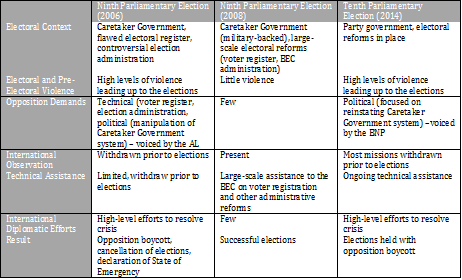 The table hints at the limits of technical assistance in facilitating a smooth electoral process in Bangladesh. While the far-reaching technical reforms that were supported by the international community were instrumental for the 2008 elections, these parliamentary elections also took place under unique circumstances. In 2007 and 2008 the BEC, with strong support from the international community, replaced the existing voter register and addressed one of the most poignant technical concerns of the opposition. In addition to a greatly improved technical landscape, the 2008 electoral process benefited from being held under a non-party government that enjoyed the backing of the military. There was little scope for electoral violence and the Caretaker Government and BEC were able to secure the political parties’ electoral participation. Given the immense popularity of the BEC and strong popular support for the return of democracy, the political parties were under significant pressure to participate, and indeed had few justifiable reasons to object to the fairness of process. The gains made in institutionalizing well-run and violence-free elections were, however, undone by the AL government in removing the Caretaker Government system after its election. One can only guess at the calculus of the BNP in insisting on an election under the Caretaker Government. However, it remains clear that keeping in place the Caretaker Government system would have removed a critical justification of an opposition boycott. The 2008 elections were politically successful because they took place under a neutral government that was able to facilitate a fair election and provide security against electoral violence. The elections were technically successful because a number of reforms, with support from the international community, greatly strengthened the administrative apparatus of the BEC. The 2014 were politically unsuccessful because the BNP could not concede an election held under an AL government. Current political culture in Bangladesh seems to require neutral government administration during electoral periods, and the experience of the Caretaker Government during the 2007-2008 period to reform political culture only highlights how deeply entrenched this culture is. The lesson therefore is that technical electoral support can open doors for electoral success, but that technical efforts are currently still secondary to solving the political obstacles to holding elections in Bangladesh. This lesson raises a number of important questions for the international community in supporting Bangladesh’s electoral democracy:
As noted earlier, this case study is intended to provide a high-level review of international electoral support and provide context to pose the questions above. Readers interested in an in-depth review of Bangladesh’s electoral reforms during the 2007-2008 period and a more extensive analysis of political factors leading to the collapse of the 2006 election cycle would benefit from the UNDP publication, “Elections in Bangladesh 2006-2009 Transforming Failure into Success”.
[1] “Democracy in the Crossfire -Opposition Violence and Government Abuses in the 2014 Pre- and Post- Election Period in Bangladesh”, April 2014, Human Rights Watch: p. 1 [2] “Bangladesh’s Elections – Another Beating”, The Economist, January 11, 2014. [3] Barry, Ellen, “Low Turnout in Bangladesh Elections Amid Boycott and Violence”, The New York Times, January 5, 2014.
About the authorJeremy Eckstein has been engaged with the electoral process in Bangladesh since 2006, when he joined the International Republican Institute’s country team in order to managed the Institute’s election observer mission. After two years in Bangladesh during the country’s period of electoral reform, he returned periodically to conduct studies, assessments, and evaluations for a range of agencies, including the United Kingdom’s Department for International Development, the United Nations Development Program and the National Democratic Institute. He currently resides in Portland, Oregon in the United States. Case Study: Electoral Support to the Sudan Comprehensive Peace Agreementby Jeremy Eckstein* Introduction In December 2013, only two years after gaining independence, civil war broke out in South Sudan. The war, caused by power struggles within the country’s ruling party, caused tens of thousands of deaths and has displaced approximately one and a half million civilians. After months and months of indecisive peace negotiations, it took the threat of United Nations Security Council sanctions for the two sides to finally sign a tenuous peace deal in August 2015. These development stand in startling contrast to the celebrations and euphoria that had surrounded the declaration of South Sudan as an independent state only four years earlier. At that time it had seemed unlikely that the country’s ruling SPLM party would splinter, that civil war would break out within two years, and that one of South Sudan’s biggest supporters would initiate a Security Council resolution against it. Yet the roots of the conflict are much deeper than the post-independence period and the six-year peace-plan that put an end to one of Africa’s most destructive conflicts, resulting in the new state. The establishment of South Sudan came at the end of a complex and fraught six-year peace plan that had put an end to one of the most destructive civil wars in African history. The implementation of the peace plan also largely avoided renewed conflict between the Sudanese People’s Liberation Movement (SPLM) in the South, and the National Congress Party (NCP) in the North, a possibility that had loomed ominously throughout the entire “interim period” of the peace agreement. The outbreak of civil war within the South only two years after its independence resulted from deep cleavages within the southern ruling class that have existed for decades. Indeed elements of the Comprehensive Peace Plan, strongly supported by the international community, set the stage for the disaster that was to befall the country following its independence in 2011. Benefitting from the luxury of hindsight this cases study seeks to clarify some of the key political elements of the trajectory that led to the current war in South Sudan and makes an attempt to identify some of the lessons that the international community learned from this process. The Comprehensive Peace Agreement The Comprehensive Peace Agreement (CPA) brought an over 20 years long North-South civil war in Sudan to an end in 2005. While characterizing this war as purely a North-South conflict is an extreme over-simplification, it is often defined as such. However, in reality it was multi-dimensional and included an especially destructive South-South element in the 1990s. One of the critical shortcomings of the CPA process was that there was no consensus within the southern leadership on its eventual objectives. Some SPLM leaders viewed the CPA as an opportunity to reform the way the entire Sudan was governed, ending the marginalization of Sudan’s southern, eastern, and western communities following a “democratic transformation” to a “New Sudan”, while other leaders in the South insisted that the ultimate objective of the plan was always to form an independent country in the South. The CPA was ultimately structured to make “democratic transformation” possible, in both North and South, while leaving the option for an independent state in the South on the table, should Southerners decide that a “New Sudan” had not been achieved in the interim period. The CPA thus established the semi-autonomous region of Southern Sudan, and populated Southern Sudanese, national, and state-level institutions with representatives of different political movements from a negotiated quota until elections could be held. The overall framework of the six-year peace plan was to hold a national census within the first few years, hold elections shortly afterwards, allow the elected officials to govern for the remainder of the CPA “interim period” in order to allow them to make “unity attractive”, and to finally give Southerners the option to form their own country or stay with Sudan. This framework was challenged from the outset. Firstly, the primary proponent of the “New Sudan” concept and leader of the SPLM, John Garang, died in a helicopter crash shortly after signing the CPA. He was replaced with a pro-independence SPLM leader, Salva Kiir, who remains the leader of the SPLM and is the president of South Sudan. In addition many delays in the implementation of the CPA milestones, political fighting among the CPA parties, armed conflicts, and foot-dragging undermined the peace plan’s conceptual process. Major delays included the implementation and finalization of the census, the passage of the National Elections Act, and the holding of elections. In fact, the only CPA milestone to happen on time was the Southern Sudan referendum on independence in January 2011. The 2010 Elections The 2010 elections were flawed for many reasons. Firstly, being held less than one year before the deadline for the independence referendum there was no conceivable way that the elected government could deliver in a way that would convince Southerners that the interim government structures could be a viable permanent alternative to succession. Secondly, the electoral victories were so overwhelming for the NCP in the North and the SPLM in the South that the 2010 elections entrenched one-party rule for the post-referendum period in the North and South respectively. Thirdly, the elections were rife with manipulation and intimidation. The international community largely turned a blind eye to the many documented electoral and human rights violations so as to not upset the status quo, hardly setting a high expectation for best practices of democracy in the post-referendum period. In the Southern Sudan Legislative Assembly, the body that would become the legislature of the new state of South Sudan, the plurality of political representation dropped dramatically following the 2010 elections from the allocations negotiated in the CPA. Before the elections the SPLM held 70 percent of the seats in the assembly, and the NCP and other southern parties held the remainder. After the elections the SPLM held 94 percent of the seats. A similar pattern occurred in the North, where the NCP was similarly, although less, entrenched. The overwhelming victory of the SPLM would have been less concerning if the party had institutionalized systems for candidate nomination, collective decision-making, and leadership selection and rotation. While these processes are somewhat present in theory, they are absent in practice. The SPLM’s control of the security services, its dominance in the political process, and strong name recognition almost guaranteed that its candidates would win any seats that they contested. As candidates were in practice selected at the SPLM leadership level without input at the grass-roots level, some locally popular candidates were passed over. Several violent anti-SPLM insurgencies occurred when these candidates lost the elections after contesting them as independents. It took several years for the SPLM to bring some of these insurgents back into the fold. This lack of trust in the SPLM’s own decision-making and political accommodation processes led in part to the outbreak of conflict in 2013. The elections themselves were severely flawed and were described as such by international and domestic election observer organizations alike. Despite the monitors’ observations that the elections were subject to administrative problems, voter registration issues, outright rigging, and state-organized intimidation, the conclusion was largely that the implementation of the elections CPA milestone, regardless how flawed, was an important step in completing the peace process, and maintaining the relative North-South peace. In regards to the elections, Human Rights Watch noted: Political intolerance, repression, and violence have eroded the legitimacy of the elections across Sudan, and violated the right of the Sudanese people to elect their government in genuinely free and fair elections. They have contributed to a worsening human rights situation throughout the country by emboldening the NCP and SPLM—neither of which have been forced to account for their actions—in their clampdown against opponents. […] International observers and diplomatic missions have failed to explicitly and resolutely criticize these documented human rights and electoral abuses, or to call for accountability and reform.[1] The implementation of the CPA was never a given and the specter of a return to North-South violence loomed large should the 2011 referendum not be held on time. It seemed that any action that would derail the CPA, including pressuring either the SPLM or NCP leadership about the elections, could result in the resurgence of hostilities between the two. Most actors saw the elections as simply a box to check on the road to the much more important referendum. The 2011 Referendum for Independence In January 2011 Southern Sudanese voted by an overwhelming margin of almost 99 percent to form their own state. Turnout was an impressive 98 percent. While observers commented on some issues around the conduct of the referendum, the referendum was conducted peacefully and its outcome was seen to accurately reflect the will of Southern Sudanese voters. It was judged a legitimate process that would allow the international community to welcome a new state into global affairs. Though there were border skirmishes between the two peace partners, many saw the fact that the SPLM and NCP had navigated the minefield of the six-year “interim period” without returning to total war as the biggest success. International Electoral Support Neither the 2010 elections nor the 2011 referendum could have been implemented without international assistance. Sudan is, in particular in the South, one of the least developed countries on Earth. It lacks roads, communications, and administrative infrastructure. In the South most of the country is impassable during the rainy season, for approximately seven months. In addition, literacy and other development indicators rank amongst the lowest in the world. In response to these challenges the international community assembled a robust set of resources to procure electoral materials, train election workers and domestic observers, provide technical assistance to the electoral institutions in the North and South, provide logistical and transportation support, and provide additional ancillary support. Some estimates suggest that the overall cost for only the referendum was over 112 million US dollars (not counting the cost of the United Nations Mission’s operations). The United Nations Mission in Sudan (UNMIS), the United Nations Development Program (UNDP), and the International Foundation for Electoral Systems (IFES) were the primary assistance providers that overcame severe logistical obstacles, uncertainty, and time-constraints to help to deliver the electoral two events. The agencies worked relatively well together. UNDP and UNMIS were even operationally integrated for the referendum. Each agency had relative advantages that were leveraged successfully. UNMIS took advantage of its reach deep into the country to provide localized technical assistance. It also utilized its fleet helicopters and airplanes to deliver critical electoral materials. UNDP leveraged its capacity to manage collective donor “basket funds” to distribute money for training and to print materials. IFES, financially supported by the United States government, leveraged its operational flexibility and was able to respond quickly to emerging needs. Other international NGOs provided considerable assistance for civil society, political party, and media involvement in preparing for and observing the elections. The agencies worked together across Sudan for the elections, and shifted their center of gravity to the South for the referendum. While the important work remained in the North, the heart of the operation was in the South. Whether or not the results of the referendum were a foregone conclusion, the international community was able to support Southern and Northern authorities to deliver a referendum that was credible and legitimate, and did so against significant operational and time constraints. Developments Since the Referendum The international community provided critical support that led South Sudan’s establishment as the world’s youngest country. However the jubilance of the July 2011 independence celebrations was quickly overshadowed by political conflicts within the SPLM’s leadership, resulting in the outbreak of civil war in December 2013. Ominous signs of the undemocratic nature of the country’s leadership even became apparent shortly after the referendum. It is widely perceived that the SPLM took advantage of the constitutional review and development process after independence to extend the terms of elected positions and to expand the powers of the Presidency. If the 2010 elections were not a sufficient sign of the undemocratic nature of the SPLM, then developments shortly post-referendum were clearly signs that power-sharing and accountability were not concepts that the SPLM leadership was eager to pursue. Clearly a “New Sudan” vision for South Sudan was not part of the program. The outbreak of conflict in 2013, largely along the same lines as earlier divisions in the 1990s, revealed the overall weakness of SPLM systems to manage leadership challenges and power-sharing within its ranks, in addition to the deeply fractured nature of South Sudanese society. Additionally, the party’s fusion to the military (the Sudan People’s Liberation Army), the power-structure and mobilization mechanisms within both the party and the army, and a culture of defection and bargaining contributed to the onset of conflict that has now displaced millions of South Sudanese, seen egregious human rights violations being committed (including mass rapes and the use of child soldiers), and has cost the lives of thousands of civilians. Conclusions The complex conflict in South Sudan has roots in poorly institutionalized government and political party systems, lack of accountability in any governing institutions, lack of a professional military with a unified chain of command, and a culture and history of corruption and impunity amongst the country’s elite. Given these circumstances it is somewhat surprising that the current civil war came as a surprise, and that the international community did not do more to address these issues between independence and the start of the conflict. With the international community having supported both the elections and the referendum, we bear some responsibility for what has eventually transpired. Two particular lessons stand out from this experience. The first is that attention was so tightly focused on holding the referendum that no signal was sent to the SPLM (or NCP, for that matter) that the well documented electoral and human rights violations would not be tolerated. Setting a higher political expectation for the significant amount of international support that was extended to the peace effort may have set a higher bar for future expectations, or given the international community more leverage to push for reforms later on. The second omission was clear planning for the post-referendum reality, and in particular an understanding of how internal South Sudanese political tensions might play out after independence. While some entities have played lip service to the notion that the outcome of the referendum was not known, the reality is that Southern independence was a foregone conclusion. Political discussions with the ruling SPLM undertaken by the international community could have been much more focused on cultivating a stable post-referendum transition period. Any illusion that the Southern leadership was a genuine partner in building a democratic and peaceful South Sudan should have at least been shattered during the constitutional review and drafting processes. Throughout and after the CPA the international community largely reacted to the shifting timelines and political developments that characterized this period. However, having had some foresight and planning into how to build the state of South Sudan and encourage its leadership to do so would have been practical. Now that a peace deal has been signed an opportunity may exist to build a stable state. In supporting these efforts the international donors should remain cognizant of some of the lessons learned from supporting the CPA. Holding elections, for example, in the absence of meaningful reforms of SPLM processes are likely to again trigger conflicts around the country. There would also need an opportunity for non-SPLM opportunities to offer alternative options. While such options seem at present a distant reality, they would require at a minimum the separation of the security forces from the SPLM, the establishment of a truly independent election commission, the standing-up of the political parties affairs council, and the guarantee of freedom of expression, which has been greatly undone and compromised in recent years. The international community might consider tying its development support to the implementation genuine and credible reforms in this arena. * Jeremy Eckstein first began working on CPA issues in 2005 in central Sudan, shortly after the CPA was signed. Later he worked with political parties in Southern Sudan, living in Juba in 2008 to 2009. He again returned to work with a Untied Nations agency in Khartoum from 2010 to 2011. Since he has drafted and co-drafted two major evaluations of electoral support in the CPA for the United States government.
[1] “Democracy on Hold – Rights Violations in the April 2010 Sudan Elections”, June 2010, Human Rights Watch. Retrieved at: https://www.hrw.org/report/2010/06/30/democracy-hold/rights-violations-april-2010-sudan-elections Case StudiesContributorsLinks Relevant to Effective Electoral Assistance
I. ELECTORAL ASSISTANCEIDEA
UN/UNDP
EC
AusAID
CIDA
DFID
Sida USAID
NED
World Bank
Research Articles
II. DEMOCRACY SUPPORT AND ELECTORAL PROCESSESCivic Education
Cost of Electoral Processes
Democracy Building and Conflict Management
Disability and Elections
Domestic Observation
Electoral Management and Institution Building
Electoral Standards
Electoral Systems
External / Out-of-Country Voting
Gender and Elections
Governance and Democratisation
Legal Framework
Media Development/Media Monitoring
Parliamentary Development
Political Parties
Procurement UNDP-IAPSO Procurement Guide
Professional Development The BRIDGE Project
Regional Focus: International Organisations
Technology
Focus on Elections and SecurityAn election is a contest for legitimate power that can be described as a non-violent competition, fought within a political forum. In this context, it is important to recognize that elections do not avoid confrontation, but rather focus on its management and containment within accepted boundaries. In practice, the assurance of equitable security during an electoral process is essential to retaining the participant's confidence and commitment to an election. Consequently, security is both integral to the goal of an election and an inseparable part of the electoral process. There is no single model of elections or democracy that is universally applicable to all countries. An election is unique; defined not only by the electoral rules, but also shaped by the social values, politics, religions, history and culture of the people. In the same way, the security of an election is unique to the circumstances in which it is conducted. The stakes of any given election are different, even if it is held periodically in the same country, due to the changing forces that shape the national interest and corresponding political agenda. Guiding PrinciplesThe organisation and conduct of credible elections demand adherence to principles and rights, which in practice, impose significant challenges for ensuring effective security, including:
To operate effectively within these electoral requirements, security forces need to be guided by their own principles, including: Equitable and rights-based Participants in an election must be treated in an equitable manner by both security forces and electoral officials. Reasonable and proportionate responses to actions must be consistent, which cannot be influenced by arbitrary factors, such as, political affiliation. An election is a mechanism by which people are able to exercise their political, civil and human rights. Security protocols must consider and acknowledge these rights, as well as the heightened sensitivity and scrutiny to the respect for these rights that occur during an election period. National ownership Elections are a sovereign process. However, in some circumstances such as, post-conflict or transitional elections, national security forces may need to be strengthened by international forces. To the degree permitted, the security of an election should fall within the ownership and control of a national authority to reflect sovereignty and avoid allegations of international interference. Advantageously, indigenous security forces are the most sensitive to their cultural practices and may therefore be best positioned to interpret and respond to emerging threats. Strategic Elections are normally planned 18 to 24 months before polling day and occur as a widely dispersed exercise requiring significant planning and preparatory activities. Security forces (police and/or military) rarely possess sufficient standing resources to secure an election, and simultaneously carry-out their regular duties. Integrated strategic planning by the electoral and security institutions is essential to prioritise, allocate and coordinate necessary resources. Non-partisan and impartial To be effective, security forces must avoid allegations of partisan bias. If security forces are found to behave in a partisan way, rather than defusing tensions they may heighten them and undermine their own function in the process. During the election period (especially during the campaign period) normal security actions may become the subject of analysis which evokes political dimensions. In politics in general, and in elections in particular, perception is as important as reality. As such, senior security managers must actively consider these political dimensions to preserve not only the reality, but the perception of impartiality. Flexible and efficient Electoral processes can face late-stage amendments to accommodate emerging legal, operational or political conditions that arise. In the first instance, security planning should include a range of contingency plans and resources to ensure flexibility. Alternatively, clearly defined constraints on security capabilities and resources based on efficient planning should be available to inform decision makers on the range of options that are feasible to accommodate. The efficiency of these operations, both in delivering substantive security services and adjusting to changes, is an important indicator for the confidence of the electoral participants. Transparent and accountable In security operations there is always a tension between operational security policies of ‘need to know’ and the public interest. In an election period, disclosure policies are normally best weighted towards the public interest, recognising the importance and value of transparency. In cases where it is necessary to protect information, extra accountability measures may be necessary to ensure post-event justifications. Transparency in this context also refers to enhancing consultative mechanisms with political groups, civil society and other organisations to ensure the role and functions of security forces are well understood in the process. A favourite saying of this author is: ‘The best operational solution is rarely politically feasible’. In many cases, the political dimensions of an election can create obstacles to otherwise seemingly simple security decisions. This feature of the electoral process highlights the potential frustrations that can arise between security and electoral officials. Ultimately, an operational solution cannot be considered desirable if it does not address the necessary political conditions. This discord emphasizes the need for strong communication and coordination between security forces and electoral institutions. NEXT: Election Security Threats and Analysis
Election Security Threats and AnalysisThe nature of an election makes it vulnerable to a range of security threats against participants, infrastructure, information and materials. Effective election security analysis must draw on information and expertise from multiple arenas. A high-level of communication and coordination among the agencies responsible for the administration and security of an election is a significant advantage. Neither can security analysis and planning be effective when it occurs only in a period shortly before the electoral process starts, nor depend solely on reactive strategies. Anticipating and pre-empting security risks, mitigating their impact or probability of occurrence, is a strategic endeavour of both the electoral authorities and their security partners. An electoral process is constituted from a complex series of interdependent sub-processes, generically including: boundary delimitation, civic education, voter education, voter registration, party registration, candidate nomination, the campaign period, polling operations, tallying and counting, dispute resolution and the official announcement of results. With the exception of boundary delimitation (which often occurs following a decennial census exercise) these sub-processes occur in some form during each election cycle. Each of these sub-processes can be characterised by different types of threats, influenced by: the particular approach adopted, cross-influence between sub-processes and the individual circumstances of the election. Further, the circumstantial conditions of an election can alter quickly, requiring the rapid reprioritisation or invalidation of initial security assumptions. Accordingly, the analysis of threats and risks is a continuous task throughout the electoral process, and is not simply event driven. The types of security threats likely to arise in a particular election are influenced by both structural and circumstantial aspects of the election process. The structural design of the electoral process such as the choice of electoral system may foster or deter certain threats. For instance, an electoral system that uses a single national district (the national borders form a single electoral constituency) and allows voters to cast their vote at any polling station, will offer no direct incentive to forcibly move voters within the territory – since irrespective of where the vote is cast, it will be counted in the final tally. On the other hand, this arrangement may promote efforts to forcibly migrate eligible voters across national borders, so they cannot participate. In security terms, this scenario reflects a heightened structural risk for border control operations during the voter registration and polling phases of an election. Circumstances will dictate in each election, and at each stage of the electoral process, the level and priority of risk posed by different threats. For example, when an election is a presidential run-off (the final two candidates competing), the danger of political assassination represents a significantly higher risk than an election of several hundred parliamentarians to an assembly. Similarly, if an election is being conducted as part of a post-conflict peace agreement, it has a very different risk profile to an election held in a country with an unbroken history of democratic elections. One methodology to map an election’s risk profile is by the identification of mission critical assets (people, infrastructure, information and materials), without which, the election cannot reasonably proceed. In combination, the unique structural and circumstantial aspects of an election will dictate at what phase of the process an asset is critical, and notably, if this may change between sub-processes. Some electoral processes by their nature are better able to adapt to certain types of attack. For instance, the destruction of ballot boxes at a polling station after polling has been completed may or may not cripple the ability of the electoral authorities to produce a result from the election. The impact of such an attack will vary significantly depending on a range of both structural and circumstantial factors. Separating ‘mission critical’ from ‘recoverable’ threats is a key step in building the election risk profile and determining priorities. Against the backdrop of these regular security challenges, several new threat trends have emerged in the past few years. These include international terrorism and organised crime: International terrorism As a well-recognised ritual of democracy, elections can attract threats from diverse groups, whose motivations may have no connection to the national stakes of an election. As recent events have demonstrated, international terrorists have the capacity and motivation to conduct “spectacular attacks” geared towards fulfilling their own propaganda agendas. The intensity of media coverage during an election is a highly visible period, affording an attractive opportunity for such attacks to occur. Organised Crime The political tensions that arise during an election offer organised crime groups an appealing opportunity – at a time when the authorities’ ability to differentiate between politically motivated violence and criminally motivated violence can be extremely difficult. Paradoxically, a group committing politically motivated offences may try to have their actions interpreted as purely criminal, whereas criminally motivated groups may wish to obscure their actions behind a political façade. Of further concern, these interests have become convergent in some post-conflict settings, where organised criminal groups have been known to kidnap individuals and sell the hostages to political groups for propaganda value. It is necessary in any section on electoral threats and analysis to highlight a cautious approach in carrying out this function. As noted in the principles above, non-partisanship and impartiality as well as transparency and accountability are important guides for electoral security. The choice of methods and subjects of information collection, during an election period, must be sensitive to the possibility of interpretation as a political intent and possible backlash. As such, extra emphasis on procedures that adopt checks and balances, are an important safeguard of the analytical process during elections.
Security ActorsIn broad strokes, security arrangements can be divided into three main types: static (e.g. protection of warehouses, polling stations and offices), mobile (e.g. protection of voter registration teams or campaign rally sites) and reserve (e.g. contingency forces to support either static or mobile forces as required). Within these three broad categories, the types of security tasks involved vary widely and depend upon significantly different capacities (skills and numbers) and lawful authorities. In many cases, the assignment of these tasks will be dictated by ‘best fit’ to function (involving a division of labour among several security institutions or contractors), but can be constrained by legal, financial and political conditions.
In some countries, the involvement of the military forces is outright prohibited and uniformed personnel are required to stay in barracks on polling day. In other countries, the military is integrally involved, but may do so under special arrangements, such as the head of the electoral management body temporarily assuming the mantle of Commander-in-Chief of military forces. Elsewhere, police forces may be able to utilise military personnel and equipment through regular legal provisions (such as secondment arrangements). The financial arrangements for security services can become a controversial issue between security and electoral institutions. This controversy (if it arises) principally stems from the high costs associated with such large scale operations, additional costs incurred by late amendments, and whether the costs should be borne as part of the electoral process (and therefore by the electoral management body) or as a function of the security forces (and therefore by the budget of the security forces). The resolution of this problem will depend on the formal arrangements of government in a particular country, but is also influenced by the electoral and security institutions ability to identify the problem early in the strategic planning phase, and find a mutually satisfactory solution. Political constraints may also affect the assignment of security forces to particular tasks in the electoral period. If a security actor has been the subject of controversies relating to partisan bias, the use of these forces in some aspects of the electoral process may be counter-productive to gaining the trust of the participants. For example, in a post-conflict environment, the involvement of the State security forces in the conflict may have created a level of distrust that can necessitate alternative arrangements. In this post-conflict scenario in particular – especially if military and police forces are undergoing major reforms in parallel to the election process – the deployment of these forces can be detrimental not only to the election, but to the reforming institutions. Neither are security actors in an election process limited to formal security institutions. Political parties, civil society groups, non-governmental organisations (NGO’s), the media and election observer groups can all have an influence on the security environment through various mechanisms. Political parties may enter into a mutually agreed Code of Conduct that guides the behaviour of their supporters and candidates. Civil society and NGO’s (national and international) may undertake information campaigns, public debates or use other strategies to assist in defusing political tensions. Media outlets may also follow a Code of Conduct that deters speculative reporting that could unnecessarily heighten political tensions. And, electoral observers may also mitigate intimidation and other threats to the process, by virtue of their presence and scrutiny of the process. NEXT: Electoral Special Security Measures Electoral Special Security MeasuresSeveral measures have evolved in different countries to enhance security during an election. The applicability of these measures varies given the unique circumstances. Listed below is a non-exhaustive list of special measures or arrangements that might be considered by election and security officials: Joint Operations Centre (JOC) The establishment of a Joint Operations Centre (JOC) has become a common feature of efforts to coordinate security and electoral operations. Normally established some months before an election, the JOC contains representatives from a range of institutions and acts as a nexus for information sharing, planning, briefing and monitoring the electoral process. Dedicated Training on Security The development and delivery of a training package for security officials involved in an election. Normally this step is reinforced by the distribution of ‘Election Cards’ to security force personnel – outlining key points about the process, their expected behaviour and lawful authorities. Similarly, the training delivered to electoral staff should include a component that outlines the role and integration of security personnel into their activities. Weapon Exclusion Zones During registration, campaigning, polling and counting exercises, special legal provisions may come into force that create a ‘weapon exclusion zone’ around these sites. Normally, the only persons legally bearing arms within these zones are appropriately authorised security personnel. Coordination of Campaign Rallies
Campaign ‘Cooling-Off’ Period Several countries impose a “cooling off” period between the end of the campaigning period and polling day. This cooling off is intended to reduce the amount of political rhetoric and tension between opposing parties, as their respective supporters go to vote together at polling stations. Security Media Component (Proactive and Reactive) In the course of an election, security forces may become the subject of disinformation campaigns. Disinformation campaigns may seek to misinform voters about the role, behaviour or credibility of security forces. In the first instance, a proactive information campaign seeks to explain the role of security forces in the process, which can deter disinformation efforts. In reactive circumstances, security forces should have the capacity to respond quickly and effectively in the media to journalist enquiries or disinformation. Enhanced Communications Network An effective communications system is well recognised as a ‘force multiplier’ for operational activities. For an election, ensuring that both election and security officials have appropriate communications equipment and interoperability at key levels – significantly enhances responsiveness and efficiency, as well as avoiding misunderstandings. Security Consultative Meetings and Liaison In certain circumstances, it may be necessary for security officials to pursue liaison and consultation with local communities to explain their role in an election. Offering an opportunity to exchange expectations, these meetings can be highly productive in alleviating concerns. If follow-up is necessary, a reliable security focal point (or team) may be appointed as a dedicated channel for election related security issues. It is strongly recommended that if this type of engagement is initiated, representatives of the electoral authorities are directly involved to avoid inconsistent messages. Rules of Engagement or Use of Force Policies Security forces often outline a policy framework termed a ‘Rules of Engagement’ (RoE) or ‘Use of Force Policy’ (UoF) to guide the actions of their personnel in certain circumstances. Usually, these policies guide security forces on what action is considered to be a reasonable and proportionate response to certain types of threats. During an election these policies may need to be reviewed with an emphasis towards ensuring that security forces are not ‘baited’ into actions that may later be politicised. In the case that security providers are contracted by an electoral institution, a use of force model should be clearly outlined in the contracting arrangements. Code of Conduct As has been mentioned earlier, several different groups, such as political parties and the media may enter into a Code of Conduct to guide their behaviour during an election. Security forces may also enter into a Code of Conduct to administer the behaviour of their personnel during an election. Investigation Taskforce Irrespective of the forum to which an electoral dispute is brought, the ability to rapidly and competently investigate the asserted facts is essential to defusing uncertainty. The awareness that any allegation will be thoroughly and competently investigated, can in itself, deter frivolous or malicious disputes from arising. Assembling a credible, impartial and competent investigation taskforce, solely for electoral matters may therefore pre-emptively defuse unnecessary disputes. The measures outlined above offer a sample of the range of security solutions that might be considered during an election process. The desirability and suitability of certain measures, or their combination, should stem from the threat analysis and strategic planning stages. Conclusion
Elections are a potent tool to defuse conflict and create a means of finding negotiated resolutions. As these peaceful means seek to resolve inter alia social, political, ethnic, religious and economic divisions, an election is a period of heightened tensions. Security is pervasive in this process and can affect both the actual, and perceived, legitimacy of the electoral outcomes. An equitably secure environment for electoral participants is fundamental to their engagement in the process, and by extension, the goal of an election itself. Whether or not an election lifts a conflict out of violence, or generates conflict, is strongly influenced by the integration of effective security policies and practices, into the electoral process. Next: Contributors to this Focus On
Cost of Registration and ElectionsThe electoral costs of registration and elections may be difficult to calculate and compare as they often vary depending on a number of factors, such as the level of responsibility and tasks of the EMB, number of elections in an election year, the timing and sequence of elections, personnel and operational costs, and more. The Cost of Registration and Elections Encyclopaedia topic evaluates the methods by which election budgets are established, tracked and funded; identifies the cost-management practices that can be adopted by EMBs; establishes a methodology for the comparative assessment of electoral costs with a goal of helping election organizers and policy makers to identify ways of managing financial resources, measure their relative costs of operations with other EMBs, and reduce the cost of electoral events.
Working Definitions of Election Costs in a Core-Costing ModelAccording to the current standard theory and practice of elections, the main expenses are incurred for the following activities: voter registration, boundary delimitation, the voting operation, counting and transmission of results, dispute adjudication, voter education and information, campaigning by political parties and candidates, and vigilance or oversight by party representatives and domestic or international observers (Goodwin-Gill 1994; López-Pintor 2000; OSCE 2001; EU 2002; IDEA 2002). Consequently, electoral costs include all the costs incurred in undertaking such activities, regardless of the kind of agency involved, whether national or local, public or private. Types of Electoral CostsVoter registration, boundary delimitation, the voting operation, counting and transmission of results and dispute adjudication are almost invariably conducted by various forms of EMBs (i.e., the executive branch of government, officials under the supervision of an electoral commission or an independent electoral commission). Providing voter education and information, may be shared by electoral authorities, political parties and civil society organizations, while the seventh (campaign activities) is exclusively conducted by political parties and candidates. The main variable for cost analysis may therefore be directly related to the specific organization or entity in charge of a given electoral activity—one or several organizations within the national government, local governments, judiciaries, private firms (e.g., quasi-public postal service and telecommunications), NGOs and political parties. The electoral budget during an election year may cover one or several elections, and in the latter case one should consider whether elections are held simultaneously or separately on different dates. These factors heavily influence the overall budget figures as well as their distribution by budget line item. Number and time sequence of elections are variables that make it difficult to compare electoral costs among different countries. It is not always easy to split budgets and assign costs to different elections. A distinction between personnel costs and operational costs is generally used as the main structuring criteria in an electoral budget. Over time, there are fixed costs for the ordinary functioning of an electoral administration; these costs are incurred independently of the occurrence of elections in a given year. Variable costs, meanwhile, are those related to the actual conduct of elections. Almost the entire budget for a specific election consists of variable costs. With the term funding source, three main distinctions can be made. One is between a) a separate electoral budget that is part of the consolidated budget of the nation and b) election-tied funds that form part of the budget of public agencies whose main responsibilities have little or nothing to do with elections (i.e. civil registries, police and postal services). Another distinction, between national and international funding of electoral budgets, is of utmost relevance in the case of post-conflict elections and even second-generation elections in emerging democracies. A third distinction, between public and private funding, is applicable primarily in regards to the funding of political parties and electoral campaigns. Electoral-budget costs that can be readily identified on a budget document are called direct costs. There are also diffuse costs—those that may prove difficult or impossible to accurately assess even if properly identified. This category can be further divided by degrees of diffusiveness; for example, some costs for activities can be clearly identified, yet still cannot be disentangled from within the general budget of the agency involved (i.e. the contribution of civil registries in providing information to EMBs for the production of voter lists; or the production of voter lists by the national agency in charge of censuses and statistics). Obtaining specific information about such costs is frequently impossible because activity-focused cost audit are not often practiced by organizations responsible for a multiplicity of programs, such as those mentioned above. As noted above in the funding source category, other diffuse costs may include actual costs hiding beneath the ordinary operations of agencies that lend various forms of support to the electoral process (i.e., police force, postal services, school systems, local governments and public TV). While these are real costs, they are neither included in the electoral budget nor are they easy to assess in many cases. An additional and very important distinction is between integrity costs and core costs. This distinction may be essential for an adequate understanding of the funding of elections, most notably in emerging and post-conflict democracies. It has much to do with conditions ensuring a safe, politically neutral environment and a level playing field. The integrity of the voting operation is mainly a function of voter security and ballot security. Voter security includes ensuring the safety of individual voters and of voting and counting facilities; removing threats and intimidation factors; and guaranteeing accessibility to polling stations. Security of the ballot implies arranging the voting and counting in such a way that the voter lists, ballot papers, tallies and other result records are tamper-proof. The main objectives are to preserve secrecy of the vote (disposition of the voting booth), to avoid double voting (a safe ballot box, use of indelible ink), and to eliminate undue manipulation of voting materials (printing control, storage and transport). The presence of party representatives and electoral observers—both domestic and international—may be required at the voting and counting locations. In summary, integrity costs generally concern security arrangements for registration and polling places. They may include funding for international personnel serving as part of the electoral administration; tamper-resistant electoral materials necessitated by a low level of trust among contenders; long-term electoral observer missions; intensive voter education campaigns and election publicity; and assistance to political parties at national and local levels as part of a broader approach to capacity building. Those costs routinely associated with carrying out elections are designated as core costs. They are incurred independently of the degree of uncertainty and security of the political environment and have to do with voter lists, voting materials, competence among polling officials, voter information, and organizational and logistical arrangements. Core costs are assumed to be fixed rather than variable; integrity costs are incurred when special and often unexpected expenses are required to ensure that the process works efficiently. The relative proportion of overall election costs that can be attributed to integrity or core costs generally depends on how far removed the politics of a given country are from conflict and lack of security. In a recent assessment of post-conflict elections, the following dummy exercise offered a useful indication of how costs may be structured. Developing a Methodology for Electoral Cost AssessmentThe classification of electoral costs are defined in Types of Electoral Costs serve as the basis for developing cost-assessment methodologies. The following steps are required:
Table 1 (below) shows the frequency and intensity with which different costs are incurred, depending on the democracy environment. Three trends are apparent when comparing electoral scenarios in stable, transitional and post-conflict democracies. First, integrity costs are relatively higher in transitional than in stable democracies, and still higher in post-conflict situations. This is primarily, although not exclusively, due to the requirement of police and military to handle security at every stage of the electoral process, frequently with the presence of an international force. Second, diffuse core costs are particularly extensive in stable democracies where a large part of the actual electoral expense is covered by budgets from different state administrations; in such environments, it is not always easy or feasible to quantify which part of their budgets are devoted to electoral activities. On the other hand, diffuse integrity costs are greater in transitional and post-conflict environments because of the need for funding from a peacekeeping budget, which are difficult to quantify. Diffuse costs attributable to political party finance are substantial and difficult to quantify in both stable and other democracies. Third, the existence and amount of vigilance costs could be reduced to some core costs for party agents in stable democracies, but would expand to domestic and international observers in the other democracy environments, especially in post-conflict situations. Election Budgets and Revenue Sources for Funding the Administration of ElectionsThe Cost of Registration and Elections (CORE) Project evaluates budgets of Electoral Management Bodies (EMB’s) in order to identify budgeting practices and techniques that influence cost control and transparency and identifies the revenue sources for funding the administration of election processes. For more information covered in this section, see:
Election Funding: Legal Framework and Practice; Election Budget Processes and CyclesAs a rule, electoral budgets tend to be part of the consolidated budget of the nation on an annual cycle. In a non-election year, the budget for the electoral authority— whatever shape it takes—is usually a line item of the national budget or is included within the budget of the larger agency of which the electoral administration is part (e.g., the Ministry of Interior). In an election year, the corresponding budget is funded from the national budget by following ordinary or extraordinary procedures, depending on whether the elections could be anticipated or were called unexpectedly. Flexibility is particularly necessary in parliamentary systems in which governments may collapse unexpectedly or a prime minister may call an election at any time within a given term of office1. Almost invariably, electoral budgets are prepared by the electoral authority and processed through the finance ministries for approval in the legislature. Most finance ministries do not have the authority, at least formally, to curtail or amend an electoral budget prepared by electoral authorities. Some exchange and bargaining between a ministry and electoral officials may nonetheless ensue. In Australia, for example, the Australian Electoral Commission (AEC) receives the major part of its funding through government appropriations, which are acts of Parliament that authorize expenditures and appropriate money from the Consolidated Revenue Fund to provide agreed levels of budget funds to government agencies. Budget levels are agreed for the budget year and three succeeding years, according to the stages of the election cycle. Adjustments to funding to cover changes in operational and legislative requirements occur through a formal process of New Policy Proposals involving ministers and the Expenditure Review Committee made up of senior cabinet ministers. Appropriations are made on an outcomes basis, and annual reporting is made in accordance with the outcomes and outputs framework, including performance indicators and targets against which performance can be assessed. Appropriations and all reporting occur on an accrual base, so non-cash expenses (such as depreciation) form part of annual funding levels. Improved information technology (IT) platforms have helped limit increases in the costs of registration and elections in Australia over the past five years—operational costs in a non-election year have increased by approximately 0.8 percent, and in an election year by 1.3 percent. The Government and the Parliament place constant pressure on the AEC (along with other publicly funded agencies) to continually review its operational performance and to contain costs. The AEC will upgrade its IT capabilities in the next three years to take advantage of the scanning and optical character recognition technologies that can further enhance its roll management systems and its management of elections. Such a budgetary practice is better established in countries where the state administration has achieved a certain degree of organizational maturity and the legal system is stable. More frequently than not, standard budgetary practices are formally followed at all levels of government (after influencing international financial and monetary agencies as a requirement for aid and trade agreements). Otherwise, the electoral budget for a fresh election after civil conflict, or elections in the midst of unstable times, is usually made on an ad hoc basis and defined with participation of international agencies (e.g., Haiti, Afghanistan). A kind of transitional situation might be that of Cambodia, where elections are funded through a special account at the National Treasury called the Trust Fund Account for Elections. Practically all contributions for elections—private and public, national and international—are deposited in this fund. Guatemala offers an interesting case where a fixed percentage of the national budget (0.5 percent) is allocated by law for the ordinary functioning of the electoral commission. In an election year, the commission follows standard budgetary procedures in defining and requesting the necessary funds for the election. Afghanistan presents a recent example of how elections are organized in a post-conflict scenario. The October 2004 presidential poll bore many similarities to other electoral processes where the international community has been heavily involved in both the political process and the practicalities of organizing elections. Those processes are inclined to choose high-tech solutions, rather than low-tech alternatives, and a large central election administrative bureaucracy with a distinct international component— which together contribute to a staggering price tag for the electoral process. A unique feature of the Afghanistan election was how early and suddenly the responsibility for planning and implementing the election was handed to the government itself, at least on paper. This marked the first time that a national election authority with no previous experience in organizing elections was charged with implementing its first election—even though the United Nations had a staff of more than 100 people on the ground tasked to work on the electoral process and had the explicit mandate to conduct voter registration prior to polling. The early transfer of responsibility for organizing the elections from the United Nations Assistance Mission in Afghanistan (UNAMA) to the national government became known as the ‘Afghanization’ of the electoral process. Notes: 1A notable exception is Switzerland, where the electoral budget stays the same in election and non-election years. This is due to the fact that there are almost always three to four referenda at the national level in a non-election year and two to three referenda in an election year.
Next: Resource-sharing arrangements with other public agencies Resource-Sharing Arrangements with Other Public AgenciesA particularly common situation in stable democracies with highly developed state apparatuses at the national and sub-national levels is that a number of electoral costs are shared among the electoral administration and other public agencies. This is the case with the making and updating of voter lists and district boundary delimitation, voter information, the conduct of external and proxy voting, early transmission of results, dispute adjudication, and security of the polling operation. Sometimes such costs are easily identifiable within an electoral budget of the national EMB or of another public agency. Frequently, however, there are diffuse costs within the state and local administrations that cannot be sorted out as electoral costs since they are part of standard costs of functioning state apparatuses (i.e., local governments, police) or of private organizations (i.e., private schools functioning as polling centers at no cost). Such costs cannot be properly assessed unless program-focused cost accounting is made by the implementing agency, which is not usually the case in most governmental agencies dealing with a variety of activities (e.g., local governments, census and statistical authorities or civil registries). A typical agency budget is normally structured by separating personnel and non-personnel services (materials and procurements), but it generally difficult to determine how much of each is devoted to a given election-related activity (i.e. security, arranging for polling stations, supplying information for voter lists) as part of the larger cost of operations of the entire organization. For example, in Spain and Sweden, voter lists are compiled in a national office of statistics. Although the electoral authorities pay a fee for the lists, this does not cover the full cost of the operation simply because there are hidden costs that could only be ascertained by program-focused cost accounting. There are other hidden costs in both countries, as in many others, related to the conduct of the polling operation by provincial and local municipal administrations, the postal services, police and embassies abroad. Such a wide range of hidden costs is less likely in countries with small state infrastructures, where almost any electoral cost incurred at any level of government can be easily spotted and referred to a general electoral budget for provision or refund by whatever authority implemented a given election-related activity. For example, in Cambodia and Guatemala, a local employee at the municipal level is exclusively in charge of helping with civil registry and voter lists. Although the municipality provides certain office support, both the main office and salary costs are covered in the national electoral budget. A number of templates of electoral budgets are included as illustrative examples of budget structures in different democracy environments.
Next: How much do elections cost? How Much Do Elections Cost?One major finding regarding the overall cost of elections is the importance of the type of democracy environment (i.e. stable, transitional and post-conflict) in determining both the kind and amount of electoral expenses. The conclusions from previous research, have been validated in the current study and are described according to the two categories below: Previous experience with multi-party electionsA very significant factor in explaining cost variations is duration of previous experience with multi-party elections. Significant cost differences exist between routine elections in stable democracies, elections in transitional democracies, and elections during special peacekeeping operations. In countries with longer multi-party democratic experience, elections are consistently less costly than in countries where such elections constitute a new undertaking. This trend cuts across regions, levels of economic development, and even interruptions of electoral practice by military breakdowns. Low electoral costs, approximately $1 to $3 per elector, tend to manifest in countries with longer electoral experience: the United States and most Western European countries; Chile ($1.2), Costa Rica ($1.8), and Brazil ($2.3) in Latin America; Benin ($1.6), Botswana ($2.7), Ghana ($0.7), and Senegal ($1.2) in Africa; India ($1) and Pakistan ($0.5) in Asia; and Australia ($3.2). In most countries that have less multi-party electoral experience, costs tend to be higher, even taking into consideration elections that have taken place as part of peacekeeping operations, where the cost per elector is highest: Mexico ($5.9), El Salvador ($4.1) and Paraguay ($3.7) can be mentioned in Latin America; Lesotho ($6.9), Liberia ($6.1) and Uganda ($3.7) in Africa; and Russia ($7.5) in Eastern Europe. Thus, duration of electoral practice is in itself a cost-reducing mechanism, perhaps the most important during the stage of democratic consolidation. Since a longer-term perspective is by definition difficult when assessing election costs in new democracies, the above findings offer strong support for the claim that efforts at capacity building in electoral administrations are probably cost-effective in the longer term. These findings also support the idea that establishing and consolidating a permanent electoral administration as the repository for managerial capacity development with regard to elections—within both the political and the administrative systems—is a cost-effective practice. As might well be expected, elections held as part of broader and longer-lasting peacekeeping operations are the costliest of all. Nicaragua in 1990 ($11.8 per elector), Angola in 1992 ($22), Cambodia in 1993 ($45.5), Mozambique in 1994 ($10.2), Palestinian Territories in 1996 ($9), and Bosnia-Herzegovina under the Dayton Accords ($8) are cases in point. This is not to say that a cost-effective approach cannot or should not be used for special operations, but that it would function to a much more limited extent than in simple transitional electoral politics or, indeed, in routine periodic elections. In the Cambodian case, in which donors subsidized both elections, it would be hard to demonstrate that the high-cost elections in 1993 (at $45 per elector) were better organized or produced a more positive political outcome than did those of 1998, which were run at costs closer to the standard of the politics of democratization ($5). Somewhat less dramatically, both Nicaragua and El Salvador also demonstrate that second elections after peacekeeping operations can be run significantly less expensively: costs dropped from $11.8 in 1990 to $7.5 in 1996 in Nicaragua, and from $4.1 in 1994 to $3.1 in 1997 in El Salvador. Consequently, elections as part of special peace-making and peacekeeping operations should be considered separately for both analytical and strategic policy purposes. (López-Pintor, 2000, 76-77). According to the research conducted for the CORE Project, elections cost more than $20 per elector in Afghanistan (2004), $5 in Guatemala (2004), $2 in Cambodia (2003), $4 in Spain (2004), and $2 in Sweden (2004). The projected per-elector cost for the 2005 election in Haiti is $11. Costs in Guatemala and Cambodia are similar to those in Spain and Sweden, respectively, but these similarities should be considered in light of the fact that the former two countries are among the poorest in the world in terms of per capita income, while the latter two are among the richest. Thus the elections in Cambodia and Guatemala can be viewed as being much more costly. A corollary to these findings is that the integrity costs of elections are reduced by efforts and investments to improve peace, security and national reconstruction, such as disarmament, demobilization, integration to civilian life, inter-ethnic reconciliation, and infrastructure development. Other electoral costs may remain constant or even increase (e.g., personnel, high technology), but integrity costs will certainly decline with democratic progress. Within the realm of core costs, progress in building state apparatuses would normally imply that certain electoral costs may be reduced or shared within the ordinary budget of other public agencies different from the electoral administration (e.g., civil registries, postal services and police). As national security, transport and communication infrastructures are of paramount importance in determining integrity costs, so is state building with regard to core electoral costs.
Democratic consolidationCore costs as a whole—especially in the areas of personnel and advanced technology—tend to increase rather than decrease independently according to the degree of democratic consolidation. One main cause of this in emerging democracies is the sheer institutionalization of a permanent professional electoral administration, which in most countries is a bureaucratic organization in the form of an electoral commission independent of the executive branch. A second set of causes stems from the complexities of the political and party systems in countries with federal, state and regionalized electorates, all of which may run different types of elections under separate schedules; when high demands for voter information persist (i.e., use of different languages); and when elections require special voter assistance (i.e. external voting, proxy voting). A third cause is the increasing use of new technologies, which may include computerization of office work, establishment and update of permanent computerized voter lists, quick electronic transmission of results on election evening, and introduction of electronic voting. All of these activities are expensive. In the specific scenario of emerging democracies, once peace is achieved and reconciliation fares well, dramatic cost decreases may be expected—though not under all circumstances (e.g., Ecuador, Kosovo and Nicaragua). The case of Cambodia illustrates the decreasing cost trend and the fact that after a given point, no further decrease can be expected. The substantial reduction of costs achieved by the National Election Committee (NEC) from 1998 to 2003 can be explained by a series of factors that are not all technical in nature. At the policy level and as a matter of pride, the Government of Cambodia does not want to rely heavily on international assistance for future elections. Eventually, the greater part of electoral costs will come from the government’s coffers. This, in itself, is a strong incentive to reduce costs. Electoral assistance dropped substantially, from almost $19 million in 1998 to $10 million in 2002 to $6 million in 2003. The 2002 reform of the legal framework in Cambodia was undertaken with the double objective of improving and reducing the costs of the electoral machinery. For instance, a permanent voter registry was introduced, and voter registration was delegated to local administrations. In addition, expensive procedures were abandoned or replaced with cheaper alternatives. For example, the practice of issuing a new voter identity card (with photograph) for each election was replaced by the use of other identification documents, such as a new national identity card. The NEC was forced to rationalize its internal practices and reduce the number of departments. The chairman of the NEC has said he believes that electoral costs in Cambodia should not vary widely in future elections; if anything, he said, the cost of materiing factors to larger electoral budgets in the future may include capital expenditures to replace aging vehicles, computers and other electoral items, and the necessity to provide for an ever-increasing voter population. In Guatemala, an assessment of election budgeting, funding and cost management in recent years found that election costs have consistently increased overall and in almost every single area. First, the 2003 election budget was more than twice that of previous elections after including foreign aid, but still around the average for Latin America. A similar pattern observed in Guatemala at the time of these elections had been seen previously in elections in Nicaragua in 2001 and Ecuador in 2002. In all three cases these were third-generation elections which took place after acute social conflicts, and each poll turned out to be more expensive and more poorly organized than the previous national election. Given that a substantial part of Guatemala’s electoral budget was funded through foreign aid, this finding should be taken as a warning to the international community to closely monitor election spending. Second, the most expensive items in Guatemala were salaries and per diem given to temporarily hired staff and polling station workers, although this cost has remained relatively constant over the last five years at 125 quetzals ($15) for polling station officers— an amount that many poll workers did not consider equitable. This expenditure was followed closely by the cost for voter list updates, although it should be noted that updating of voter lists and rearrangement of the polling stations accordingly was basically covered by external aid. Cost increases in the official national electoral budget basically involved larger expenses for voter education and an increase in the number of polling stations to 8,885. Over a five-year period, voter information and education had the largest real growth in costs, most of which stemmed from an effort to reach rural and indigenous populations in their own languages (half of the Guatemalan population is of Mayan descent and does not speak Spanish). There is no single item for which a cost decrease has been recorded.
Next: Electoral budget histories in 1990s
last modified September 08, 2006 11:18 Electoral Budget Histories in the 1990sElectoral costs do not tend to decrease overall once civil conflict and severe political turmoil have been overcome, although some line items of expense may prove to be more sensitive than others to cost-cutting measures. In other words, stability is much less expensive than civil conflict, but it cannot be taken for granted that electoral costs will decrease once democracy is stabilized and a state administration continues to develop. There are no grounds to expect that such massive processes as voter registration and voting would not be subject to the same challenges and expectations as other undertakings by a modern state administration (i.e., tax collection, educational services, postal services and communications). There are more countries where electoral costs have increased during the last five years than those where costs have decreased. In about half of the countries, the budget was merely inflation-dependent and did not change in substance. The case of Switzerland, with a constant electoral budget over the last five years, illustrated this situation. In contrast, Canada, Spain and Sweden experienced high budget increases due largely to automation of voter lists and early transmission of results, expansion of postal voting, and intensive voter-information activities. Although second- and third-generation elections following civil conflict tend to cost less than the first post-conflict elections, there are cases showing the opposite trend. In three Latin American countries (Nicaragua, 2001; Ecuador, 2002; Guatemala, 2003) later elections were more expensive than earlier ones. Electoral expenses showing the largest growth tend to be for personnel and professional services. Sometimes this occurs following the establishment of an increasingly consolidated electoral administration, as in Cambodia and Guatemala; at other times, it stems from outsourced professional expertise in computer and telecommunication fields, as in Australia, Spain and Sweden. Voter information and postal voting are other expenses experiencing growth, especially in well-established democracies where sophisticated voter-information efforts offer individualized notification of date and place of the polling. For example, in Switzerland, voter information accounts for as much as 50 percent of the entire electoral budget. According to the survey response from the Australian Electoral Commission (AEC), the areas of operation experiencing the greatest increase in costs related to upgrading the AEC Web site (developing the ’virtual tally room’), administering a 40 percent increase in the volume of postal voting, and also administering the increased volume of overseas voting together with attendant security issues. Postal voting within country and abroad is becoming increasingly popular, yet is quite expensive. In Spain, for example, the cost per registered voter grew from $2.1 in 1996 to $4.1 in 2004. While reporting and accounting factors may explain a large part of the growth, there is still considerable room for actual cost increases, which can be explained by significant changes in the management of the electoral process. In any case, cost increases have been much larger than the 10 percent increase in the number of eligible voters from 31.4 million in 1996 to 34.5 million in 2004. Some of the discrepancy is related to the change in Spain’s currency from the peseta to the euro as well as the fall in the US dollar’s value against the euro over the past couple of years. These external factors are responsible for the estimate that at least 25 percent of the current cost per registered voter should be considered ‘inflated’ by mere accounting factors; taking this into consideration, the actual 2004 cost is $3 per registered voter. Other factors are also responsible for the higher costs in 2004 compared with 1996. The major significant changes in the management of elections in Spain over those eight years included:
In Sweden, the cost of technology and Web communications is fairly high due to the large investments that have been made. In addition, most of this work is done by consultants instead of permanent staff—yet another reason for the high cost. Voter-information efforts are mainly focused on the production of a magazine in 14 different languages (in addition to Swedish); placing information on the official Web site; producing brochures; and advertising on television and radio. Brochures and films in sign language and Braille are also produced. The cost for voter information is around 18 million kroner ($2.3 million) for each general election; this number increased by 60 percent between 1998 and 2002. Before the election to the European Parliament in June 2004, the central EMB participated in the government’s Democracy Campaign by organizing information seminars for representatives from municipalities, organizations, government agencies and schools. The authority focusing on schools included information brochures in its general dissemination plan. The central EMB is prepared to develop its information activities further before the general election in 2006; among the suggestions additions are the preparation of special information packages for schools and immigrants. Special investments in new technology and Web-based communication have been made in recent years in Sweden. To fund them, a relatively high annual budget has been granted to the central EMB. The cost of IT support and technology in 2002, more than 20 million kroner, was almost double its usual cost. The new technology is mainly used to produce a voter register, assist in accurate boundary delimitation and in managing election results. In addition, election results are published electronically immediately after the close of polls on Election Day. Some countries show dramatic reductions in electoral budgets. The case of Cambodia looks spectacular because the first elections were held as part of peacekeeping operation in 1993 and had an exceptionally high cost—nearly $46 per registered voter. Subsequently, the cost dropped to $5 in 1998 and to $2 in 2003. Expense-line items undergoing the greatest reductions in recent years include staff savings (Canada), voter education (Australia) and voter registration after establishing a permanent registry (Cambodia). In other countries such as Spain, however, no significant cost reduction was noted from one election to the next—although in the longer term a number of cost-reducing measures have been singled out. Spain’s electoral authorities have gained experience over the past 20 years with a number of cost-effective measures:
The expenses that remain constant vary greatly among countries. Examples include fees to registration and polling officials in Canada or Guatemala; training in Australia; general voter-information campaign by the EMB (Spain); voter education (Cambodia); and every single budget line item (Switzerland). Next: Public funding of political parties Public Funding of Political PartiesThe source of funds for political parties varies around the world based on culture, precedent and legal standards. In most countries in continental Europe, political parties are at least partially funded from the national budget in the form of various types of allowances, including those for regular party operation, functioning of parliamentary groups of party representatives, and for campaign expenses in an election year1. In the United Kingdom and the United States, private financing of parties represents the largest portion of campaign expenses. In emerging democracies, there are examples of the different legal models as well as of compliance in actual practice. A mixed model with public and private financing is frequently established with an obligation for disclosure by political parties and controlling authority held by the EMB. More often than not, a legal vacuum exists regarding sanctions for non-compliance or other enforcement mechanisms at the disposal of the implementing authorities. In Australia, political parties and independent candidates receive public funding for campaigning, as per the Commonwealth Electoral Act 1918 (the Act). Under the Act, candidates or Senate groups are eligible for election funding if they receive a minimum of 4 percent of the formal first preference vote in the division (House of Representatives) or the state or territory (Senate) in which they stand for election. The amount payable is calculated by multiplying the number of eligible votes by the current election-funding rate, which is indexed to increases in the consumer price index every six months and was set at $1.972 per vote for the 2004 election. The total amount payable that election was $42 million. Following an election, key participants in the electoral process are required to lodge with the Australian Electoral Commission (AEC) various returns disclosing certain campaign transactions. These transactions include donations received and electoral expenditures by candidates and Senate groups; details of electoral expenditures, donations received; donations made to candidates and others by third parties; electoral advertising by broadcasters; and published electoral advertisements. Regarding political party financing, the disclosure provisions of the Act are intended to improve the integrity of the electoral process by allowing the electorate to be well informed about the major donors to political parties, groups and candidates as well as the levels of some kinds of expenditures by those involved in the electoral process. The AEC receives and processes the various returns required under the Act, makes them publicly available for inspection (on the AEC Web site), and conducts a program of compliance reviews of disclosures made by the political parties and associated entities. Even as the AEC’s workload in administering these requirements and activities continues to grow, it is frequently criticized by parties and members of Parliament who are often interested in exposing the financial arrangements of their political opponents while seeking at the same time to limit the transparency of their own arrangements. During the 2003–2004 period, some 184 annual returns were processed; 1,190 donor returns were processed; and 102 compliance reviews were conducted. According to the AEC Portfolio Budget Statements, the cost associated with funding and disclosure activities during 2004-2005 was estimated to be $2.8 million. In Spain, a mixed model applies, with public funding provided to political parties for ongoing and electoral operations. Public funding for campaigning is not directly a part of the electoral budget, and parties can also receive funds from private sources. Campaign subsidies are calculated in proportion to the number of votes and seats obtained. Political parties also receive funds from their membership, private donors, their own investment revenues, and bank loans. Access to state radio and television is free of charge and is managed by a special commission supervised by the electoral committees. Sweden has a rather peculiar mixed model that is based largely on informal agreements among political parties. For one thing, any political party, candidate or organization can conduct an election campaign. Organizations other than political parties were involved in campaigning prior to the referendum in 2003 on replacing the Swedish currency, the kroner, with the euro. Any business was able to fund campaign organizations prior to this vote, and many did so3. Regarding the financing of political parties, there is no system of regulation, although there is one law containing rules and moral guidelines for political parties. There are no provisions for disclosure of contributions to political parties; however, the political parties represented in parliament reached a mutual agreement in the 1960s to share information about sources of contributions with each other, but not with the general public. Political parties are also obligated to produce an annual report, which is also not made public. There are four main sources of funding for Swedish political parties: direct public funding, indirect public funding, income from party membership, and lotteries conducted by parties or their affiliated organizations. The main source is direct public funding given to political parties during election periods and between elections, with the amount based on performance in the previous election and current representation in the legislature. Indirect party funding is typically provided through the party-affiliated press, which is publicly subsidized. Although membership in political parties has declined, income from membership still remains important, representing between 5-10 percent of the total budget of the two main parties in the early 1990s. Some political parties or their affiliated organizations receive income from lotteries; the Social Democrats are particularly successful in this respect. Although no law prohibits political parties from receiving funds from private businesses, party leaders agreed in the 1970s to refuse such contributions. In Guatemala, public financing of political parties is established by the law. Parties are entitled to free postal and telecomunnications services from the calling of an election until one month after its conclusion. Moreover, political parties receive public funding in proportion to the number of votes obtained in the first round of the presidential election, at a rate of 2 quetzals per vote, if and only if a party receives at least 4 percent of total valid votes. Disbursement is made under the control of the national electoral commission, Tribunal Supremo Electoral (TSE), in four annual installments between elections. Political parties may use public funds for either ordinary operations or campaign expenses. The TSE has the responsibility for audit and control of party finances and expenses. Before each annual disbursement, parties must submit a detailed report of expenses. In the event that a political party does not abide by its accounting and reporting obligations, the TSE may bring the party before the courts in an effort to force compliance. Private financing is neither contemplated nor prohibited, and no limit on campaign expenses is established in the law. It follows that it would be extremely difficult to estimate campaign expenses except for the public subsidies component, even if all parties complied with the obligation for disclosure after elections. In Cambodia, the Law on Political Parties states that parties should be funded through their members’ contributions, from income generated by lawful business activities, from donations of private enterprises or individuals, and from the political party’s own assets. Contributions from foreign firms, public or government institutions, and NGOs are forbidden. Regardless of their participation in the electoral process, all political parties are required to report annually to the Ministry of Interior their income and expenditures, balance sheets, statements of bank accounts, and assets. These documents are not available to the public. Regarding campaigns, the same law establishes that the State shall provide funding for campaigning to political parties on an equal basis; to date, however, this provision has never been applied. Existing laws also require parties to report campaign expenditures and maintain a special account registry showing their sources of income and expenditures. The registry must remain available to the election commission for examination, if requested. The only actual government contribution to campaigns of political parties comes under the provision of free airtime on state radio and TV. The electoral authorities arrange free equal access to airtime for political party campaign messages during the 30-day campaign period. This, however, does not apply to local commune elections. In Haiti, few provisions or policies had been determined regarding political party campaign activities by the time the electoral budget was drafted and international assistance was pledged for the 2005 elections. This oversight illustrates the uncertainties and challenges that are typical of post-conflict environments. In Afghanistan, the picture is also rather bleak even though laws regarding political party contributions have been passed. The political entities registered to take part in an election must have a dedicated bank account where all campaign contributions are deposited, as stipulated in the Joint Electoral Management Body (JEMB) Regulation on Political Campaign Finances. Each Afghan citizen or organization may contribute up to 2 million Afghani ($47,000) to a candidate per campaign period. Any contribution greater than 1,000 Afghani must be recorded and reported to the JEMB. The only kind of campaign contribution from a public source that can be accepted is in the form of security services. Thus, current circumstances hold that no public money is available to political parties, its candidates, or independent candidates running for office. Even though political entities are not allowed to accept funding from abroad, international NGOs have been offering courses and advice on how to organize a political party, develop a political program, and how best to run an election campaign in a democratic environment. Notes: 1Private funding in most of these countries is allowed, but it tends to be secondary in importance. 2All references to Australian electoral costs are in Australian dollars. 3The vast majority of businesses supported replacing the kroner with the euro, thus greatly tilting the balance of funding in favor of the “yes” vote. Some analysts attribute voters’ rejection of the euro at least in part to a backlash against the huge amount of money spent by euro supporters. Next: Electoral Assistance from the international community Electoral Assistance from the International CommunityIn emerging democracies, the funding of an electoral budget by the international community, totally or in part, is an important component of democracy assistance. The amount varies from practically funding an entire election in a post-conflict scenario to more limited support of a specific phase of the electoral process, such as voter registration, civic education, and the provision of some materials like ballot papers and indelible ink. The following are illustrative country examples. In Afghanistan, as in Kosovo since 2000, elections in 2004 were financed completely by foreign donors, with an overall cost per registered voter of more than $20. An additional peculiarity was the financial management of the election. Even though the JEMB was responsible for the election, it did not have complete authority over finances; that authority rested with UNDP and its Voter Registration and Elections Project. According to a conservative estimate by the unit responsible for the election budget, more than $190 million was spent to obtain 8,128,940 ballots, resulting in a cost of $23 per vote. This figure excluded all costs related to the security operations conducted by 18,000 US troops and 8,000 ISAF (International Security Assistance Force) soldiers. Other costs not included were related to expansive civic education activities and logistic assistance provided by international NGOs but paid by individual donor countries; the total amount of such assistance may have amounted to more than $30 million. More than 2,000 domestic electoral monitors were separately funded by USAID. Special election support teams from the European Union ($2 million) and the Organization for Security and Cooperation in Europe (OSCE) were also separately funded by their respective organizations. The estimated total cost for the direct polling operation inside the country was $55 million. In addition, UNAMA spent almost $21 million, and support to the Ministry of Interior for security cost a further $10 million. The latter funds were primarily spent on salaries, new vehicles fitted with communication equipment, and other equipment (except weapons and ammunition) necessary for the national police to perform its duties. Not included in these totals was the $23 million contract to Global Risk Strategies (GRS) to field 96 international staff to conduct security coordination and perform logistical planning for the EMB in the field. In fact, to a very large extent, GRS became the JEMB’s field structure. There was also the issue of funding external voting processes for Afghan citizens living elsewhere, particularly refugees in neighboring Iran and Pakistan. Significant resources were needed to set up and run, in fewer than 80 days, a registration and voting operation in those two countries for more than one million potential voters,. In Pakistan an in-person registration exercise was conducted prior to Election Day (this was not feasible in Iran). On Election Day, both Pakistan and Iran offered in-person voting at a limited number of polling centers, primarily near locations with large Afghan refugee populations. The cost, excluding resources spent by host countries (in particular, for security arrangements), amounted to nearly $30 million. This exercise resulted in 818,189 votes being cast. It is not surprising that the 2004 elections in Afghanistan were so complicated to arrange and proved quite costly. The election authority charged with organizing the 2004 presidential poll was faced with an electorate that had not experienced an attempt to hold democratic elections in four decades. Instead, more than 25 years of violence had dominated the political landscape and colored the political climate of the country. A significant amount of money was therefore needed to recreate the election authorities’ infrastructure, as well as on civic and voter education to facilitate the electorate’s understanding of a democratic electoral process. The electoral administration had a huge pool of internationals teaching Afghans how to run elections via on-thejob- training, which affected the cost of the election. Security concerns also played a significant role. Preparing and organizing elections is more costly in a post-conflict society, as much of a country’s physical infrastructure has been destroyed and large segments of the population have moved internally or become part of a diaspora. The late decision to allow eligible Afghan refugees in Pakistan and Iran to take part in the poll further increased the costs. In Haiti, it is likely that a three-election event in November 2005 will be almost entirely financed internationally. As in Afghanistan and Iraq, the electoral budget in Haiti is illustrative of the exceptional electoral setting in post-conflict societies. First, there is the overall cost of approximately $10.5 per registered voter, not including political party funding and international and domestic observer missions. The voter registration operation alone will cost around $2.10 per registered voter. Typical of post-conflict situations, infrastructure and technical equipment costs (i.e. transport, office space rental, communications and computer facilities) will require approximately $2.30 per registered voter. It should be noted that the electoral cost per registered voter in 2005 will be higher than it was ten years ago in 1995, when it reached $4 (López-Pintor 2000, p. 74). The total resource requirement for the period October 2004 to December 2005 amounts to $48,893,180, which is expected to cover personnel and operational costs for municipal, congressional and presidential elections. The Haitian government will finance the cost of 82 headquarters electoral staff and also contribute $2.9 million to the extraordinary electoral budget, to which three main international donors (Canada, the European Union and the United States) have committed $41 million. International financial resources for operational items have been linked to objectives of quantitative output through a result-based framework created by the electoral commission. Of the $41 million committed by donors, which will be administered by UNDP, $9 million has been allocated for voter registration to be conducted by the Organization of American States (OAS). The international community has pledged additional funding for security services and civic education and election observation programs, including political party activities. The following countries and regional organizations have pledged or are considering technical assistance opportunities prior to the 2005 elections in Haiti: Brazil, Chile, Colombia, France, Japan, Mexico, Spain, Venezuela, the Caribbean Community (CARICOM), and the Organization of French Speaking Countries (OIF). The United Nations Stabilization Mission in Haiti (MINUSTAH) is also preparing to establish a Trust Fund aimed at mobilizing additional resources for the elections as may be required. The substantial contribution of the international community is the only hope to sustain the entire electoral operation, as the national contribution amounts to less than 10 percent of the total budget. International financial assistance for Cambodia has consistently decreased every election since 1993. In 1998, international assistance funded almost 80 percent of the total cost of the election, but this percentage declined to around 60 percent for the 2002 commune elections and to less than 50 percent for the 2003 national election. The estimated cost per registered voter was $45.50 in 1993, but dropped dramatically to $4.40 in 1998, and continued to decrease to $2.30 in 2002 and $1.70 in 2003. For the 2003 national election, the budget was funded at 24,344,723,000 riels ($5.68 million) from a Trust Fund for Elections in the National Treasury and 24,931,681,000 riels from the international community. Seven billion riels were provided to the National Election Committee (NEC) from UNDP; six billion riels was provided by one donor country to the NEC through the Ministry of Finance; and only 536 million riels went from donors directly to the NEC. The donors’ money covered, for the most part, the non-salary, non-contingency budget costs. UNDP signed funding agreements with 12 donor countries and coordinated the earmarked funding to cover all the various phases of the process in agreement with each country. The Cambodian government’s money was used almost exclusively for salaries. The NEC accredited over 1,000 international observers, with two most important observation missions being conducted by the Asia Foundation (305 observers) and the European Union (some 120 observers). The approximate cost was $1.5 million for the EU Election Observation Mission and $240,000 for the Asia Foundation observation effort. These costs offer proof that international funding of civil society activities in election monitoring sometimes comes in relatively massive amounts. For example, in the 2003 Cambodian general election, external funding amounted to almost as much as the entire electoral budget of the NEC. In Guatemala, the electoral budget was generously funded by international assistance up to $9 million (not including international observation missions), with assistance provided mainly by Canada, Japan, Norway, Sweden, Switzerland and the United States. Of the $9 million, $3.5 million flowed through the Organization of American States (OAS) for technical assistance on voter lists, and the remaining $5.5 million was provided directly to the national electoral agency. The distribution of this aid by item was approximately as follows: voter registration, $2.5 million; voter education, $2.5 million; purchasing of equipment, $2 million; and training for poll workers, $2 million. To a lesser extent, external aid was provided to civil society organizations monitoring the elections. All in all, electoral expenditures amounted to around $23 million, which is equivalent to $4.6 per register voter. There were also several large international observer missions, including particularly extensive ones from OAS and EU, with an average cost of around $1 million each. Voter Registration CostsThe main issues regarding voter registration costs have to do with the type of registration system (permanent versus ad hoc, automatic versus show-up update); institutional locus responsible for voter registration (the EMB or a separate agency); and degree of resilience in cost assessment (easily identifiable versus diffuse costs). The following conceptual considerations, which are likely to be relevant to a correct assessment of voter registration costs, are excerpted from a UNDP assessment mission in Cambodia in August 2004. For more information covered in this section, see:
General Considerations on the Purpose of Voter Lists in Comparison with Other Registries of PeopleVoter lists are meant for the exclusive purpose of recording the enfranchisement of voters and facilitating the voting operation by which the citizens eligible to vote (with given age and legal conditions) exercise their right to suffrage on a periodic basis. Voter lists are the tangible proof of enfranchisement, and the quality of such lists is to be judged according to their capacity to serve that specific purpose. Other registries of people exist and are meant to achieve different purposes: civil registries, lists of residents, and different personal identification documents (i.e., identity cards, passports and driver licenses). The number of registries and the institutional locations of each registry vary from country to country, depending on historical and legal traditions. Civil registries, which are usually based at local government levels, serve the purpose of recording and certifying births, deaths and marital status. Certification by civil registry is the main proof of citizenship, which in turn is generally based on nationality. Civil registries also offer proof of age—and both citizenship and age are the fundamental requirements for voter enfranchisement. Other lists are compiled Voter lists should not be considered per se as registries of citizens or of residents. Voter lists are intended neither to help with the identification of citizens, nor (even less so) to serve as a resource for the quantification of the population of a given country. Voter lists essentially exist for the purpose of allowing individual voters to vote only within a given constituency and at a given polling station. In the production and maintenance of voter lists, the kind of links to be expected between voter lists and other types of registries basically depends upon two factors. One is the legal administrative tradition of a given country. The other refers to the special circumstances under which voter registration is organized, most frequently in the case of emerging democracies and post-conflict situations. In the latter case, problems stemming from a deficit of population statistics, civil registries and citizen identification, as well as significant displaced populations, may strongly influence the procedures whereby voters are registered. In general, the main link between voter lists and civil registries is the requirement of a birth certificate as proof of citizenship (which is normally defined by nationality) and, at least in the first instance, a proof of residency (which would normally be required for the allocation of individual voters to constituencies, polling centers, and polling stations). Voter lists and personal identification documents are linked by the necessity for the voter to be identified at the ballot box. Finally, the link of voter lists with population censuses can be found in the facilitating role of census data for the organization of early voter registration, and the disaggregating of voter lists into constituencies. Also, population statistics may be crosschecked with voter lists to assess the size or age of segments of the population that will be eligible for enfranchisement at the present time or in the future. Or provide citizens or residents in a country with certain personal documents, such as national identity cards, passports or driver licenses. These activities are frequently undertaken by some branch of the security administration, normally the national police, and these documents exist for the purpose of personal individual identification. A third type of registry is a list of residents, which may be compiled, maintained and updated by local authorities in the districts of large cities, townships, communes or villages. These lists may serve different purposes normally related to the delivery of public services at the local level, and to provide information to higher levels of government for their respective action (i.e., correcting or updating other lists of citizens on which residence information is required, like the voter lists). Finally, another kind of documentary record is the population census, which is usually compiled every 10 years for the production of aggregate statistics of the population at different territorial levels of a country. Aggregate census information (but not data on individual persons) has many different uses, including the definition of electoral constituencies, which may be based on population, and the allocation of parliamentary or local council seats to constituencies according to population. Next: Voter registration systems in a global perspective Voter Registration Systems in a Global PerspectiveVoter registration can be conducted on an ad hoc basis only for a specific election or organized on a permanent basis either with periodic updating or with updating as a more continuous process. Ad hoc registration occurs least frequently, with the exception of post-conflict elections, which are often conducted with an ad hoc registry of voters. Nevertheless, there are exceptional cases even in well-established democracies where a permanent voter registry was instituted only recently (i.e., Canada in 1997). In addition, voter registration may be compulsory or voluntary for citizens. A global survey of 124 countries by International Institute for Democracy and Electoral Assistance (IDEA) found that compulsory voter registration is quite common in Western Europe as well as in Central and Eastern Europe. In those nations, it is organized on a continuous basis whereby the voter is automatically registered on a voter list after turning 18 years of age, with no requirement to appear before any public authority. This system is based on individual citizenship and age information, provided from either civil registry records or residents’ rolls compiled at local government levels. Compulsory registration is not widely practiced in Africa or North America. In South America, the two practices are evenly distributed. Again, much depends on the way civil registries and residence records are organized. Permanent voter registers are updated either on a continuous basis or at specific time intervals, normally during the period immediately preceding an election. Continuous registration requires an appropriate infrastructure to maintain the register either at the electoral administration or at the civil register. This involves adding the names and other relevant information for those who satisfy eligibility requirements (attaining citizenship, satisfying residency requirements, and attaining voting age) and deleting the names of those who no longer meet the eligibility requirements (usually because of death and change of residency). Continuous registers are used more often than periodic registers in all regions of the world, despite the complex machinery and high cost incurred. It is important to note, however that voter registration through a periodic voter register is ultimately a more expensive operation than maintaining a continuous register (IDEA, 2002, p. 30). Next: Quality standards of voter lists Quality Standards of Voter ListsDemocracy means rule by the people, and the purpose of a voter list is to register the people who are eligible to exercise the right to vote. The following standards of democratic quality are particularly relevant:
There are also standards of technical efficacy such as the following:
Since the achievement of absolute perfection in almost any ongoing population record is unlikely, the main guiding principle for voter rolls, according to IDEA, is that enrollment procedures:
Next: Managing the cost of voter/civil registries: Country Experiences Managing the Cost of Voter/Civil Registries: Country ExperiencesIn Australia, voter lists are automatically updated with civil registry information. The Australian Electoral Commission (AEC) divisional staff continually process enrollment information and enter it into the computerized Roll Management System (RMANS) in order to ensure an accurate and up-to-date electoral roll. This includes information about newly eligible persons, electors changing addresses, and deletions of electors who have left their enrolled addresses or died. The staff also process information received from Continuous Roll Update (CRU) activities and elections. Data matching programs undertaken in conjunction with other Commonwealth, state and territory authorities have also assisted the AEC in confirming enrollment details for approximately 43 percent of occupied addresses that can be enrolled without the need for direct contact with residents. The AEC also provides roll products for joint roll partners (state and territory electoral bodies), senators and members of Parliament, registered political parties, medical researchers, government agencies and authorities, and the public. The costs associated with the roll administration activities in 2003–2004 amounted to $58 million (a period leading up to the national election), and the estimate for the 2004–2005 financial year was $46 million. In Sweden, the voter register is compiled on the basis of the civil register, which is continuously updated by the National Tax Agency, the organization that since 1971 has been responsible for keeping a correct civil register. Before every election, the central EMB acquires from the agency a complete voter register, which is extracted from the database containing the civil register. The central EMB pays the agency a fee for this information; the amount for the euro referendum in 2003 totaled 500,000 kroner ($64,000). The amount is calculated on the basis of the number of persons in the register, with the per-name being 2-5 öre (1 kroner = 100 öre). The central EMB receives the voter register in an electronic format and produces printed registers for each polling station. This is done with the use of statistics and maps provided by the Land Survey. The cost of dividing and printing the register by polling station is equivalent to 300,000 kroner. Additional costs (almost 13.5 million kroner) involve the printing and dissemination of voting cards to all eligible voters. In Spain, lists of voters have a permanent automatic character. They are substantially produced and updated with information based on civil registries and lists of residents provided at the municipal level. Voter lists are handed to the provincial office of the Office of the Voter Registry and then compiled at a national level. Lists were updated on a yearly basis until 1998, when monthly updates were established. Lists of voters are distributed to the municipalities for a five-day revision period before every election. Following revision, the Office of the Voter Registry distributes voter lists organized by booth to each polling station. Also, voter lists are distributed to political parties, but not to the Ministry of Interior, which receives only aggregate figures of voters at different levels of government. Costs related to the routine production and monthly update of voter lists are part of the ordinary budget of the National Institute of Statistics, which totaled 200 million euros in 2004. The costs are not officially quantified separately in the organization of the Institute’s budget, but could be more than 15 percent. In its turn, the Ministry of Interior includes all costs related to the use of voter lists at election times (13 million euros in 2004). These costs cover reproducing the lists to be handed out to political parties; postal communication to voters informing them of the reviewing period before every election and of their specific polling locations; and the management of external voting. This extensive outreach effort explains why voter registration-related expenses have shown the largest actual growth over the last five years. The Ministry must reimburse the Office of the Voter Registry for these costs. Spain allows external voting by mail, both within the national territory and abroad (the 2004 voter list consisted of 34,557,370 individuals, of whom 1.1 million were voters living abroad). Voters from abroad are included in a separate list of absentee voters that is produced by the Office of the Voter Registry with information provided by Spanish consular offices. At election time, consular offices share management of the ballot abroad with the Office of the Voter Registry. Voters first apply for external voting at the consular office; then most of the ballots are mailed directly to the corresponding local electoral commission, and a smaller amount is handled directly by the consular office for remittance in Spain. All external ballots—including those from within the country—are supposed to be deposited at local electoral commissions within three days following Election Day since the official vote counting must take place on the third day. External voting operations have recently involved more than 600,000 people living in the country and 295,000 from abroad, amounting to 1.8 percent and 0.8 percent of the entire electorate, respectively. Voting abroad has continued to increase over time, while in-country mail voting tends to remain unchanged (Ramos Vadillo, 2003; Brugarolas Masllorens, 2003). In Guatemala, voter registration costs amounted to 20 percent of the total electoral budget in 2003. The rising cost was due to a particularly complicated method of updating voter lists by which the voter lists and polling stations were split into two sections: updated and non-updated. The process of updating the voter register by allowing people to vote closer to their residence resulted in a split register—nonupdated voters and updated voters. This made the entire operation not only costly, but also created much confusion among the electorate. A technical problem while processing updated voter information produced an unknown number of legally registered voters who could not be found on the updated register but were still on the non-updated list; the problem stemmed from the fact that the electoral law states that citizens must vote in the municipality where they are registered. The assessment by the European Union Observer Mission concluded that a main liability of the electoral process was the failure of organizing voter lists when allocating voters to polling stations in accordance with the identification records previously given to the almost two million voters who had updated their registration or registered for the first time. This shortcoming was recognized as a major issue a few weeks prior to Election Day, but the problem could not be properly addressed by the national election commission. As a consequence, many voters were unable to exercise their right to vote even after the commission decided to allow for a tendered ballot in the first round for those duly registered voters whose names did not appear on the voter list of the corresponding polling station (EU EOM Report, February 2004). Despite recent efforts to improve the rate of voter registration, accounts continue to be received of actual, if not legal, disenfranchisement of certain populations (primarily rural residents and indigenous people). (López-Pintor and Gratschew, 2002, 37). In Cambodia, voter registration costs in 2002 were part of the commune election budget and were close to $1.00 per registered voter. In 2003, the update of the list was also part of the electoral budget and amounted to $0.50 per registered voter; the update of a permanent registry in 2004 was estimated at $0.14. Therefore, this is a case where registration costs were lowered in comparison to the overall cost of elections, largely due to the establishment of permanent, automatically updated registries. The cost of voter registration operations for the commune elections included the production of photographic identity cards for each voter. The total voter registration operation amounted to 20 billion riels ($4.9 million), which was included in the electoral budget of the commune elections. In 2003, Cambodia created a permanent voter registry based on the voter list used in 2002 for the commune elections. Registration operations were delegated to the commune administrations but were closely supervised by the National Election Committee (NEC). The operation was an update of the previous voter list: voters already on the list did not need to re-register. Only those who had reached voting age or who had moved from one commune to another were required to register. Under this new system, no voter card was issued. As a result, the total cost of voter registration amounted to 12 billion riels ($2.9 million) and was incorporated in the 2003 electoral budget. In 2004, as required by the Law on the Election of Members of the National Assembly (LEMNA), updating of the permanent registry entailed an annual voter registration and revision of the list even if there were no upcoming elections. Voter registration and list revision are conducted between October 1 and December 31 of each year. Therefore, a new valid voter registry is generated each year. For these operations in 2004, the NEC prepared a budget of 3.7 billion riels that was approved and provided entirely by the government. This amount was not part of any electoral budget. In future, this recurrent expenditure may either be granted on an ad hoc basis as happened in 2004 or eventually be integrated in the annual functioning budget of the NEC. The cost of voter registration will likely continue to decline as the procedure becomes part of usual commune administration operations. In 2004, savings had already been realized on training and direct assistance to commune clerks. Since registration operations are no longer conducted directly by the NEC, part of the cost is now indirectly absorbed by the commune councils, which provide the personnel. Although the financial burden of voter registration seemed to be ‘passed on’ to the commune councils, the NEC is bound to provide “appropriate training, capacity building, facility, supplies and materials and budget to the commune and clerk to enable the implementation of these responsibilities.” Regardless, these costs are already lower than those of a periodic registration. The NEC also provides salary supplement incentives to commune clerks for the additional administrative burden during the annual update period. In Haiti, as in Guatemala recently, the voter registration operation for 2005 will be conducted with technical assistance from the Organization of American States (OAS). Of a total electoral budget of nearly $49 million, some $9 million will be allocated to the task of voter registration, which ideally will include the possibility of creating the basis for a civil register, still non-existent in the country. The overall voter registration process will be automated, and no manual registration will be made. All voters will receive a digital card that will gradually replace the national identification card. The OAS is planning to establish 615 offices for registration activities (400 registration centers, 185 automated registration offices, and 30 automated registration mobile units). The registration centers will be located in rural areas; the automated offices in urban areas; and the mobile units in the semi-urban areas. The number of automated centers will be adjusted as required to reach a larger number of potential voters. It is estimated that the registration process will take four months (March–June 2005). The concept of operations also provides for the establishment of approximately 3,200 polling centers. All automated registration offices will also be considered as polling centers, and voters will be advised where to vote during the registration process. Haiti’s provisional electoral council and the international donors have approved this project, and the OAS is already implementing it. The government will directly fund operating costs for approximately 82 staff at the electoral council’s central headquarters. Provision of $2,017,167 under this heading reflects the need to hire voter registration officers. According to the electoral law of 1999, each voter registration office should comprise a staff of five: a president, vice president, secretary, and two voter registration officials. The monthly salary of voter registration officers is approximately $111, while voter registration officials receive $97 for a two-month period. Voter registration in Afghanistan prior to the 2004 election was particularly complicated and even hazardous. The actual size of the electorate was unknown, and identity card ownership was very limited among the population. Therefore, a nationwide registration exercise was implemented, resulting in what was regarded as a largely successful registration drive. Due to the security situation, all registration centers were required to have communications (satellite phones in most cases) and to be well protected and mobile. Much money was spent on acquiring thousands of vehicles, in addition to setting up the entire registration organization to run a computerized register. With a $74 million budget, the voter registration exercise was the single most expensive component of the entire electoral process. An additional $7.4 million was spent on registering refugees in Pakistan the week before the poll. Unfortunately, the voter register was never used in the polling stations on Election Day because voters were allowed to cast their ballots in any polling station in the country. The EMB has yet to decide how to turn the current voter register into a continuous voter registration process.
Electoral Cost Management PracticesA few general considerations are pertinent in a discussion of cost management. First, expense processing and cost management are handled in very different ways in elections that are fully managed by international organizations (i.e., Cambodia in 1993, Kosovo from 2000 to 2002, and Afghanistan in 2004); elections administered by national authorities with substantial financial support from the international community (i.e., Angola in 1992, Guatemala in 2003, and Mozambique from 1994 to 2004); and elections fully handled by national electoral authorities (i.e., well-established democracies). In the first scenario, expense processing is handled directly by the international agency in charge of election finances—the OSCE in the Balkans and UNDP in other regions of the world. Budgeting, procurement and auditing procedures are followed in accordance with the rules of the relevant international organization. In financially sustainable, well-established democracies, expense management is conducted by the relevant department within the electoral administration in accordance with domestic public management regulations, some of which might pertain specifically to election expense management. Finally, in situations where national electoral authorities are only partly subsidized by the international community, management of expenses charged to external funds tends to be totally or partly in the hands of international implementing agencies like UNDP and the International Organization for Migration (IOM), or a regional organization like the OAS. Another issue concerns the management of political party and campaign finance by public agencies—an important and sensitive issue in both stable and emerging democracies. Significant variations exist among countries in terms of public versus private funding, legal limits on campaign expenses, obligation for disclosure by political parties, and enforcement responsibilities of electoral authorities. Total or partial public financing of political parties is already common in most democracies, and in some countries such financing represents the fastest-growing electoral public expense over the last five years (i.e., Canada). A correct assessment of campaign costs and financing is of utmost relevance for reaching some sound conclusions about whether the playing field is level for all parties and participants. The fact that political finance reporting and control is methodologically complex and politically sensitive should not keep it from the forefront in both election management analysis and democratic quality assessment. Regarding specific management practices, the following issues deserve attention: procurement procedures, inventory control, cash transactions, cost overruns, budget audit, high-technology investment and cost-effective measures. Each is described in detail below. Electoral Procurement ProceduresProcurement procedures for equipment, services and supplies are generally prescribed by government guidelines and practices, often complemented by EMB regulations and practices. The guidelines have become increasingly standardized around the world since the 1960s in response to regulations and pressure from international assistance and finance agencies like the World Bank, the International Monetary Fund, and UNDP. An interesting case of adapting general governmental prescriptions to the specificity of election expenses is that of Spain. The state administration’s general procedures for expense management are applied with some modifications: a given expenditure requires financial clearance by the general expense-controlling agency within the executive branch of government. This is to ensure that expenses are handled according to budgetary and public contractual provisions. Until the mid-1980s, electoral expenses followed standard clearance procedures, which made management burdensome and dysfunctional due to the short timeline typical of the electoral process. (Making funds available for an after-expense justification was the procedure actually followed to make elections possible). Further legal reform introduced the modality of permanent financial control; in this system, prior clearance for every expense is not necessary, yet the controlling authority retains the right to examine electoral expenses at any given time in the process. Moreover, the Ministry of Interior must submit a detailed report on expenses to Parliament after the election. As for expense management by the different agencies involved in the process, each agency may spend the anticipated allowance in the budget from its own funds, with the understanding that it will be reimbursed by the Ministry of Interior. Such expenditures might cover voter registration expenses other than the current maintenance of the voter list to external voting—and certainly polling operations at lower levels, which are managed by local authorities. The situation in Cambodia, an entirely different political-administrative environment, illustrates the difficulties in obtaining disbursements of the budget. In practice, the difficulties concerning electoral funding stem from the Ministry of Finance’s procedural and administrative practices, which are not geared for quick response in the context of election preparations. The standard finance procedures applicable to an ordinary government department are not capable of responding to the National Election Committee’s exceptional time constraints in terms of procuring election-related materials and ensuring unavoidable cash-flow disbursements during the organization of elections. In addition, direct funding from international donors or through UNDP tends to be disbursed quite late in the process, sometimes even after the election, thus creating additional cash-flow problems. In some cases, excessive earmarking may hamper the timely utilization of funds and may require last-minute changes to funding agreements to fit the actual operational expenditures more flexibly. Inventory Control of Unused Electoral Supplies
As in the case of procurement, inventory of unused supplies is conducted according to general government regulations and varies substantially among countries. For example, in Spain an inventory of both used and unused supplies is made following an election. Local municipal authorities are in charge of making an inventory and storing electoral materials. They pass on this information to the national government’s provincial and regional delegates who, in turn, consolidate the inventories at the provincial level and report to the Ministry of Interior. No special or unanticipated costs are incurred in this activity other than current operational costs of the different administrations involved. Supplies that can be reused are stored on municipal premises. Unused supplies, mostly paper products, are discarded or recycled at the local level. Inventory control in Australia requires that arrangements for the storage of unused supplies be included in the contract when ballot paper is purchased. This is treated as Australian Electoral Commission inventory and is carried on the balance sheet at cost. It is all processed electronically. In Canada, electoral supplies and materials are tracked using the Supply Management System, which is an application developed in-house that uses a weighted monthly average cost to estimate the value of unused supplies. In Sweden, an inventory of unused supplies takes place after each election; unused material without text, such as voting envelopes, can be used in future elections. The central EMB always keeps in stock a certain amount of voting envelopes and paper used for printing ballots. This stock is regarded as a reserve. The local EMBs store materials used in polling stations, such as ballot boxes and polling booths. These are normally made of strong, long-lasting material and do not need to be replaced often, which is why they constitute a very low and rare cost in the budget of the EMB. In Guatemala, sub-national electoral commissions conduct an inventory of used and unused supplies, focusing particularly on long-lasting materials such as screens and ballot boxes, which are stored for the next election. The national electoral authorities keep a record of all inventories. In Cambodia, all unused supplies are inventoried and stored in a central warehouse. Each year, a committee for inventory is established and performs its task for all departments of the National Election Committee. In addition, the department of operations receives monthly reports on the movement of supplies and materials in and out of the warehouse. Developments in Afghanistan in 2004 illustrated some of the uncertainties and complications that can arise from the electoral system itself. The electoral formula for the presidency requires a run-off between the two top candidates if no single candidate receives 50 percent plus one vote in the first round. In planning for this possibility (which ultimately was not necessary because Hamid Karzai won more than 50 percent in the first round), the electoral Secretariat had to purchase significant quantities of polling day commodities such as tamper-evident bags, seals and indelible ink. These unused materials are now stored in a borrowed UNICEF warehouse in Kabul. Currently, the Joint Election Management Body (JEMB) and its Secretariat are trying to decide where and how to store ballot boxes and other polling material. The JEMB is fully reliant on the UN’s inventory system and has not yet developed its own policies and procedures.
Cash Transactions for Electoral-Related Goods and ServicesRegarding payroll procedures and cash transactions, the rule is that salaries are seldom paid in cash1. In general, cash transactions are limited to minor purchases and petty cash. In Australia, for example, the election commission handles very few cash transactions, and these are restricted to the use of petty cash (limited to $100 per transaction) for which there are established controls and accounting procedures within the organization. Likewise, deposits for the nomination of candidates and fees for party registration can be paid in cash. In Spain, small allowances such as per diem for poll workers are paid with checks and bank transfers, although there have been cases when cash payment has been facilitated by local authorities. Special allowances for security services provided by the National Police are included with salaries in the corresponding monthly payroll. (Per diem assigned to polling and security officers was most recently established at rates of about S$60 and $98, respectively). In Sweden, the EMB handles no cash transaction except for small purchases of certain office supplies. Note: 1There are some exceptions, including Cambodia. In that country, salaries are paid in cash but all other transactions are made through bank transfer or by check. Electoral Cost OverrunsIn general, the Cost of Registration and Elections (CORE) Project survey indicated that election managers tend to keep expenses within limits anticipated under budgetary premises. Covering cost overruns does not seem to be a major problem regardless of the kind of democracy setting: stable, transitional or post-conflict. In the rare case of unanticipated expenses, electoral authorities have requested and obtained from the government some extra funds whose potential necessity was anticipated in electoral legislation (e.g., Canada, Guatemala, Spain), or the expenses were netted against surpluses within the agency’s approved budget (most often in Canada). Electoral Budget AuditAccounting procedures and audit practices in the surveyed countries generally follow widely shared international standards, at least formally. Electoral expenses are normally subject to some internal audit at the EMB, plus an external audit by the national accounting control agency. An annual audit cycle is the norm. Accounting generally applies to income and expenses organized by broad chapters or budget lines (i.e., personnel, procurement services) encompassing the entire electoral operation. Program focused accounting is not usually applied (i.e., the overall cost of voter registration as part of activities by the different agencies involved). Some specific country examples and their variations are detailed below. In Australia, the electoral budget requires approval by the Department of Finance on an annual audit cycle. In Canada, the Office of the Auditor General may decide to perform an audit or evaluation at any time. In Spain, all electoral expenses are audited by the national audit agency on an annual basis. This agency also audits the finances and expenses of political parties. An internal audit by the Finance Ministry’s auditor general can be made at any time during the process. In Switzerland, the budget is audited by the Finance Committee and the Finance Delegation of the national parliament. In Guatemala, there is an internal audit at the election commission and an external audit by the National Controller General on an annual cycle. In Cambodia, the budget is internally audited by the Ministry of Economics and Finance on a yearly basis; donor funds, however, are audited by external agencies. A national accounting audit agency remains to be established in Cambodia. Investing in High-technology Electoral SolutionsNew technology is not only considered a pressing necessity for electoral modernization, but it has also become a status symbol for many organizations and countries. The question is not whether to employ new technology, but how much to use and at what cost. Examples below from countries at different levels of socioeconomic development examine this feature of electoral systems. In Australia, the Australian Electoral Commission (AEC) has proposed to upgrade its Roll Management System (RMANS) and the supporting IT capacity. This will be undertaken over a four-year period and will enable the MANS to integrate with other Web-based systems, exploit image and optical character-recognition technologies, meet e-government standards, and more easily adapt to new technologies as they emerge. Pilot programs have been undertaken to test the use of optical scanning and character recognition to process applications for enrollment and other forms. An automated postal voting system is also envisaged. The trials have successfully collected Continuous Roll Update (CRU) enrollment application data and transmitted the information to a RMANS test database. The results of these tests will be reported to government by June 2005. Over the next two to three years, the AEC will further enhance the security of its IT network with the rollout of additional network attached storage (NAS) servers to each division. In Sweden, investments have been made in new technology and Web-based communication during the past few years. The cost of IT support and technology almost doubled in 2002, when it was a little more than 20 million kroner ($2.6 million). In 1994, the Swedish central EMB was first in the world to publish preliminary and later final election results in real time on the Internet. Results for the parliamentary elections of that year were reported through a reporting receiver to the central EMB (then located at the National Tax Agency) directly from the polling stations. In the parliamentary elections of 1998, the final election results were reported in this way also. The central EMB was established as an independent authority in 2001, and one reason for the structural change was to facilitate the installation of new technology. In Canada, all aspects of the administration of federal elections, except voting, have been computerized since the 1990s, and the systems are upgraded constantly. The National Register of Elections was established in 1997 as a permanent voter list to replace a door-to-door enumeration system, and this has resulted in considerable savings. Elections Canada also developed REVISE, a system used for the revision of the preliminary lists of electors during an election and to oversee the integration of changes into the Register. In 2003, Elections Canada developed REVISE-2, which allows changes of address across all electoral districts. Also, a Web site has been developed on which a range of training materials, handbooks, forms, election returns, election results and maps are made available. In Spain, permanent voter lists are computerized and updated on a monthly basis. Early transmission of results is facilitated by high-tech communication. The electoral unit at the Ministry of Interior has developed a Web site with electoral information and results. The use of electronic voting is being tried on a pilot scale. At the national level, a branch of the National Police—a civil guard composed of 70,000 individuals— voted by Internet for its Staff Advisory Committee in 2002 and 2004. On a much smaller scale, a rehearsal with Internet and cellular telephone voting took place in four small municipalities during general elections in May 2004. Prime Minister Zapatero announced in August 2004 that electronic voting might be used in the referendum on the European Constitution early in 2005. Apparently, electronic voting is seen more as a way to encourage voter turnout than to reduce costs. In other countries like Guatemala, office management and the voter registries are computerized. Furthermore, quick vote counting and transmission of preliminary results are subcontracted with a private firm. Nevertheless, there are no plans to introduce other new technologies like electronic voting. In Cambodia, the electoral list is compiled in a centralized database. For the past three elections, lists for each polling station have been generated by computer. (A new computer system costing $220,000 was offered to Cambodia in 2001.) Efforts are ongoing to improve technical aspects related to the sorting of voter names and the cleansing of double registrations; the budget for this is around $20,000. There are plans to change the software platform to one that is less expensive to maintain and to provide computer equipment to all provincial offices, including networking capacity; the prospective budget for these operations is $103,000. Such initiatives are bound to improve the technical quality of the list while reducing the costs of technical maintenance. The production of the list on CD-ROM will enhance its accessibility and considerably reduce the cost for political parties to buy the list for their own use. Cost-Effectiveness in ElectionsSome final considerations regarding cost effectiveness in elections include the following:
ContributorsContributors to Focus on Cost of Registration and ElectionsThe material in this ACE Focus On comes from the Cost of Registration and Elections (CORE) Project initiated by the United Nations Development Programme (UNDP) and the Center for Transitional and Post-Conflict Governance at IFES; written and produced by Jeff Fischer and Dr. Rafael López-Pintor. The primary goal of CORE is to assist governments and independent organizations in their efforts to identify and examine all forms of election-related costs and funding sources. The Center is grateful for the support provided by Linda Maguire of the UNDP and would also like to acknowledge research and editing assistance provided by members of the Center’s staff, including Will Covey, Jamie Crowley, Joanne Faulkner, Maya Serban and Rakesh Sharma. To download a PDF copy of this publication in English, please click here
Case StudiesThis section of the Cost of Registration and Elections (CORE) Project contains the main findings and conclusions drawn from case studies on electoral costs in 10 countries. The countries were selected as illustrative of election management within different democracy environments—from stable to transitional to post-conflict, because they were also examined in a previous UNDP study published in 2000 and other countries, meanwhile, were added based on geographic location and size of the electorate. Afghanistan - Conflict environment with large- and medium-sized electorates Australia - Stable democracy with large- and medium-sized electorates Cambodia - Conflict environment with small-sized electorate Guatemala - Transitional democracy with small-sized electorate Haiti - Conflict environment with small-sized electorate India - Stable democracy with large- and medium-sized electorates Iraq - Conflict environment with large- and medium-sized electorates Mexico - Transitional democracy with large- and medium-sized electorates Spain - Stable democracy with large- and medium-sized electorates Sweden - Stable democracy with small-sized electorate
IraqIntroduction This case study concerns the first post-war elections in Iraq, held on 30 January 2005. The figures in this paper are based on budget estimates and on partial expenditure reports collected during the implementation of the 30 January 2005 elections. As of the time of the final revisions to the study (March 2006), final expenditure figures are not yet available, both because the IECI has remained busy with a referendum and general election in 2005 and so has not completed its 2005 audits and because so many agencies contributed to the 2005 costs. The budget estimates are, however, reasonably accurate estimates of the incurred costs. I. Background on the electoral process The Law of Administration for the State of Iraq for the Transitional Period (Transitional Administrative Law, TAL) called for five elections during the transitional period (defined as beginning with the formation of a fully sovereign Iraqi Interim Government on 28 June 2004 and ending with the formation of an elected government under the terms of a permanent constitution, as of the final revisions to this paper, the assembly elected on 15 December 2005 has not yet formed a government). All of the required elections were held according to the schedule set in the TAL, which was in itself a notable achievement:
Through a consultative process facilitated by the United Nations, Iraqi political leaders decided to empower an independent electoral management body to conduct the elections during the transitional period. The Independent Electoral Commission of Iraq (IECI) was created by Coalition Provisional Authority (CPA) Order no. 92, which describes the IECI as the “exclusive electoral authority throughout Iraq during the Transitional Period. II. Structure of the EMB The IECI is an “independent and autonomous, non-partisan, neutral and professional government office” empowered “to organize, oversee, conduct, and implement all elections set forth in the TAL.” (CPA 92) The IECI has two major components: the Board of Commissioners regulates the electoral process and has ultimate responsibility for the planning and implementation of the elections; the Electoral Administration, headed by the Chief Electoral Officer (also a non-voting member of the Board), is responsible for carrying out the electoral process. The members of the Board of Commissioners were selected in June 2004 after an extensive process of public nominations; a panel of respected international election officials appointed by the United Nations (UN) proposed a slate of commissioners to the then-Governing Council, which accepted the panel’s recommendations. The Electoral Administration is divided into a National Electoral Office, 18 Governorate Electoral Offices, and 542 District Electoral Offices/Voter Registration Centres. In addition, there is a Kurdistan Regional Office and two sub-governorate offices in Baghdad, the largest governorate. Each District Electoral Office is responsible for, on average, 10 polling centres with up to 3,000 voters each. The national office has divisions for Finance, Administration, Public Outreach (including services for electoral contestants and observers), Capacity Building, and Operations. In addition, a small planning and reporting cell assists the Chief Electoral Officer. After the first elections on 30 January 2005, legal and audit units were established in the national office reporting directly to the Board of Commissioners. The national office has a staff of approximately 220 persons, the governorates a staff of 22 each, and the districts a staff of 10 each; most of these positions have been filled. In the governorates of al-Anbar and Ninewah, the security situation has precluded the regular operation of the District Electoral Offices/Voter Registration Centres. III. Legal framework CPA Order no. 92 grants the IECI broad authority over its finances:
The IECI presented a budget for the 30 January 2005 elections to the Interim Government’s Ministry of Finance in September 2004. While the budget did include some approximate costs for FY2005 to aid the government’s financial planning, these figures were of course very general given the uncertainty surrounding the election calendar for 2005. The 30 January 2005 budget also contained several important unknowns which, in the end, proved to be substantial cost. One of these was secure logistics – the delivery and retrieval of 3.3 million kilograms of election material to more than 5,000 polling centres in the midst of severe ongoing conflict. These costs were eventually borne by UNOPS. In addition, the original budget did not provide for out-of-country voting. The IECI decided to conduct out-of-country voting in October, and contracted the International Organization for Migration (IOM) as its implementing partner. The costs for this operation (US$92 million, of which some portion was unspent and returned) were provided by the Government of Iraq. The IECI operates under the procurement, human resources, and accounting rules of the Government of Iraq. IV. Electoral costs a) Establishment of the IECI As a new institution, the IECI required facilities, office furniture and equipment, communications and information technology, and other capital investments. These costs amounted to approximately $28 million, of which approximately $12.5 million was provided by the United Nations for office furniture and equipment and communications and information technology and $3.5 million was provided from Iraqi budget funds by the CPA for the renovation of a headquarters facility. b) Voter registration The voter register for the 30 January 2005 elections was based on the existing Public Distribution System (PDS) database, used by the Ministry of Trade to manage a monthly rations program. To be used as a voter register, the database required a substantial period for corrections and additions. The costs of this period amount to approximately $83 million. These costs were mainly for staff, printing, data entry, and secure logistics. The bulk of these costs was borne by the IECI through Iraqi budget funds, but the UN funded the data entry project, and the United States Agency for International Development (USAID) funded printing of registration forms, procurement of other registration material, and public information. c) Polling Polling costs were approximately $180 million. The largest line items were for polling staff, material procurement (including polling kits, ballots, and voters lists), and secure logistics. Again, the majority of costs were funded by the Iraqi budget, but the UN funded a large section of the secure logistics costs (approximately $50 million) by contracting with a global logistics firm, which in turn, sub-contracted with security firms working in Iraq. USAID made several donations in kind, as did the Governments of Denmark and the Peoples’ Republic of China. Other support has been provided by the Italian and Japanese governments for training of the election staff. d) External voting The IECI concluded a Memorandum of Understanding with the International Organization for Migration (IOM) for the implementation of an external registration and voting program in 14 countries. This program was implemented on very rigorous timelines, and the Memorandum allowed for costs as high as $92 million. This total was reached by estimating up to $50 per potential voter, based on recent external voting projects. In addition, $3 million was budgeted for each country in security costs based on IECI experience with an external data entry centre. IOM returned $20 to the IECI, so the final cost of the external registration and voting operation was $72. e) International assistance The IECI received international technical assistance under the leadership of the UN. In addition to the UN, IFES, the UK Department for International Development (DFID), and the European Commission provided staff to the international assistance team. f) Security costs The security environment in Iraq imposed a number of security costs. These included personal protection for the Board of Commissioners and international technical advisors, but also markedly higher than normal costs for the storage and transportation of election materials, which required a reliance on air movements and private security contractors. In addition, a number of projects, including data entry, took place abroad and at higher cost due to domestic security concerns. g) Support from the Iraqi government In addition to direct budget support, the Iraqi government provided office and warehouse space, especially through the Ministry of Trade, and support from the security services. The Ministry of Education provided most of the polling locations. About the author
Jarrett Blanc has been the Chief-of-Party for IFES’ Center for Transitional and Post-Conflict Governance in Iraq and in the Palestinian Authority. He advised the CPA and the Iraqi Governing Council on the establishment of the Independent Electoral Commission of Iraq and on the establishment of the electoral calendar and legal framework. He was a senior advisor to the IECI in the planning and implementation of the 30 January 2005 elections. In the Palestinian Authority, he advised the Central Elections Commission, Palestinian Legislative Council, and diplomatic community and coordinated IFES’ technical assistance program. Blanc also has field experience in Afghanistan, Kosovo, Lebanon, and Nepal. HaitiAcknowledgement This case study is based on information from various publications and reports of international bodies, including the Organization of American States (OAS), UNDP and the National Democratic Institute for International Affairs (NDI), on the May 2000 elections in Haiti. Additional information was obtained through personal interviews with members of the Provisional Electoral Council, (Conseil Electoral Provisoire). The author would like to extend special recognition to the Chief of the Electoral Mission of the United Nations Stabilization Mission in Haiti (MINUSTAH) and his staff, who provided the most accurate financial information for the elections to be held in 2005. This study was revised in March 2006 by Pierre-André Guillaume, electoral consultant of UNDP for MINUSTAH /Electoral Assistance Section. STRUCTURE OF THE EMB The Conseil Electoral Permanent, Haiti’s permanent electoral authority, was established in the 1987 Constitution (articles 191 to 199). It was conceived as an independent council tasked with developing a voter register, organizing elections and serving as the tribunal for electoral disputes. However, although it was created by law, this permanent council has not been formed yet, because the Constitution calls for a full election cycle as prerequisite for establishing the council—a situation that has not occurred since the creation legal creation of the council. Therefore, since 1988 all elections have been organized by a provisional electoral authority (Conseil Electoral Provisoire, to be referred to henceforth in this section by the acronym ‘CEP’). Since 30 April 2004, the CEP has been composed of a board of nine members: one appointed by the private sector; three by the Catholic, Episcopal and Lutheran churches; one by human rights organizations; one by the Supreme Court; and three by political parties. The composition of the board was agreed following a political settlement in June 2002 and incorporated into the Resolution 822 of the Permanent Council of the Organization of American States (OAS) in September 2002. This board began to function after taking oath at the Supreme Court in May 2004, and it will continue functioning until the permanent electoral authority is set up under the constitutional procedures scheduled to begin after the newly elected president of Haiti takes office (article 134:1 Constitution). After the resignation in December 2004 of the president of the CEP, the council continued working under the leadership of an interim president who will be confirmed as president of the council in August 2005. A Comité d’Appui to help the executive functions of the CEP was appointed as indicated in internal by-laws. STRUCTURE OF THE CEP OF 2005 The Provisional Electoral Council (CEP) is a hierarchical structure, with the nine board members acting as the highest level. The CEP has an electoral structure composed of departmental electoral offices at the provincial level (the Bureaux Electoraux Departementaux - BED); communal electoral offices at the district level (the Bureaux Electoraux Communaux -BEC); and voting centres (CV), formed of voting bureaus (BV) at the polling station level on Election Day. The CEP has 11 department electoral offices (BEDs), which follow the geographical division of Haiti in departments: Ouest, Sud-Est, Nord, Nord-Est, Artibonite, Centre, Sud, Grande-Anse, Nord-Ouest and Nippes. Each department has one BED, with the only exception of the department of Ouest—the largest one— which has two: BED Ouest I and BED Ouest II. In the departments, the BEDs are divided into Bureaux Electoraux Communaux (BECs). The number of BECs within each department varies by the number of the communes. Although Haiti has 140 communes, the CEP has 142 BECs, because Port-au-Prince, the capital, has three BECs. Each BEC has several voting centres (CV). For the elections of 2006, the CEP will establish 803 voting centres around the country, which in turn will have several voting bureaus (BVs). For the 2006 elections, the CEP has planned to establish 9,214 BVs throughout the country. THE BEDs and BECs The role of the BEDs and the BECs, is to organize, manage and monitor the electoral process and to solve procedural challenges presented by political parties in a timely manner in the administrative territories under their jurisdiction. Each office is headed by a president, vice president and secretary appointed by the CEP. These three officials are assisted by two legal advisors charged with resolving electoral disputes at the local level. The departmental electoral offices are present in the following cities: North (Cap Haitien), Nord-West (Port-de-Paix), Nord-East (Fort Liberte), Artibonite (Gonaives), Grande-Anse (Jeremie), Nippes (Miragoane) and South-East (Jacmel), Plateau Central (Hinche), South (Les Cayes), West I and West II (Port-au-Prince). The role of the voting bureaus is to manage election day operations at the polling stations during the 2006 elections. THE VOTING CENTERS Voting centres are accessible to the people living in the area and are designed to be easily accessed. They are situated by preference in schools, government buildings or other public facilities. Each voting centre has between 1 and 50 voting bureaus. Each voting bureau can receive a maximum 400 voters. The geographical identification of the voting centres and their physical description, the distance and travelling time from the BEC, accessibility, risk, etc., was conducted by MINUSTAH. All voting centres were approved by the CEP. A total of 9,214 voting centres have been established for 2006 elections. THE NEW STRUCTURE OF CEP In October 2005, the CEP will be transformed into a Conseil d’administration and will have a new mission, namely: to plan, organize and realize elections and take strategic decisions. In the meantime, a new Director General is in charge of all executive and operational aspects of the process. The general direction is divided into other components: electoral operations, administrative, legal, communication, security, etc. THE REGISTRATION PROCESS The voter registration operation for 2005 will be conducted with technical assistance from the Organization of American States (OAS). Of a total electoral budget of nearly $49 million, some $9 million will be allocated to the task of voter registration, which ideally will include the possibility of creating the basis for a civil register, still non-existent in the country. The overall voter registration process will be automated, instead of the current manual registration. Registration period, originally scheduled to take place from 9 August to 25 April, has been extended until 9 October 2005 in order to reach all the country. Presidential and legislative elections will take place on 7 February 2006 for the first round and on 21 April 2006 for the second round. Local elections are scheduled to take place on 18 June 2006. All voters will receive a digital card that will gradually replace the national identification card. The OAS has established 615 offices for registration activities (400 registration centres, 185 automated registration offices, and 30 automated registration mobile units). The registration centres have been located in rural areas; the automated offices in urban areas; and the mobile units in the semi-urban areas. The number of automated centres will be adjusted as required to reach a larger number of potential voters. The registration process will take six months (April-October 2005). As part of the operations, 3,200 polling centres will be established.. All automated registration offices will also be considered as polling centres. Voters will be advised about their voting locations during the registration process. The CEP and the international donors have approved this project to be implemented by the OAS. Some 3,535,025 identification cards are expected to be distributed by OAS to voters around all the country. ELECTIONS CONSTITUTIONAL FRAMEWORK From 1801 to 1987, Haiti had a total of three Fundamental Acts, 22 Constitutions (two of which were imperial), 14 amendments, and one accord. Regarding electoral provisions, there have been 25 electoral acts. The current electoral law, the 3 July 2005 Electoral Act, is regulated by the 29 March 1987 Constitution as well as by the Electoral Acts of August 1990 and February 1995. There is also the Political Party Functional Law, dated 31 July 1986. The president is elected for a five-year term (consecutive terms are forbidden, although one can hold the office a second time after a five-year hiatus). Since the reintroduction of a bicameral Parliament in 1987, deputies are elected for a four-year term and senators for a six-year term. One third of Senate seats are up for election every two years. Under regulations for the 2006 elections, which will fill every elected seat in the country, the Senate will be composed as follow: winners by majority in the first round of the election will be elected for a six-year term. The second round will oppose the candidates who have the same quantity of votes for a four-year or a two-year term (articles 76 to 78 of the electoral decree). The main elements of the electoral system are presidential elections (articles 86 to 90), elections to Senate (articles 80 to 85), elections for Deputies (articles 74 to 79) and local elections (articles 91 to 111). Winners at local elections are elected for a four-year term (articles 98, 102,108). Local elections will take place after the second round. They are very important, because they will permit the establishment of the Conseil Electoral Permanent called for by the current Constitution of 1987. PRESIDENTIAL ELECTIONS After the introduction of the direct presidential election, a plurality system was established for the 1950 and 1957 elections. However, only one candidate campaigned in the 1950 election (Paul Eugene Magloire); in 1957 there were two candidates (Francois Duvalier and Louis Déjoie), so the system of decision was actually the majority system. No presidential elections were held during the two Duvalier governments (1957-1986). After the fall of the Duvaliers, there have been four presidential elections: 1988 (Leslie Manigat elected), 1990 (Jean-Bertrand Aristide elected), 1995 (Rene Preval elected), and 2000 (Aristide elected again). The president is elected via absolute majority. If no candidate achieves this majority in the first electoral round, a second round is held between the two candidates with the highest number of votes. ELECTIONS TO THE SENATE
ELECTIONS TO THE CHAMBER OF DEPUTIES
LOCAL ELECTIONS
AMENDEMENTS TO THE ELECTORAL SYSTEM The new electoral decree of February 2005 was modified many times. Appeal was made at the Cour de Cassation of the contentious decisions: requirement for candidates to the Senate, rules of majority for president, requirement process for financing parties and candidates. Various decrees are expected to be enacted by the government in the second half of 2005 about various aspects of the electoral process like the electoral lists, financing of political parties, nationality of candidates, and identification card. ELECTORAL ASSISTANCE SECTION SUPPORT The Chief Electoral Officer (CEO) joined MINUSTAH on 18 August 2004. This was the official starting point of Electoral Assistance Section (EAS) within MINUSTAH. The mission carried out many important tasks. It assisted the CEP in revising the electoral law by preparing working papers on the main issues involved in the drafting of the new legislation and internal by-laws. It also provided support to the CEP in formulating a chronogram of activities with sets of options. The main areas of support are: training sessions for members of CEP, political parties, civil society, voter registration plan proposal, assisting CEP staff, registration process, communication systems, budget management, establishing civic education programs, tabulation centre, electoral calendar, logistics plan, security system, procurement guidelines, procedures for the elections, establishing voting centres, legal aspects, and regional coordination. One of the critical phases of electoral processes are the procedures around voting and counting, complaints and appeals processing, tabulation and announcement of the final results. The greatest challenges were for the EAS to plan, work with a CEP, sometimes divided, execute complex electoral operations, solve budget problems, and participate in creating good environment to attain the objective of successful, peaceful, nationally and internationally accepted elections. OAS ELECTORAL TECHNICAL ASSISTANCE The Organization of American States (OAS) voters plan provides for the establishment of approximately 615 offices for registration activities (400 registration centres, 185 automated registration mobile units). The registration will be located in the rural areas, the fixed automated in the urban area and the mobile in the semi-urban areas. The overall voters’ registration will be automated and voters will all receive a digital card (Carte d’identification nationale) that will gradually replace the “numéro d’identification fiscal” (NIF). OAS provided support to the CEP in creating a reliable electoral registry for the elections, issuing a secure and adequate identification card to the voters, providing the operational framework for a plan of strengthening and modernizing the civil registry and contributing to the training of electoral technicians. A high-tech registration system has been conceived. The electoral partial list (LEP) and electoral general list (LEG) have been prepared and are available at the time of the writing of this document. The registration system is fundamental for the success of the vote and the future of a strong civil register. STRUCTURE AND CONCEPT OF OPERATIONS The concept of operations provides for establishment and operations of the BEDs and BECs, elaborate technical strategy for registration, staffing BEDs, logistical support, purchase and deployment of transport vehicles, communication facilities, security and coordination between the MINUSTAH Electoral Unit and other institutions. MINUSTAH UNVs Many UNVs participate in supervision of electoral process in assigned regions. They assist CEP technicians for registration of voters, identify sites for registration and voting centres, plan training sessions, and provide logistical support to BEDs and BECs. Each BED is headed by a District Coordinator who reports directly to the Chief Electoral Officer. The district coordinator supervises the electoral process down to the communal levels. CIVIC EDUCATION Only $1,263,167 has been provided for civic education, despite the importance of this component of the electoral process. Under this heading comes the cost of consultants that the CEP plans to hire to conduct civic education programs over 13 months. The consultants are expected to conduct civic education programs prior to the registration process and through election day. Additional funds have been requested from donors for this line item of the budget. An intensive campaign is expected during the registration process, followed by a massive campaign to promote voter participation after political parties and candidates are registered. So far, there is nothing planned to support political party activities by either civic education NGOs or domestic monitoring groups. As the voter registration process, public information on the electoral decree and the national identification card began in April 2005. Approximately 200,000 radio spots and 1,500 television spots have been launched. Civic education materials have been produced and distributed nationwide (500,000 posters, 1,000,000 pamphlets and 1,000 banners). In June 2005, two important national registration days were conducted: one for women and another for civil society. It should be noted that women represent 52% of the Haitian population and this national day has significantly boosted the registration process. TRAINING SESSIONS In August 2005, a training of trainers’ course will be conducted for 60 participants, who then in turn will have to train 550 civic education agents who are expected to then train up 3,500 civic education promoters from departmental level down to the communes. According to the year 2003 census, 4.2 million Haitian citizens will have the right to vote in the 2006 elections. The municipal elections are expected to be held in June 2006, and the first round of the legislative and presidential elections scheduled to take place in February 2006. The second round for these elections will follow on 21 April 2006. In compliance with the Constitution, an elected legislative power will be installed in May after the second round, and the president will be sworn-in in May 2006. The total resource requirement for the CEP, the provisional electoral council, for the period from 1 October 2004 to 31 December 2005 is planned to amount nearly $49 million, covering personnel and operational costs. The Haitian government will cover the regular costs of the CEP’s approximately 82 headquarters staff. It will also contribute $2.9 million for the extraordinary electoral budget. Three main international donors (Canada, the European Union, and the United States) have committed to provide $41 million. The financial resources for operational items have been linked to quantitative outputs. This budget covers all elections (at least two, but possibly three) in 2006. Since the CEP is not a permanent institution and there are no other activities between election years such as updating the voting list or issuing IDs as do most permanent EMBs, there is no ordinary budget. The substantial financial contribution of the international community, as described below, underpins the entire electoral operation in Haiti. Because of financial constraints, the national contribution is less than 10 percent of the total budget. Table 1 shows the structure of the required funds. Table 1. Budget projection from electoral division of MINUSTAH
Note: This budget is a work-in-progress and may very well change as donor negotiations precede. Some of the main issues and trends regarding election cost structures are detailed below. a) Transportation Given the precarious conditions for communications in Haiti, transport represents a major issue. Thus, the CEP will purchase approximately 200 vehicles and have three block coordinators based in Port-au-Prince to provide direct support to the electoral departmental offices in their area of responsibility. The three blocks coordinators are going to be divided in the following way: 1) South, comprising Jacmel, Les Cayes, Jeremie and Miragoane; 2) North, comprising Artibonite and Plateau Central; and 3) West, comprising Port-au-Prince. Each block coordinator will have one vehicle. The departments will be provided with three vehicles each while the communal office will receive one vehicle each. This will bring the total fleet to 191 vehicles; additional vehicles for transport of electoral equipment from seaports to storage facilities and communal sections can be rented locally. There are also ground fuel station companies that can be contracted locally. Air transport is also available in almost every commune for landing helicopters. Several seaports are available and provide facilities for unloading equipment, but storage facilities are rare. In most departments and communes, telephone facilities exist, both fixed lines and mobile services (except in Jeremie, which has no cellular phone service). There are community radio services and TV channels. Radio communication services will be placed in each department and commune to facilitate direct communication with Port-au-Prince and other departments. b) Staffing and logistics Local staff and logistical facilities will be provided. Office space will be provided by the government where possible, otherwise offices will be rented when it is not possible to secure government-owned premises. There will be requirements for the refurbishment of all office spaces and small construction services to ensure that the electoral infrastructures are viable. For local and temporary personnel, Table 2 outlines what is planned for electoral staff costs. Table 2. Planning for electoral staff costs
* To be funded by Haitian government National staff salaries are estimated to cost $4,027,939. Cost estimates are based on the phased recruitment and deployment of 165 staff for the departmental electoral offices and 1,395 staff for the communal electoral offices to be hired for 15 months. The cost estimate for salaries is based on $3,526,250 for departmental electoral offices and $501,689 for communal electoral offices, rates that are derived from the national salary scale rates for public servants. CEP central headquarters operating costs for approximately 82 staff will be directly funded by the government. Voter registration officers’ salaries are estimated to cost $2,017,167. According to the electoral law of 1999, each voter registration office should comprise a staff of five: a president, vice president, secretary, and two voter registration officials. The monthly salary of voter registration officers is approximately $111, while voter registration officials receive $97 for a two-month period. A total of $10,080,000 is provided for salaries of 56,000 polling officers for each of the three types of elections: municipal, legislative and presidential (first and second round). The cost estimate for polling officers’ salaries is based on $60 per officer for 56,000 officers covering approximately 14,000 polling stations (300 voters per station on average). In accordance with Haiti’s electoral law, polling stations will be open from 6:00 a.m. to 4:00 p.m. $501,689 for communal electoral offices, rates that are derived from the national salary scale rates for public servants. CEP central headquarters operating costs for approximately 82 staff will be directly funded by the government. Voter registration officers’ salaries are estimated to cost $2,017,167. According to the electoral law of 1999, each voter registration office should comprise a staff of five: a president, vice president, secretary, and two voter registration officials. The monthly salary of voter registration officers is approximately $111, while voter registration officials receive $97 for a two-month period. A total of $10,080,000 is provided for salaries of 56,000 polling officers for each of the three types of elections: municipal, legislative and presidential (first and second round). The cost estimate for polling officers’ salaries is based on $60 per officer for 56,000 officers covering approximately 14,000 polling stations (300 voters per station on average). In accordance with Haiti’s electoral law, polling stations will be open from 6:00 a.m. to 4:00 p.m. c) International financial assistance UN Security Council resolution 1542 (2004) gave MINUSTAH the mandate "To assist the Transitional Government of Haiti in its efforts to organize, monitor and carry out free and fair municipal, parliamentary and presidential elections…through the provision of technical, logistical and administrative assistance…" OAS General Assembly resolution 2058 of June 8, 2004 calls on the OAS special Mission for Strengthening Democracy in Haiti "To assist the country’s Provisional Electoral Council in preparing, organizing and overseeing the elections and the proclamation of the results, in cooperation with MINUSTAH." Pursuant to these provisions, the OAS and MINUSTAH approved a Memorandum of Understanding to foster cooperation and outline and assign tasks to coordinate their efforts to achieve their stated objectives. The OAS is to be responsible for the registration of voters in the electoral process, which will create a civil register system, while MINUSTAH electoral mission will provide technical assistance to the CEP over the entire electoral process in all areas. Of the $41 million committed by donors, $9 million has been allocated to the OAS through UNDP. The following countries and regional organizations have pledged or are considering technical assistance: Brazil, Chile, Colombia, France, Japan, Mexico, Spain, Venezuela, the Caribbean Community (CARICOM), and the Organization of French Speaking Countries (OIF). The international community has pledged additional funding for civic education and election observation programs, including political party activities. MINUSTAH is also preparing to establish a Trust Fund aimed at mobilizing additional resources for the elections as may be required. MINUSTAH is assisting CEP to build internal capacity and to make efficient use of international resources. At the same time, several key organizational issues that may affect CEP staffing, including inter alia, operational planning, technical assistance and logistical support, are currently being discussed at the CEP. This extraordinary budget provides for hiring and training of 57,642 nationals: 165 departmental electoral office staff, 1,395 communal electoral office staff and 56,000 polling station officers. The total resource requirements for 2004–2005 elections have been linked to CEP objectives through a result-based framework. About the author Dr. Félix Ulloa is NDI's senior resident director in Haiti, managing the Institute's programs there since 2000. Prior to joining NDI, Dr. Ulloa served as magistrate of the Supreme Electoral Tribunal in his native El Salvador from 1994 to 1999. He has taught at several universities of El Salvador, and has been invited to the Language School of Middlebury College in the United States. He also served as president of the Institute of Law of El Salvador, and has participated in elections programs for the United Nations, OAS, the International Foundation for Election Systems (IFES), the International Institute for Democracy and Electoral Assistance (IDEA), the Center for Elections Assistance (CAPEL), and NDI, providing oversight for electoral bodies, political parties, and civic organizations. Dr. Ulloa has published books, essays and articles in several countries, on topics such as democracy, elections and political parties. He earned a law degree from la Universidad Complutense, Madrid, and from la Universidad de El Salvador. He has also completed other post-graduate studies at the Institut International d'Administration Publique in Paris and at the Hubert H. Humphrey Institute of Public Affairs at the University of Minnesota in the United States. MethodologyA standard case study methodology was followed. A panel of authors and election specialists was selected on-site1. Panel members were guided by a checklist template as well as documentary sources and individual informants for consultation. The case studies were researched in the field and written between September 2003 and January 2005. The case study reports generally include an outline of the current structure of each nation’s EMB, including appointment procedures, terms of office and scope of responsibility, followed by a description of the legal framework for elections—primarily concerning budgeting and funding provisions (i.e., reference to voter registration, polling operations, campaign expenses by political parties and candidates and financing of media access). The reports assess how the legal provisions regarding election funding are actually followed in practice. They also consider the main obstacles— political, financial, administrative or technical—to the application of the law in the proper management of the electoral budget.
The case studies describe the electoral budgets and procedures of EMBs in both non-election and election years. Voter registration costs, especially new registration operations in conflict environments, are considered separately. The cost of polling operations in the most recent general election is scrutinized by disaggregating budget figures by main items and comparing them to previous elections to discover the main reasons for change, if any. The cost of external voting operations is analyzed when it can be separated from the aggregate electoral budget. International funding of electoral budgets is categorized by area of application, i.e. whether awarded to the EMB or to other election-related actors, such as domestic and international observer missions. A number of cutting-edge issues are examined whenever information is available. Among the questions directly addressed are the following:
Finally, the case studies offer an overall assessment of current and most recent practices in election budgeting, funding and cost handling, by describing election items that have proved either more susceptible or more resilient to cost-saving measures. Documentary resources most often consulted in the preparation of the case studies included constitutions, electoral laws, laws on political parties, organization charts of the electoral authorities, election bylaws and electoral budget documents. Professional literature and Web sites were also consulted. And finally, informal and semi-structured personal interviews were conducted with electoral authorities and specially qualified informants, academics and practitioners. Note: 1The authors are academics and practitioners with long experience in the field, most of them related to electoral authorities as senior staff or international consultants. Cost of Registration and Elections Survey Research
Direct DemocracyDirect democracy is the term used to describe particular forms of voting within any democratic system. The term direct democracy is commonly used to refer to three distinct types of vote: referendums, citizen initiatives and recall. The common characteristic of these mechanisms is that they all place more power directly in the hands of voters, as opposed to elected representatives.Direct democracy is therefore often seen as conflicting with representative democracy, in which voters elect representatives to make decisions on their behalf. In contrast, under direct democracy, voters can themselves make decisions about specific policies or issues. Broad arguments are advanced in favor of and against direct democracy. This Encyclopedia topic looks at three different forms of direct democracy, explains how direct democracy mechanisms are designed and administered, and outlines the advantages and disadvantages of each.
Referendums
"Referendum" is the term given to a direct vote on a specific issue, in contrast with votes cast at elections, which are made in relation to parties or individual candidates and generally reflect voters' preferences over a range of different issues. Referendums may be held in relation to particular circumstances (e.g., to amend a country's constitution) or in relation to particular political issues (e.g., whether or not to join an international organisation) but are in general held in relation to issues of major political significance. The terms used to define referendums may differ in different countries; the following are the most common types of referendums held in countries across the world.
Types of referendumReferendums fall into one of two main categories: the mandatory referendum or the optional referendum. Mandatory referendum A mandatory referendum is a referendum that must be held in certain circumstances, or in relation to certain issues. The outcome of a mandatory referendum is usually binding. Mandatory referendums may be required in relation to pre-determined issues. Typically, these are issues of major national significance, for example joining a supra-national organisation (as in Switzerland). In addition, in many countries, proposed amendments to the constitution must be affirmed by a referendum. Alternatively, mandatory referendums may be required in pre-determined situations. One example is in a Presidential system, where in the case of disagreement between the President and Legislature, a referendum may be required to resolve the dispute. The requirement for mandatory referendums is usually specified in a country's constitution or other law. Optional referendum The second category of referendum is the optional referendum. These are referendums which do not by law have to be held, but can be initiated by the government, and in some cases by other parties. Optional referendums may or may not be binding. A government can decide to initiate a referendum on a major political issue. It might do so because public pressure for a referendum forces it to hold one, or it might choose to hold a referendum because it is divided on the issue at hand. Optional referendums initiated by the government have been held frequently in Europe on the issue of European Union integration (although in some cases, such referendums have been mandatory because they involve an amendment to a country's constitution). These referendums may not be legally binding, although it may be politically difficult for a government to ignore the outcome. In addition, in some countries, Parliament or a Parliamentary minority may also be able to call a referendum. A further type of optional referendum is the abrogative referendum. Abrogative referendums are held when citizens force a vote on a piece of new law passed by the legislature, usually by collecting a certain number of signatures in support of a vote, see citizen initiatives. In some countries, abrogative referendums can also be used in relation to existing legislation. If the law is defeated in a vote on the issue, it may be required to be repealed or amended.
Design featuresThere are therefore key design features that help to define different types of referendums. The first and perhaps most important is how the referendum fits within a country's overall legal system; are referendums mandatory under a country's constitution or other laws? Is a referendum required to be held, or has it been initiated by the government, legislature, or citizens? A second key feature is the issues in relation to which referendums can be held. If the circumstances in which referendums can be held are clearly specified in a country's legal framework, the issues on which referendums will be held will be known. Typically, these will relate to issues of major constitutional or political significance, such as a country's constitution, sovereignty, or international relations. A large proportion of referendums held in Europe, for example, have been connected to the issue of European integration. However, where referendums are optional, the subject matter on which they are held may vary. Without restrictions, abrogative referendums could relate to any issue that is the subject of legislation. Some countries that provide for holding referendums therefore place restrictions on the issues that can be the subject of referendums. In Uruguay, for example, referendums cannot be held in relation to fiscal policy or laws relating to the executive, whilst in Colombia, political amnesty is barred from being the subject of a referendum.
IssuesA number of issues arise in regard to the politics, administration and logistics of holding a referendum. Combination of polls When a referendum is held, it must be decided whether or not it is to be combined with another poll (e.g., an ordinary general election), or whether the referendum is to be held separately. It is sometimes argued that combining polls can increase the risk that voters will confuse separate issues (e.g., the performance of the incumbent government can be confused with the issue on which the referendum is being held). However, from an administrative point of view, it may be more cost effective to hold a referendum at the same time as an election. The referendum question A second important issue relates to the wording of the referendum question. Studies suggest that the wording of the question can have an important effect on the outcome of a referendum; who determines the exact question that appears on the ballot is therefore significant. Is the government responsible for framing the question, even in cases when the government initiates the referendum and therefore has an interest in designing the question to increase the chances of achieving its own desired outcome? Does the Electoral Management Body have oversight of the question? Whoever designs the question, it is important that the question put to voters must be clear and straightforward. For information on the UK Electoral Commission's approach to referendums questions, click here.
Campaign regulationsIn relation to the referendum campaign, campaign regulations may be implemented to try to ensure that there is a level playing field between organisations campaigning for and against the referendum. These might include limits on campaign expenditure although in some countries, these may be deemed unconstitutional; see United States) and/or controls on the acceptance of campaign contributions. Alternatively, public funds may be allocated to campaign groups to ensure a minimum level of campaign spending on each outcome. The role of the government and provision of information The role of the government in a referendum campaign can also be important. Is the government allowed to campaign for the outcome it supports (in Ireland, the government is not allowed to campaign); does it distribute its own promotional material or run government broadcasts outlining its views? Similarly, is there a neutral source of information, separate to the government and referendum campaigners, and/or are there requirements providing for the dissemination of non-partisan information about the issue to voters? Does the Electoral Management Body have a role in providing information to voters? If information is provided through a neutral channel, who can put information into this channel? Voters may be more inclined to trust information from sources other than campaigners, and a source of information that is perceived to be neutral will be important to many voters. For an example information booklet from Ireland, please click on the link below: The Referendum on Irish Citizenship
Turnout/majority requirementsFinally, a critical issue is when a referendum is judged to have passed. In some countries, a referendum will pass if a simple majority of voters vote "yes." In others, a referendum vote is only binding if a specified turnout threshold is reached: a recent referendum in Taiwan was defeated because turnout did not reach the minimum threshold required. Finally, some countries require a double or super majority to pass (e.g., when a referendum must achieve an overall majority and a majority in a number of states for it to pass, or when the yes vote must achieve a certain percentage of the overall vote), or an overall majority of registered electors (rather than voters who actually turnout to vote). Clearly, the requirements for a successful referendum have an impact on the likelihood of whether a referendum passes or not. For information on the requirements for Australian referendums to pass and details of successful Australian referendums, click on the link below: 1999 Referendum Reports and Statistics
Arguments for and against referendumsSeveral arguments are advanced in support of and in opposition to referendums. Supporters of the use of referendums argue that, in the context of increasing voter apathy and disenchantment with traditional forms of democracy, direct democracy can help to re-engage voters with politics and democracy. Another argument advanced in favour of referendums is that they can be used to resolve political problems, particularly for incumbent governments; where a governing party is divided over an issue, for example, holding a referendum can help reach a solution on the issue without splitting the party (one example of this is the 1975 UK referendum on whether the UK should remain in the EC, over which the ruling Labour government was deeply divided). There are also a number of arguments made against the use of referendums. One is that it weakens representative government by undermining the role and importance of elected representatives. Another is that voters do not always have the capacity or information to make informed decisions about the issue at stake, and instead may make ill-informed decisions based on partial knowledge or on the basis or unrelated factors such as the economy or support for the government. This trend may be exacerbated in the case of referendums on complex issues such as constitutional change or international treaties, with which voters are likely to be unfamiliar. Opponents of referendums also argue that, if the executive has the power to determine when referendums are held, they can be used as a political tool to suit the needs of the governing party rather than in the interests of democracy. They also claim that, since in many countries turnout at referendums is lower than at national elections, the argument that referendums increase the legitimacy of political decisions does not stand up. However, experts in Switzerland (where a number of direct democracy votes take place each year) believe that, although turnout at referendums is around 45%, more than 45% of electors participate in direct democracy, since different voters participate in the different votes that interest them. Next: Citizen Initiatives
Citizen Initiatives
Citizen initiatives provide for the inclusion of constitutional or statutory proposals on the ballot at an election if enough signatures are collected in support of the proposal. The number of signatures required to place an initiative on the ballot varies, but is usually a proportion of the number of voters who voted at the most recent election, or a fixed number of registered voters. Depending on the design of the initiative process, if the ballot measure is passed by voters, it may become part of the state or country's law. The initiative process therefore provides citizens with an opportunity to directly frame the laws and/or constitution under which they live. Use of the initiative process varies substantially across different countries and in different regions within them. The following are examples of common types of citizen initiative and the design features that distinguish them.
Types of citizen initiativeConstitutional Constitutional initiatives can be used to propose amendments to a country or stateÕs constitution. The number of signatures required to place a constitutional measure on the ballot is usually higher than the number required to place other types of measure on the ballot. Statutory Using a statutory initiative, citizens can propose statutory measures to be placed on the ballot. A lower signature threshold is usually required for this type of initiative. Direct If an initiative is a direct initiative, then the measure that is circulated in petition or placed on the ballot automatically becomes law if it is approved by voters, without any involvement by the legislature. Indirect In contrast, indirect initiatives allow for the involvement of the legislature in framing the laws that arise from the initiative process. This involvement might take a number of different forms. In some countries or states, when a petition has met the required threshold, the legislature is able to formulate its own proposal to go on the ballot as well, to offer voters an alternative between the citizen initiative and the legislature's response. Alternatively, the legislature may have a role after a measure has passed, e.g. if a ballot is approved by voters, the legislature may have some scope to amend the measure. Abrogative referendums/recall There are two other types of direct democracy mechanisms which are commonly labelled as initiatives, because they are invoked when citizens collect enough signatures in support of a measure. These are the abrogative referendum and the recall. Details about these mechanisms can be found in the sections on referendums and recall.
IssuesIn order to start an initiative, proponents of the measure are required to collect the signatures of a small, specified number of supporters of the initiative and file it with the relevant government office (in some countries and states, the requirement is as low as 25 signatures). Once an initiative has been filed, its proponents must begin the process of collecting the relevant number of signatures required to get the initiative on the ballot. If and when the relevant number of signatures are collected, the initiative is normally included on the ballot of the next election in the appropriate jurisdiction. A number of important issues arise in relation to process of preparing, circulating and approving a citizen initiative. The significance of each of these issues varies, however, according to the relevant constitutional and political context. Ballot title Once a proposition is filed, the first key issue is the wording of the ballot title to be circulated in petition and which will appear on the ballot. Typically, the ballot title will be a short summary of the proposed measure. The proposed measure will normally have been drafted by the individual or group proposing it, or by a legal team engaged by them, whilst the ballot title will normally be drafted by the office responsible for overseeing the administration of the initiative process. Agreeing the ballot title can be a long process, since whilst administrators aim to ensure that the ballot title clearly and accurately reflects the measure being proposed, proponents seek to put forward a title that maximises the chances of it being passed. Well funded initiative campaigns may file various versions of the same proposition then conduct opinion polls to assess the relative popularity of each, in order to ensure the proposition that is taken forward stands the highest chance of success. Signature collection and verification After an initiative has been filed and the ballot title agreed, the proponents of an initiative are required to gather a specified number of valid signatures within a specified time period from the date on which the initiative was filed. The number of signatures required varies; clearly, the lower the signature threshold or the longer the time allowed for signature collection, the more likely it is that the initiative will qualify for the ballot. Signatures must normally be collected from registered voters; usually, a proportion of signatures collected will be found to be invalid, so proponents must collect a number of signatures in excess of the actual threshold. Signature verification is undertaken by the department responsible for administering direct democracy and will normally be undertaken on a random sampling basis. The signature collection and verification process does not always run smoothly (see the recall section). A sample of petition forms from the US state of Oregon can be found at the link below:
Campaigning and the provision of information During the petition circulation stage and in particular once an initiative has qualified for the ballot, proponents and opponents of initiatives will run campaigns for and against the measure. As with a referendum campaign, in some places, campaigning is regulated; contributions or expenditure may be capped. In others, however, there may be difficulties in implementing campaign controls because of the constitution; in many US states, for example, courts have ruled that expenditure limits are unconstitutional, because campaign expenditure has been equated with freedom of speech, which cannot be restricted. This has become a contentious issue because of concern in the US over the role of money and the initiative industry (see below). In addition to campaigns run by organisations campaigning for or against the initiative, the administration responsible for overseeing the initiative process will often publish an information pamphlet providing voters with information about the proposal. Typically, this might include a statement from the pro- and anti- campaigners, as well as a non-partisan analysis of the measure produced by the government. It might also include statements from other individuals and organisations who support or oppose the measure. Details of how campaigners can arrange to place a statement in an information booklet in Oregon, and an example of a Californian voter information guide, can be found on the links below: http://www.sos.state.or.us/elections/forms/sel405.pdf http://voterguide.ss.ca.gov/propositions/prop_summary.html Number of initiatives on the ballot Because there are not normally any limits on the number of initiatives that can be included on a ballot, it may be the case that there are multiple initiatives on any given ballot. The number of initiatives on a ballot normally depends simply on the number of initiatives that have qualified for the ballot in the relevant period before the election (some initiative proponents will deliberately time petition circulation in order to ensure that the initiative appears on the ballot for one particular election rather than another) In the US state of Oregon, there were 26 different initiatives on the ballot at the 2000 Presidential election. The link below provides an up to date record of the initiatives that have qualified for the Californian state ballot at the 2004 US Presidential election: http://www.ss.ca.gov/elections/elections_j.htm#2004General The initiative industry In a number of US states in particular, concern has been expressed that the use of citizen initiatives is increasingly professionalized, and that the "initiative industry," rather than citizens, determine which measures make it onto the ballot. Professional firms can assist with virtually all aspects of the initiative process, including: initial drafting of the initiative; opinion polling and focus group research; negotiation over the ballot title; securing endorsements to be used in campaigning; petition circulation; proposing counter-initiatives; and campaigning for the initiative once it has qualified. One area of concern to some observers has been the use of paid signature collectors to circulate the initiative in an effort to qualify the measure for the ballot. This is perhaps because the use of companies acting for profit to collect signatures arguably seems most at odds with the concept of citizen backed initiatives which are promoted by volunteers who believe in a measure. It is almost accepted in some countries that, without the assistance of professional signature collectors, it will be virtually impossible to get an initiative on the ballot, meaning that only well-financed campaigners are able to get initiatives to the ballot. Some US states have tried to legislate against this by banning the use of paid signature collectors, or requiring professional firms to pay collectors by the hour rather than per signature. This has been ruled unconstitutional in some states, however. Counter-initiatives In some places where citizen initiatives are proposed frequently, one trend is for opponents to propose a counter-initiative as a means of opposing the original initiative measure. This tactic can be successful in that the existence of two related but opposing initiatives increases voter uncertainty and confusion about an issue, increasing the likelihood that voters will simply oppose both measures. Use of this tactic may be effective for opponents of specific initiatives, but it also increases the number of initiatives in circulation and potentially on the ballot. Role of the legislature, government officials and courts The role of the legislature, government officials and courts in relation to citizen initiatives tends to be strictly defined and rather limited. As outlined above, there is a role for the legislature in relation to indirect initiatives, where there may be an opportunity for it to amend initiative measures, or propose their own alternatives. However, in cases where the design of the initiative process does not provide for the involvement of the legislature, the only reviews that are permitted by the state in relation to initiative proposals is whether or not they comply with the administrative requirements imposed, i.e., are there enough proponents, have enough valid signatures been gathered? A further administrative task is to draft and agree the summary of the ballot title. In some places, where there are strict controls on the number of issues that an initiative can deal with, administrators might also be responsible for checking that the initiative proposal deals only with one issue. In systems where initiatives need to be translated into more than one language, administrators might also be responsible for confirming whether the translation of the initiative proposal means the same in all the relevant languages. However, other than these legally defined administrative tasks, there is often no role for officials or the courts in reviewing the constitutionality of initiative proposals, for example, the compatibility of the proposal with human rights measures. In some US states, this has led to a situation in which a significant proportion of initiative measures are struck down by the courts after they have been passed by voters.
Advantages/disadvantagesIn addition to the general advantages and disadvantages of direct democracy (i.e. reducing the democratic deficit versus undermining representative government, see referendums) there are a number of perceived advantages and disadvantages specific to citizen initiatives. Advantages It is argued that the simple existence of the initiative mechanism acts as a check on the activities of the legislature. This is because legislators are more likely to introduce certain reforms and measures if the initiative mechanism exists, because it is likely that if they do not, an initiative on the issue will be launched. One example is that US researchers have shown that US states that use the initiative process are more likely than those that do not, to have introduced governance reform policies (e.g., term limits, campaign finance controls). Another indication of this is the number of initiatives that are introduced but subsequently withdrawn in Switzerland, because the introduction of the initiative has in itself forced the legislature to address the issue. It is therefore claimed that the initiative process makes legislatures more responsive. Disadvantages One often cited disadvantage of citizen initiatives is that they result in badly drafted law, since (except in the case of indirect initiatives) the wording of the measure as initially proposed ends up as statute if the measure is passed. It is argued that the failure to use the expertise provided by government lawyers and officials who are familiar with the drafting process leads to laws that can be meaningless or ineffective, or have to be re-drafted, because the individuals or lawyers who draft the measures are not experienced in legislative drafting. Additionally, in some cases, statute created by the initiative process is found to be unconstitutional. A further disadvantage is the sheer number and complexity of issues that voters are expected to vote on. It is argued that it is impossible for voters to make informed decisions when they there are a substantial number of initiatives on the ballot, and that the likelihood of simple A frequent criticism of citizen initiatives is that they are only really accessible to well-resourced organisations and interests, and that the process is therefore hijacked by special interest groups promoting their own interests. Empirical evidence about the success of well-financed interest groups is mixed: some research has suggested that money does not in fact have a major effect on the outcome of citizen initiatives, whilst other studies have highlighted the role of money, in particular in defeating initiatives. However, there can be no doubting the importance of professional firms in the initial stage of the initiative process, in particular in terms of signature collection. A common criticism of citizen initiatives (and other forms of direct democracy) is that they enable the "tyranny of the majority." This term refers to the electoral power of majority groups in society being used to restrict of hinder the rights of unpopular minority groups. Critics argue that without the moderating influence of the legislature, legislation may be passed which actively targets the rights of groups within society which are unpopular. However, research undertaken in the US has produced different conclusions about whether initiatives do actually restrict the rights of minorities or not.
Possible reformsIn places where it exists, the citizen initiative process is generally an accepted feature of the political system. However, many people familiar with the initiative process have outlined possible reforms to refine the initiative process. Most possible reforms of the citizen initiative process focus on reducing the importance of money in the process and/or ensuring that voters are best able to make informed decisions about initiatives. Reducing the importance of money Various reforms could be enacted to limit the role of money in the initiative process. In relation to signature collection, banning the use of paid signature collectors and/or payments per signature, or requiring signature collectors to identify whether or not they are paid collectors or volunteers, might reduce the importance of professional firms in the process. Another alternative is to require a fixed proportion of signatures to be collected by volunteers, although this might be hard to regulate. In terms of the campaign, imposing campaign or contribution limits reduce the significance of campaign funding, although in some places these may be constitutionally difficult to introduce. Subsidies for less well-funded campaigns might be one way of trying to ensure that well-financed campaigns are not able to completely outspent less well-financed opposition campaigns. Minimising complexity of issues To ensure that voters are able to make better informed decisions about ballot initiatives, it has been proposed that the number of initiatives on the ballot is limited, the argument being that it is impossible for voters to make informed decisions about complex issues when they are faced with several initiatives on the same ballot. Other proposals include limiting the reading-age level of the ballot title, or restricting the number of words in the title, to ensure that initiatives are presented in as clear and straightforward terms as possible. Ensuring a role for the legislature and court It has been argued that statutory provisions arising from initiatives could be improved by involving the legislature and/or court in the initiative process. On one level, this could simply mean providing assistance with the drafting of initiatives, which would mean that they are better written. Another improvement to the process would be to allow courts to screen initiatives to judge whether or not they are constitutional. This would prevent initiatives being struck down by the courts as unconstitutional after they have been passed by voters. Alternatively, it would also be possible to give the legislature a more significant role in the initiative process, effectively turning it into an indirect process. As indicated above, such reforms could include allowing the legislature to draft its own proposals in response to initiatives and allowing the legislature to make minor amendments to initiative statutes. Next: Recall
RecallRecall is the name given to a mechanism by which voters can end an elected official's period of office before the next scheduled election for the office. Combining elements of the initiative process and a normal candidate election, a recall initiative is launched when a recall motion is filed with the relevant administration. Proponents are then required to gather a specified number of signatures in support of the recall measure. Typically, the number of signatures required will be a proportion of the votes cast for the officer who is the subject of the recall at the last ordinary election to that office. If and when the recall petition acquires enough valid signatures, the issue is put to voters at a ballot to determine firstly, whether or not the officer in question should be recalled and secondly, who should replace the officer if the recall measure is successful. The recall mechanism is the least common of the three direct democracy mechanisms. Although many US states include provision for the recall in their constitutions, the mechanism is not used at national level. Provision for the recall mechanism outside the US and at national level is rare, even in countries where direct democracy is widely used (e.g., Switzerland).
Design issuesRestrictions on which officers the mechanism applies to Where a country or state's constitution provides for use of the recall mechanism, relevant legal provisions will need to specify which elected officials the mechanism can be applied to. Only in Venezuela does the recall mechanism apply to a country's elected head of state. However, in most US states, the recall mechanism can be used to recall all elected state officials, from local and county officials up to the office of Governor. Judges may also be the subject of recall campaigns. In some states, some on-elected officials such as administrative officers can also be recalled. Restrictions on applying the recall mechanism In some places that have adopted the recall mechanism, officers can only be recalled if it can be demonstrated that they have acted improperly (e.g. the US state of Minnesota, where the grounds for recall of an elected official are serious malfeasance or nonfeasance during the term of office). In others, there are no requirements for officials to have acted improperly or incompetently, and the simple fact of enough signatures being collected is enough to force a recall vote. Number of signatures required to force a ballot The number of signatures required in order to hold a recall ballot clearly has a significant effect on the likelihood of being able to do so; the fewer the number of signatures required, the more likely it is that a vote on whether an officer should be recalled will take place. At the 2003 California recall, recall proponents were required to gather signatures of 12% of the vote for Governor at the last election in a period of 160 days. Many other US states require 25% of voters to support a recall; California's threshold of 12% is the lowest in the States. Verification of signatures As with the citizen initiative mechanism, the requirement to produce a specified number of signatures in order to hold a ballot creates the need to collect and verify signatures. Signatures are normally only valid if they are collected from individuals who are registered to vote in the jurisdiction of the officer who is the subject of the recall. Verification of signatures is undertaken by the office administering the recall initiative. The importance of the signature collection and the verification process is demonstrated by the high profile Chavez recall initiative in Venezuela, where the National Electoral Council initially ruled that a large number of signatures collected by recall proponents were ineligible. For news stories in English about the Chavez case, please click on the links below: http://www.eluniversal.com/2004/05/06/06A457503.shtml Combining the votes on the recall and a successor One feature of the recall mechanism which varies in different places is whether, once a recall petition has collected enough valid signatures, the recall ballot is combined with the vote for a replacement officer if the recall be successful. In some places, the votes are combined, meaning that voters have to vote on two issues: firstly, whether or not the officer in question, and secondly, who should replace the officer if the recall is successful. In such cases, if the recall vote is defeated, the vote on a successor is irrelevant and is ignored. However, if the recall vote passes, the candidate who achieves the most support on the second vote is elected as a successor to the recalled officer. Alternatively, an initial ballot on whether or not to recall the officer is held, and only if the recall vote is passed is a second vote on a successor held. There are arguments for and against each of these alternatives. One argument against combining the votes is that the combination might confuse voters about the process, and that it prevents voters from focusing solely on the recall issue. Arguably, when voters make a decision about whether to support the recall, they should be able to focus on the issue at hand and the performance of the incumbent, without the distraction of possible successors. On the other hand, combining the two votes leads to cost savings and increases administrative efficiency. A further issue is that combining the recall and successor vote could mean that the vote for (i.e. to retain) an incumbent who is successfully recalled is actually higher than the plurality vote in favour of the successor, which could give a legitimacy problem. This scenario might be avoided by using voting systems such as the Alternative Vote or Supplementary Vote. However, this would mean that a combined vote would become increasingly complicated for voters. The recall in a party based electoral system More generally, there is a question of compatibility of recall with the electoral system. If the electoral system is candidate-based, there is no problem. If however it is party based, should the voters have the right to recall a specific representative nominated by a party? Would there be a difference between representatives chosen by the voters under open list proportional representation? In general, in list systems, does the party or the voters fill the vacancy caused by a successful recall?
Advantages and disadvantages of the recall mechanismProponents of the recall mechanism argue that it acts as a discipline on elected officials, in that elected representatives will be less likely to make unpopular decisions if it may make them more likely to be the subject of a recall campaign. However, the same argument is also used against the recall: opponents argue that the recall mechanism completely undermines representative government by making elected officials afraid to make unpopular but necessary decisions. A further argument in favour of direct democracy is that it provides voters with the continued opportunity to make a democratic decision about who governs them, since they do not have only one opportunity every three to five years to elect the people who will represent them, but retain a degree of control over the decision for the duration of the office. However, it is claimed by opponents of the recall that the mechanism could be used irresponsibly, and that it could be used by political parties as a political weapon against rival incumbents. The claim that the recall mechanism was being used as a political tool was made by many Democrats against Republican party activists in relation to the 2003 California Recall. Next: Total Recall - the election of Schwarzenegger in California Total Recall - the election of Schwarzenegger in California
Gray Davis was re-elected Governor of California in November 2002. However, within less than a year he had been ousted from his post and replaced by a man previously more famous for his acting and his muscles. So how did it come to be hasta la vista for Governor Davis in such a short space of time?
The recall mechanism in CaliforniaHistory Like many other US states, Californian democracy provides for the use of the recall mechanism. Adopted into the Californian constitution in 1911, the recall mechanism is a process by which the electorate can seek the removal of elected public officials before the end of their terms of office. Prior to 2003, the recall mechanism had been used in California on numerous occasions. Several local government officials have been recalled, and four state legislators have been recalled, in 1913, 1914 and 1995 (twice). However, whilst previous state Governors have faced some level of recall attempt in the last 30 years, Governor Davis was the first Governor to face a recall election. Launching a recall initiative To launch a recall initiative, proponents are required to file a notice of intention with the California Secretary of State's Office. The notice must include a statement explaining in no more than 200 words why the proponents are seeking a recall, and must give the names, signatures and addresses of either a minimum of 10 people or the number of people required to have signed the nomination of the officer who is subject to the recall, whichever is the greatest. Proponents of the recall must be registered voters within the electoral jurisdiction of the officer they seek to recall. Within a week of the notice being filed, the officer in question is given the opportunity to make a 200 word statement in response to the initiative. Circulating the petition Once the notice has been certified by the Secretary of State, proponents are required to collect a number of signatures equivalent to 12% of the votes cast for the officer the last time the office was on the ballot. Signatures must be collected within 160 days, and the petition must be circulated in at least five Californian counties. In the 2003 recall, the recall petition was certified for circulation on 25 March 2003, giving proponents until 2 September 2003 to collect 897,158 signatures. Signatures are only deemed to be valid if they are from voters registered in the electoral jurisdiction of the officer who is the subject of the recall; similarly, only such registered voters are qualified to circulate the recall petition. Reporting and verifying petition signatures Proponents of the recall are required to file the petition with the election official in each county in which the petition is circulated. Whilst the petition is being circulated, county election officials are required to report to the Secretary of State on the progress of the petition; the first report must be submitted within 30 days of the recall being initiated, and every 30 days thereafter. The report must advise on the number of signatures collected in the most recent 30 day period, the total cumulative number of signatures collected, and the total number of valid signatures collected. County election officials are not required to begin verifying signatures for validity until 10% of the total number of signatures required have been collected. Once the verification process begins, a random sample of signatures must be checked. Where more than 500 signatures are reported at any one time, either 3% of signatures submitted or 500 signatures must be checked, whichever is the smallest. The recall election
In California, the recall and the vote for a successor to replace the officer should the recall succeed are included on the same ballot. The officer facing recall is not entitled to stand as a candidate for re-election. Therefore, if in the first vote the incumbent officer receives the support of more than 50% of the electorate, the recall is defeated and the second vote is irrelevant. However, if a majority vote to recall the officer, the candidate who receives most votes is elected. At the 2003 recall election, there were also two state wide initiatives on the ballot. This differs from other US states and other countries, where once a petition has qualified, a separate yes/no vote on whether or not to recall the officer will be held before a vote on a successor is held. Critics of the Californian process argue that this causes confusion for voters. In addition, it also raises the possibility that if an officer is recalled, his successor could be elected with a less legitimate democratic mandate: for example, if an officer is narrowly recalled on a vote of 51% in favour, 49% against, but the winning candidate on the second vote receives the support of 37% of voters, the new Governor arguably has the support of 12% fewer voters.
The 2003 recall campaignThe case against Gray The campaign against Gray Davis was initially launched by an organisation called the People's Advocate, an anti-tax organisation headed by Ted Costa, the official proponent of the recall effort. The main charge against Gray was that he had mismanaged the Californian economy, creating a budget deficit of over USD 30 billion and the need for large tax increases. The efforts of the People's Advocate were supported by a number of Republican Party activists and by other California political parties such as the Libertarian Party and the American Independent Party. In May, the recall campaign was boosted when Republican Congressman Darrel Issa launched his own recall effort, Rescue California, backed by significant funding and the expertise of political strategists. Rescue California was instrumental in collecting signatures for the recall petition, organising its efforts on a professional basis and claiming to have collected around 70% of the valid signatures submitted. Opponents of the recall included labour leaders and public sector employees, and were led by an organisation called Taxpayers Against the Recall. They argued that using the initiative would set an expensive precedent, and that recall should only be used in the case of abuse of office or corruption. The announcement of the election The recall petition was certified for petition on 25 March 2003. By the middle of July, recall proponents claimed to have gathered 1.6 million signatures, well in excess of the 897,158 needed to secure the recall ballot. On July 23, Secretary of State Kevin Shelley verified that 1,356,408 of the signatures were valid. The following day, Lieutenant Governor Cruz Bustamante announced that the recall ballot would be held on October 7. Candidates for the election One notable feature of the 2003 recall election was the large number of candidates who stood for election. Nomination procedures for a recall election are required by the constitution to be virtually the same as for a normal election to the office of Governor (except that papers have to be filed no less than 59 days before the date of the recall election). Candidates at the 2003 recall were therefore required to collect 65 nomination signatures and pay a USD 3,500 fee (or submit USD 10,000 in lieu of the fee). The low threshold for nominations meant that 135 individuals stood as replacement candidates, thus ensuring an extremely long ballot for voters to consider. The Republican and Democrat parties The most prominent of the candidates was undoubtedly Arnold Schwarzenegger, film actor and husband of a member of America's most famous political dynasty, Maria Shriver, niece of assassinated President John F Kennedy and Bobby Kennedy. Following considerable speculation about whether he would join the race to succeed Gray Davis, Schwarzenegger, a Republican, used an appearance on the Tonight Show on 6 August to announce his candidacy. His entry into the race prompted other high-profile Republican candidates to drop out of the race to be Gray's successor. The Democrats faced a more difficult position in choosing whether or not to stand a replacement candidate. On the one hand, their main aim was to win the recall ballot and defeat the recall proposition. It was argued that achieving this result would be helped by the presentation of a united front, with no Democratic candidates for successor. However, an alternative argument was formulated along the lines that, should the recall succeed, it was necessary to have a Democratic candidate on the ballot as a potential successor. The debate was settled when, on August 7, Cruz Bustamante entered the race to offer a prominent Democratic candidacy. The campaign controls Different controls applied to the recall element of the campaign, and the campaign to promote replacement candidates. The issue of recall is treated by campaign finance law in California as equivalent to a ballot measure, whilst the question of a successor is treated in accordance with controls on normal candidate elections. In practice, this meant that whilst Governor Davis was not subject to any contribution limits on the amount of money he could accept in trying to defeat the recall measure, replacement candidates were subject to contribution limits of USD 21,200 and an expenditure limit of USD 10,624,000. The outcome of the recall process At the election on October 7, the measure to recall the Governor was passed by a vote of 55.4% against a no vote of 44.6%. Of the replacement candidates, Arnold Schwarzenegger achieved 48.6% of the vote (more than had supported Davis), his nearest rival Crus Bustamante achieving 31.5%. Governor Gray Davis was duly recalled, and Governor-elect Schwarzenegger sworn in on 17 November. The total cost of running the recall election, including providing voters with a state voter information guide, was estimated to be just under USD 70 million.
Useful linksState information and voter guide
Campaign sites Independent websites
Next: Swiss Direct Democracy Swiss Direct Democracy
When it comes to direct democracy, Switzerland is usually cited as the country that is the closest to having a directly democratic system of
History and backgroundDirect democracy has a long standing tradition in some of the Swiss cantons, going back as far as the fourteenth century. When Switzerland became a federal state in 1848, direct democracy instruments were introduced at the national level as well. The federal constitution introduced the principle of holding a mandatory referendum in order to change the constitution, as well as the popular initiative for a total revision of the constitution. Further rights of referendums were introduced in 1874, and the popular initiative for a partial revision of the constitution in 1891. Between 1848 and February 2004, 517 referendums were held, whilst between 1892 and May 2004, 244 initiatives were proposed.
Forms of direct democracy - federal levelNumerous different direct democracy mechanisms can be used at federal level in Switzerland. The mechanisms fall into two broad categories: referendums and initiatives - there is no provision for use of the recall in Switzerland. Each mechanism can be used to achieve different results, and has different design features. Referendums Unlike in other countries, in Switzerland it is not the government that decides if a referendum is held on an issue; the circumstances under which referendums are used are clearly prescribed within the country's constitution. The first type of direct democracy mechanism is the mandatory referendum, i.e., a referendum that the government must call in relation to certain important political issues. These are:
The first three kinds of mandatory referendums require a double majority to pass; that is, they must achieve a popular majority (a majority of the votes cast at the referendum) whilst at the same time achieving a majority vote in a majority of the cantons. The latter three, which take place as part of the initiative process, only need a popular majority. Optional referendums can be held in relation to new or amended federal acts and/or international treaties. The optional legislative referendum is held in relation to all federal laws and urgent federal laws which are due to be valid for more than a year. The optional referendum on international treaties is held in relation to international treaties that are of unlimited duration and may not be terminated, and international treaties that provide for membership of international organisations or contain legislative provisions that have to be implemented by enacting federal laws Optional referendums are called if 50,000 signatures are collected in support of a referendum within 100 days, or if eight cantons request a referendum, and pass with a popular majority. Until 2004, an optional referendum has never been successfully requested by a group of cantons; the first referendum initiated by the cantons was held on 16 May 2004. Initiatives Initiatives can be used to propose changes to the federal constitution. In addition, in 2003 Switzerland adopted a new form of initiative, to be used in relation to more general statutory provisions. Once an initiative is filed, a specified number of valid signatures (i.e. signatures of registered voters) are required in order to force the Federal Council and Parliament to consider the initiative and to hold a referendum on the initiative proposal. Amendments to the constitution can be proposed using two different initiative mechanisms. The popular initiative for a partial revision of the constitution provides voters with the opportunity to propose a draft revision to part of the federal constitution. 100,000 voters must sign an initiative in order for a referendum to be held on the proposal. The popular initiative for a total revision of the constitution also requires the support of 100,000 voters in an initiative. In both cases, the signatures must be collected within 18 months of the initiative being filed. From late 2006, the general popular initiative will be available to Swiss voters. This mechanism can be used to force a referendum on the adoption of a general proposal that will be incorporated on a constitutional and/or legislative level, providing that 100,000 signatures are collected in support of the initiative. Until 2006, initiatives in Switzerland can be submitted as a general proposition or in the text that would be adopted if the initiative measure is successful. However, after the implementation of the general popular initiative, the popular initiative for a partial revision of the constitution will only be accepted in the form of a written text proposition (general propositions in relation to the constitution should be made using the general popular initiative). In response to initiatives which meet the required signature threshold, the Swiss Parliament advises the people on whether to adopt or reject the proposal. In addition, the government is also able to formulate a counter-proposal that is included on the ballot. The "double-yes" vote allows voters to approve both the original initiative and the government's response to it, and indicate which of the two measures they prefer. The measure which receives the most support is passed.
Forms of direct democracy - cantonal levelUse of direct democracy is even more extensive in Switzerland's 26 cantons (i.e., state authorities). However, use of direct democracy varies between the cantons; between 1970-2003 Zurich held 457, whilst Ticino held just 53 (the canton of Jura held just 45 referendums, but was only formally established (by referendum) in 1979). In addition to the referendum and initiative mechanisms used at federal level, the following mechanisms are also used in some or all of the Swiss cantons. Unlike at federal level, the legislative initiative has for some time provided voters in all cantons with the opportunity to propose additions to laws. In some cantons, the administrative initiative can be used to demand that certain work is undertaken in public administration (e.g., building a new school or a new road). In addition, some cantons provide for the initiative to launch a canton initiative, an initiative to force the canton to table a motion to the Federal Assembly. All the Swiss cantons provide for legislative referendums on legislation passed by the cantonal parliament; however, in different cantons, these may be mandatory or optional. Administrative referendums may be held on major public projects that will incur high levels of public expenditure (and may lead to increases in taxes); these are sometime called fiscal referendums. Lastly, administrative referendums may be held on the non-fiscal issues of public administration listed above.
Characteristics of the use of direct democracy in SwitzerlandTurnout Swiss voters are given the opportunity to vote in federal referendums on average four times a year. Typically, voters will also vote on a number of cantonal and local issues on the day of a federal ballot. Over the second part of the twentieth century, turnout at federal referendums fell from around 50-70% to an average of around 40%; this mirrored a similar decline in turnout at federal elections from 80% to around 45%. One suggestion is that this comparatively low turnout is due to the sheer number of votes that the Swiss are able to vote in; however, it is argued by many that a far higher proportion of the population is politically active than appears so from the figure of 40%, since it is not always the same 40-45% of voters who vote at each opportunity. Issues Given the numerous opportunities for using direct democracy in Switzerland, it is perhaps not surprising that the variety of issues on which referendums are held is extremely wide. Since 1990, referendums have been held on such diverse issues as:
Impact of direct democracy Undoubtedly, direct democracy has played a key role in shaping the modern Swiss political system. Yet it is important to question the actual impact of direct democracy on the legislative issues that, in other countries, are the responsibility of elected representatives. On one reading, it could be argued that the impact has been limited: in the first century of using the initiative (1891-2004), just 14 initiatives were passed in Switzerland. Yet to consider this statistic alone ignores the considerable, indirect impact of direct democracy. Although the majority of initiatives fail, the fact that there has been an initiative, and therefore a campaign, increases publicity surrounding the issue in question and public knowledge of it. This may well increase pressure on the government to introduce measures dealing with the issue, even if it is not required to by virtue of a successful referendum. An initiative might therefore be successful in achieving some of its proponents' aims, even if it is not successful in the sense of having passed. This trend explains why many initiatives are filed but subsequently withdrawn; because sometimes a government chooses to act before an initiative reaches the referendum stage. A further impact of the direct democracy mechanisms within Switzerland is that the government is forced to seek a wider consensus about the statutory (and constitutional) measures that it seeks to introduce than is the case in a purely representative system. In a representative system, the party of government may, in the absence of a large majority, have to develop cross-party consensus on an issue in order to ensure that the measure is approved. In the Swiss system, the possibility of an optional referendum forces the government to ensure consensus with groups outside of Parliament so as to prevent the possibility of such groups seeking to overturn the new legislation. Conversely, the significance of direct democracy in the Swiss system is often cited as the reason for the weakness of Swiss political parties and the relatively low significance attached to normal elections. This is because, given the prominence of direct democracy, political parties are not solely responsible for controlling the federal agenda. In addition, direct democracy often raises cross-cutting issues on which members of political parties might not be in agreement.
Useful links and sourcesSwiss federal chancellery and information DVD
Next: Contributors ContributorsContributors to Focus on Direct DemocracyFocus on direct democracy was produced by Ellie Greenwood, whilst on secondment to International IDEA from the UK Electoral Commission. The work was undertaken as part of IDEA's project on the global use of direct democracy. The project is considering how the use of direct democracy can enhance democratic systems, and aims to produce a series of tools outlining options for the design of direct democracy institutions. Contributors to the "Focus On..." seriesContributors to "Elections and Security"The Elections and Security Focus On was written by Sean Dunne in December 2006. Sean Dunne holds a Bachelor’s degree in information technology from the University of Central Queensland, Australia, and a Master’s degree in politics from New York University, USA. Mr. Dunne has a military and law enforcement background, and since 1999 has been a Political Affairs Officer of the United Nations Electoral Assistance Division. He has been involved in elections in more than 20 countries around the world, many of them occurring in the context of post-conflict or transitional circumstances. _________________________________________________________ Contributors to "HIV/AIDS and Elections"The HIV/AIDS Focus On is based on a report developed by Kondwani Chirambo at IDASA (The Institute for Democracy in South Africa). It was compiled and further enriched with external sources by Johan Lindroth, whilst on secondment to International IDEA. Since HIV/AIDS was first discovered in 1981 more than 20 million people have died from AIDS, and today one person is infected with HIV every five seconds. Africa is the continent worst stricken by HIV/AIDS, and Asia and Eastern Europe are experiencing a terrifying increase in the number of persons infected with the virus. The IDASA research project had the objective of investigating the probable impact of HIV-AIDS on electoral processes as a key facet of the democratisation process in Africa. The rationale is that democracy requires strong institutions and the full participation of citizens in political, social and economic life to be sustainable. The main message from the research report is that the legitimacy and effectiveness of the South African democracy and its electoral processes risk being undermined by the HIV/AIDS epidemic. On behalf of IDASA we would like to thank the following persons and institutions for their cooperation and support: the Rockefeller Brother Fund, the Ford Foundation, the Independent Electoral Commission of South Africa, Citizen Surveys, the Electoral Institute of South Africa, Derek Davids, Mary Caesar, Marietjtie Myburg, Vasanthie Naicker, Shaila Gupta, Paul Graham, and People Living with HIV/AIDS and care givers who supported the project. _________________________________________________________ Contributors to "E-Voting"Focus on e-voting was produced by Nadja Braun, whilst on secondment to International IDEA from the Swiss Federal Chancellery in cooperation with Maria Helena Alves (Independent Consultant of the ACE-Project), Jeff Brady (IFES), Kristina Lemon (Senior Administrative Officer at the Swedish Election Authority), Anna Kessling (Analyst at the Swedish Ministry of Justice) and Robert Krimmer (Research Group E-Voting.at of the Vienna University of Economics and Business Administration). Ms Nadja Braun worked as an expert forthe Council of Europe working group on e-enabled voting and as a legal adviser for the Swiss e-voting projects _________________________________________________________ Contributors to Elections and DisabilityJerry Mindes was formerly Director of Strategic Business Development at IFES. Mr. Mindes is a recognized expert on issues affecting the political, social and economic advancement of people with disabilities in developing nations. For more than five years he led IFES' global initiative to enfranchise people with disabilities and guided IFES' work in the broader field of human rights and elections, working in over 15 nations in every part of the developing world. _________________________________________________________ Contributors to "Direct Democracy"Focus on direct democracy was produced by Ellie Greenwood, whilst on secondment to International IDEA from the UK Electoral Commission. The work was undertaken as part of IDEA's project on the global use of direct democracy. The project is considering how the use of direct democracy can enhance democratic systems, and aims to produce a series of tools outlining options for the design of direct democracy institutions. _________________________________________________________ Contributors to Cost of Registration and ElectionsThe material in this ACE Focus On comes from the Cost of Registration and Elections (CORE) Project initiated by the United Nations Development Programme (UNDP) and IFES; written and produced by Jeff Fischer and Dr. Rafael López Pintor. The primary goal of CORE is to assist governments and independent organizations in their efforts to identify and examine all forms of election-related costs and funding sources. IFES is also grateful for the support provided by Linda Maguire of the UNDP and would also like to acknowledge research and editing assistance provided by members of IFES' staff that included Will Covey, Jamie Crowley, Joanne Faulkner, Maya Serban and Rakesh Sharma. last modified September 08, 2006 IntroductionThe past decade has seen an enormous increase in the use of Information and Communications Technology (ICTs) in election management, which has considerably changed election administration in many countries. The use of ICTs can positively impact election management, especially in making some processes quicker and more efficient. But ICTs solutions also carry risks, they often suffer from unrealistic expectations, and they may not be appropriate in some contexts. In his 2009 statement to the UN General Assembly, Secretary General Ban Ki Moon expressed his concern that “…some of the poorest countries in the world have chosen some of the most expensive electoral processes and technology…”. The global electoral assistance community is still in the early stages of developing and adopting best practices for ICTs in elections. This paper offers towards this process the following guiding principles, which are not exhaustive. ICTs solutions in electoral process should be:
The complexities and costs of ICTs solutions make it absolutely imperative that their procurement takes place effectively and transparently. This paper identifies key challenges in procuring electoral goods and services, with a specific focus on electoral ICTs. In relation to electoral procurement the paper emphasizes how it has a much larger scope and impact than is often acknowledged, being often one of the most expensive lines in an electoral budget. It cuts across a wide array of activities around the electoral cycle and should therefore be adopted as an integral part of electoral management and assistance – both in planning and implementation. Delays and shortfalls in procurement and distribution of materials can critically impact the execution and outcome of an election. Therefore, procurement planning is vital and should always be integrated into the programming phase of electoral management exercises and assistance. Planning should include: the development of a procurement strategy and risk management analysis; analysis of supply chain constraints; cost analysis; and assessment of implementing partners’ capacities. The “EC-UNDP Operational Guidelines for the Implementation of Electoral Assistance Projects” note that sensitive, highly specific or costly election materials should preferably be procured with the close collaboration and involvement of the UNDP Procurement Support Office (UNDP/PSO)7. For very expensive, highly technical materials UNDP procurement procedures would include additional risk mitigation mechanisms, such as pilot and validation tests to be conducted as part of the evaluation and before a vendor is selected. The paper focuses also on voter registration, arguably the area where the use of ICTs is expanding most rapidly. Voter registration is a crucial and considerably expensive undertaking in an electoral process, as an accurate voter register is a cornerstone of a credible election. This paper distinguishes three categories of voter registration methodologies according to the level of technology used: low-tech, medium-tech and high-tech. Current trends show how countries, including impoverished post-war countries, are introducing high-tech systems using biometric features, such as Automated Fingerprint Identification Systems (AFIS) or facial recognition scanning, for civil and voter registration. When such complex technological solutions are considered to be procured and adopted, it is fundamental to acquire a full understanding of needs and requirements, and an accurate procurement plan. Procurement for voter registration systems, particularly biometric systems, involves diverse complexities: procurement of biometric-experienced ICTs specialists; decisions regarding local versus international competitive processes; minimum standard requirements; security issues; cost-effectiveness; disaster recovery issues; total solution models (i.e. build operate transfer models) versus technology transfer models, and change management issues. This paper addresses these and other issues in the context of UNDP procurement. While focusing on UNDP’s recent experiences, it outlines potential lessons learnt and best practices in terms of planning and managing procurement of electoral goods and services which are relevant to a wide variety of stakeholders. Procurement at UNDP is in line with policies, regulations and best practices of International Public Procurement, and therefore it is a useful reference for any public institution or organisation involved in procurement for elections. To conclude, the paper’s main topics are summarized and considerations and best practices are mapped for future reference of practitioners in the introduction and use of ICTs in electoral processes. Procurement in Electoral ProcessesElectoral goods and services represent one of the most important and costly parts of an election. Any delay or shortfall in the procurement or distribution of electoral materials or timely receipt of required services can have serious implications for an election, potentially affecting its schedule or even outcome. Procurement does not, however, relate only to buying materials – ballot boxes, polling kits etc. It also involves the procurement of services or building infrastructure. In terms of services, contracting a CSO to conduct trainings or voter education, identifying and hiring specialists on short-term contracts, buying radio and TV spots – all these services must be contracted through a procurement process. In addition, many different types of infrastructure may be required, just a few examples are: furniture and refurbishment of buildings, hardware and software equipment, vehicles, communication tools and supplies. As an example, the following separate electoral activities often require a vast list of items to be procured (particularly if the election is a ‘first generation’ election following the establishment of the EMB after, for instance, a conflict):
Procurement is generally defined as “the overall process of acquiring goods, works or services, which covers all functions from the identification of needs, solicitation and selection, preparation and award of contract and administering the contract through all phases till the end of a service contract or the useful life of an asset”. This indicates that procurement is not an isolated action in time, but rather a continuous process of variable complexity which typically involves several stages, different stakeholders and parties, legal and contractual obligations and consequences. As electoral procurement often utilizes public or donor funds, Public Procurement principles apply and rules and procedures must be observed and followed to safeguard the use of such funds. Such rules will govern the complete process for procurement of goods and services as well as the resulting contracts. Procurement Challenges in Electoral AssistanceAn electoral procurement process aims at delivering all requested goods and services of the required quality, quantity and standards within the established timelines for the agreed price. An electoral procurement process may face number of different challenges:
Electoral Procurement Processes and Procedures at UNDPUNDP has, over the years, developed an extensive understanding and experience in providing technical assistance and support to the conduct of democratic elections, as part of the Democratic Governance practice area. A key support area is the procurement of electoral items, ranging from ballots and ballot boxes, to ink, stationery, and lately, biometric voter registration equipment as well as services. UNDP has recently increased its focus on the crucial pre-polling period of planning and budgeting, which also reflects an increasing concern over how public funds are managed in general; recognising that the procurement of electoral material and services is one of the most expensive parts of an electoral budget. Procurement in UNDP is guided and must be conducted in accordance to specific principles, processes, procedures and best practices applying at all levels from strategy to operation. For instance, in UNDP electoral assistance projects, a competitive tendering process must be undertaken unless detailed outlined in the ProDoc, including a separate budget line and supportive proposal, and then vetted by UNDPs LPAC.8 Such process will be in any case guided by specific procedures and rules. Similarly to other entities conducting public procurement, UNDP uses principles and procedures that help in streamlining the procurement processes, mitigating risks, ensuring optimal quality of the process and the result. Procurement Principles of UNDPThe main principles which guide UNDP procurement in general and for extension apply to any UNDP procurement project in relation to electoral processes are: Similar procurement principles, guidelines and practice are observed in other major International Organisations. For example, the EU procurement directives determine how contracts should be awarded for public works, supplies and services. They set rules for competitive tendering procedures, open up the EU’s public market to competition, prevent ‘buy national’ policies and promote the free movement of goods and services. They aim to foster quality, transparency and fairness. Member States have implemented the EU Procurement Directives in national law. The World Bank similarly focuses on nondiscrimination between bidders, transparency of procurement proceedings, economy of government contracting, effectiveness of procurement processes and accountability of both the private and public sectors. UNDP Procurement ProcessesIn general, public procurement differs from procurement amongst private entities in the formality and measures applied to guarantee the observance of the governing principles, as listed above in the case of UNDP. For an easy overview, the following chart outlines the major steps applicable to UNDP, but it also reflects generally for any public procurement. Strategic analysis and procurement plan: Identifying needs and developing a strategic approach to the procurement thereof through appropriate and timely planning are key elements to successful procurement, regardless of whether it is goods and/or services. Early and detailed planning should ideally address challenges in procurement and facilitate efficient, effective, and transparent procurement. Next chapter is dedicated to this fundamental step of strategic planning in procurement. In accordance with the procurement plan and strategy, the procurement action will initiate with a request being defined through Technical Specifications (for Goods and Equipment) or Statement of Works (SoW for Works) or Terms of Reference (ToR for Services). In practical terms, this is typically prepared and finalized with the involvement of procurement personnel and approved, including the allocation of dedicated funding being assured. Thereafter a method of procurement or a modality by which to solicit offers for the required goods, works and/or services must be selected depending on the nature and value/size of the project and its procurement elements. Methods of solicitation in UNDP, for example, are 1) Requests For Quotations; 2) Invitations To Bid; 3) Requests For Proposals; and 4) Local Shopping. Such methods involve different levels of formality, complexity and process. They can also target different scopes of supply markets, being the process based on either open international competition, limited international competition or local and/or national competition. The tender (bidding) period initiates with the issuance/ publication of the Solicitation documents, which will include among other sections, the corresponding instructions to bidders, terms and conditions, technical specifications or TORs/SOWs, price schedule, and evaluation criteria. Also essential aspects as technical, commercial and qualification documents to be provided; quantities, terms of delivery and conditions are detailed, contributing to minimizing risks and ensuring quality. Once the bidding period closes, bids received will be correspondingly opened and handed over to procurement staff for evaluation. UNDP defines Evaluation of Bids, as “The process of assessing offers in accordance with the established evaluation method and evaluation criteria, with a view to obtain best value for money for the organisation. The process needs to be conducted in a fair and transparent manner to ensure equal treatment of all bidders”. Evaluation results in the selection of supplier/s considering the specified evaluation criteria and based on procurement principles including best value for money. A Contract or Purchase Order can be awarded to the selected supplier/s only following internal approval from the corresponding contract committees. If necessary negotiations may be conducted with the selected supplier to finalise matters before a contract or purchase order is issued. Contract Administration or Management is often an ignored but important stage of the procurement process to ensure that the time, cost and quality criteria are met. This will involve monitoring and liaison as necessary with the supplier and end user to ensure that all parties in a contract fully understand and fulfil their respective obligations. Procurement Around the Electoral Cycle Strategy and PlanningProcurement should be understood and treated as a managerial discipline running through all parts of the project management rather than simply as an administrative undertaking. Procurement planning should include the development of a procurement strategy, plans and risk analysis from the early project formulation phase and address the identified challenges in electoral procurement. Electoral procurement strategyFor each procurement project a procurement strategy must be defined, intended to ensure that all relevant aspects are covered during the process to be conducted, starting with the selection of a procurement method to asset disposal considerations. In short, a procurement strategy should involve the following issues:
Electoral Procurement PlanningA full integration of procurement planning into the programme design phase is essential for an electoral assistance project. A joint planning process between programme and operational staff, allows for the necessary understanding of procurement requirements, the market and associated risks. During project formulation, procurement plans should be developed in line with and operationalizing the corresponding procurement strategy, including thorough discussion and accomplishment of the following: Procurement planning also means that key objectives, timeframes, roles and responsibilities are clearly identified and operationalized in the plan. Procurement plans, like operational plans and budgets, are dynamic documents that need continuous updating through the project, in order to reflect changes and address any new challenges that may arise. As shown in the figure, planning represents the highest savings potential of the procurement process, as the earlier we find ourselves in the process the more we can influence costs, quality and timelines. Therefore, appropriate planning at the start of the process contributes to timely procurement and a better allocation of resources, avoiding the risks of unjustified higher costs due to late action, and without compromising established regulations or quality levels. If procurement has not been planned well in advance – and all identified risks been mitigated - it often leads to rushed processes and eventually undesired procurement outcomes, delays or non-performances. Procurement should ensure that the solicitation of offers is timely, purchases are cost effective and materials are delivered on time as per required quality. In relation to this, procurement officers should be encouraged to develop the necessary understanding of supply markets through market research, and include such factors and their interrelations in the corresponding procurement plans. Time, Cost and Quality, the same pillars that define “best value for money”, are crucial factors to be carefully considered when planning procurement of electoral materials as well. Each of them interrelates and influences the other two, resulting in a matrix of relations which needs to be factored in from the start, at planning stage. First, timing is an essential factor in electoral procurement as it affects the complete project implementation, the pricing and total costs, the credibility of the electoral process, and ultimately the results. Here, timing is not only considered as delivery time but also the time needed for further inland distribution, especially when goods are consolidated from all over the world, as well as time needed for mobilization of staff and preparedness. Major system enhancements — e.g. new IT systems and/or voter registration systems — should aim to start as early as possible in the post-election period to maximise the time for testing, procedural development, training, cultural acceptance, as well as durable and institutionalized adoption of the solution. All these will have a great impact on the sustainability of the solution. Secondly, in relation to costs and pricing, it is worth to note that in the case of electoral processes a considerable part of the materials sourced for may be low-tech and relatively easy to produce, hence low cost “a priori”. However, the urgency and need for expedited response and extreme consolidation capacity make that for certain usual items in elections only a limited number of specialised suppliers that can respond under such circumstances exist. When timelines are tight, the buyer becomes highly dependent on suppliers, while suppliers must deploy more resources and effort to respond, all in all potentially resulting in dramatic increases in their prices. Later Part 2 provides a complete overview on budgeting and issues related to costs. Last but not least, quality requirements need to be factored in the procurement plan, as they determine major aspects including what is to be sourced, where it can be sourced, the appropriate methods, etc. The overall implementation of the project will highly depend on having procured the right items for the job, i.e. the right quality in broad meaning. In terms of quality issues then, procurement plans should consider for example the implications of the quality level/standards required on the range of available products/equipment and responsive suppliers; interrelations with cost and time, i.e. the higher the quality requirement the more that prices and timelines tend to increase; considerations in terms of necessary testing; considerations on alternative solutions; and quality specifications such as materials, sizes, performance, standards, in order to minimize involved risks. Technical Specifications and their Role in the Process: Solicitation, Evaluation and TestingTechnical Specifications, as the principal means to define the procurement requirement, deserves special attention for its important role in procurement, especially for complex equipment and new technologies. In short, the specification is the “heart” of the procurement transaction as it: Specifications in the case of goods should involve most importantly all technical/physical details, complemented as necessary by functional and performance specifications, defining the purpose and capacities of the item. It is important to not limit specifications for goods to only physical details, especially when procuring equipment, new technologies and complex systems. In addition, specifications should be stated in a generic manner, avoiding the use of brand or trade names as far as possible. In the case of services, requests are mainly defined based on functional and performance criteria, being the principal specifications to use for services. For example, requests for services should provide background and objectives, the terms of reference (ToR) or Statement of Works required (SoW); quality standards; the qualifications and experience of consultants required; time period; deliverables/output; milestones and reporting; provisions for monitoring and evaluation, etc. Specifications, wherever possible should use internationally accepted Standards to provide a recognized and measurable reference for compliance, remove uncertainty and provide a clear benchmark the suppliers should meet. A typical use of standards is in relation to quality. Quality refers to the perception of the degree to which the product or service meets the customer’s expectations. It actually has no specific meaning unless related to a specific function and/or object, as quality is a perceptual, conditional and somewhat subjective attribute. Therefore, using established and specific standards helps in clarifying what is the exact level of quality requested. In UNDP electoral procurement activities where typically there is an international basket fund electoral assistance project managed by UNDP, (UNDP conducting the procurement under UNDP procurement procedures, in support to an EMB), the technical specifications should be developed at the earliest stage possible within the project and jointly by UNDP and the EMB. It is absolutely necessary in this context that the final technical specifications are agreed and signed off by the EMB before the procurement request is issued to the suppliers. This approach ensures involvement, agreement and adoption of the solution by the beneficiary – the EMB, which is part of the process. The signed-off technical specifications form the backbone from which the evaluation criteria are established. Attempting to draw up such evaluation criteria in the absence of a pre-established, signed-off, technical specification can be troublesome. For example, evaluators might disagree on what criteria should be used and what is each one’s relative importance. Absence of clear and agreed specifications will prevent development of proper offers from suppliers and complicate evaluation, the supplier selection phase and after-delivery stages. The following points illustrate this: In addition, where no efforts have been made towards appropriate definition of specifications, standardisation of practices and early establishment of criteria in the process, procurement has faced risky situations of vendor lock, where the vendor may influence to define the specifications, limiting competition and eventually developing a monopoly type situation. There are additional advantages when a technical specifications document is drawn up and it forms an integral part of the procurement process and order placement. For example, ideally it should be possible to fully test a product’s conformance before sign-off and deployment. In practise however this is not always feasible. For example, the specifications for a biometric voter registration kit may include the criteria of registering at least 10,000 voters, as well as detecting, via fingerprints (or a fused algorithm of fingerprints and facial recognition) any attempt to register a person more than once on the same kit. Therefore, we should then register 10,000 different people as voters while occasionally testing the duplicate voter registration functionality. In reality, however, a more reduced number of mock voters are registered during the test sessions and based on that functionalities are tested. Following this example, in case that during implementation kits are discovered not to adhere to the specifications despite tests were considered passed, supplier selected and offered equipment is signed-off for conformity, then the purchaser has the recourse to request the supplier to meet the established specifications as per solicitation documents. Solicitation documents typically form an integral part of the contract, and therefore they become legally binding once signatures are stamped as contract being accepted by both parties. Stakeholder Interactions and CommunicationThroughout the project, but especially in the initial planning stages, good communication between the programme and operations components of the project is vital.10 All programme staff -- election operations, training, voter education etc – must be clear early on their requirements. Coordination between UNDP representatives should inform and agree with the EMBs and the donors on the procurement requirements that must be followed. Interaction occurs in electoral procurement processes typically as representatives from EMBs are encouraged to participate in evaluation processes conducted by UNDP, as observers. Participation seeks to ensure EMBs provide the necessary technical inputs and are familiar with the goods or services offered. Nevertheless, if any EMB requests participation as a full evaluation team member, i.e. with voting rights, the request must be authorised by UNDP, when UNDP is the responsible and accountable procuring entity. In such cases, the composition of the evaluation panel shall be in accordance to UNDP rules and regulations. International and local rules & legislationEMBs in developing countries are not always regulated by the rules that multinational organisations such as UNDP have developed and honed over decades. But many of UNDP’s procurement principles can ideally be transferred to the EMB for sustainability. National partners should be involved in, and familiar with, UNDP’s procurement process. First, this enhances transparency and shared ownership – national partners will also feel responsible for selected goods and services. Second, it assists the EMB’s staff in familiarizing themselves with UNDP procurement principles, which are usually also relevant to any national public procurement rules the EMB must follow once direct UNDP procurement support has ended. However, the compatibility of UNDP, EC and international procurement principles with any local procurement regulations that the EMB will have to comply with should also be kept in mind – especially when the EMB takes ownership of the procurement systems. Even if the principles are similar, discrepancies between the procedures required by national legislation and those required by UNDP and the EC can be significant. International and local marketsA commonly faced challenge in applying International Public Procurement principles, which also affects the interaction between stakeholders, lies in ensuring the most cost effective and efficient procurement process while at the same time fostering the development of local markets for electoral supplies/goods. Procurement has to be undertaken on the basis of above-mentioned principles, i.e. ensuring transparent competition, achieving value for money and mitigating procurement risks. UNDP procurement rules require international competition (for processes of volume above a certain threshold) and unfortunately this does not always support the development of the local market or the capacity of national partners. Yet, in some cases, overall development objectives can influence the procurement strategy. For example, occasionally a project may waive the requirement for international competition for some products so as to support the local economy/markets and build local capacities. However, a decision like this would be contingent to a number of internal approvals in the case of UNDP, and more in general should be based on a country-specific risk analysis, proper planning and a timely start to the procurement process. Risk and feasibility studies may reveal though that a certain item is not available from local sources. For example, digital mobile registration kits may not be available on the local market, or there may not be facilities to print ballots with sufficient security features. Even other materials, like stationary items, that are available locally are often required in such large quantities, or as part of polling kits with other items that cannot be bought locally, so that local procurement may not be feasible. In all cases the comparative importance of using the local market must be determined at the outset of the project and ideally included in the overall country program and in the procurement strategy. It must be noted that equipment internationally procured could be costly to maintain (purchase of spare parts, purchase of additional units, servicing, etc.) independently by an EMB, which needs to be taken into consideration for technologic equipment, for example, when defining the scope of the technical specifications, technical support, guarantee and after sales services. For instance, in Afghanistan, there were strong imperatives to use the local market to stimulate Afghan business as part of reconstruction and recovery efforts. As a result, the electoral assistance project’s procurement plan involved local contractors and service providers to the extent possible within the UNDP rules that require competitive international bidding. In Afghanistan this involved a partnership with an international NGO, who trained Afghan businesses on UNDP procurement rules and how to tender for UNDP contracts. Management Arrangements and Types of EngagementUNDP has different management arrangements, units and tools to help with the procurement process in support to EMBs. The following is a short introduction to these topics. The choice of implementation modality assigns the policies and procedures to be followed when implementing UNDP-supported programmes and projects. UNDP can arrange for its support to programmes/projects in one of the following four ways, using the following implementing partners (or institutions): UNDP will always continue to pursue national capacity development under DEX/DIM which is the default modality in electoral assistance. However, UNDP can, if it deems it necessary, engage with other implementation partners under DEX/DIM. The use of ‘implementing partners’ is initially identified during the formulation of the project. Upon the appropriate implementation modality, the implementing partner to undertake the programme/project arranges for the procurement of inputs and is fully responsible for further implementation in compliance with international practices. Regardless of whether management arrangements are fully DEX/DIM or partly NEX/NIM, UNDP can engage NGOs/CSOs for specific sub-components in three possible ways: In short, if a UNDP project is identifying an NGO/CSO as an implementing partner, this is a programming decision made on the basis of a vetting process/recommendations of UNDP’s LPAC (Local Project Appraisal Committee) at the project formulation stage. Whilst, if the NGO/ CSO is a contractor of a UNDP project, this is a procurement decision made later on the basis of a competitive bidding exercise. Finally, UNDP can fund, through grants, proposals prepared and submitted by CSOs. This modality is different from contracts as it provides an opportunity to CSOs to design proposals themselves, in the form of micro-capital grants up to $150,000. Centralized Procurement Support within UNDPOrganisations, especially if highly decentralized as it is UNDP in terms of programming and operations, may largely benefit from maintaining specific support functions at central level. In the case of UNDP procurement, this is achieved through UNDP/PSO (Procurement Support Office) Global Procurement Unit (GPU), which provides support and conducts procurement on behalf of UNDP COs for strategic or capacity-related reasons. PSO GPU focuses only on UNDP Practice Areas, being Electoral Procurement and Assistance a major one. Advantages experienced from such set up are visible in terms of results: streamlined and quality-assured procurement of complex items and equipment or in high risk situations. For that, there are a number of factors that directly contribute to GPU’s capacity to provide so, including: Regarding the type of support functions proving suitable to perform at a central office, in the case of GPU in support to electoral processes are:
Functions above and benefits from a central support office become more value adding and useful as the more experiences are achieved. Accumulated experience and knowledge from a wide range of projects including various Country Office different election systems, different technical solutions, and different political, institutional and security landscapes, becomes a key asset to effectively provide quality and expert services to UNDP. Another aspect facilitated by the existence of a central support office is the production of statistics and cross-organisational analysis of demand factors and markets’ responses, such as product trends and procurement volumes, among others. In terms of volumes and products, how does electoral procurement look currently from a central support office? As per data from PSO GPU procurement, the below illustration shows which items represented during the period the main expenditures overall. Among them, it is remarkable the volume that biometric registration equipment and technology represents, being by large the product group that concentrates most of the cost. This confirms a trend towards an increasing use of biometric/digital registration technology, and of overall budget expenditure around this highly costly technology investment. Should a similar overview be established today, the commodity expenditure volumes would confirm even further such trend, with approximately 10 African countries currently introducing biometric civil/voter registration technology, including Zambia, Kenya, Benin, Togo, DRC, Guinea, Cote d’Ivoire, etc. (The graphic below includes only 2 countries at that time). Finally, support from central office shall include at the top of the priorities longer term focus and activities, as continued resources development and coordination at institutional level. With regards to this fundamental aspect, UNDP PSO GPU is part of the Joint ECUNDP Task Force on Electoral Assistance collaborating and participating regularly in joint EC-UNDP formulation missions with an operational focus, workshops and other initiatives within the field of electoral assistance. CASE STUDY: The Cross-Institutional Strategists Process in ZambiaThe recent example of Zambia illustrates a case of a cross-institutional joint strategizing process. This included an early analysis of technical specifications, market research, testing and validation of various kinds of biometric registration kits, and an analysis of associated risks to the process. All this took place even before the procurement planning phase. The process was facilitated by the Joint EC-UNDP Task Force which undertook a number of missions in Zambia during 2008 and 2009. The missions, aimed at electoral assistance project formulation and identification covering the 2009-2012 electoral cycle in Zambia, included the following activities: The procurement process was conducted by UNDP PSO GPU, in support to the UNDP Zambia office. Specifications development and bidding period took place during the last quarter of 2009, arriving the last kits to Lusaka in May 2010. Zambia is thus among one of the most promising case studies both in terms of the potential integration of the civil register and the voter register in a seamless manner, and also for the related programme/operational/procurement planning. A Tool for Efficiency in UNDP Procurement: Long Term AgreementsLong Term Agreements (LTAs) are framework agreements maintained with one or more suppliers for a certain commodity, service, or group of them for a period of up to 3 years typically. The purpose of establishing Long Term Agreements (LTAs) includes among others: UNDP/GPU maintains LTAs with several expert suppliers for a vast range of strategic and essential electoral materials typically required. The main focus of LTAs in the past has been to cover commonly procured items for manual registration, following past trends. Materials requested are in most cases highly diverse, requiring consolidation and special packing/integration for later distribution. This typically involves complex logistics. Electoral related materials covered by LTAs include items such as ballot boxes and seals, voting booths, indelible ink, registration/polling kits, IT equipment, power supplies and freight forwarding services. Most of these goods are not normally available locally and therefore covered through global LTAs. Recent needs assessments, mapping exercises, analysis on conducted procurement and feedback from field missions, show a trend towards higher technological solutions, e.g. using Optical Mark Reader (OMR) methodology or introducing comprehensive digital biometric voter registration solutions. The strategic focus for the immediate future is thus to increase the scope of procurement tools, such as LTAs/prequalification lists, etc. to include items of higher level of technology, higher production complexity and higher security requirements. Another potential area of expansion for procurement tools and agreements is consultancy services in the field of elections, for example provision of support and training for domestic observers; training of political parties on voter registration and polling procedures, etc.; media support and monitoring services; and support to civic and voter education services. Nonetheless, tendering processes will continue to be routinely launched due to the different needs and individual character of each project complexity, volume, promoting local involvement, etc. Costs and Budgeting for Electoral ProcurementCosts of elections include costs incurred in undertaking activities in support of the functions of the electoral cycle – including among others voter registration, boundary delimitation, civic and voter education, professional development and training, voting operations, result tabulation and transmission of results, audits etc. Substantial sums are spent on the procurement of goods and services in support of these activities. The most expensive type of elections are ‘first generation’ elections carr ied out in post-conflict countries or in newly formed States. The most expensive activities typically relate to the setting up of the election administration and its territorial structure (the so called “securitisation” of the elections), the first voter registration exercise of eligible voters from new, the procurement and distribution of election materials, the recruitment and training of inexperienced staff, the development of an initial stakeholders’ capacity, extensive voter information and education campaigns. Other relevant costs that might have a big impact on the budget are transportation (including vehicles, boats, helicopters, charter planes) and security, especially in relation to the specific electoral event. In some extreme cases like Afghanistan and Iraq, these costs might reach almost 50% of the budget. Second or third generation elections might still incur high implementation costs related to, for example, higher voter registration costs and systematic improvements to existing technology but in general terms, cost reductions should arise over time due to improvements in planning and training, and the re-use of equipment (polling station kits and the like). Ideally, a country should aim to bring its electoral costs down from one electoral cycle to the subsequent one. The reduction might be expressed as a percentage of the total costs of the previous election, such that cumulative reductions will enable national appropriation of the total costs. However, there are many relevant logistical (e.g. security concerns, geographical extension of the country, weather conditions) and technical/political factors (e.g. electoral systems and voter registration systems) that might keep costs high. Other key operational decisions to be taken by the EMB can considerably affect the electoral budget, such as the decision to increase security features to be applied to ballot papers (increasing design and printing costs), or to increase the level of technology to be introduced from new. Procurement costs constitute a bulk of electoral budgets. Tracking the costs of procurement and establishing a well-functioning budget, however, are complex tasks. While the price of the goods and services to be bought can be well-known, procurement officers need to take into account less visible costs related to, for example, acquisition, installation, maintenance, storage and disposal. These costs also include training of electoral staff using technology, and consequences that can occur if training has been poor. Hidden costs equally include supervision (operational and technical). Consecutive electoral cycles need to be taken into consideration when estimating the following distinctive costs in the budget:
These are all costs which impact sustainability and constitute the so called ‘Total Cost of Ownership’ (TCO). Erroneously, often only purchase price is taken into account in assessing value for money. Cost effectiveness, involving direct and indirect costs as mentioned above, need to be well understood. At the same time TCO may be difficult to quantify, where “Creative” TCO calculations are also a possible source of tender manipulation and inflation of prices. Applying common sense – especially in cases of big discrepancies – can help. Risk ManagementRisk assessment is carried out in order to predict possible problems and to identify their likely sources with the primary objective of preventing such problems from arising in the first place. Risks need to be identified, analyzed, quantified and prioritized. Risks can be grouped in two categories - both of which need to be taken into account in the procurement plan. Endogenous risks are risks that are largely within the control of the organisation. Examples are poor procurement planning, poor contract management, inadequate forecasting procedures etc. Exogenous risks, on the other hand, are risks that are largely outside the control of the organisation such as the risks of weather, military activities, political activities etc. These risks require contingency planning. Risk assessment requires careful and systematic analysis of endogenous and exogenous factors that may influence the smooth implementation of a well-defined procurement plan. It provides an important basis for risk management at the subsequent stage. Based on the reasons above, and the fluid nature of election budgets, it is thus immensely important to include, as possible, contingency line items in the budget. The most commonly experienced challenges in electoral procurement preparations, which increase the risks of the process relate to: decisions on implementation methodologies; development of technical specifications and terms of reference; time constraints; insufficient budgets for procurement needs; and national ownership and capacities. Here are some examples: Contingency planning is to have a reserve for when something not under our control goes wrong. Some examples of risks requiring contingency planning in the ICTs area include:
Appropriate Technologies and ICTs for DevelopmentAppropriate technology refers to technology applications designed with special attention towards environmental, ethical, cultural, social and economic aspects of the community it is intended for. With these goals in mind, appropriate technology usually requires fewer resources, is easier to maintain, has a lower overall cost and a decreased impact on the environment. The term is also often utilized to describe suitable simpler technologies in developing countries and emerging democracies that can most effectively achieve the intended purpose in a specific location. Thus, taking the level of development into account, the term therefore is usually used in two ways:
Information and Communication Technologies for Development (ICT4D) refers to the application of ICTs within the field of international socioeconomic development. In this case, ICT4D aims to apply information technologies to alleviate poverty, and ICTs can be applied to directly benefit the disadvantaged population, or in an indirect sense where the ICTs assist governments (supported by non-governmental organisations) in order to improve the socio-economic conditions in a given country. Therefore, examples of appropriate technologies in ICTs are, for instance, mobile phones, which reach a wide geographical coverage. In a similar vein, e-mail and web-access provides rather inexpensive services through the utilization of cooperative computer networks that can run wireless ad hoc networks. For remote areas, satellite internet access is more expensive but has the advantage of operating on a higher speed and increases connectivity. Types of initiatives in relation to ICT4Dev are:
Introduction of ICTs in Electoral ProcessesAny effort to make electoral assistance more effective must also tackle the issue of the increasing use of technology in electoral processes. The accelerating development of ICTs applications available for electoral purposes and the appeal that such applications have for partner countries’ EMB are factors to be considered by all EMBs, development agencies, electoral assistance providers and practitioners. ICTs have already dramatically changed the way elections are conducted in many developed countries. This process is likely to continue and affect more and more emerging democracies, regardless of their level of preparedness to introduce such applications, and despite the fact that the cost implications can be enormous. It seems that post-conflict and emerging democracies, in particular, are making, with donor funds, the biggest leaps in technology, with sometimes serious deficiencies in sustainability. There is a great demand from partner countries, in which suppliers of ICTs solutions often play a role, to development agencies to invest in ICTs applications for electoral processes, which should consider the level of capacity already attained by the respective EMB. Among others, recent examples are Benin, Malawi, Zambia, Tanzania, Togo, Mauritania, Ivory Coast, DRC and Nigeria. The biggest challenge is how to ensure a sustainable, appropriate, cost effective and transparent use of technology, particularly in postconflict elections, and in fragile and emerging democracies. There is no fixed solution that can be applicable everywhere: different situations require different solutions. As a general rule, the level of technological upgrades suitable for a given partner country should always be directly related not only to the capacity, but also to the trust and independence enjoyed by its EMB. These elements – trust and independence – are decisive to the acceptance of the use of ICTs by the public and, as a consequence, influence the level of trust in the electoral process. Provided that technologies are legally supported, operationally appropriate, accurate, cost-effective, timely implemented, transparent and sustainable, they can build credibility by improving the speed and efficiency of the electoral process. However, too much attention to technology applications may divert the EMBs from other important matters and may drain development agencies’ or EMB budgets. Costs associated with purchasing and distribution, system defects, poor design or testing may leave development agencies captive to increasing costs in order to save what they have already invested in. There is a need to “skill up” staff to implement sustainable systems, and this may not be easy given the short timetables that are often involved. Finally, undue influence in favour of one solution or another may be exerted by interested vendors or even by development agencies who wish to introduce a technology similar to the one in use in their own country. Also, it might be so that political groups in power view the use of technology as the ultimate and the most effective method to control the electoral process. Within this framework of possibly conflicting interests, EMBs, development agencies, practitioners, academics and electoral assistance providers have an important role to play in influencing the technological choices to be adopted in a given electoral process, so that it meets the appropriate needs of the country. Added conflicting interests appear when developing technical specifications, validation testing, allocating budgets and deciding on available timelines for appropriate implementation. Guiding Principles for Procurement of ICTs Applications for Electoral ProcessesBest practices in the use of ICTs in elections are still developing. However, drawing on recent experience of election practitioners, the ACE project identifies several guiding principles for the adoption and use of ICTs in an electoral context.21 When an EMB considers introducing and procuring technology, these principles provide a useful starting point. They can help to establish and maintain public confidence in the electoral process. These guiding principles are: 1. Take a holistic view of the new technologyTechnology is just a tool and therefore it is not an end in itself. When technology is applied to any activity related to electoral administration and elections, it is important to consider carefully the electoral context in which the technology is used. For example, if technology is being considered for vote counting, the guiding principles that apply to vote counting also apply to the technology. It is also good to keep in mind that electoral processes involve more than just operations and technology. They include relevant laws, regulations and guidelines, social and political contexts, the organisational culture of the body implementing the technological solution, the procedures developed to complement the technology and the training of technicians and users. 2. Consider the impact of introducing new technologiesWhen a new system is being considered to replace another, an evaluation is needed to assess the impact of the change on all stakeholders. Once the system is adopted, the transition phase needs to be carefully managed to ensure that problems do not occur and that all functions can continue to be effectively carried out. Some strategies that can be used by electoral administrators to minimize the impact of new systems, new technology and changes on electoral processes are: 3. Maintain transparency and ensure ethical behaviour while adopting new technologyTransparency – meaning openness and accountability – is a key feature for the credibility of democratic elections. An indicator of transparency can be the access afforded to electoral observers, both domestic and international, to all procedures at every stage of the electoral process. With manual processes, transparency is relatively straightforward, as the processes are usually visible and it is not difficult to provide meaningful access to observers. By contrast, with the use of some technologies it may be more difficult or even impossible for observers to testify that the outcome is correct. Electronic voting systems are one example where in some cases it can be very difficult to ensure that the vote that is registered is indeed the vote cast by the voter and, therefore, that the resulting vote count is accurate. On the other hand, the use of technology may enhance transparency once the data entry into the respective system is proved to be accurate and large quantities of data can produce meaningful reports with very few errors. It is useful to compare “micro” and “macro” perspectives when analysing the transparency of manual and electronic systems. With manual processes, transparency is relatively straightforward at a micro level. For example, observers or party agents can easily observe operations in a paper-based voting station, and compare results in that station to those published centrally. However, a macro-level perspective is more difficult. Results are not immediately available and there are no assurances that unobserved voting stations that haven’t been observed directly are presenting accurate results. In contrast, electronic systems can facilitate transparency at the macro-level. For example, electronic systems can allow for results to be easily generated almost immediately after polling stations close, with results for the entire country tabulated and presented at different regional levels all the way down to individual stations. But one downside of electronic systems is that an observer may not always be confident that the vote cast by the voter is indeed the resultant vote counted at the end of the process. If a random sample of the equipment is tested and found to be accurate, however, then an observer can reasonably assume that the rest should behave similarly. Whether an electronic system is observed or not it will behave the same way. By contrast some argue that a manual process may be affected by whether or not it is observed. For example, voting station staff may pay more attention to adhering to rules and regulations and accurately counting the votes while they are being observed, and less so if left to their own devices. Knowing that a small percentage of voting stations observed operated correctly does not necessarily extrapolate to the remaining percentage of unobserved stations. With the use of technologies, transparency may be achieved in different ways depending on the technology. This may involve the use of techniques, such as the creation of audit trails, creation of log files, code verifications, digital signatures and compilation checks, among others. As a result, the skills needed by observers of electoral processes using various technologies, may be completely different than those needed to observe manual processes. To ensure transparency, the election management body may seek the assistance of specialized experts or auditors able to verify the accuracy of their systems and to provide special training to observers. In addition, auditing the implementation of technology is required. External audits are recommended. Regarding issues of transparency and trust, EMBs are expected to follow appropriate ethics when implementing new technology. For instance, when choosing technology suppliers, EMBs should ensure that the tendering process is fair and open, without favouritism or corruption, and that all government purchasing procedures applicable to the selection of technology are followed. When buying hardware and software, EMBs should ensure that proper licenses are obtained. Apart from the legal and ethical issues with using unlicensed or unregistered software, users also run the risk of not being notified of known bugs, software fixes or upgrades. Antivirus software should be used for laptops and desktop computers. A complication is that most antivirus software programmes will not update their virus definition files without an internet connection. This poses a serious problem for laptopbased kits deployed to remote regions without internet access. 4. Consider the security issues related to the new technologyComputer systems used for elections must include high levels of security. Unauthorised persons must be prevented from accessing, altering or downloading sensitive electoral data. Demonstrable security levels are another way of ensuring that election IT systems are transparent and trustworthy. Various mechanisms exist to provide for computer security. These include password protection, encryption, verification programmes and physical isolation. 5. Test the accuracy of results produced by the use of technologyAccuracy is vital to the credibility of an election, particularly for voters’ lists, vote recording, vote counting and the reporting of election results. To ensure that technological systems are trustworthy, there must be ways to test and verify that data is recorded properly and that the manipulation of this data produces accurate outputs. System accuracy may be tested by randomly entering known data into the system and verifying that the resulting outputs are correct. In addition, for voting systems, a test should be performed to verify that the same set of data processed through several randomly chosen, similar but independent systems produces the same results. On the whole, it should be expected that accuracy increases as new and improved technologies are adopted. 6. Ensure privacyElectoral computer systems often contain sensitive personal data for large numbers of individuals, which can include names, addresses and other personal details. Many countries have privacy laws and policies that place restrictions on access to personal information, under the general principle that every person has the right to personal privacy. If a person’s privacy is invaded by improper use of electoral data, both the person and the respect accorded to the electoral process may suffer. Accordingly, security features in electoral computer systems should take account of the need to protect the privacy of personal data. Audit trails can be built into systems containing personal data to track and monitor which individuals have accessed or modified personal data and to prevent any unauthorised invasion of privacy. 7. Voter privacy in electronic voting/internet votingConflicts arise when an electoral IT system needs to ensure that a person that voted is a citizen, has the right to vote, and did not vote more than once. To ensure this security, the system should know the identity of the voter. But the system should not, however, know how the voter voted. There are solutions for these issues, but EMB’s and voters need to be educated on these solutions. EMBs need proof that the electoral IT system ensures a valid voting process, and the voter needs to be ensured of his voting privacy. 8. What services are to be provided by the technology?Elections are largely about providing a service for its clients, the voters. When choosing a new technology, the level of client service, including the ”ease of use and voters’ satisfaction”, as well as how the technology is perceived by its users’, needs to be a priority consideration for the EMB in order to ensure that the credibility of the electoral process is not jeopardized. There are a number of strategies that can be adopted to reduce users’ unrealistic expectations or suspicion, and in order to ensure trust. There should be: 9. Ensure inclusivenessWhere a technology with impact on internal and/or external users is being adopted, it is advisable to organize a consultation process with those users or their representatives to ensure that their needs are met and that they are satisfied that the new system is acceptable and reliable. It is important to provide sufficient information to users to enable them to feel included in the process and therefore increase the likelihood that the new technology will be successfully implemented. Since election technology has the potential to directly affect the political process, it is important to engender a sense of ownership in its users, much more so than might be considered for other government systems. In addition, access and equity considerations should be taken into account when adopting new technology to ensure that people with special needs are included. 10. Consider the technology cost-effectivenessTherefore, before making a commitment to implement new technology, it is important to determine whether it is financially viable, by getting a complete account of all likely costs and savings, namely: In addition, carrying out the following studies might also prove useful: These considerations and the results of these studies can help to identify additional functions, benefits and user satisfaction to be provided by the technology under consideration. These considerations can also help to provide a realistic estimate of the expected costs or savings needed for a thorough evaluation of the proposed technology’s cost/efficiency ratio. This, in turn, can help determine whether the technology is worthwhile, viable and affordable. Relatively minor improvements may not justify the extra cost and by the same token, if a low-cost, low-tech solution is available and it is acceptable for the specific task, there may not be a need to implement a proposed high-cost, high-tech solution. Whenever possible, the expected life-span of the technology should also be determined. In principle, a technology that can be re-used for more than one purpose or for more than one election is more cost-effective than one that can only be used once before it needs to be replaced. 11. Evaluate efficiencyAlthough it is often expected that a new technology is more efficient than the old one, it might not be the case in practice. It is possible to replace an efficient manual process with an inefficient automated one if the new process is not carefully thought through. When deciding to implement a new technology, it is important to ensure that the new system is more efficient than the one it replaces. One of the anticipated benefits of technology is the ability to perform accurately large complex tasks in a relatively short time compared to the time needed to undertake the tasks manually. While this may enable EMBs to reduce costs by deploying fewer staff, it may also lead to additional pressure on staff as productivity rises and more is expected of them. 12. Evaluate sustainabilityEvaluating sustainability is one of the most important criteria in the adoption of new technologies. In his 2009 report on elections, the Secretary General expressed his concern that some of the world’s poorest countries are adopting some of the most expensive technology for elections. Technology is generally expensive to acquire, but if it is sustainable, and able to be used for more than one purpose or more than one election, it can be more cost-effective in the long term. New technology may also require the use or availability of other technologies or specific infrastructures, such as communications and electrical energy networks. For example, if a country has an intermittent power supply, implementing a network of personal computers may not be the best choice. High humidity or high levels of dust or sand may also restrict the choice of appropriate technology. In general, local infrastructure must be capable of supporting a chosen technology. If it is not, it could mean that the technology being considered is not appropriate or that there is a need to upgrade the infrastructure, in which case additional costs and benefits should be carefully assessed. There is also a need to evaluate the technical and financial capacity of the electoral management body (EMB) to maintain a new system during an agreed upon or required time span. Usually, it is desirable for an adopted technology to be used for several years; therefore funds will need to be secured, not only for the initial implementation, but also for the foreseeable lifespan of the technology. These funds need to be budgeted for and guaranteed before committing to a new technology. Another aspect related to the sustainability of a new system is the availability of appropriately skilled staff to run and maintain it, either by the EMB or by outside service providers. The costs associated with keeping staff skills up-to-date and the capacity of both EMB and service providers to retain trained staff needs to also be considered. Another potential pitfall is attempting to do too much too quickly. Instead of implementing a radically new technology (compared to the existing local technology) in one step, it may be more appropriate to gradually implement change over a series of electoral events. 13. Evaluate the flexibility of the technology to adapt to new election regulationsA technology that is flexible is also more likely to be cost-effective and sustainable. It may be desirable to adopt a technology that has the potential for more than one use if this does not compromise the primary need for the technology. In cases of transitional environments, where the future of election management methods is uncertain, it is desirable to avoid purchasing technology that is highly specialised and inflexible, and to purchase instead more generic products that can facilitate the use of a wide range of applications. Another of the perceived advantages of using technology for elections is its ability to provide users with greater flexibility and more options. Therefore, procedures should be implemented to ensure that the new technology does not reduce flexibility by limiting the number of options available. 14. Ensure the legal ownership of the output of the system as well as the system itselfEMBs, Government agencies, donors and UNDP need to ensure that the product of implementation of high-tech IT systems – the databases that contain the registration details of potentially millions of citizens, remain under the control of the EMB and/or Government bodies at all times, and are accessible indefinitely regardless of the interfaces, software platforms, encryption methods or other hosting systems put in place by the vendors/suppliers of the system. EMBs and their partners should never remain permanently tied to one supplier. Scope and opportunity should always exist for the EMBs/Government agencies to “move” supplier in the future, if there is a day to day management component built into the supply contract, should the management and day to day operation of the system lead to implementation difficulties that may lead the national authorities to consider switching the managers of the system. In any case, high-tech solutions, no matter how “cutting edge” today, will eventually require upgrading, and possible re-tendering, at some point in the future. Legal advice should be employed at the outset, including at all stages of the procurement process and particularly upon contract signing, to ensure that the national authorities have the right to eventually consider “taking” the file databases in the future to a new system manager, without having to request of citizens to return to register all over again, under the system of a new supplier. ICTs and electoral integrityProcurement of electoral services and goods constitutes a major part of the organisation of elections in terms of planning, costs and implementation (purchasing and distribution). Integrity and transparency is thus essential - lack of integrity in the purchasing system may put the legitimacy of the whole electoral exercise at risk. Integrity-related risk factors: There are several measures available in order to lesson the possibility for integrity problems to arise: Voter RegistrationVoter registration is an important, and often very expensive, part of an election. Also, it is one of the areas of the electoral cycle where the influence and the application of ICTs are growing the most. Voter registration establishes the eligibility of individuals to cast a ballot. As one of the more costly, time-consuming and complex aspects of the electoral process, it often accounts for a considerable portion of the budget, staff time and resources of an election authority. If conducted well, voter registration can confer legitimacy on the process. A flawed voter registry, on the other hand, complicates electoral planning and removes an important safeguard against fraud. A voters list makes it possible to separate two of the most important functions of the election authority: verifying voter eligibility and controlling the legitimacy of the balloting process. The list may also be used in voter education, and may be provided to political parties and candidates to aid them in their campaigns. While elections may proceed without it, a voters list offers advantages that readily justify its use. By confirming that voters have met all eligibility requirements, the voters list helps confer legitimacy on the electoral process. Conversely, the legitimacy of the process will immediately be called into question if there are problems with voter registration, and particularly with the integrity of the voters list. Voter registration therefore is one of the most important tasks of election administration and there are three options to implement it:
Periodic ListA periodic register of voters, or a “periodic list,” is established for a specific electoral event, and electoral administrators do not necessarily intend to maintain or update the list for future use (although it may be used for by-elections in the period of time after its compilation and before the next occasion a periodic list is compiled). Normally the list is drawn up immediately before the election, although this need not be the case. This system is relatively expensive and time-consuming since it requires direct contact with all eligible voters before the election. It may be particularly useful where the infrastructure is lacking to maintain a continuous list, where population mobility is high or where there is opposition to the maintenance of lists of citizens by the government. The periodic list may also be preferred by quasi-governmental agencies, such as electoral management bodies or commissions, particularly as a periodic list is often “owned” by the EMB as the agency that compiles it. Continuous ListA continuous list of voters is a list that is maintained and regularly updated by the electoral administration. This system depends on an appropriate infrastructure to maintain the list. Maintenance typically involves adding the names and other relevant information of new people that satisfy the eligibility requirements (e.g. those reaching the voting age, naturalised citizens, etc.), deleting the names of those who no longer meet the requirements (e.g. through death), and altering the details of those voters whose recorded data in the voters list requires updating (e.g. through name change form marriage or change of residence). Since the continuous list is updated on a regular basis there is no need for a full or final registration drive immediately before an election (although a period is often designated for revising the list during the election campaign). A continuous list may be maintained either locally or nationally. To facilitate list updates, many election authorities form data-sharing partnerships with other government bodies. For example, when citizens change their place of residence, they may inform the tax bureau, the post office, the housing authority or the health system. In many countries with a continuous register, partnerships allow the election authority to receive regular updates of changes to these bodies’ files. This makes it possible to update the electoral register without any direct contact between the voter and the election authority. In some cases, on learning about a change of address, the election authority may send the voter a new voter registration card with a request to update and confirm the information that appears on it. Voter List drawn from the Civil RegistryA third option for registering voters is to generate the voter list from the civil registry. Civil registries are maintained, to various degrees, in many countries. Civil registries may contain a variety of information on all citizens, such as name, address, citizenship, age, marital status and identification number. In certain countries, particularly in Europe and Latin America, the voters list is produced from information contained in the national civil registry. In countries with a civil registry, a central question, as it pertains to elections, is whether the body responsible for maintaining the civil registry (often the interior ministry) should be responsible for the voters list. Some countries give the same institution responsibility for both registries; others choose two agencies, each with responsibility for one of the lists. If a civil registry is in place, producing a voters list from it is relatively efficient and costeffective. This is because the major costs are borne in the first place by the civil registry authorities. And while it is relatively expensive to maintain a civil registry, the information recorded may be used for multiple purposes, reducing the government’s overall data management costs. The major drawback of the system is its major strength. Even though the high cost may be justified, data sharing among government institutions may give rise to controversy. Concerns may be expressed about the loss, or potential loss, of privacy, particularly if the government decides to add additional data fields, or merge the registry with, for example, the tax authority’s database. If the concerns are widespread, a civil registry may be simply unacceptable despite its usefulness. Voter Registration MethodologiesThe type and sequence of registration activities vary considerably according to the specific system and methods chosen for gathering voters’ data. These methods can be divided into three broad categories based on the levels of technology currently applied to the process: Biometric systems are used to measure physical characteristics and behaviours (fingerprints, speech, face, iris and the like) with the objective of recognizing patterns to distinguish those that match closely enough to be considered identical from those that are different enough to be considered non-identical. Biometric systems have proven particularly useful in two specific segments of the electoral cycle, namely voter registration and voting operations. If Automatic Fingerprint Identification System (AFIS) technology is used during voter registration, duplicate registrations can be detected. AFIS technology refers to software applications capable of establishing the identity of an individual through fingerprints by the use of biometric functions. AFIS technology has been included in many voter registration processes in the last years, and in some cases it has been included in the legal provisions governing voter registration. Biometric systems are in fact increasingly considered to be the definitive solution to voter impersonation and multiple voting practices. They are especially popular in post-conflict countries and emerging democracies with either very limited or non-existent forms of civil registry identification, such as DRC, Togo, Guinea, Angola, Nigeria, Mozambique and Pakistan, and are under consideration in a large number of developing countries. The importance of the centralised matching function – It is imperative, for a biometric registration system to be successful, that the data for all voters is matched against all other voters to allow the system to identify all potential double registrants. Many biometric registration kits, for an additional cost, can be fitted with an inbuilt “Micro AFIS” that allows a suspected double registrant to be immediately detected by the software on the laptop computer where he or she registers more than once, i.e. in the same registration centre. As most voters that attempt to double register will do so in different registration centres, however, there is a requirement for the data on all kits to be matched against the data of all other kits in a centralised location. If there is a live (e.g. by satellite) link-up between all kits at all times during the registration process, it may be possible to “catch” a double registrant that is attempting to double register in two different registration centres when he registers at the second centre. This would be an extremely expensive method of detecting double registrants, however. If the data from all the kits is only recorded on compact disc or external memory cards and periodically delivered to the centralised data centre at various times during the voter registration process (e.g. once every week), then all data from all the biometric registrations kits will need to be merged in order to allow the technology to throw up all the suspected double registrations when the data for each voter is matched against every other voter, and therefore potential double registrants may only definitely be caught at the end of the process.23 Electoral management bodies should not underestimate the amount of time and resources that need to be allocated to the matching task, depending, particularly, on how they address the following issue. Prior to commencing the data matching, the electoral management body that decides to employ AFIS or other biometric technology will be faced with the issue of whether or not to allow the technology to definitely determine what is a double registrant, or whether such a decision, which may, in some cases, result in sanctions such as the forfeiture of the right to vote (as in Kenya), should be taken by an EMB official on presentation of a suspected double registration by the technology. Conducting a “naked eye” inspection of a suspected double registration from two digital fingerprints, however, is not an accurate way to decide on a suspected double registrant. In order to improve the accuracy of the decision, therefore, the biometric software can sometimes employ fused algorithms to match both the digital fingerprints with the facial features from the digital photos to arrive at more definitive possible duplicates. EMB staff will then be able to take a decision on what is a double registrant from the photos. Implementation of such a system, however, needs to be well planned. If, for example, 2 million voters are registered using biometric technology, then the central matching exercise will need to conduct up to 2 trillion matches. An enormous ampount of computing power is necessary for that number of matches to identify a possible, lets say, 0.001% double registrants. EMBs need to plan the manpower, the computing power and the time necessary to conduct the central matching exercise , particularly in cases where the EMB officials make the final decision on each suspected double registrant case thrown up by the system. Dealing with double registrants – Different countries and EMBs deal with confirmed double registrants in different ways. In some countries, the EMB will simply make a decision as to which of the voter’s registrations (usually the first) is considered the legitimate one, and the second and subsequent registrations will be removed from the voter lists database. In other countries such as Kenya, however, double registration is a criminal offence. The double registrant not only will lose his or her right to vote, but the details of the double registrants may be handed over to the police authorities for prosecution. The issuance of voters cards at the time of registration may complicate matters further. If the registrant has been issued with his or her voters card at the time of registration (a common practice) then the electoral management body will be faced with the challenge of either trying to recover the voters cards from the double registrants, or, which is the more usual practice, of notifying each polling centre on polling day, of the voters that registered in both that centre and other centres. This list may be required if the double registrant attempts to vote with the voter card issued by that centre. If the voter is not on the real voter list for that centre,24 and has a legitimate voter card for that centre issued during the voter registration period, then the polling staff should be instructed to check the list of double registrants to see whether the voter is a confirmed double registrant. An exhibition period, where a provisional voter register is displayed some time before the elections in order to allow voters to confirm that their details were entered correctly and lodge objections against voters who they claim are not entitled to vote at that centre (or at all), can be an excellent opportunity for the EMB to address the double registrants issue prior to polling day. Four potential intervention points to support registration are:
Case Study: AFIS in PracticeNigeria is one country in which AFIS has been used for election purposes. The EMB identified and removed millions of duplicates from the voters register based on decentralized datasets (using a number of local government areas rather than the whole country as one dataset) using AFIS. AFIS has also been used in the voter registration process in the Democratic Republic of Congo and Venezuela and electoral rolls have in previous elections been produced by Pakistan’s National Database and Registration Authority (which has database systems including fingerprint biometrics) on behalf of the Elections Commission of Pakistan. It was also considered for the 2003 elections in Yemen to address problems with the voters register. In Yemen, the issue was not to develop a new AFIS system, but rather to explore the possibility of merging the voter register with the existing AFIS-based civil registry system. ACE Consolidated Reply: "EMBs using Automatic Finger Identification Systems (AFIS)" Voter Registration Technologies and MaterialsWhile technology could be an important tool to reduce costs and improve sustainability, the danger for EMBs, electoral assistance providers and donors is that they become hostages to vendors, who have been known to opt for technological solutions which might not be standard compliant, suitable, cost effective and/or sustainable for the partner country in the long run. An important issue is also whether the system proposed by the vendors is a proprietary system, where the security encryption algorithms or other methods used by the vendor to maintain a commercially competitive advantage are protected by the suppliers contract and thus render it impossible for the EMB or any other relevant Government body to “move” suppliers once the system has been established. In such cases, complex matters of intellectual property rights can arise, resulting in issues as to who “owns” and controls the databases that are created by the use of the technology. It is important to remember also that the “depreciation costs” are high in terms of the equipment procured and are aggravated by a failure to properly store and look after the equipment. In this context, it is convenient to study, at the identification/formulation stage, the institutional context of a given country, its capacities and the potential and synergies ICTs can offer. Another risk is the failure of the whole system due to the low quality of the collected voters’ data, failure of equipment before data has been retrieved, or mistakes in its processing during the registration updating, which can jeopardise the significant investments made in the technology. Thus, a careful feasibility and sustainability analysis covering the whole electoral cycle should be made before embarking on large scale support to “medium or high-tech” solutions. Currently UNDP is experiencing a strong interest from African countries such as Benin, Malawi, Zambia, Tanzania, Togo, Mauritania, Ivory Coast, DRC and Nigeria in the procurement of ‘high-tech biometric voter registration kits’. The systems need to gather data via so called “mobile biometric or ID registration kits”. In general terms these kits have all of the hardware and software needed to identify eligible voters and issue them with either the voters’ cards or a proof of registration on the spot. All the components of the kits are contained in an ergonomic robust case and are: UNDP and the EC have, in last the five years, acquired a lot of experience in support of biometric voter registration processes via the different projects implemented or in the process of being implemented, such as in the Portuguese-speaking African and Asian Countries, DRC, Togo, Guinea, Nigeria, Bangladesh, Zambia, Benin, Cote d’Ivoire and Cambodia, etc. From a technical point of view, experience demonstrates that it may be sound to separate the supply of the biometric registration kits from the supply of the AFIS system, for the specific reason to have the fingerprint images and the templates meet standards that are industry-wide compliant, therefore not making one country hostage to a specific vendor and at the same time, ensuring long term sustainability. If a single vendor has provided both the biometric kits and the AFIS system, nobody can check the quality of the biometric data captured. Afghanistan example time line to establish a 15 millions fingerprint Biometric solution from the Vendor after contract with UNDP was signed Voter Registration – Project LifecycleBased on literature review and experiences in the field, the EC Study on the Use of Information and Communication Technologies in Electoral Processes (forthcoming) identifies five steps in the voter registration project lifecycle: Phase I: Project initiation and requirement gathering – During this phase, the formal request indicating the type of the project is formulated, e.g. whether it entails the creation of a new voter register or the updating of the previous one. Afterwards, the main stakeholders are identified who meet and discuss the project objectives, the expected challenges, and the main expectations in terms of deliverables and targets. A working group is established within the EMB (which may include also external actors). The working group first ensures the compliance of the project with the legal framework and the mandate of the EMB. Second, it defines and validates the operational concepts, which are presented to the stakeholders who then decide on the fate of the project. Phase II: Detailed planning – At this stage the operational plan and the preliminary budget are developed thus providing an overview over resources, timing, deliverables and milestones of the voter registration project. Elements to be included in the operational plan and the budget are, for example, training, logistics and procurement, implementation and post-implementation activities, communications, sensitization and cross-cutting issues (e.g. gender balance). The results are integrated into a single plan and budget which should be approved by the stakeholders. Phase III: Implementation – This phase involves the execution of the plans developed in Phase II. Sometimes simulations are used in order to better understand the expectations of the targeted actors. When technologies are involved in the project, it is at this stage that hardware and software are acquired on the basis of well defined technical specifications. Phase IV: Rollout and evaluation – During the rollout, the voter register is finalized. At this stage, it is critical that not only the project performance and quality indicators are fulfilled, but also that stakeholders (political parties and candidates etc.) accept the outcome. In order to evaluate the level of acceptance, metrics based on the main guiding principles are developed. The below figure provides an overview of the principles, how they can be measured as well as the degree to which they are possible to measure. Phase V: Post-implementation – At this stage the project reaches the end. Contracts and outsourced activities are terminated and the voters register is maintained between elections. Auditing of the Voter ListAuditing of voter registration is of prime interest to stakeholders of the electoral process. It provides the opportunity to understand the processes for establishing/updating voter registers as well as assessing the resulting voters register. Given the role played by voters registers in elections, several attempts have been made to standardize their auditing procedure. However, u to now, there is no systematic approach to their verification. This is in part due to the complex process leading to establishing or updating voters registers. The approach suggested to auditing voter registration is based on first assessing the process itself and later using statistical testing as a tool to collect auditing metrics (i.e. evidence) to enable interpretation of facts discovered when evaluating the registration process. The electoral cycle approach provides three entry points for the audit of voter registration processes: The Control Objectives for Information and related Technology (COBIT) represents a set of rules that facilitate the audit of an organisation’s – such as an EMB in charge of the voter registration process – internal processes. The stages of an independent COBIT-based audit process are as follows: Audit of voter registration processes entails the audit of two elements, namely the registry itself but also the procedures for its creation and/or update. Three techniques are used to this end: Case Study: Voter Registration Audit in YemenThe National Democratic Institute for International Affairs (NDI), in collaboration with the Yemen Electoral Monitoring Network (YEMN), carried out an audit of the voter registration process in Yemen in 2008. The audit was undertaken partly as a result of distrust among the local political parties regarding the impartiality of the electoral commission and partly because of the widespread protests that occurred during the registration process. NDI and YEMN selected 13 governorates to monitor. The governorates chosen were particular in two respects: they either had disproportionately low levels of female representation in the registry and/or the number of registered voters exceeded the actual population. A 5% random sampling method was used to further select the registration centres to be monitored. In total, YEMN monitored 330 of 5620 centres (5.8%) in the 13 selected governorates. Examples of the findings of the monitors include:
Procurement of ICTs SpecialistsICTs is a highly technical and specialised field with normally high costs involved. IT Advisors, Specialists and/or Consultants should have at least a degree in an ICTs related field with adequate experience. This person(s) should have the knowledge and confidence to make decisions or advise on large ICTs investments. Experienced ICTs experts are in high demand and therefore cost more. Adequate budget and procurement and recruitment time should be allocated for ICTs person(s). In most cases, the EMB needs to approve the UNDP personnel to be recruited. In a few other cases it is the responsibility of UNDP Country Office. In both cases special attention should be given to the UNDP IT Advisors / Specialists / Consultants. Evaluation of ICTs person(s) is a demanding task and non-ICTs staff do not always recognise the qualities needed for the ToR at hand. Almost in all the cases CV’s of ICTs persons is littered with ICTs jargon and buzz words. Therefore it is recommended to make use of rosters such as the United Nations Electoral Assistance Division (UN-EAD) and the Joint EC-UNDP Task Force rosters for ICTs persons. Local vs. International CompetitionIn IT, as in many other areas, local vendors may be competitively disadvantaged against international companies that might have more experience in composing tender documents. Local vendors may be competitive, but companies who have dealt successfully with UNDP before often know how to refine their tender documents and handle the process of bidding better. Language may also be a entry barrier for local companies if the tender documents are in for example English, or not in the local language, as for example is the case of Cambodia where the language was Khmer, Afghanistan where the language was Dari or Pashto and Moldova where the language was Russian or Romanian. Most of these local markets are very small and to afford a translator is for them already a considerable investment for one process. To avoid this issue, in many cases the tender are specified “local only.” Yet in many cases the local market is very small and many vendors fail the minimum requirements of the tender. In such situations, in order not to compromise competitive requirements while still aiming at including as possible local vendors, a potential strategy is to encourage international companies to partner up with local companies. Another solution would be to host a pre-bid conference/training explaining the different required documents to the prospective vendors. The conference can for example clarify on issues related to: Minimum Standard Requirements and the Procurement ProcessAlthough a large number of ICTs standards define the minimum requirements of (for example) biometric systems exist, attention should be drawn to the fact that – in the context of electoral processes – EMBs and other national institutions, UNDP and other international development partners believe that these standards are not mandatory and therefore do not assert compliance with standards. This creates an environment which is not conducive to convergence of the procured solutions with other needs within the country, e.g. public administration. Furthermore, many EMBs, UNDP offices and other actors do not perform acceptance testing of provided solutions beforehand. These issues, which impact upon sustainability, should ideally be carefully revised in the specifications phase. As an example of how using standards can simplify long term planning, standards specified in 1984 by the International Civil Aviation Organisation (ICAO) Document 9303 can be used to specify the layout of the civic ID or voter card. The same standard can be used to specify photo sizes to be used on these cards. This ICAO 9303 document also specifies how the photo should look like with regards to lighting, distance, coverage, etc. This standard will ensure that future electoral cycles will have the same look and feel, same standard layout, no matter which vendor is used. This will reduce costs (same graphics design, same printing facilities, etc.) and reduce confusion with election officials on Election Day. ICAO 9303 also specifies the electronic information standards to be used on e-voter or e-citizen ID’s. ICAO also recommends that the fingerprints image should be stored in the Federal Bureau of Investigation (FBI) developed compression format called Wavelet Scalar Quantization (WSQ). This ensures that the captured fingerprints could be re-used when a new biometric vendor is selected in following electoral cycles. The WSQ standard is also the most effective compression format for fingerprints. The same goes for the photos, recommended to be stored in the JPEG 2000 (J2K) format. This will reduce storage size (and therefore costs) and ensure sustainability. The technical specifications sections of the ICAO 9303 document, Parts 1, 2 and 3, have received the endorsement of the International Organisation for Standardization as ISO Standards 7501-1, 7501-2 and 7501-3, respectively. Such endorsement is made possible by means of a liaison mechanism through which manufacturers of travel documents, readers and other technologies provide technical and engineering advice to the Technical Advisory Group/Machine Readable Travel Document (TAG/MRTD) under the auspices of ISO. Through this working relationship, the ICAO specifications have achieved the status of worldwide standards by means of a simplified procedure within ISO. The liaison mechanism with ISO has been successfully applied not only to the endorsement of new specifications for travel documents as ISO Standards but also to the approval of amendments to the specifications. Subsequent revisions to Doc 9303, Parts 1, 2 and 3, will therefore be processed for ISO endorsement in the same manner as previously. Risks involved increase even further if, in addition to not requesting compliance with practises and/or standards, EMBs choose not to perform acceptance testing of provided solutions. Because of the importance of the software component of the biometric solution, EMBs (and national authorities in charge of civil registration) should adapt common standards in procurement of software products and services as described in IEEE 12207. This standard presents the commonly accepted practices for ensuring a well-defined and persistent assurance process for acquired software. The 12207 framework describes a complete set of practices for software, which range all the way from conceptualization through retirement. This translates into the following activities: Formal acceptance of the solution includes preparation and performance of test cases, test data, test procedures, and a test environment. Inspections and audits are rigorous but they require resources and have concomitant costs. It means that when drafting the Request for Proposal (RFP) for procuring a biometric voter solution, the RFP has to be both feasible and cost justifiable. In this way, EMBs and Procurement Officers will have the adequate decision-making tools when it comes to ICTs, especially for biometric voter registration projects. Security Issues Related to New TechnologiesComputer systems used for elections need to include high levels of security. Unauthorised persons must be prevented from accessing, altering or downloading sensitive electoral data. Demonstrable security levels are another way of ensuring that electoral processes are transparent and trustworthy. Various mechanisms exist to provide for computer security. These include password protection, encryption, verification programs and physical isolation. Disaster RecoveryA voter registration process, being not only expensive but also potentially very political, may be subject to malicious attacks in some circumstances. Being that this paper mainly targets post conflict and emerging democracies, attacks on EMBs are a viable risk. This section deals with the process, policies and procedures related to preparing for ICTs continuation of normal operation after a natural or human-induced disaster. Disaster Recovery Site (DRS) is a duplication of the main IT items on the primary site for use in case of fire, sabotage or disaster. It could be in another building or on a separate premise. The operation will be able to continue using the DRS (secondary site). A thorough and well-equipped DRS could almost duplicate both the size and the cost of hardware of the primary site. It would also almost double the set-up time. Careful planning should be conducted as to what the purpose of the DRS would be. For example, is it to protect the process, the data or both? If the objective is to protect the process and the data, then enough space should be allocated to the processing workstations too. This should be budgeted from the beginning of the project. Total Solution vs. Technology TransferWith respect to services with a high ICTs content, there is a tendency to adopt methodological approaches that set the roles and responsibilities in two distinct ways: “total solutions” versus “technology transfer to the EMB.” In short, total solutions mean the provider controls the process end to end. Technology transfer to EMB means at the end of the process, the EMB is capable of repeating the process itself without external assistance. While technology transfer is indeed often desirable this is not always necessarily the case. Deliberately choosing to outsource certain systems may sometimes be more efficient than having everything run directly by the EMB. It is however important that any such outsourcing is a conscious decision based on an efficiency analysis and not the by-product of a failed technology transfer. Of course avoiding “vendor lock” must be part of such an analysis too. The EMB should also always have an in-depth understanding of and insight into and ultimate control over the outsourced services provided to them. The issue of appropriate transfer requires further study since it impacts on the project’s management, costing and sustainability. The level of the possible transfer should be factored into the specifications writing, before the solicitation documents are prepared. It is important to ensure that any technology transfer in place is directed at key employees of the EMB that form part of their permanent staffing structure. Staff temporarily employed and released on a cyclical nature (in line with electoral cycle demands) should possibly be excluded from consideration in this regard as they may not be available for employment during a future electoral cycle. Adequate budget must be provided to not only attract the required talent for these key posts but also to keep them. From a procurement perspective, these key role players (i.e., posts) should be identified and included in the knowledge transfer responsibilities in the supplier’s contract. There is also the need to be aware of approaches that advertise the use of a public-private partnership known as Build-Operate-Transfer (BOT). This is a kind of form of project financing, wherein a private company receives a concession from the Government to finance, design, construct, and operate, for instance, the production and issuance of ID cards (with a fee to be paid by end users) in the context of a civil registration. This enables the project proponent to recover its investment, operating and maintenance expenses in the project. Due to the long-term nature of the arrangement, the fees are usually raised during the concession period allowing the proponent to reach a satisfactory internal rate of return for its investment. Traditionally, such projects provide for the infrastructure (in this case biometric voter registration kits and servers) to be transferred to the government at the end of the concession period.31 (BOT) can be controversial and is not necessarily recommended when it comes to the electoral process because of the dangers of vendor lock. There may also be issues that the technology that was built and operated by the vendor becomes obsolete and requires large upgrading a shortly after the transfer. The Impact of Introducing New TechnologiesWhen a new system is being considered to replace another, an evaluation is needed to assess the impact of the change on all stakeholders. Once the system is adopted, the transition phase needs to be carefully managed to ensure that problems do not occur and that all functions can continue to be effectively carried out. These are some strategies that can be used by electoral administrators to minimize the negative impact of new systems, new technology and changes on electoral processes: A system implementation schedule can be influenced by whether there is fixed term or variable term election systems. With fixed term elections, implementation schedules can be set around a known election date while with variable term elections, new systems should ideally be in place and ready to go before the earliest likely date for the election. However, election calendars are not always set in stone and due to unforeseen activities elections could suddenly be called for in the middle of an on-going voter registration process, and EMBs may have to prepare for the use of both new and old voters cards simultaneously for casting the ballots. Change ManagementICTs projects in many countries fail not because the solution is not apt but because the aspect of change is often neglected. Implementation of new systems and procedures means that staff will find changes in their roles and in ways of conducting their business. If the issue of change is not dealt with in a sensitive and professional manner then one is likely to encounter failure in implementing new systems. It is, therefore, important that advisors to EMBs also have the skills that are required to be agents of change. Managing change refers to the making of changes in a planned and managed or systematic fashion. The aim is to more effectively implement new methods and systems in an ongoing organisation. The changes to be managed lie within and are controlled by the organisation. The purpose is to avoid knee-jerk or reactive responses and to demonstrate anticipative or proactive responses. The content or subject matter of change management is drawn from psychology, sociology, business administration, economics, industrial engineering, systems engineering, and the study of human and organisational behaviour. Creating a Voter Registry on the Basis of the Civil RegistryIn the context of voter registration processes, convergence between civil and voters’ registers is the approach toward a common processing of population and voter information in order to achieve cost effectiveness, completeness and accuracy in voters registers. It involves replacing the costly electors enumeration process by abstracting from a population register a sub-file to be used as a matrix for generating voters lists. When the properties of the population registers enable such an abstraction, both the population and voters registers are said to be “convergent”. Convergence in this instance is defined as the interlinking of population registers and voters registers. In order for the population register to be enabled to exchange information with the voters lists format, completeness and integrity must be assessed. For obvious reasons, using a population register to identify individuals eligible to vote is only as reliable as the civil register itself. If the register is outdated or full of errors, many eligible voters will not be identified, and names that should be removed from the voters list will remain. In addition, computer errors are possible when names are moved from the population register to the voters list. This problem is likely to be more pronounced when multiple databases (health, driver licenses, taxation, passports etc.) maintained by different government agencies are merged to create the voters list. Lack of reliable data in the population register will compromise the reliability of the voter registry. If the voter register after abstraction cannot be trusted, not only will there be a lack of public confidence in the register, but the register may also cause more political worries than if no data were available at all. The Overall Responsibility of the EMBNot with standing the approach of abstracting the voter registry from the civil registry, it is important that the election administration should remain responsible for generating the voters lists. There are several arrangements throughout the world where the public administration (e.g. Ministry of Interior) produces voters’ lists which are then used by the election administration. However, such arrangements are problematic. The difficulty lies in the following question: who is responsible for the quality of voters lists and their impact on the outcome of an election event? To avoid such issues, it is advisable to have a single entity in charge of both producing and using voters lists, therefore being responsible for all outcomes related to their use. Creating a civil registry on the basis of the voter registryWhilst still in an experimental phase, it is possible to build a civil register on the basis of a voters’ register. The figure below exemplifies a structured way of transforming the electoral register into a civil register over consecutive electoral cycles. A periodic voters register cannot serve as the basis for building a civil registration system since it lacks the structure enabling continuous registration of events. However, when it has been transformed into a fully-fledged permanent voters register the opportunities are open. Voter registration ought to be compulsory as voluntary registration is not conducive to complete, current and accurate vital statistics. It should be noted that the approach is not uniform throughout the country. Compulsory registration can be coupled with incentives - such as linking the possession of the voters’ card to obtain basic public administration services such as for example health, attendance to school for ones’ dependants, banking, etc.- to further enhance the reliability of the civil registry to be constructed. Once continuous voter registration activities are optimally performed, it is possible to extend the data collection component with recorded vital statistics. Challenges to the implementation of this process are many and the process needs to be carried out in a systematic manner to be in the forefront of possible setbacks. First, a wellfunctioning public administration that supports the continuous voter registration activities needs to be in place. Moreover, legislation could further support the integrity of the data by encouraging compulsory registration. Finally, the absence of good coordination between the different agencies involved (e.g. the EMB and the Ministry of Interior etc.) may result in the production of different series of vital statistics which are inconsistent. Coordination needs to take place at two levels: the data-collection level and the data processing level. Case Study: From voter registration to civil register in DRCRecently, in the DRC, as mandated by law, voter registration was successfully conducted in 2005-2006. It has resulted in a single comprehensive file containing demographic and biometric data (portrait and two index fingers) of about 25 million inhabitants from a population estimated to be 65 million inhabitants. Given a relative young population in the country, it is assumed that 38.46% of the population captured by the electoral register represents above 80% of the adult population. Therefore, the electoral register is currently used as the national identification file. In order to obtain a passport, the single document to be presented is the electoral card, making the electoral card not only a de facto national identification document but enabling the electoral register to play the role of a civil registration system. However, this approach has its limits and disadvantages. For instance:
ConclusionThe overall objective of this paper is to shed light on the main issues related to procurement of goods and services for electoral processes, with particular attention towards the procurement of goods and services related to the introduction or upgrading of ICTs in these processes (especially in relation to voter registration). The initial argument highlighted the importance of procurement planning as well as the integration of procurement plans and strategies in the programme formulation stage as an integral part of the wider electoral cycle approach. Notwithstanding the importance of these activities, the procurement planning phase has thus far arguably not received enough attention. The unawareness of procurement planning stands in stark contrast to the actual importance of and costs related to procurement issues including pilot and validation testing. As mentioned throughout the paper, any delay or shortfall in the procurement or distribution of materials could have serious implications for the rest of the voter registration or electoral schedule, thus potentially affecting the outcome of the voter registration or election, or even be the reason that the voter registration or election is not implemented at all. With a well-defined procurement plan at hand, the electoral assistance project/ programme is more likely to achieve appropriate identification of needs and strategies, analysis of associated risks and supply chain management constraints, and assessment of implementing partners’ capacity facilitating proper management arrangements and appropriate types of engagement. The footprints of the ICTs revolution are particularly strong in the electoral field: ICTs have dramatically changed the way elections are conducted not only in democratic states, but also in post-conflict states and emerging democracies. Consequently, when it comes to decide how to tackle the increasing use of ICTs in electoral processes, all stakeholders in a given electoral process, including development partners in the context of electoral assistance projects, has an important role to play in influencing the technological choices to be adopted. Being among the most crucial and expensive undertakings, as well as within area where the influence of ICTs applications is growing the most, requests of electoral assistance for voter registration processes is particularly important. More and more countries are requesting assistance to introduce and use biometric features in voter registration processes, especially using Automated Fingerprint Identification Systems (AFIS) in the hope of enhancing the sustainability and credibility of their voter registers. For successful support to technological upgrade to voter registration processes, electoral assistance providers need to acquire a better understanding of procurement planning and strategy for the purchase of goods and services for the implementation of, in particular, biometric voter registration systems. This relates essentially to procurement requirements and selection of the adequate level of technology, development of comprehensive technical specifications, appreciation of associated risks, timely procurement and an appropriate allocation of resources. When it comes to specific issues related to procurement for biometric voter registration, there are several issues that need to be confronted: Finally, there is a need to look into the total solution, build-operate-transfer methodologies versus technology transfer to the EMB. “Total solutions” mean the provider controls the process from end to end. “Technology transfer,” on the other hand, means that at the end of the process, the EMB is capable itself of repeating the process without (too much) external assistance. While technology transfer is often desirable, it is not always so because outsourcing of certain functions and services may be under some circumstances more efficient. When transfer prevails, factors related to project management, costing and sustainability need to be carefully analyzed. More generally, as the election process and the electoral assistance project proceeds, the procurement plan needs to be adjusted according to current developments, thus emphasizing the procurement plan as a living and flexible document available for updates and modifications. As with procurement processes for elections in general, the delay or shortfall of procurement of goods and materials related to voter registration processes may affect the outcome of the voter registration process itself and also impede on the overall electoral schedule and process. Through its daily project/programmatic work, UNDP is heavily involved in electoral procurement and key issues identified throughout the paper rely primarily on experiences and lessons learned drawn from UNDP-managed basket funds with important contributions of the European Commission and/or EU Member States. Through the Global Procurement Unit (GPU) as part of UNDP PSO advisory services and direct procurement support are made available to UNDP Country Offices and EMBs. GPU is part of the Joint EC-UNDP Task Force providing continuous assistance to UNDP Country Offices and EMBs in procurement planning and budgeting, on-site training and, in many cases, targeted exploratory, formulation and assessment missions relating to procurement and operations for each step of the electoral cycle. Moreover, UNDP Long Term Agreements (LTAs) have been established to ensure efficiency in the procurement process, including turn-around times that comply with UNDP rules and regulations and quality of procured goods and services. Given the current role of ICTs in electoral processes in both emerging democracies and post-conflict states, the strategic focus of GPU for the immediate future is to increase the scope of LTAs and other procurement tools to address systems including items of higher level of technology, higher production complexity and higher security requirements. Over the last decade, electoral assistance practitioners and the donor community have experienced great opportunities, but also coped with substantial challenges in formulating and implementing projects and programmes seeking to introduce or upgrade ICTs usage in electoral processes. Some best practices have thus already been identified: AcknowledgmentsThis is the first paper in the Operational Paper Series published by the Joint EC-UNDP Task Force on Electoral Assistance, prepared in collaboration with the International IDEA and the ACE Electoral Knowledge Network. This paper would have not been possible without the key contributions of a number of individuals who provided and shared their expertise, insights, comments and thoughts for the original concept and various draft versions that brought to the final product. Those individuals, include, in alphabetical order: Anne-Sofie Holm Gerhard, Chris Kyriakides, Domenico Tuccinardi, Dunia Ramazani, Fabio Bargiacchi, Francesco Torcoli, Frick Olivier, Linda Maguire, Mette Bakken, Niall McCann, Richard Atwood and Victor Margall von Hegyeshalmy. Useful insights and additional contributions have also been provided by Angela Bargellini, Benjamin Clarholm-Anton, Lee Kironget, Ola Petterson, Peter Wolf, Ricardo Godinho Gomez, Sara Staino, Teresa Polara and Tomas Matraia. The graphic concept and design of this paper was created by Adelaida Contreras and Tomas Matraia. ACE Focus On...ProcurementThis is the first paper in the “Operational Paper Series” published by the Joint EC UNDP Task Force on Electoral Assistance (JTF). It was prepared in collaboration with the International Institute for Democracy and Electoral Assistance (IDEA) and the ACE Electoral Knowledge Network (ACE). It is therefore also published as ACE Focus On.1 This paper is the result of operational lessons and best practices learned since 2004 through the partnership between the European Commission (EC) and the United Nations Development Programme (UNDP). The collaboration between the JTF and International IDEA since 2004 has enabled continual support to the ACE Project using materials and tools derived from: EC–UNDP projects, UNDP and IDEA Guides on Electoral Assistance/Electoral Administration and Joint EC-UNDP-IDEA face-to-face Training and eLearning Course on Effective Electoral Assistance. The paper aims to provide a resource for stakeholders contributing to or benefiting from electoral assistance. While focusing primarily on UNDP rules, its major aspects involved in the procurement and the application of ICTs solutions in voter registration, of interest to: electoral management bodies (EMB) local civil society organisations (CSO) involved in elections; political parties; media actors; EU Delegations and headquarters; UNDP Country Offices and headquarters; the wider community of development partners and donors; as well as service providers and vendors. The issues outlined in this paper, will be elaborated further in a handbook on “ICTs civil/ voter registration and data transmission” and an “eLearning Course on ICTs in Electoral Processes and Electoral Procurement” currently being finalised by the Joint Task Force and IDEA in the context of the ACE activities. In addition, these aspects are regularly addressed in UNDP electoral assistance projects as part of the work of the Joint EC-UNDP Task Force and the support of the UNDP Global Programme for Electoral Cycle Support (GPECS). "Focus On..." Series
The "Focus on..." series aims to explore in greater detail cross-cutting issues referenced in the ACE Electoral Knowledge Network. A subject matter specialist introduces each topic, highlights issues and sample materials in ACE and identifies additional online resources for users to research more information. IntroductionCampaign finance is understood as all monetary and in-kind contributions and expenditures collected by and incurred by candidates, their political parties or their supporters for electioneering. Campaign finance regulation covers rules on contribution and expenditure limits, the reporting and disclosure obligations of electoral contestants to provide information about the origins of received contributions, the nature of incurred expenditures, and the enforcement of campaign finance rules by an oversight body.Throughout the world, there are a variety of campaign finance systems, and campaign finance regulations need to be analysed in reference to the broader legal framework and the political and cultural context. The interest in the issue of campaign finance is a relatively recent phenomenon, and its importance has increased in the last few years. Like all aspects of the electoral process, campaign finance needs to be assessed against international standards and good practices.
Main Approaches To Campaign Finance RegulationMany countries have adopted campaign finance regulations aimed at promoting fair political competition and curbing the influence of money over policies and politics. Campaign finance regulations include rules on contributions, expenditures, disclosure requirements, enforcement, and sanctions. These regulations can be divided into three main categories: sources of financing, campaigning, and reporting/ oversight and sanctions. The table below summarizes the main components of each of the three main groups with a reference to one or several international instrument(s) applicable to the type of regulation cited.
A variety of campaign finance systems exist around the world, ranging from loose sets of legislation to tightly regulated legal frameworks. Within this large array of systems, some regulations are more common than others. The graphic below (figure 1) shows the percentage of countries using the different types of campaign finance regulations. The figures mentioned below are based on the International IDEA political finance database[1] and are only related to regulations applicable to the financing of electoral campaigns in the 180 countries surveyed for the database. Thus, percentages given regarding the contribution limits and bans, the campaign spending limits, and the reporting requirements are those applicable to both political parties and candidates in relation to campaign finances. [1] The International IDEA Political Finance database provides information on practices in the field of political finance in 180 countries around the world. Available at: http://www.idea.int/political-finance/index.cfm. Data as of June 2015. Review of Existing Methodologies and Approaches to Regulation of Campaign FinanceDepending on the country, campaign finance regulations may be contained in the constitution, and/or elaborated in a specific law on campaign finance or in broader laws on elections or political parties. Additionally, criminal legislation, such as the penal code, as well as legislation governing anti-corruption measures, auditing, media, gender equality or taxes, may also contain provisions about campaign finance. Relevant constitutional/ judicial case-law may also clarify some legal provisions on campaign finance. Most campaign finance laws allow the oversight body to provide further clarification of campaign finance regulation through the publication of instructions. Practice varies throughout the world, with different institutions tasked with the supervision of campaign finance regulations. Institutions may include an Election Management Body (EMB), a specialized body, a Ministry, a Court, or a government/ auditing institution. Of the countries with oversight bodies responsible for enforcing campaign finance rules, the most common institution taking over this supervision task is the election management body (47% of the cases). This Focus On is limited to countries in which the electoral management body is responsible for campaign finance regulation, which means that most case studies will address specific aspects of campaign finance regulation in countries where the EMB is responsible for campaign finance monitoring.
The EMB is considered in many countries as the best suited institution to enforce campaign finance legislation since it is generally a permanent state body which is supervising and managing the whole electoral process. On the other hand, the EMB might not have the specialized personnel, sufficient institutional and financial resources, or enough time to carry out such a task. In addition, in instances where the EMB has some representatives from different political parties, it might be seen as partial or susceptible to take political-biased decisions. For ease of understanding, and in order to review the existing methodologies and approaches to regulation of campaign finance, the three sets of regulations mentioned above - i.e. regulation of income, regulation of spending, and regulation of control mechanisms - will be considered in greater detail.
Sources of financing Most countries around the world use a mixed campaign finance system that allows for both public financing, allocated by the State, and private financing, given by individual and/or legal entities. Both types of financing allow for monetary and in-kind contributions.[2] Public campaign financing Public funding is a widespread practice of campaign finance regulation,3] and a common aim is to contribute towards a landscape where parties and candidates can compete equally. A potential upside is that it may encourage compliance with campaign finance rules because of the threat to withhold public funds if electoral contestants fail to abide by them. Public financing also implies the need for transparency regarding the use of these funds, since the public is the ultimate source of these funds and should be allowed the possibility of meaningful scrutiny. The level of public funding disbursed is also another critical factor to take into account. If there is too little money or if the number of eligible recipients is too important, the allocation of public funding will have a limited impact, if any at all, and could be seen as a waste of taxpayer money or will make no difference to political parties which will be granted a fairly small amount of public funds. On the other hand, in instances where the level of public financing is high and constitutes the dominant funding source, there is a risk that electoral contestants become increasingly dependent on public funding and lack grass-roots support bringing about the weakening of the link between political parties/ candidates and their electorate.
Public campaign financing can be both direct and indirect. Direct financing refers to monetary contributions in the form of both annual subsidies covering parties’ routine functioning, as well as electoral campaign subsidies granted to candidates and political parties for the purpose of contributing to campaign and election costs. Indirect financing includes non-monetary contributions, which can range from providing candidates and/or political parties with services for free or at a reduced rate – such as access to public media or use of billboards in order to display the electoral materials – to allowing the use of state property for the purpose of campaigning, to printing of electoral materials, or to tax relief based on campaign contributions. Public financing can either be allocated before the election or after in the form of reimbursement of electoral expenditures once electoral actors have complied with reporting requirements. It is typically based on objective criteria, such as parliamentary representation, percentage of votes cast for the party or the candidate, the number of candidates put forward by the party in an election, or a combination of these criteria. Most countries use some kind of threshold for receiving public funding which is often lower than the electoral threshold for the allocation of a mandate in parliament. The allocation of public funding can be made contingent on compliance with requirements for women’s participation.4] According to International IDEA’s political finance database, 27 out of the 180 countries listed have adopted reforms that directly target gender equality.5] One approach is to create financial incentives in the form of additional public funding for political parties meeting legal criteria such as including a certain number or percentage of either sex on their candidate lists or reimbursing for example, some specific expenditure related to childcare services. Another approach is to reduce, deny or withdraw public funding for political parties which do not include a certain number or percentage of women candidates. The last approach is to earmark a certain share of the public funding to activities related to gender equality within the party, such as the training of women candidates or the support of women’s wings.
Private campaign financing Private funding includes contributions6] from individuals or legal persons, self-financing and in some instances, loans taken out by political parties and candidates to finance their campaign, depending on the states’ legislation. Private campaign financing is a form of political participation and it is important that all individuals have the right to freely express their support of a political party or a candidate of their choice through financial and in-kind contributions. Private funding can be limited by amount (quantitative limitations) and/or by source (qualitative limitations), as private financing can distort the political process in favour of wealthy interests. Quantitative limitations, which cap the monetary amount of campaign-related contributions people can make to a candidate or a political party, aim to minimize the possibility of corruption and the purchasing of political influence. However, contribution limits have to be balanced with the legitimate need to protect freedom of expression. Caps on the contribution amounts may be seen as an infringement of freedom of expression since they limit financial and in-kind support from individuals. Two contradictory principles are at stake here: the need for parties and candidates to raise enough funds to campaign effectively, and the right of people to express themselves by giving money. In some countries, money is speech and freedom of expression trumps other principles, such as the principle of fair elections, while in some others, the use of money is limited in order to create the conditions for an even level playing field. According to International IDEA’s political finance database, 38 % of countries cap the amount that individuals and/or legal entities can contribute to a political party in relation to an election, while 30% of countries limit the amount a donor can contribute to a candidate. Qualitative limitations, which restrict the sources of contributions, aim to limit the ability of particular groups or wealthy contributors to gain political influence on candidates or political parties. These restrictions often apply to non-citizens, companies, unions, government contractors, and anonymous persons. The graphic below (figure 4) shows the different types of contribution bans to electoral contestants in relation to election campaigns.7]
Besides private contributions, electoral contestants are also permitted to finance campaigns by taking out loans to equalize access to private funding among candidates regardless of individual wealth. This source of financing is considered private campaign financing. When loans are allowed, electoral contestants can take out loans from financial institutions (banks, credit card companies), and sometimes from legal entities or individuals. For transparency, legislation should require that all bank loans and loan details be reported and disclosed, including: identity of the lender, total amount of loan, interest rate, repayment period, and any contingency which may impact the initial conditions agreed for the loan in question. Campaigning Campaign spending regulations usually aim at restricting the amount of money that can be spent and the kinds of expenditures that political parties and/or candidates can incur for electoral purposes. This common form of regulation consists of setting a ceiling on the permissible electoral expenditures that individual candidates can incur and/ or the total amount spent by a political party during a campaign and/ or setting out rules prohibiting the use of administrative resources for electoral purposes. Spending limits The rationale behind a ceiling on expenditures is twofold: levelling the playing field by ensuring that candidates with more financial means are not unfairly advantaged, and keeping the total campaign costs at a moderate level, and thus minimizing the need for additional fundraising and subsequent political dependence on donors. The spending limit has to be realistic enough to allow candidates and political parties to effectively campaign and reach out to voters. The spending limit is usually determined by factors such as the voting population, the geographic size of constituencies, the length of the campaign period, and other factors such as the cost of inflation. Whether electoral contestants are provided with free media time by law is another important factor in setting spending limits, given the high cost of paid advertising. However, setting a ceiling on expenditures can be undermined if third parties such as interest groups, trade unions, corporations, associations, or individuals spend money on behalf of or in opposition to a particular political party or candidate and do not have to abide by the spending limit. Most countries have no regulations on third-party spending,8] which remains an area of concern, and “gives interest groups a significant role in political spending, although campaign spending by parties and candidates is subject to statutory limits.”[9] To make the spending limit effective, it is important for regulations to define two things: electoral expenditure and the campaign period. These inform electoral contestants of both the types of expenditure that must be reported in the financial reports and the timeframe, respectively. The definition of electoral expenditures must encompass both monetary and in-kind expenditures. In-kind expenditures, such as use of the candidate’s personal car or the supply of personnel by the political party for electoral purposes, should count towards the spending limit according to their market value to prevent circumvention of spending limits. The definition of electoral expenditures should also take into account the issue of illegal expenditures (such as vote buying10]) which have to be reported in financial reports but cannot be financed through legal sources. Indeed, while those expenditures are illicit by nature, they are nevertheless incurred to get electors’ votes. In this regard, they have to be counted against the spending limit when such a limit does exist. Besides capping electoral expenditures, some campaign finance systems also limit or ban certain types of expenditure; most notably on paid political advertising. Paid political advertising is statutorily forbidden in a significant number of Western European countries such as: Belgium, Denmark, France, Germany, Ireland, Malta, Norway, Portugal, Switzerland, and the UK and in some central and Eastern Europe, such as the Czech Republic and Romania. In these countries, electoral contestants are usually granted free airtime, generally on public service broadcasters, to present their programs. Other countries, such as Australia, Argentina, Canada, or South Africa, do not have a blanket ban, but have restrictions regarding the use, content and amount of political advertising (either the amount of money spent on political advertising or the number of advertisements). The rationale behind this ban is to constrain growth of campaign spending and to prevent the domination of public debate and electoral campaigns by wealthy parties and to maintain the presentation of balanced views. In addition, it is believed that bans on paid advertising safeguard the quality of political debate. With bans on more expensive and financially intensive campaigns, less expensive means – such as social networks, door-to-door campaigning, and campaigning through networks of volunteers – become more popular. However, a ban on political advertising may make it more difficult for new parties and candidates to make their views known to voters. The key issue regarding potential limitations or bans on paid political advertising during the campaign period is to assess whether or not political parties and candidates are able to get their messages to voters and whether voters have full access to receiving political and electoral information.
Abuse of administrative/ state resources The misuse of administrative resources refers to the use of state (or public) legal, institutional, financial, and coercive resources for campaign purposes when these are not provided by law. The misuse of administrative resources during electoral processes, including in countries with a long-standing tradition of democratic elections, is a widespread phenomenon and represents one of the most crucial and recurrent challenges as regards campaign finance regulation enforcement.11] The misuse of public resources is particularly damaging because it typically benefits the incumbent party. If misuse of state resources is mostly addressed through formal regulations civil society and the media must be vigilant in monitoring compliance to ensure that the state institutions involved in administering and regulating the electoral campaign treat all parties and candidates equally, impartially, and fairly. The political will of the state authorities remains a key factor to ensure free and fair elections and effectively implement measures to prevent the misuse of administrative resources. Administrative resources can be classified in four main categories:12]
The misuse of administrative resources during electoral processes may threaten some of the basic requirements of free and fair elections, i.e. equality of opportunity between electoral contestants, transparency of the campaign, and freedom of expression of opposition parties/ candidates. Legislation pertaining to the use of administrative resources varies considerably throughout the world. Different ways of regulating the issue may be considered; from banning civil servants from actively participating in campaign activities, to requiring public servants to resign from their position before running in an election. Whatever the regulations, the principle of neutrality that guarantees a level playing field for all political contestants and that entails impartial behaviour by civil servants and authorities at all levels should prevail throughout the election campaign period. Enforcement/ sanctions/ disclosure To maintain the integrity of the electoral process, strengthen public confidence in political actors, and hold both political parties and candidates accountable, proper enforcement of laws and regulations on campaign finance is critical. To do so, the oversight body needs to have at its disposal an array of sanctions which are deterrent, effective and proportionate to the gravity of the violation. Campaign finance reporting and disclosure are important measures to inform the public of the financial support given to electoral contestants, thereby promoting transparency in the campaign finance system. Reporting Campaign finance reporting is the main policy instrument for achieving transparency in campaign finance regulation and refers to the timely submission of information about contributions received by parties and candidates (and third-parties when applicable), as well as their expenditures. A common requirement for political parties and candidates is to appoint a financial agent who is responsible for all campaign finance aspects of the campaign, such as collecting contributions, paying expenditures through a campaign-specific bank account opened for this purpose, and keeping an accurate and detailed account of all transactions made for electoral purposes. This rule aims to increase the transparency of a campaign’s sources of financing, to enhance the comprehensiveness of financial transactions reported in the financial report, and to ease the supervision task of the oversight body. The OSCE/ODIHR Handbook for the Observation of Campaign Finance recommends that “It is good practice for authorities to introduce a standard template and guidance for reporting, which enables timely analysis and meaningful comparison between different parties and candidates. (…) Reporting formats should include the itemization of all contributions and expenditures into standardized categories as defined by the regulations. Itemized reporting should include the date and amount of each transaction, as well as copies of proof of the transaction.”[13] Although reporting rules are crucial to ensure that all political actors comply with campaign finance legislation, maintain the required records, and report on all direct and in-kind contributions and campaign expenditures, they should not be burdensome for political actors. This is why some countries (such as Canada, USA or Australia) use thresholds under which resources and expenditures do not have to be reported. The frequency of financial reporting depends upon each state’s legislation. Only a few countries require electoral contestants to report on their assets and liabilities at the start of the campaign or during the campaign (such as Armenia, Belarus, Croatia, Russia, Uruguay or the USA). The deadline to submit (final) financial reports to the oversight body should be precisely defined in the law in order to allow electoral contestants to gather all supporting documents within the legal allocated time. It is also critical that the timeframe for the oversight body to issue its decisions is sufficient to allow for a thorough and comprehensive audit of financial reports.
Disclosure The United Nations Convention against Corruption (Article 7-3) calls on State Parties “to enhance transparency in the funding of candidatures for elected public office and, where applicable, the funding of political parties.” Disclosure is the key principle allowing the dissemination of information about electoral contestants’ finances and enabling public scrutiny regarding the sources of financing and campaign spending, thereby promoting accountability of electoral actors and transparency of the whole campaign finance system. Disclosure rules should clearly define: Moreover, in countries where political finance regulation is used to promote gender equality, disclosure mechanisms can help assess whether measures—such as electoral quota enforcement and earmarked funds for female candidates—are being adequately implemented. Indeed, the publication of political parties’ financial reports allows other electoral contestants, civil society organizations and citizens to check whether funds earmarked for gender-equality initiatives have been used for that purpose. Gender disaggregated reports are important tools to assess the effect of financing regulations on women’s participation in electoral contests, to determine how women’s fundraising and spending compares to that of men and whether party funds are equally allocated to male and female candidates. It is noteworthy to underline that financing disclosure rules differ throughout the world. In some countries, data and information included in electoral contestants’ financial reports are not published either by the candidates and the political parties themselves or by the oversight body, while in some other countries, disclosure rules require the publication of information contained in the financial reports. Some oversight bodies have developed very interesting detailed databases to allow for public scrutiny (Australia,14] Canada,15] and the USA16]). The question of the disclosure of donors’ identity is dealt with in different manners the world over. In some countries, the identity of donors is not made public as this is seen as a violation of privacy or because of the risk of intimidation or physical threat. In some other states, disclosure of donors’ identity is required above a certain threshold. Finally, in some countries, all information relating to the donor’s name and address is made public. In the last two instances, the rationale is to enhance transparency of financing sources and to allow for public scrutiny. Supervision and enforcement To ensure impartial enforcement of and compliance with campaign finance regulations, it is crucial that the oversight body is independent of political influence. Moreover, it must have the authority to detect and investigate infringements, as well as to apply sanctions. The oversight body must also have the necessary financial and staff resources to carry out its duties. The members of the oversight body should be appointed on the basis of neutral, objective and non-partisan criteria and given the security of tenure. Regarding the mandate of the oversight body, the OSCE/ODIHR Handbook for the Observation of Campaign Finance has underlined that “Responsibilities should be clearly defined in the law and may include: providing guidance on how to comply with requirements and informing other electoral stakeholders of the rules; establishing reporting forms and reporting procedures; receiving, auditing and publishing financial reports; initiating inspections and public investigations; handling and adjudicating complaints; imposing sanctions; and publishing decisions on adjudicated complaints.” Besides enforcing campaign finance rules, the oversight body should also play a supporting and advisory role by providing guidance on how to comply with reporting requirements, holding trainings for electoral contestants, publishing compliance guidelines, and establishing financial report templates to help parties and candidates comply with the regulations. In order to help electoral contestants understand the rules they have to abide by, some oversight bodies have developed some guidance policies. Civil Society Organizations (CSOs) can also play a very important role in monitoring campaign finance and estimating campaign costs (such as the costs of billboards, political/ electoral advertising, and of renting campaign venues or cars) to assess whether a candidate or party has reported accurately and has complied with campaign finance rules.
Sanctions To maintain the integrity of the campaign finance system, strengthen public confidence in the political sphere, and hold both political parties and candidates accountable, proper enforcement of campaign finance regulations is critical. Indeed, the best conceived system is of little value unless it is implemented and enforced effectively, and a full range of legal sanctions serves little purpose if the oversight body is not endowed with sufficient powers to apply them.17] To support campaign finance regulations, the oversight body needs to have at its disposal a range of sanctions. These sanctions may be administrative, financial, electoral or criminal and have varying degrees of severity. Sanctions must be objective, enforceable, effective and proportionate to their specific purpose. While regulatory authorities can determine sanctions, there should be an opportunity for a party to request that the final decision regarding sanctions should be made by the appropriate judicial body, in accordance with judicial principles. In any case, the principles of effective remedy and due process must be strictly respected. [1] Figure based on 151 countries. The sum is greater since some countries have multiple oversight bodies dealing with campaign finance regulation. [2] In-kind contributions can be defined as all gifts, services, or property provided free of charge or accounted for at a price below market value for which there is no financial transaction. [3] 66 % of countries worldwide provide direct public funding to political parties and candidates according to International IDEA’s political finance database: http://www.idea.int/political-finance/ [4] Public funding can also be earmarked for types of activities such as youth wings or for measures to encourage the political participation of national minorities and persons with disabilities. [5] Albania, Bosnia and Herzegovina, Brazil, Burkina Faso, Cape Verde, Colombia, Costa Rica, Croatia, Ethiopia, Finland, France, Georgia, Haiti, Honduras, Ireland, Italy, Kenya, Korea (Republic of), Mali, Mexico, Morocco, Niger, Panama, Papua New Guinea, Portugal, Romania and Togo. [6] A contribution is defined as any deliberate act to bestow advantage, economic or otherwise, to a political party or a candidate. [7] See questions 2, 4, 6, 8 and 10 of the International IDEA political finance database. [8] Third-party financing can be defined as all campaign expenditures made independently of a candidate or party with the aim of promoting or opposing a candidate or party, either directly or indirectly. See OSCE/ODIHR, Handbook for the Observation of Campaign Finance, 1st edition, 2015. [9] International IDEA Handbook on Political Finance, Stockholm, International IDEA, 2014. Available at: http://www.idea.int/publications/funding-of-political-parties-and-electioncampaigns/loader.cfm?csModule=security/getfile&pageID=64347 [10] Vote buying can be defined as a form of electoral malpractice that is intended to increase the number of votes that a particular candidate or political party receives in an election by providing money or other benefits to constituents in exchange for their vote. [11] See European Commission for Democracy through Law, Report on the misuse of administrative resources during electoral processes, adopted by the Council for Democratic Elections at its 46th meeting (Venice, 5 December 2013) and by the Venice Commission at its 97th plenary session (Venice, 6-7 December 2013), p.8: “the conduct of elections according to the rule of law involves the setting of a mechanism that would ensure the respect of democratic principles, the guarantee of equal treatment in the exercise of the right to vote and to be elected, the development of a political culture, as well as transparency in the exercise of rights and duties by the electoral actors, preventing therefore any kind of abuse.” [12] This classification of the administrative resources and the definition thereof are based upon the categorization set out by the Open Society Justice Initiative in Monitoring Election Campaign Finance: a handbook for NGOs, 2004. [13] OSCE/ODIHR, Handbook for the Observation of Campaign Finance, 2015, available at: http://www.osce.org/odihr/elections/135521 [14] See: http://www.aec.gov.au/Parties_and_Representatives/financial_disclosure/index.htm [17] Para. 158 of the Thematic Review of GRECO’s Third Evaluation Round, available at: http://www.coe.int/t/dghl/monitoring/greco/general/DOUBLET_EN.pdf Assessment of Strengths and Weaknesses of Existing Legal FrameworksThere is no blueprint for campaign finance; each country will need to reflect its unique historical, political and socio-economic setting in the design of its own regulatory framework. This section focuses on comparing the strengths and weaknesses of existing legal frameworks by stressing the goals pursued by campaign finance regulations and their positive and negative effects on the electoral process. It also highlights several key elements to consider for all approaches regarding the main shortcomings of existing campaign finance systems worldwide. Comparative assessment of strengths and weaknesses of existing legal frameworks This section includes a summary table that assesses the potential positive and negative effects of existing frameworks against the goals pursued and the effect on the electoral process. ‘Strength’ relates to the rationale having led to the adoption of different campaign finance rules and the impact that these campaign finance regulations can have on the electoral process as a whole, while ‘weakness’ pertains to their negative effect.
Main weaknesses of existing legal frameworks Although a legal framework is necessary to regulate the influence of money in politics, it is not always sufficient. In many countries legal regimes governing campaign finance are riddled with loopholes and poorly enforced. It is difficult to enforce campaign finance regulation when laws are too complex, burdensome or vague to be implemented, or when oversight bodies are insufficiently resourced to carry out their duties.
Loopholes/ Ambiguous laws One recurrent problem of existing campaign finance systems is imprecision or the lack of definitions of key terms. Indeed, it makes little sense to set out extensive and detailed reporting and disclosure requirements when the concepts of electoral expenditure, the length of the electoral campaign period or in-kind contributions are inadequately defined.[1] The absence of clarity in the regularity framework is also problematic when reporting requirements, such as opening a dedicated bank account or appointing a financial agent, or disclosure requirements are established by law without greater detail. The oversight body will then need to develop and issue instructions to further clarify the obligations of electoral contestants if it has the mandate to do so. A common loophole is when regulations apply to either parties or candidates, but not to both, allowing for funds to be channelled from one to the other and thus circumventing the law. Most countries around the world do not have regulations on third-party spending. As mentioned in the IDEA Handbook on Political Finance, “actors that are neither political parties nor candidates may want to spend funds in order to influence political discourse in general or the outcome of an election. Such political spending by [third-parties] poses serious problems in terms of the amount of corporate and interested money that can be channeled in to the political process.”[2] This area remains problematic and third-parties are often used as vehicles to circumvent campaign finance regulations, such as spending limits, contribution limits or disclosure requirements in countries where this issue is not dealt with. Absence of enforcement The oversight body must be independent in terms of appointment, security of tenure and funding. It also needs to have adequate authority to supervise and investigate accounts and refer irregularities to criminal justice authorities. Whenever appointment and dismissal procedures of the oversight body members are not independent from political pressure, when appointees are not guaranteed security of tenure, or when the funding and the independence of its budget necessary for the oversight body to fulfill its mandate is not sufficient, there is a risk that the oversight body can be deadlocked along ideological lines, perceived as partial or be susceptible to biased enforcement of campaign finance regulations. A broad range of sanctions is the main toolset that the oversight body can use to effectively enforce campaign finance regulations. Sanctions should be flexible enough to cover the type and gravity of a possible violation and also proportional, effective and deterrent. Thus, a balance should be struck between sanctions that are excessively harsh and those that are too weak to act as a sufficient deterrent, leading to situations where electoral contestants prefer to accept penalties rather than comply with the law. [1]Defining such key understandings is critical to guarantee the completeness of the financial reports by enabling electoral contestants to classify the expenditures that have to be included in their financial report and have to be accounted for the compliance with the spending limit and the timeframe during which they have to abide by the campaign finance rules. [2] Cf: p.259 of IDEA’s Handbook on Political Finance. Topics for Further DiscussionCampaign Finance is a recent and developing topic and has attracted growing attention from regulators and electoral contestants in the last few years. As such, some aspects of campaign finance regulation discussed in this Focus On might have to be adjusted in order to take into account new developments, while new areas of concern/ new components of campaign finance regulation should be addressed. The following questions aim at considering avenues of reflection in order to broaden the scope of this Focus On. Alternative models of campaign finance enforcing bodies This Focus On is limited to countries in which the electoral management body (EMB) is responsible for campaign finance regulation. However, monitoring campaign finance can be undertaken by a variety of different bodies, including a competent supervisory body, a Court or a state financial body. Taking the EMBs solely into consideration gives only a partial overview of the supervision mechanisms since, according to the IDEA political finance database, only 47 % of the countries targeted by the database have an EMB as the campaign finance oversight body.[1] Taking into account examples from countries in which the supervision of campaign finance is taken on by a specialized body (such as in France or Lebanon) could help include the topic of political party financing since those institutions are generally tasked with the monitoring of political finance as a whole. This would help bring specialized expertise and auditing skills. On the other hand, including instances of campaign finance oversight carried out by Courts (such as Tunisia or Guinea) would help demonstrate further the sanctioning process since those judicial institutions are endowed with power to investigate potential violations of campaign finance regulations and to impose sanctions. Role of Civil Society Organizations in monitoring campaign finance Civil society organizations (CSOs) can often play a major role in investigating facts, exposing wrongdoing, advocating for change, highlighting flaws in the regulatory process, identifying gaps in implementation, and proposing workable remedies and solutions. Moreover, CSOs are sometimes in a position to monitor campaign finance for a longer period and at a deeper level than is normally possible for the oversight body. Campaign finance monitoring carried out by CSOs is a fundamental technique to achieve governmental transparency and accountability. Is it possible to combine/ link institutional campaign finance supervision and domestic campaign finance monitoring carried out by CSOs? If so, how this Focus On could address this relationship? There is also a growing number of campaign finance observation/ monitoring handbooks and reference materials (such as codes of good conduct or methodology manuals) published by international organizations or CSOs, including notably: § BRIDGE (Building Resources in Democracy, Governance and Elections); § The Institute for Democracy and Electoral Assistance Political Finance Database; § The Institute for Democracy and Electoral Assistance Handbook on Political Finance; § The International Foundation for Electoral Systems (IFES) Political Finance Oversight Handbook, Training in Detection and Enforcement (TIDE) § The Organization for Security and Cooperation in Europe’s Office for Democratic Institutions (OSCE/ODIHR) Handbook for the Observation of Campaign Finance; § The reports of the Council of Europe’s Group of States against Corruption (GRECO) including assessments on political party and campaign finance systems in the 49 GRECO members; § Monitoring Election Campaign Finance A Handbook for NGOs, Open Society Justice Initiative (2005) - see at: http://www.soros.org/sites/default/files/Handbook_in_full.pdf; § CRINIS, joint project from Transparency International and the Carter Center, http://archive.transparency.org/regional_pages/americas/crinis § Regional Transparency International Initiatives, available at: http://www.transparency.org/news/feature/elections_and_anti_corruption_in_europe.
Social media and the internet Social media have been extensively used by both the institutional actors (through the publication of electronic financial report templates and the disclosure of financial reports on internet) and the electoral contestants (through the setting up of Facebook and Twitter accounts and the submission and the publication of their financial reports). → The website of the oversight body could be used to disseminate information on campaign finance regulation. Indeed, all materials aimed towards candidates and political parties (handbooks, campaign account template, FAQs, etc) should be published on the oversight body’s website, be readily accessible in user-friendly reports, and be available sufficiently in advance of the electoral period. The oversight body could develop a single web-based portal/platform which will allow political parties and candidates to file their campaign finance accounts directly and electronically, if the legal framework foresees electronic submission of financial reports. This would allow for a timely and up-to-date publication of all relevant information related to the financing of the campaigns. Decisions issued by the oversight body along with financial reports lodged by electoral constants should be made public in a timely manner to make this information easier to interpret and to reorganize for research purposes. → From the perspective of electoral contestants, the use of social media and the internet represent an innovative way of campaigning, allowing them to reach out to a greater number of voters more easily and at a lower cost. Most of countries do not have specific rules governing the extensive use of social media and the internet. This area will have to be further looked into and be dealt with in connection with the broader issue of New Voting Technologies.
Considerations when assessing campaign finance regulationsThe purpose of these sets of questions is to try to put together all the questions that relate to each thematic chapter developed in the Focus On. Those highlight the key points of the main campaign finance regulations and are seen as a tool to help practitioners and all observers approach the subject. Sources of financing Campaigning Enforcement / sanctions / disclosure
New York City - USA Matching funds systemAn alternative way to distribute public funding is the matching funds system in which the government matches all or part of the funds raised privately by electoral contestants. New York City has adopted such a system called “New York City’s multiple match public financing system”. New York City provides public money to candidates (capped at 55% of the maximum amount that a participating candidate is allowed to spend) in exchange for the candidate’s acceptance of expenditure limits and enhanced disclosure. This system supercharges small contributions by matching up only the first $175 of each eligible contribution - even if candidates can receive contributions larger than $175 - at a six-to-one ratio.[1] Before becoming eligible to receive matching funds, participating candidates must first meet a “qualifying threshold” by gathering contributions from a certain number of constituents depending on the type of election (mayor, comptroller or city council). This system creates an incentive for candidates to rely on small donors. [1] Thus, for a contribution amounting to $50, the match amount will be $300 and the overall value of the contribution will be $350. USA Contribution limitsIn 2014,[1] the US Supreme Court struck down the aggregate limit on the amount individuals may contribute in total to political parties and federal candidates on the grounds that aggregate limits on campaign contributions were unconstitutional under the First Amendment, as they constituted a violation of freedom of speech. [1] McCutcheon v. Federal Election Commission, 572 U.S (2014). Available at: http://www.supremecourt.gov/opinions/13pdf/12-536_e1pf.pdf Tunisia: Illegal expendituresAccording to the Tunisian Election Law, an electoral expenditure is any expenditure in cash and in-kind incurred by or on behalf of the candidate or the party list during the election period and consumed during the election campaign in order to get voters’ vote. During the 2014 general elections, the Superior Independent Electoral Authority (ISIE in its French acronym) issued a decision laying down the rules, procedures and financial arrangements for the election campaign in order to further clarify some key concepts. In this instruction, the ISIE went beyond the definition of the electoral expenditure in the law, to define what an illegal expenditure was, i.e. vote buying, political advertising and illegal propaganda, and to highlight that those expenditures shall be counted against the spending limit.[1] . [1] Article 38 of the decision of the High Independent Authority for the Elections n°20-2014 of 8 August 2014 related to the rules, procedures and methods of the funding of the electoral campaign, the Tunisian Official Gazette n°65 of 12 August 2014. Jurisprudence of the European Court of Human Rights (ECtHR) Paid political advertisingThere is an extensive jurisprudence regarding paid political advertising. On several occasions, the ECtHR ruled that a ban on paid political advertising constitutes a breach of freedom of expression under Article 10 of the European Convention of Human Rights and may violate freedom of expression of small political parties, since they receive minimal coverage in the edited media and thus paid advertising may be the only way to obtain coverage. However, in a recent ruling, the ECtHR mitigated its position, deciding that a ban on political advertising constitutes a permissible attempt to “protect the democratic process from distortion by powerful financial groups with advantageous access to influential media”.[1] [1] Case of Animal Defenders International v. UK, ECtHR(GC) 48876/08 (22 April 2013) See also, Bowman v. United Kingdom, App. No 24839/94, 26 Eur. H.R. Rep. 1 (1998). TV Vest & Rogaland Pensjonistparti v. Norway, ECtHR,21132/05 (11 December 2008). See also VgT v. Switzerland (No 2) [GC] 32772/02 (30 Jun 2009). Mexico: Regulations on the misuse of administrative resourcesMexico has extensive provisions regarding the misuse of administrative resources. The Federal Code of Electoral Institutions and Procedures (COFIPE) forbids the use of social programs and of federal, state, municipal, or Federal District resources in order to induce or coerce citizens to vote for or against any political party or candidate from the start of the campaign to the elections. In April 2013, the head of Mexico's Social Development department dismissed seven officials after some were mentioned in taped discussions about using anti-poverty programs (i.e. providing small monthly stipends to poor families and handing out government-supplied wheelchairs) to promote the governing party in the 2013 local elections. Canada Transparency – Disclosure of donors’ identityAccording to the Elections Canada Law, candidates have to give the full name and address of contributors who have donated a total amount of funds and goods or services greater than CAD200.The names and addresses of contributors are then made public on the website of Elections Canada.[1] This disclosure requirement also applies to registered third parties. They must report their election advertising expenses within four months of election day. Among other information, the financial report must include the name and address of any contributor who gave a total of more than CAD200 for election advertising in the period starting six months before the election was called and ending on election day. This information is then made public on the website of Elections Canada.[2] UK: Advisory role of the oversight bodyThe UK Electoral Commission has posted a warning on its website saying that “Candidates and their agents must follow certain rules set out in legislation. We provide guidance to help candidates and agents comply with the rules. You do not have to follow this guidance, but if you do, you will normally be doing enough to comply with the law.” The Electoral Commission has a team who is in charge of publishing written guidance and training political parties prior to the start of the electoral campaign. To that purpose, the Electoral Commission regularly posts updated guidance documents on its website. Reporting forms, power-point presentations regarding main campaign finance regulations, and a webcast to explain how to fill in and submit financial reports are made available and can be accessed anytime. In the run-up to major elections and referenda, the Electoral Commission also carries out targeted campaign monitoring to check that candidates are complying with the rules on spending and donations and evaluate the risk of possible infringements of campaign finance regulation. Monitoring compliance with the rules during the campaign also aims at obtaining information on activity that the Electoral Commission may refer to when looking at the financial disclosures submitted by candidates. The Electoral Commission also has enforcement powers to investigate allegations of potential breaches of the rules, as well as breaches it identifies proactively and can impose a range of sanctions. If the Electoral Commission believes that the breach has a significant impact on confidence in the transparency and integrity of party and election finance, it can pass the matter to the police or prosecuting authority.[1] USA: Third-party spending and disclosureThe cornerstone of the US campaign finance system is transparency, which is ensured by frequent and detailed campaign finance disclosure. By law, the official committees of candidates for federal office, party committees, PACs, and Super PACs are required to file regular reports to the FEC disclosing the funds they raise and spend on the campaign. The reports contain a list of all donors who donated over USD 200, along with their address, employer and job title. The FEC makes the reports public on its website within 48 hours after their receipt. However, the growing importance of outside groups, which can incur unlimited independent expenditures as long as they do not coordinate with candidates’ campaign committees, have raised concerns as regards transparency of third-party campaign spending. Indeed, the so-called 501(c) non-profit organizations do not have to disclose their donors as long as campaign activity is not their primary activity and have been used, especially since the 2012 general elections, as vehicles to circumvent disclosure requirements.[1] During the 2012 election cycle, overall outside spending amounted to a total of USD 1.3 billion. According to the Center for Responsive Politics,[2] of USD 1 billion spent by outside groups, USD 300 million was spent by the 501(c)s.[3]
[1] See the very interesting article
published on 28 July 2015, “Super PACs and
candidates can't coordinate, except when they obviously do.” http://www.huffingtonpost.com/entry/carly-fiorina-super-pac_55b79747e4b0074ba5a6233c
[3] See OSCE/ODIHR Limited Election Observation Mission Final Report on the 2012 US General elections, available at: http://www.osce.org/odihr/elections/99573?download=true Armenia: Lack of EnforcementThe Oversight and Audit Service was, until 2011, a temporary body within the Central Electoral Commission, tasked with monitoring the contributions to, the accounting and use of pre-election funds of candidates, parties and party alliances participating in national elections. In its 2010 evaluation report on Armenia in Transparency of Party Funding,[1] the Group of States of Corruption (GRECO) stressed that “the independence of the monitoring institutions is insufficient. […] while the CEC is an independent body, it is composed of a majority of representatives of political parties, which may result in a lack of a determined and proactive approach towards supervision. The first stage of the supervision is carried out by the CEC’s Oversight and Audit Service, which is composed of four seconded public officials. There are no measures in place, such as rules on incompatibilities or limitations of the number of mandates, to prevent conflicts of interest and undue interference in the work of the Oversight and Audit Service, nor of the CEC itself. The Oversight and Audit Service, which is only a temporary body established in election periods, clearly lacks sufficient professional staff and financial resources to go beyond a mere formal check of the documents submitted by the parties and candidates, all the more as it has to verify the declarations on pre-election funds within 20 days of their submission. While both the Service and the CEC may request additional information from the parties and candidates and are vested with investigative powers, including access to information from other institutions (e.g. banks), the evidence collected by the [GRECO team] clearly indicates that these powers are hardly used in practice and that no cross-checks are performed to verify the accuracy of the data contained in the declarations. […] The CEC and the Ministry of Justice have no competence to impose administrative sanctions.” The GRECO thus recommended “to ensure that an independent and integrated mechanism is in place for the monitoring of the funding of political parties and electoral campaigns, and that it is given the mandate, the authority and the financial and staff resources to effectively and pro-actively supervise such funding, to investigate alleged infringements of political financing regulations and, as appropriate, to impose sanctions.” The Armenian Government decided to address the lack of enforcement of campaign finance regulations and amended in 2011 the Electoral Code and the law on political parties. As a result, the Oversight and Audit Service is now a permanent body with a mandate to review both the funding of political parties and election campaigns and has to draw up statements on candidates’ declarations that are then submitted to the CEC for discussion and review. The GRECO, in its 2012 compliance report,[2] underlined that “Positive measures include the new non-partisan composition of the Central Electoral Commission, a reinforcement of the independence of the members of the Oversight and Audit Service from political parties,[3] as well as the fact that the staff resources of the service have visibly been increased and that administrative sanctions may now be imposed by the Central Electoral Commission.” [1] http://www.coe.int/t/dghl/monitoring/greco/evaluations/round3/GrecoEval3(2010)4_Armenia_Two_EN.pdf, [3] The members of the Central Electoral Commission, as well as the Head of the Oversight and Audit Service, cannot be members of a political party. The other civil servants employed by the Service are submitted to the principle of political restraint, which means that they cannot use their position in the interest of political parties. France: Sanctions non deterrentIn France, the allocation of public funding to political parties is contingent on gender equality requirements. By law, if the difference based on sex among candidates put forward by political parties during the last parliamentary elections is larger than 2%, public funding is reduced by 3/4 of this difference. Since the inception of the system, French political parties have chosen to pay the penalty rather than nominate more female candidates. During the 12th legislature (2002-2007), political parties lost annually 7 million EUR; during the 13th legislature (2007-2012) parties lost 6 million EUR per year; and since the beginning of the 14th legislature (2012 to now) political parties have lost annually 6 million EUR. Although French media regularly report on the amount of the annual penalties political parties have to pay, nothing has been done since the inception of the system. Political parties prefer to pay fines rather than opening candidatures for women. Capacity BuildingIntroductionElections are technically and politically demanding enterprises, requiring sound management and specialized skills. While under heavy political and time pressure, electoral management bodies (EMBs) are expected to conduct elections that are credible and acceptable to all stakeholders. To achieve these goals, EMBs must ensure that elections are not only technically sound but also politically acceptable and legitimate. As a result, there is little room for errors that may call into question the integrity of the electoral process. Capable and professional election administrators are essential for organizing elections, and without the right skills in place election processes can be undermined. To achieve professional, effective and sustainable electoral administrations, the development of the capacity of EMB staff needs to be prioritized. However, despite the significant expertise needed to conduct successful elections, the field of election administration is still not regarded as a profession in many quarters and the professional and capacity development of electoral staff is not as prioritized as it would need to be, neither among governments, donors, electoral assistance providers or election managers themselves. Meticulous and accurate implementation of electoral procedures, and suitable skilled staff, are both key elements for the delivery of credible elections. EMBs need to ensure that all election officials, whether core staff or temporary workers, are well trained and acquainted with the necessary skills to apply high professional standards in the implementation of their technical work. EMB members and staff need appropriate skills and, most importantly, a commitment to the principles of electoral management, including integrity, impartiality, independence, transparency, efficiency and service-mindedness.
ContextProfessional training prompts public trust that the entire process is “in good hands” and visible professionalism in an EMB gives political parties, civil society, voters, the media and other stakeholders the confidence that electoral managers are capable of undertaking their tasks effectively. A lack of visible professionalism in electoral management, on the other hand, will lead to public suspicions of inaccurate and perhaps fraudulent activity. Any lack of trust in the process will make it easier for complaints from those who did not win the election to find public support, whether the complaint is valid or not. In addition, the professionalization of election administrators will also enhance the autonomy of EMBs, making them less susceptible to political manipulation. Unfortunately, the benefits of training and professional development activities are not immediately tangible and EMBs generally have a difficult time persuading governments and Ministries of Finance to approve budgets that contain sufficient funds for these activities. Changes in electoral procedures and increasing sophistication of the processes are such that even the most experienced staff cannot rely on experience alone in order to adequately perform their tasks. Furthermore, EMBs must cope with the typical “brain drain” that often leads the most qualified staff to move to better paid positions in the private sector or with international organizations, and the consequent loss of institutional memory.
Inhibitors of EMB ProfessionalismThere are numerous problems which the EMB may have to overcome to achieve an acceptable level of professionalism. Some may be within the EMB itself, such as attitudinal or resource prioritization issues. Others may be the product of factors in the EMB’s external environment. The political climate within which elections take place largely determines the electoral credibility and legitimacy. In environments of political fear, intimidation, and violence, in societies with no respect for rule of law, or where governments have no transparency or accountability, it is difficult to manage credible elections. Nevertheless, a professionally oriented EMB can still work hard under such circumstances to demonstrate a commitment to ethical principles and by so doing contribute to efforts to build confidence in the electoral process. Examples of EMBs which delivered acceptable results under the most trying circumstances include the EMBs of Afghanistan (2004), Iraq (January 2005), Mozambique (1994), Nicaragua (1990), and South Africa (1994). A sound electoral legal framework is essential for the successful planning and conduct of electoral events and also for the professionalization of the EMB. Where the legal framework falls short of the acceptable norms, the EMB may encounter difficulties in delivering electoral events that are acceptable to all stakeholders, and may thus appear to be unprofessional. In order to avoid political disruptions and other uncertainties that may undermine the electoral process, it is preferable that changes to the legal framework be finalised long before the date of an electoral event. This allows the EMB sufficient time to educate the public about the changes, make the necessary modifications to its procedures, and train its staff. It also allows the parties and candidates time to adjust their plans if necessary. The experience of many EMBs, however, particularly in emerging democracies, is that last-minute changes to the legal framework are common. Temporary EMBs, such as those in some parts of Eastern Europe, may suffer from interruptions which undermine their professional development. A full-time EMB tends to have sufficient time (although not necessarily resources) to train its staff in between elections; a temporary EMB may only have 90 days in office, which makes long-term training and capacity-building practically impossible. The heavy reliance of a temporary EMB on temporarily seconded public servants may also undermine EMB professionalism, especially because the office from which they are seconded may not be able to release the same staff to the EMB for every electoral event. Lack of adequate or timely funding can also undermine EMB professional development programmes. Some EMBs, especially in fledgling democracies, struggle to get enough funds for electoral events. When funds are eventually made available, it may be too late to conduct meaningful training of staff, especially temporary electoral staff. Funding may also have conditions that inappropriately limit the EMB’s choice of types of staff training or development.
The Electoral Cycle Approach and The Provision of Electoral AssistanceThe electoral cycle approach is a key instrument to facilitate understanding of the inter-dependence of different electoral activities, helping EMB officials and donors to plan and allocate resources for specific activities in a timelier fashion than in the past. In particular, it places an important emphasis on the post-electoral period as a significant moment of institutional growth and building of capacity, as opposed to a vacuum between elections. This offers an ideal opportunity for permanent EMBs to build the capacity of their staff. The electoral cycle approach has also proved to be a formidable learning tool for electoral assistance providers, requiring adequate transfer of know-how, through long-term capacity building of local stakeholders. This in turn builds the capacity and professionalism of electoral administrators and allows them better plan for and implement their core tasks without external support. The electoral cycle supports development agencies and partner countries to plan and implement electoral assistance within the democratic governance framework by thinking ahead 5 to 10 years, rather than reacting to each electoral event as it occurs. In order to achieve this, it is crucial to acknowledge at both the political and operational levels that every time a decision to support an electoral process is made, such a decision entails an overarching involvement and commitment to the democratic evolution of the concerned country far beyond the immediate event to be supported. Any decision to keep offering ad hoc electoral support, while this might still be acceptable at the political level, must be accompanied by the consideration that it will not solve the democracy gap in any partner country, but will instead trigger a more staggered process of development cooperation. Indeed, the core mistake of past electoral assistance projects did not rest in the provision of ad hoc short term support, but in the belief that such support alone would suffice to ensure the sustainability of the following electoral processes, enduring results in the independence and transparency of the electoral management bodies concerned and the consequent democratic development of the partner country. The electoral cycle approach is valuable in engaging other stakeholders in the process and providing them with tools to improve their assessment of times and roles for their action. Consequently, financial support should be linked to a longer-term and integrated strategy, which should include the electoral period as one phase of a longer-term democratization process. Development Opportunities
BRIDGEThe most comprehensive professional development opportunity available for electoral administrators is the Building Resources in Democracy, Governance and Elections (BRIDGE) curriculum, jointly developed by International IDEA, the UN Electoral Assistance Division, the United Nations Development Programme, IFES and the Australian Electoral Commission. BRIDGE is a comprehensive modular professional development program with a particular focus on electoral processes. Written by a large international team of experienced democracy professionals associated with the partner organizations, the curriculum represents the most ambitious attempt ever undertaken to cover the spectrum of electoral processes and their effective administration. The Curriculum is made up of 16 stand-alone modules, covering all aspects of the electoral process. All modules can be customized to meet specific needs and contexts. All BRIDGE modules are available in English, with some or most of the modules also available in Arabic, French, Portuguese, and Russian. Read more about BRIDGE here.
ELearning Courses on ElectionsE-Learning courses on elections provide a dynamic and interactive platform where election administrators, practitioners and stakeholders can deepen their knowledge and develop skills surrounding several topics within the theme of the electoral process. These courses are a vital capacity building tool that allow for professional development within the framework of a very technical field. Many E-Learning Courses on elections are the product of a collaborative effort between international institutions and organizations that operate in the field of elections, making the content internationally accessible. To see which E-Learning courses are available in the field of elections, see our page on Extended Learning Opportunities.
Graduate or Postgraduate QualificationsThere is also a strong case for EMB staff gaining graduate or postgraduate qualifications in electoral management and governance. Although there are a number of universities around the world that offer courses on electoral management and governance, there is still no B.A. or M.A. to be attained in this field. To see graduate or postgraduate in the field of elections, see our page on Extended Learning Opportunities ContextProfessional training prompts public trust that the entire process is “in good hands” and visible professionalism in an EMB gives political parties, civil society, voters, the media and other stakeholders the confidence that electoral managers are capable of undertaking their tasks effectively. A lack of visible professionalism in electoral management, on the other hand, will lead to public suspicions of inaccurate and perhaps fraudulent activity. Any lack of trust in the process will make it easier for complaints from those who did not win the election to find public support, whether the complaint is valid or not. In addition, the professionalization of election administrators will also enhance the autonomy of EMBs, making them less susceptible to political manipulation.
Unfortunately, the benefits of training and professional development activities are not immediately tangible and EMBs generally have a difficult time persuading governments and Ministries of Finance to approve budgets that contain sufficient funds for these activities.
Changes in electoral procedures and increasing sophistication of the processes are such that even the most experienced staff cannot rely on experience alone in order to adequately perform their tasks. Furthermore, EMBs must cope with the typical “brain drain” that often leads the most qualified staff to move to better paid positions in the private sector or with international organizations, and the consequent loss of institutional memory. IntroductionIn June 2017, 100 election experts from across the United States penned an open letter to Congress noting that many jurisdictions were “inadequately prepared to deal with rising cybersecurity risks.”[1] This concern is echoed globally, as increasing reliance on complex technology-based systems in electoral processes has left troves of sensitive information potentially vulnerable to adversaries.[2] Experiences in several recent elections around the world highlight threats to cybersecurity, as well as how the implementation of certain electronic data management technologies can impact post-election disputes.[3] However, many Election Management Bodies (EMBs) lack the capacity, resources, or appropriate framework to test whether their data management systems are secure from these vulnerabilities, and to put measures in place well in advance of elections to protect data integrity. Cybersecurity[4] should be considered and implemented at the inception phase of building or upgrading any technology-based election system, as a key component of digitizing specific elements of election administration. At the same time, international good practice around cybersecurity and open data requires EMBs to act transparently and to ensure election results are verifiable and can ultimately be accepted by the electorate. Therefore, it is important to protect both cybersecurity and transparency in the electoral context – a challenge that is particularly unique to EMBs.[5] Beyond striking this balance, election administrators must focus on cybersecurity as an ongoing and ever-changing concern. As soon as cybersecurity good practices are developed, they may become outdated, because technology moves forward very quickly, as does the technical expertise of those who seek to find and exploit its vulnerabilities. While it is important to learn from experience, rapid technological innovation means that EMBs should endeavor to secure the next election, not focus on vulnerabilities in the last election. This means identifying potential future vulnerabilities, not only addressing issues that have been identified or exposed in the past. It also means looking at cybersecurity holistically, as one type of vulnerability may be addressed in isolation while another is exploited instead. Or, different types of cybersecurity exposure may compound to produce a unique vulnerability that can result in significant problems, whether though malpractice (negligence or mistake) or fraud (deliberate exploitation).[6] While existing guidelines on cybersecurity, discussed in the literature review below, provide sound guidance on mitigating technological exposure in elections (for example, by ensuring sound cyber hygiene practices and implementing two-factor authentication), they may not consider other types of exposure, such as restrictive laws, weak procedures or untrained staff, that can undercut cybersecurity frameworks and lead to breakdowns in the electoral process or in public trust of electoral outcomes. Given all these considerations, how can EMBs secure systems from technical vulnerabilities that leave them exposed and may lead to post-election challenges, while at the same time protecting principles of open data and transparency? In this paper, the International Foundation for Electoral Systems (IFES) outlines strategies for EMBs to strengthen their technology and procedures to resist vulnerabilities, by following what we have termed a Holistic Exposure and Adaptation Testing (HEAT) process. While no electoral process or technology is infallible, the HEAT process aims to secure automated or digitalized electoral processes – as far as possible – against unanticipated threats, illicit incursions, system failures, or unfounded legal challenges. Types of cyber security exposure in elections As the name suggests, the HEAT process focuses on the types of exposure an EMB may face when implementing different types of technology systems (technology, human, political, procedural, political and legal exposure, as summarized in the text box at right). This process encourages a more holistic assessment of what could go wrong in data and technology management and allows the EMB to identify strategies to reduce or eliminate different types of exposure in a systematic manner. Because the HEAT process seeks to provide a holistic approach to cybersecurity in elections, we have drawn lessons from international principles, election cybersecurity case studies, risk-mitigation methodologies and technology-related election court judgments. The proposed process is also guided by international best practices on data management and cybersecurity, as well as transparency, open data and privacy. A thorough HEAT process, as described in this paper, has significant time and cost implications. However, without such a process in place, an EMB may experience an electoral crisis that far exceeds the time and resources invested in such a risk-mitigation process. It is important to note that a HEAT process is only suitable for the earlier part of the electoral cycle when there is significant time for the EMB to implement measures to mitigate identified deficiencies. While the HEAT process itself may be achievable in a short time period, it is often the case that cyber vulnerabilities cannot be addressed by “quick fixes,” but require significant lead time to address properly. For example, if certain legal or procedural vulnerabilities are revealed, several months or more may be required to draft or pass amendments, or to adjust procedures and then train and publicize new procedures effectively. If a HEAT process is conducted and reveals vulnerabilities too close to an election to be able to rectify, this could then have an adverse effect on stakeholder confidence in the electoral process.[7] This is particularly true in environments with pre-existing low trust. This paper outlines the existing literature on cybersecurity and data protection in elections, including international standards, good practice guidelines, cybersecurity frameworks, election observer guidelines, and jurisprudence. This literature is then applied to discuss the various types of exposure EMBs may face when implementing technology and seeking to protect data and data processing in elections. This application is important, as while much of the standard-setting is taking place in North America and Europe, in IFES’ experience many developing democracies outside of these regions are also considering and using election technologies. Finally, the paper introduces the IFES HEAT process as a holistic tool for identifying and mitigating different types of cybersecurity exposure in elections.
[1] “Election Integrity Open Letter to Congress,” National Election Defense Coalition, https://www.electiondefense.org/election-integrity-expert-letter/. [2] Reuters, “Two 11-year-olds altered election results in hacker convention’s replica of U.S. voting system,” CBC, August 14, 2018, https://www.cbc.ca/news/technology/def-con-hacking-convention-voter-village-1.4784803. [3] For example, electronic transmission of results at the polling station level or maintenance of national biometric voter registration databases, but also penetration of less high-profile databases such as personnel records for ad hoc staff that could undermine the public’s confidence in the EMB (and its capacity to secure more sensitive databases). [4] A note on definitions: In this paper, IFES uses the terms ‘cybersecurity,’ ‘data security’ and ‘data protection’ interchangeably, in line with ISO standards and academic literature. See, for example, Basie Von Solms, Rossouw von Solms, "Cyber security and information security – what goes where?", Information & Computer Security, https://doi.org/10.1108/ICS-04-2017-0025 which offers a definition that: "Cyber Security [is] part of Information Security, which specifically focuses on protecting the Confidentiality, Integrity and Availability (CIA) of digital information assets against any threats, which may arise from such assets being compromised via (using) the Internet." [5] For example, other agencies such as Defense, or institutions such as banks or insurance agencies, can focus primarily on cyber-security without the same transparency concerns. [6] IFES has defined these terms further in Chad Vickery and Erica Shein, Assessing Electoral Fraud in New Democracies: Refining the Vocabulary, May 2012, http://www.ifes.org/sites/default/files/assessing_electoral_fraud_series_vickery_shein.pdf. Electoral fraud differs from electoral malpractice along several key dimensions. The range of possible actors is wider for fraud, as it can include any person or group with a stake in the election result. This may include voters, political parties, state officials with election-related duties, candidates and the media, in addition to election workers. Malpractice, on the other hand, is largely analyzed in the context of election officials (permanent and ad hoc staff), though other actors (e.g., political parties, the media) can breach their duty of care as it relates to codes of conduct, guidelines, or internationally accepted best practice. The nature of the action and the presence of intent is most significant: fraud is committed deliberately and with intent to interfere with the electoral process (manifested as either an action or an omission, in the case of an actor with official election responsibilities), while malpractice results from carelessness or neglect. [7] The Venice Commission’s Good Practice in Electoral Matters, http://www.venice.coe.int/webforms/documents/default.aspx?pdffile=CDL-AD(2002)023rev-e, includes a provision that the fundamental elements of the election legislation should not be fundamentally amended one year prior to a forthcoming elections. Literature Reviewa) International and Regional Standards for Cybersecurity in Elections International standards for elections provide the basis for assessing the introduction of technology into the electoral process. Any introduction of technology must promote core election principles, such as transparency and accountability of the process, as well as integrity and verifiability of election results. On the other hand, as societies evolve and technologies advance, international institutions are continually updating and refining standards for cybersecurity, transparency, open data, and privacy. These evolving standards stem from – and must adhere to – fundamental political rights established by the Universal Declaration of Human Rights (UDHR) and the International Covenant on Civil and Political Rights (ICCPR).[1] Beyond these universal instruments, international organizations and governing bodies are increasingly establishing international standards on the conduct of elections in which any election-related data is stored digitally. Although not the first forum to establish guidelines on data management, recognized international standards are summarized in the United Nations (UN) General Assembly Guidelines for the Regulation of Computerized Data Files.[2] 9 Adopted by the General Assembly in 1990, these guidelines provide broad principles of data management that place responsibility for data on those persons who collect it, specifically requiring that data collectors be responsible for ensuring that the data is accurate, transparently and lawfully collected, properly restricted to avoid discrimination, securely stored, and lawfully disseminated.[3] The UN guidelines do not provide specific technical requirements to ensure that these principles are met, and the guidelines apply only to “governmental international organizations.”[4] These guidelines define the principle of security as taking appropriate action to “protect the files against natural dangers, such as accidental loss or destruction and human dangers, such as unauthorized access, fraudulent misuse of data or contamination by computer viruses.”[5] Though the guidelines do not explicitly mention election technology, they have implications for electronic data management in electoral processes and outline protections that should apply to the full range of stakeholders involved in the electoral process – voters, candidates, election officials, among others – whose data may be collected. There are additional standards for the introduction of technology in voting or vote-counting processes specifically. Most notably, the Council of Europe’s 2017 e-voting standards place specific responsibility on EMBs for the “availability, reliability, usability and security of the e-voting system.”[6] The Council of Europe also maintains a set of non-binding standards for e-voting that cover the application of general principles, such as universal suffrage and accountability, to e-voting technology. Universal suffrage requires that voting interfaces are easy to use and understand for all voters, for example, and accountability requires that the system be open to audits and that EMBs maintain responsibility for ensuring compliance with security requirements “even in the case of failures and attacks.”[7] Some countries establish their own voluntary standards or legislation. For example, the U.S. Electoral Assistance Commission maintains a set of voluntary guidelines to help election authorities test whether their systems meet certain functionality, accessibility and security standards. Many U.S. jurisdictions have adopted these standards as obligatory.[8] Certification of election technologies has also been captured in the Council of Europe’s guidelines for certifying e-voting systems, which focused on selecting certification bodies, renewing certification, and conducting cost-benefit analyses.[9] The privacy of the individuals whose data is collected is another integral aspect of data management that has become particularly prominent with the recent passage of the European Union’s (EU) General Data Protection Regulation (GDPR),[10] which went into effect in May 2018. This regulation governs personal data of EU residents that companies and organizations collect, store or process, and requires more openness about what data they have and who they share it with.[11] The United Nations has adopted various general resolutions on data privacy[12] to ensure the privacy of individuals or groups whose data is collected. Collectively, these principles aim to ensure transparency in the collection of data to protect the use of this data and offer the opportunity to determine whether information is accurate and nondiscriminatory. For the sake of transparent elections, it is important to allow access to certain types of data to voters, political parties, and civil society organizations. For example, access to preliminary voter lists is important in order to verify details and to challenge registrants who are not eligible, and access to final voter lists is important so these can be used by party agents on Election Day and for voters to know which polling station to go to. Limitations on data access are typically imposed, such as limited access for political parties to the full voter register or its signed version.[13] In 2011, 75 countries signed the Open Government Declaration, committing themselves to advancing transparency and openness within government.[14] The declaration includes a provision for increasing access to and use of new technology in order to make government practices transparent, secure online spaces and platforms, and provide “alternative mechanisms of civic engagement.”[15] The Open Government Declaration also provides standards that require signatories to “increase the availability of information about governmental activities.” This includes open access to government data so that information can be easily found and used. The importance of open data is enshrined in the declaration: “We recognize the importance of open standards to promote civil society access to public data, as well as to facilitate the interoperability of government information systems.”[16] These standards will be essential when implementing voting and counting technology, where individual information must be securely and transparently stored and checked to ensure the validity of both the voters and the vote. b) Best Practice Guidelines for Implementing Election Technology Improper management and implementation of technology can discredit an entire electoral process, leading to public disenchantment with elections and even violence. Although there are a variety of different principles for data collection and management, there is no single set of good practice guidelines for their implementation. A substantial number of intergovernmental and international nongovernmental organizations, including the Council of Europe, European Commission, IFES, International IDEA, the National Democratic Institute (NDI), and the Organization for Security and Co-operation in Europe’s Office for Democratic Institutions and Human Rights (OSCE/ODIHR), among others, have contributed guidelines and handbooks on election technologies. There are three recent publications that connect cybersecurity and elections. They are all valuable contributions in advance of upcoming elections around the world and the use of technology therein. In February 2018, the Center for Internet Security (CIS) published A Handbook for Elections Infrastructure Security, which establishes election system risks and how to mitigate them through a detailed use of good practice that county or state election administrators could implement.[17] Academic institutes such as the Harvard Kennedy School’s Belfer Center have also contributed to the literature in this space, with a State and Local Election Cyber-Security Playbook, that is designed for U.S. election officials but can also be used in wider contexts.[18] This publication offers a myriad of recommendations organized by various topics and using the five-step functional approach developed by the National Institute of Standards and Technology (NIST). Most recently, in July 2018, an EU Cooperation Group[19] published a Compendium on Cyber Security of Election Technology that aims to systemize the cyber concerns and threats across the European continent and offers myriad experiences accumulated from EU member states’ elections in case studies.[20] IFES has found through global experience that EMBs or governments often focus on security concerns during the collection of data, and focus less on how the data will be processed, transmitted and stored. IFES argues that one of the first steps in implementing election technology is to weigh the costs and benefits of adopting a particular tool.[21] 8 IFES has found through global experience that EMBs or governments often focus on security concerns during the collection of data, and focus less on how the data will be processed, transmitted and stored. Regardless of country context, this step should always include the input of a diverse group of stakeholders, such as election officials, government leaders, political party leaders, and civil society organizations, including special needs groups. This assessment also provides an opportunity to identify the problems in the electoral process that a particular technology can help solve. IFES’ own work on guidelines states that “a specific technology should only be considered if there is a specific problem that the technology can address.”[22] It is important that there be a clear need for the technology, and that technology is not introduced for technology’s sake. The technical and financial feasibility, potential benefit, and likelihood of acceptance by stakeholders of the new technology should be evaluated before testing whether the technology is a good fit.[23] The common practice of procuring election technologies from private vendors, for example, brings potential benefits, such as world-class technology expertise and global experience, but also risks. IFES, the European Commission, and the UN Development Programme (UNDP) all note the risk of private vendors having control over EMB operations once the technology is in place, with EMBs unable to switch technology again without incurring huge costs.[24] Security vetting of private contractors can also be a challenge. The electoral legal framework may present a challenge for the introduction of new technology in the electoral process. The relevant legal provisions may reside in three locations: “the constitution, if there is one, the laws relating to elections (or articles in general laws related to elections, such as for example, the criminal code), and the secondary legislation (such as regulations, rules and procedures often passed by EMBs).”[25] In some cases, legislation governing these technologies may be found in areas outside of elections, such as regulations on data protection.[26] Before working within the existing framework of laws and regulations, it is necessary to address “not only the tools needed, but also the systems and processes that must be reengineered in order to shape an effective solution.”[27] As noted by the Council of Europe, any changes to the legal and regulatory system should be accompanied by clear, public explanations of why those changes are necessary, which “will reinforce voters’ and other stakeholders’ trust and confidence.”[28] In addition, the country’s specific election system must also be considered before implementing new election technology. For example, before using new technology for voter registration, it is important to know who registers voters (the EMB, another government agency, or another organization), who collects data on voters, how that information is shared with the EMB (if the EMB does not collect the data), and who owns the data.[29] New technology typically requires additional human capital considerations, such as stronger information technology (IT) skills and experience. Many election staff often lack the skills to manage new technology without training.[30] In Kosovo in 2010, local staff were found to need two electoral cycles’ worth of training before they would have the IT skills and experience necessary to run the relevant technology on their own.[31] This highlights the security risks around poorly equipped technology users who may be easy targets for malware on individual terminals that are connected to a wider system. An appropriate timeframe for procurement, implementation, testing, and training is also a decisive factor in determining whether to use a new technology. Timelines for ensuring a smooth transition to new technology will vary by country and electoral cycle. EMBs should have a clear plan, from the initial determination of the merits of the technology to the electoral process through final implementation. Introducing new technology too quickly can fail to build public trust and can lead to technical issues, further eroding trust in the process.[32] A fundamental part of this process that is often not adequately factored into planning is the testing process, which should be part of standard operating procedures. Another key factor to consider is whether there will be a process of systems integration, usually between hardware and software, or the wholescale introduction of new hardware and software into an electoral process. Both can produce vulnerabilities, but systems integration can give rise to unique challenges, particularly where a new solution is essentially “bolted on” to an existing system or platform. The level of public trust and confidence in the electoral process and the EMB specifically must also be taken into account when deciding whether to implement new election technology.[33] If public trust in the electoral process is already low, introduction of a new system may cause public unrest.[34] Rather, technology should be introduced at a stage when all electoral stakeholders enjoy significant trust in the process, rather than attempting to use technology to mask the problems. In terms of confidencebuilding measures, IFES has previously noted that, while fully open source code for technology platforms may not be necessary, it is the more preferable option to support transparency and public trust.[35] A growing number of governments are requiring open source technologies, which can aid with re-use, integration, and standardization, while also making the technology more sustainable and cost-effective. Open source solutions are also inherently transparent, which can improve credibility with stakeholders and avoid vendor or implementer lock-in or conflict of interest. Should open source code not be used, IFES has noted that “experts representing key electoral stakeholders (political actors and civil society) should be allowed sufficient access to review the source code and should not be restricted in reporting their analysis of its content by the use of any non-disclosure agreements (NDAs).”[36] In cases where open source technologies are not or cannot be used, NDAs should be pre-negotiated as part of the procurement process to protect the intellectual property of the technology providers and to ensure that critical stakeholders, such as political parties, observers, and election commissions, have access to the code in order to rigorously test the security and functionality of the technology and maintain minimum levels of public trust. To build trust, the Council of Europe recommends public debates or consultations that include all voters. These public outreach activities should lead not only to greater trust in the technology itself but to greater trust in the implementers of the new technology, which is equally important. International IDEA’s recommendations include releasing the results of pre-implementation testing, auditing the new technology regularly, and developing and publicizing clear policies “that cover all aspects of technology use.”[37] Specific tools that provide independent ways to test the system, such as voter verified paper audit trails (VVPATs) and post-election audits of technology systems, are also a good means to gain public trust and secure against fraud.[38] Public communication around contingency planning is also fundamental so that changes in procedure – for example, switching to paper ballots in case of a power outage or security breach – are not perceived as suspicious in and of themselves. c) Cybersecurity Instruments and Frameworks The field of cybersecurity in elections is still emerging, both in national legislation and in international jurisprudence and standards. Apart from the Council of Europe’s 2006 Cybercrime Convention (Budapest Convention), there are no other binding international instruments at present that directly tackle prevention of and punishment for cyberattacks.[39] Countries often have general security regulations that do not cover all cybersecurity-related issues, or they are scattered in multiple pieces of legislation and government regulations, some of which may be outdated. A coherent legal framework for cybersecurity is important. For example, Ukraine passed a Law on Cybersecurity, which took effect in May 2018, in response to its dire need to systematically handle cyberattacks, such as the (Not)Petya malware attacks of June 2017.[40] Several high-level policy institutes have developed cybersecurity frameworks to systematically address cyberthreats and vulnerabilities in any complex system. These organizations include the U.S. Computer Emergency Readiness Team (US-CERT),[41] NIST,[42] the information systems non-profit ISACA,[43] and the International Organization for Standardization (ISO).[44] In the absence of election-specific cybersecurity standards, these general frameworks may be useful for EMBs. Cybersecurity frameworks are typically organized using a functional approach (that is, breaking down processes into functions). NIST, together with US-CERT[45] identified a functional approach in its framework in five steps that is now widely used within the cybersecurity community: identify, protect, detect, respond, and recover.[46] The US-CERT framework is detailed on the comprehensive NIST website. NIST also runs the Computer Security Resource Center, which keeps its 800-series publications (resources focused on cybersecurity) in one searchable archive. These publications range from targeted security recommendations, such as email protection or message authentication code algorithms, to best practices for employees and general frameworks. ISACA provides a framework for information systems security audits[47] and a framework for balancing the risks and benefits of information technology.[48] The latter is based on five principles: 1) meeting stakeholder needs; 2) covering the enterprise end-to-end; 3) applying a single, integrated framework; 4) enabling a holistic approach; and 5) separating governance from management.[49] The EU Agency for Network and Information Security (ENISA) and ISO have identified critical cyberthreats that must be addressed. ISO’s cybersecurity guidelines, which were produced through a joint committee with the International Electrotechnical Commission, includes a list of more than 50 threats, and ENISA publishes an annual “Threat Landscape” report identifying the top 15 cyberthreats that year.[50] While some are more directly relevant to EMBs than others, all could be used to undermine the security and legitimacy of the electoral process. ENISA identified threats as diverse as information leakage, such as in the 2017 French elections, cyber espionage, such as the Russian involvement in the 2016 U.S. elections, ransomware, and insider threats.[51] The diverse landscape of threats from inside and outside an organization demonstrate the need for comprehensive and systematic cybersecurity protection. d) Election Observer Guidelines As well as introducing new operational and security considerations, emerging election technology has also changed the observation of elections. When observation missions are unprepared to observe, analyze, and report on the use of new technology, the legitimacy of elections can be undermined by a lack of effective observation or inaccurate observations, especially in the event of disputed results. This can be particularly true for citizen observation missions that may lack the methodologies or capacity to properly observe technology processes in elections. One example of this is the 2017 Kenyan elections, when the opposition claimed technological malfeasance and manipulation had cost them the election.[52] Citizen observers were the only ones able to verify the counting and results tabulation process, but the elections ultimately were annulled over alleged irregularities in electronic results transmission and the process for final certification of results – an aspect of the electoral process that was more difficult for both citizen and international observer groups to observe.[53] Some international election observation organizations have published handbooks on how to observe technology in elections. These documents provide future observation teams with election technology standards and best practice guidelines. The consensus among these groups favors more technical skills for core teams, longer and earlier missions, and closer observation of election technology – including during the development of specifications and the procurement stage. The Carter Center’s Handbook on Observing Electronic Voting recommends having at least two members of a core observer team with technical skills, ideally with a combination of electoral experience and technological or computer science skills. These “e-voting experts” should have five to ten years of relevant experience.[54] Core team members without a technical background need additional training to evaluate the technical aspects of the electoral process. The Organization of American States (OAS) recommends that a “core group” of technical staff and specialists, along with long-term observers, conduct an analysis of the technology to be used in the upcoming elections. The results should be used to determine the training needed for short-term observers.[55] New technology requires extra preparation on the part of election observation missions (EOMs). According to The Carter Center, EOMs should start as early as possible, typically four to six months before an election, and stay until any dispute resolution has finished.[56] NDI recommends observer involvement at every stage of the technological adoption process, including developing specifications for hardware and software, testing the technology, and reviewing training manuals and attending training sessions for EMB employees.[57] The Carter Center, ODIHR and the OAS provide a questionnaire for observers monitoring new election technology; the OSCE has a checklist of questions in their Handbook for the Observation of New Voting Technologies.[58] This demonstrates that observer groups are adapting to the new requirements that election technology presents, although funding and resources can be a challenge in supporting longer-term and more technical observation. Apart from direct observation of key events, such as for example tabulation of election results as well as interviews with EMBs, election observers should be equipped to evaluate and report on testing and auditing, and certification, if any, of any election process that involves new technology. e) Case Law Several recent cases in national courts have provided various precedents on cybersecurity in elections centered on the following issues: implementation and transparency of technology in Kenya; electronic voting machines (EVMs) in India, Germany, and Finland; e-voting in Estonia and Austria; and cybersecurity in the Philippines, all of which are discussed below. Together, the cases highlight the importance of a verifiable paper trail for the voting and counting process, transparent tabulation and certification of results, clear procedures and instructions for using technology, equality among voters, and the importance of having cybersecurity policies and practices in place. Implementation and Transparency of Election Technology In its judgment annulling the August 2017 Kenyan presidential elections, the Supreme Court ruled that the Independent Electoral and Boundaries Commission (IEBC) had failed to adhere to legal requirements for “free and open elections.” The election results were finalized and announced based on information from tabulated results forms (34B) that came from centralized tallying centers, instead of waiting until the IEBC received all original results forms (34A) from individual polling stations. The court focused on the IEBC’s failure to provide full access to its servers and server logs and its failure to provide a plausible explanation for results released based on incomplete information. The court stated it “had no choice” but to accept the petitioners’ claim that either the servers were infiltrated and the data compromised, or the IEBC itself had intentionally or unintentionally compromised the data.[59] Multiple errors in implementing technology were referenced in the decision, including interruptions on data mobile coverage without an adequate backup plan and discrepancies between results published on the website and official results released when compared to the breakdowns of results transmitted from polling stations to the National Tallying Center. Use of Electronic Voting Machines (EVMs) Courts in India, Germany and Finland have all ruled on EVMs, focusing on the use of VVPATs to authenticate results, voting technology that is understandable to the average voter, and clear instructions for EVMs, respectively. In its judgment of October 8, 2013, the Supreme Court of India directed the government to fund the gradual phase-in of VVPATs, agreeing with the petitioner that a paper trail is a vital security measure for e-voting. Although the Indian Election Commission (IEC) was able to print records from their EVMs with a decoder device, the court ruled that VVPATs were also necessary. The IEC claimed that it had tested VVPATs in field trials and had not yet adopted them on the basis of those trials. The court noted that “[f]rom the materials placed by both the sides, we are satisfied that the ‘paper trail’ is an indispensable requirement of free and fair elections. The confidence of the voters in the EVMs can be achieved only with the introduction of the ‘paper trail.’”[60] Following the 2005 parliamentary (Bundestag) elections, the Federal Constitutional Court of Germany ruled on two complaints about the use of computer-controlled voting machines. Complainants alleged that two laws that had been drafted, and the specific EVMs used, violated the principle of the public nature of elections, which means that all essential steps of an election “are subject to the possibility of public scrutiny.”[61] The complainants moved to invalidate the elections and to repeat them with voting slips and ballot boxes. The principle of equality was also alleged to have been violated by the different treatment of voters who used voting slips and voters who used EVMs. The court ruled that one of the laws in question did permit voting machines without effective monitoring of voting or results and was therefore unconstitutional. It found that the EVMs used were also incompatible with the public principle; votes were recorded only on an electronic storage medium, so voters could not verify their votes, and could only see that the machines had registered a ballot. No procedure should render the voter unable to verify “whether his or her vote is unfalsifiably recorded and included in the ascertainment of the election result, and how the total votes cast assigned and counted.”[62] The court did not dissolve the Bundestag, saying that without evidence of manipulation, or evidence that results would have been different without the EVMs, there was no sufficient reason to invalidate the elections. The public interest “in the protection of the status quo of the people’s representation composed in trust in the constitutionality of the Federal Voting Machine Ordinance outweighs the election errors that have been ascertained.”[63] EVMs were introduced in Finland through a pilot project in the 2008 municipal elections. E-voting was an option at polling stations in three municipalities, and voters there had a choice between traditional and e-voting. Voters used a voting card to cast their vote, but instructions on the card were incomplete. Accordingly, nearly two percent of e-votes were not recorded. In its decision on a subsequent election petition, the Supreme Administrative Court found that both the instructions on the cards and the EVMs used were inadequate, and annulled the elections.[64] Elections were then re-held using only traditional voting. The Council of Europe’s observation report concluded that universal suffrage, especially the right to vote and the right to be elected, had been violated.[65] Use of Internet Voting or Electronic Voting (e-voting) E-voting has featured in several major court decisions, most notably in Estonia and Austria. In 2005, the Estonian Parliament (Riigikogu) passed an amendment allowing e-voters to change their vote on the internet an unlimited number of times during advance polling. E-voters could also cast one paper ballot as their final vote, either in the advance period or on the day of the polls. The president of Estonia challenged the amendment in the Supreme Court, claiming that it gave e-voters an unfair advantage, violating the principle of uniformity in § 156(1) of the Estonian Constitution, interpreted as all having an equal possibility to affect the voting results. The president did not contest e-voting itself, only the ability for anyone e-voting to change his or her vote.[66] The amendment was ruled constitutional and in line with the Council of Europe standards of e-voting. Estonia uses a mandatory ID card to verify identity in e-voting, so no legal obstacles were created. Voters already used different means to vote, such as postal voting, and did so in different situations, meaning voting was already not strictly uniform. The principle of one vote per voter was guaranteed by an electronic version of the double-envelope system used in advanced voting: voters approve their evotes by digital signature, pairing personal data with the encrypted vote. The two were not separated until after polls closed on Election Day, ensuring that no voter could vote twice. Voters’ information could not be transferred together into the computer that did the counting, guaranteeing secrecy. Each subsequent vote replaced the last, preventing voters from using multiple channels to cast multiple votes. The court noted that a possible violation of the right to equality is only unconstitutional if it is disproportionate to the “weight of the aims pursued.”[67] The aims of increasing participation in elections and modernizing voting practices were considered legitimate (although it is worth mentioning that the amendment did not actually increase turnout, and that comparative studies generally have shown that the use of technology tends not to influence turnout).[68] Further, the court found that using e-voting without allowing voters to change their vote may open this process up to possible intimidation, as internet voting is used in an uncontrolled environment, unlike the controlled environment of a polling station, where it is difficult to guarantee secrecy and freedom from intimidation. The Austrian Constitutional Court ruled on remote e-voting following the 2008 Austrian Student Association elections, in which e-voting was introduced for the first time. Two political parties in the election brought complaints against the election and the regulations governing it. The court did not object to e-voting generally, but ruled that the relevant legislation was not specific enough on the duties of the Election Commission, the specifications of the technology to be used, and the protection of the principles of secrecy and publicity. Although there was no evidence of malfeasance, the law left open the possibility of tampering. A CD-ROM with the election data stored on it that could be used to print the data at any point was found insufficient as a paper record. The court noted that electoral principles require public access to the system used and the underlying software, including the source code. Because the e-vote was remote, regulations therefore had to be at least as stringent as regulation of postal voting. Austrian law requires that student elections are held Tuesday through Thursday, and evoting was available from the preceding Monday through Friday. The court ruled that this also violated the law. The ruling was in 2011, after the terms of the representatives elected in the 2008 election had expired, so no election was annulled. Ensuring Cybersecurity in Elections While not enshrined in case law, punitive measures imposed on the EMB in the Philippines in 2016 are instructive in terms of the EMB’s responsibility for cybersecurity in elections. In March 2016, the Philippines Commission on Elections (COMELEC) was hacked by a group called Anonymous Philippines. The hackers took over COMELEC’s website, which was temporarily shut down in the aftermath, and released extensive voter information, including fingerprints. Following the attack, the National Privacy Commission recommended criminal charges against COMELEC Chairperson Andres Bautista for negligence. In its decision of December 28, 2016, the commission stated that “the willful and intentional disregard of his duties as head of agency, which he should know or ought to know, is tantamount to gross negligence. The lack of a clear data governance policy, particularly in collecting and further processing of personal data, unnecessarily exposed personal and sensitive information of millions of Filipinos to unlawful access.”[69] The commission did not find Bautista guilty of helping with the attack, but did establish a precedent of holding EMBs and their leadership accountable for information security failures and data breaches in elections. The commission ordered COMELEC to implement new security measures, conduct a privacy assessment, appoint a Data Protection Officer, and establish a Privacy Management Program and a Breach Management Program. Less than a month later, a computer was stolen from the Office of the Election Officer (OEO) in Lanao Del Sur, which the National Privacy Commission noted was “COMELEC’s second large-scale data breach in a span of less than a year.”[70] The computer contained biometric records of registered voters. Chairperson Bautista was impeached in October 2017 and resigned that month. Bautista was accused of mishandling the data hack, receiving payment from the company whose voting machines were used in the 2016 elections, and failing to disclose his assets. As of the time of writing, a Senate inquiry is ongoing. The Philippines case is a compelling example of potential institutional and personal liability for EMBs and election officials with respect to cybersecurity in elections, and the role that privacy commissions may play with respect to oversight of personal data in elections.
[1] Article 21 of the UDHR states that the will of the people “shall be expressed in periodic and genuine elections which shall be by universal and equal suffrage and shall be held by secret vote or be equivalent free voting procedures.” [2] United Nations General Assembly, Guidelines for the Regulation of Computerized Data Files, 14 December 1990, res. 45/95. http://www.refworld.org/pdfid/3ddcafaac.pdf. [3] Ibid. [4] Ibid., sec. B. [5] United Nations General Assembly, Guidelines for the Regulation of Computerized Data Files, sec. A(7). [6] Council of Europe, CM-Rec (2017)5, 17 June 2017, Appendix I, sec. VIII. This is a revision of the 2004 standards, which were the first of their kind. [7] Council of Europe, CM-Rec. (2017)5, Appendix I, sec. VIII. [8] “Voluntary Voting System Guidelines,” Voting Equipment, U.S. Election Assistance Commission, https://www.eac.gov/voting-equipment/voluntary-voting-system-guidelines/. [9] Council of Europe, Certification of e-voting systems, 2011. [10] Regulation (EU) 2016/679, https://eur-lex.europa.eu/legal-content/EN/TXT/?qid=1532348683434&uri=CELEX:02016R0679-20160504. [11] “What does the General Data Protection Regulation (GDPR) govern?”, European Commission, https://ec.europa.eu/info/law/law-topic/data-protection/reform/what-does-general-data-protection-regulation-gdpr-govern_en. [12] G.A. res. 44/132, 44 U.N. GAOR Supp. (No. 49) at 211, U.N. Doc. A/44/49 (1989). See also General Assembly resolutions 68/167 of 18 December 2013 and 69/166 of 18 December 2014, as well as Human Rights Council resolutions 28/16 of 26 March 2015 on the right to privacy in the digital age and 32/13 of 1 July 2016 on the promotion, protection and enjoyment of human rights on the Internet. [13] Ed. Michael Yard, “Civil and Voter Registries: Lessons Learned from Global Experiences,” International Foundation for Electoral Systems, 2011, 15. [14] Open Government Partnership, Open Government Declaration, 2011, https://www.opengovpartnership.org/open-government-declaration. Since joining in 2011, Hungary and Turkey withdrew their participation. Azerbaijan’s status is inactive since 2015. [15] Ibid. [16] Ibid. [17] Calkin et al., A Handbook for Elections Infrastructure Security, Center for Internet Security, 2018, https://www.cisecurity.org/wp-content/uploads/2018/02/CIS-Elections-eBook-15-Feb.pdf. [18] Harvard Kennedy School’s Belfer Center, Defending Digital Democracy Project (D3), ‘The State and Local Election Cyber-Security Playbook, https://www.belfercenter.org/publication/state-and-local-election-cybersecurity-playbook. [19] Comprising experts from the EU member states, the European Commission and ENISA. [20] EU NIS Cooperation Group, Compendium on Cyber Security of Election Technology, July 2018, https://www.ria.ee/public/Cyber_security_of_Election_Technology.pdf [21] Ben Goldsmith and Holly Ruthrauff, Implementing and Overseeing Electronic Voting and Counting Technologies, International Foundation for Electoral Systems and National Democratic Institute, 2013, 23-24. [22] Michael Yard, ed., Direct Democracy: Progress and Pitfalls of Election Technology, International Foundation for Electoral Systems, 2010, 20. [23] Ben Goldsmith, Electronic Voting and Counting Technologies, International Foundation for Electoral Systems, 2011, 13. [24] European Commission and United Nations Development Programme, Procurement Aspects of Introducing ICTs solutions in Electoral Processes, 2010, 73; Yard, ed., Direct Democracy: Progress and Pitfalls of Election Technology, International Foundation for Electoral Systems, 112. [25] Goldsmith and Ruthrauff, Implementing and Overseeing Electronic Voting and Counting Technologies, 106. [26] Organization for Security and Co-operation in Europe, Guidelines for Reviewing the Legal Framework for Elections, 2nd ed., 2013, 65-69. [27] Yard, ed., Direct Democracy: Progress and Pitfalls of Election Technology, 21. [28] Council of Europe, Guidelines on Transparency of E-enabled Elections, 2011, 5. (Source No Longer Found) [29] Michael Yard, ed., Civil and Voter Registries: Lessons Learned from Global Experience, 2011, 8; European Commission, Methodological Guide on Electoral Assistance, 2006, 59-60. [30] Yard, ed., Civil and Voter Registries: Lessons Learned from Global Experience, 157. [31] Ibid., 42. [32] European Commission and UNDP, Procurement Aspects of Introducing ICT Solution in Electoral Processes, 2010, 55. [33] European Commission, Methodological Guide on Electoral Assistance, 57. [34] Council of Europe, “Guidelines on the implementation of the provisions of Recommendation CM/Rec (2017) 5 on standards for e-voting,” CM-Rec(2017)50, June 14, 2017. [35] Ben Goldsmith and Holly Ruthrauff, Implementing and Overseeing Electronic Voting and Counting Technologies, International Foundation for Electoral Systems and National Democratic Institute, 2013, 175-176. [36] Ibid. [37] Helena Catt, et al., Electoral Management Design, revised ed., International IDEA, (Stockholm, Sweden: 2014) 266-267. [38] European Commission, Methodological Guide on Electoral Assistance, 63. [39] “Budapest Convention and related standards,” Council of Europe, https://www.coe.int/web/cybercrime/the-budapest-convention. [40] The original ransomware attack known as “Petya” held hostage data from several companies and demanded a ransom to release it. A number of cyber security analysts maintain that the newer versions were rather aimed at causing damage. Olivia Solon and Alex Hern, “’Petya’ ransomware attack: what is it and how can it be stopped?” The Guardian, June 28, 2017, https://www.theguardian.com/technology/2017/jun/27/petya-ransomware-cyber-attack-who-what-why-how. [41] US-CERT, https://www.us-cert.gov/. [42] NIST, https://www.nist.gov/. [43] ISACA, https://www.isaca.org/Pages/default.aspx?gclsrc=aw.ds. [44] ISO, https://www.iso.org/home.html. [45] US-CERT, https://www.us-cert.gov/. [46] National Institute of Standards and Technology, Framework for Improving Critical Infrastructure Cybersecurity, ver. 1.1, 2018, 3, https://www.us-cert.gov/ccubedvp/cybersecurity-framework. [47] Shemlse Gebremedhin Kassa, “Information Systems Security Audit: An Ontological Framework,” ISACA Journal vol. 5, 2016, https://www.isaca.org/Journal/archives/2016/volume-5/Pages/information-systems-security-audit.aspx. [48] “COBIT,” ISACA, http://www.isaca.org/cobit/pages/default.aspx. [49] ISACA, COBIT 5: A Business Framework for the Governance and Management of Enterprise IT, Executive Summary. [50] International Organization for Standardization and International Electrotechnical Commission, ISO/IEC 27005:2011, 2011; European Union Agency for Network and Information Security, ENISA Threat Landscape Report 2017, 2018. [51] European Union Agency for Network and Information Security, ENISA Threat Landscape Report 2017, 79-87. [52] “Kenya opposition leader Raila Odinga claims election fraud,” Financial Times, August 9, 2017, https://www.ft.com/content/2f795986-7cda-11e7-ab01-a13271d1ee9c. [53] Julia Brothers, “Using Open Data to Verify Information in Elections,” NDI, March 2018, https://www.demworks.org/using-open-data-verify-information-elections. [54] The Carter Center, Observing Electronic Voting, (Georgia: 2012), 5. [55] Gustavo Aldana, et al., Observing the Use of Electoral Technologies: A Manual for OAS Electoral Observation Missions, Organization of American States, 8. [56] The Carter Center, Observing Electronic Voting, 2012, 6-7. [57] Vladimir Pran and Patrick Merloe, Monitoring Electronic Technologies in Electoral Processes, National Democratic Institute for International Affairs, (Washington, DC: 2007), 35-41. [58] The Carter Center, Observing Electronic Voting, 2012, 41-65; Aldana, et al., Observing the Use of Electoral Technologies: A Manual for OAS Electoral Observation Missions, 33-35; Organization for Security and Co-operation in Europe, Handbook for the Observation of New voting Technologies, (Warsaw, Poland: 2013), 70-71. [59] See section 279 of Odinga and Musyoka v. IEBC et al. (Supreme Court of Kenya 2017): “The IEBC in particular failed to allow access to two critical areas of their servers: its logs which would have proved or disproved the petitioners’ claim of hacking into the system and altering the presidential election results and its servers with Forms 34A and 34B electronically transmitted from polling stations and CTCs.” [60] Swamy v. Election Commission of India (Supreme Court of India 2013). [61] Judgment of the Second Senate of 3 March 2009, 2 BvC 3/0 (Federal Constitutional Court of Germany). [62] Ibid. [63] Ibid. [64] Sections 2.42 and 2.5 of KHO:2209: 39 (Supreme Administrative Court of Finland). [65] Kieth Whitmore, Information Report on the Electronic Voting in the Finnish Municipal Elections, Council of Europe, 2008, 3. [66] Constitutional judgement 3-4-1-13-05 (Supreme Court of Estonia). [67] Ibid. [68] See, e.g., Kristjan Vassil and Till Weber, “A Bottleneck Model of E-Voting: Why Technology Fails to Boost Turnout,” New Media & Society 13, no. 8 (2011), 1336-1354; Karel Sál, “Remote Internet Voting and Increase of Voter Turnout: Happy Coincidence or Fact? The Case of Estonia,” Masaryk University Journal of Law and Technology 9, no. 2 (30 September 2015): 15-32; Harald Baldersheim, Jo Saglie, and Signe Bock Segaard, “Internet Voting in Norway 2011: Democratic and Organisational Experiences,” Oslo: Insitute for Social Research (2013), 10-14; and Gary H. Roseman Jr. and E. Frank Stephenson, “The Effect of Voting Technology on Voter Turnout: Do Computers Scare the Elderly?”, Public Choice 123, no. 1 (2005): 39-47. New e-voters tend not to be new voters, but instead the technologically savvy portion of the existent traditional voter pool. A study on turnout in Estonia from 2005 (when the law was passed) to 2015 found a small increase in turnout following the introduction of e-voting, but not a causal connection. Mihkel Solvak and Kristjan Vassil, E-voting in Estonia: Technological Diffusion and Other Developments Over Ten Years (Tartu, Estonia: Johan Skytte Institute of Political Studies, 2016), 11-12, 169. [69] National Privacy Commission, “Privacy Commission recommends criminal prosecution of Bautista over “Comeleak,” January 5, 2017, https://www.privacy.gov.ph/2017/01/privacy-commission-finds-bautista-criminally-liable-for-comeleak-data-breach/. [70] National Privacy Commission, “NPC starts probe into COMELEC’s 2nd large scale data breach; issues compliance order,” February 20, 2017, https://www.privacy.gov.ph/2017/02/npc-starts-probe-comelecs-2nd-large-scale-data-breach-issues-compliance-order/. Types of Exposure That Can Impact CybersecurityDrawing on the themes, trends, and approaches that emerged from the literature review, we have identified five different types of exposure an EMB must consider in its use of data management technology platforms. These different types or “dimensions” of exposure have informed the development of IFES’ HEAT process, which is outlined in the next section of this paper. a) Technology Exposure Election management systems for various parts of the electoral process are becoming increasingly automated or digitalized,[1] including voter registration, voter identification and authentication on Election Day through electronic voter lists (e-poll books), party and candidate registration, and tabulation of election results, among others. In IFES’ experience, most countries running elections today have automated and digitalized at least one of these processes, most commonly the tabulation of results. Unfortunately, there are myriad ways a piece of technology or an entire system can be misconfigured or compromised, deliberately or otherwise. While there are various applicable international principles and guidelines, as discussed above, there are usually no country-specific standards for employing automated or digitalized systems in elections, with some exceptions.[2] The danger of cyberattacks on EMBs has become ubiquitous, and the level of sophistication of such attacks varies. Perpetrators range from under-resourced and often young individuals, who want to commit vandalism, gain notoriety, or make a political statement by defacing an EMB’s website, to Advanced Persistent Threat (APT) groups, usually cyber offensive groups supported and financed by states that want to inflict damage during elections or as part of hybrid warfare. Attacks can therefore range from simple hacks using existing penetration testing tools (for example, Kali Linux)[3] to advanced exploitation of a hardware or software vulnerability that might not even have been documented before the attack (known as zero-day exploits).[4] Wide interconnectivity also creates possibilities for novel attack vectors. In 2016, for example, a botnet82 (Mirai Botnet) was discovered in a small jewelry store, and was eventually found to have compromised 25,000 CCTV cameras globally (Mirai Botnet), raising a concern that certain types of devices can be compromised even during their production.[6] The so-called Internet-of-Things (IoT) – which is basically the concept of connecting any device with an on and off switch to the internet or to other devices – allows for a constant and substantial increase in the number of internet-facing devices that may be ripe for exploitation by malicious actors.[7] Internet-facing systems with limited capacity that depend on their own organization’s resources to function and be maintained can also be open to distributed denial-ofservice (DDoS) attacks. In Estonia in 2007, a DDoS attack nearly shut down internet infrastructure in the country, while in Kyrgyzstan in 2009, hackers effectively took the country offline after a ten-day DDoS cyber assault, eliminating 80 percent of the country’s online capacity. DDoS attacks flood the system with numerous requests from many different locations. Due to limited resources, EMBs typically do not have the capacity to withstand persistent, powerful DDoS attacks without some external assistance. DDoS attacks will always be a threat, since they are inherent to the free design of the system. For example, election results reporting can be targeted by a DDoS attack during election night, when the interest of election stakeholders peaks in a very short period of time and the impact of denied service will therefore be significant. Beyond deliberate attacks, election technologies are also vulnerable to misconfiguration, accidental misuse, deterioration (especially in transfer or storage), and various types of hardware and software failure. For example, in the 2013 electoral process in Kenya, a significant number of voter identification kits suffered battery failures. Election technology may also require back-up satellite coverage in the event of cellphone or internet failure. It is, therefore, paramount that there are contingency procedures in place, sometimes requiring reverting back to pen and paper.
b) Human Exposure The need to protect systems from cyberattacks might be obvious, but it is still off the radar of many organizations’ decision-makers. A 2018 research survey by PricewaterhouseCoopers (PwC) posited that almost half of company executives lack an overall information security strategy and that many executives are still beginners in data-use governance.[8] This is typically a problem of vertical disconnect between decision-makers and IT specialists, and EMBs are no exception. Most EMBs lack a dedicated cybersecurity officer. Election commission members often do not understand or appreciate the cybersecurity dangers associated with their decisions. When they do, they may resort to hoping their systems are obscure, irrelevant, or beyond the reach of hackers. Given how important elections are, this is a systemic fallacy with dire consequences. The failure of decision-makers in EMBs to understand the importance of cyber protection usually goes hand in hand with a lack of basic cybersecurity practices (commonly referred to as cyber hygiene) used by staff on computers connected to sensitive networks. In some situations, this even extends to IT staff.[9] Inadequate cyber hygiene may or may not be compounded by a lack of understanding of the social engineering aspects of a cyberattack. For example, it can require training to understand the dangers of impersonation during unsolicited communication, as well as the difference between requested and unsolicited conversation over the phone or other communication channels, such as emails or chat on social networks. Three of the major ways in which EMBs are vulnerable to human exposure are phishing attacks, watering hole attacks, and insider attacks. Phishing attacks are cyberattacks through impersonation or other fraudulent action, performed to gain access to systems or to some piece of information, such as passwords. This method of attack was used by Russia in targeting the presidential campaign of Hillary Clinton in 2016.[10] A phishing attack aimed at specific personnel, such as the most vulnerable staffer who knows the least about security or exhibits the most lax behavior, is referred to as spear-phishing. Most adversaries target the weakest link to make such attacks affordable, so high-tech responses aren’t necessarily the right answer. If an attack is also aimed at high-level executives or decision-makers, it is commonly known as whaling. One of the most common attack vectors in spear-phishing is fraudulent emails (also referred to as spoofing) or clone-phishing (where a legitimate and previously delivered email is cloned and malware inserted).[11] In case of high-level attacks by advanced hacker organizations, emails are crafted to be virtually indistinguishable from legitimate intra-institutional emails and may contain links with malware. Once the victim clicks on the link, the damage may already be done, and it may take substantial effort and training to remove the malware. Watering hole attacks are where a hacker or hacking group guesses or observes which websites an organization’s employees often uses and infects one or more of them with malware in order to ultimately infect the organization’s network. Insider attacks represent yet another attack vector that can be devastating. If an adversary has physical proximity to an election system, it may be easier to procure or install a malevolent player inside an EMB, which can inflict serious damage to election systems. An insider attack may also come from an individual acting destructively to achieve some political goal. Insider attacks may come from weak physical security of systems, inadequate vetting of contractors, or even poor hiring and employment practices. A related problem is the limited pool of experienced IT experts willing to start or continue working for EMBs. EMBs typically pay salaries comparable to the rest of the public sector, while good IT experts can earn much more in the private sector. While this may be a problem for any type of expert working with an EMB, where the responsibility is enormous and wages limited, it is even more so with IT. Incentives must be considered when evaluating human exposure. A related challenge is the requirement for even greater openness and transparency to EMB systems and platforms for stakeholders such as observers and party agents, which as seen in Kenya in 2017 may even be ordered by the courts. This presents even greater entry points for human mistakes or interference, and argues for a careful security credentialing process and oversight and monitoring of stakeholder access. c) Political Exposure There is no end to the ways in which an EMB can be exposed politically, sometimes by their own action or inaction, especially in developing democracies where checks and balances may not be in place. It takes significant time and effort to build trust in elections and the institution running an election but takes very little to lose that trust. For example, if corruption is alleged during a procurement process for new election technology, whether proven or not, this can significantly impact public perceptions of the EMB. Types of political exposure include political influence on EMBs to adopt certain types of election technology, improper influence over election technology procurement processes, and allegations of improper technology use that is designed to cast doubt on the institution, process, or outcome. Procurement of election technology can be particularly fraught, especially as technology vendors access senior political figures promising an easy fix to integrity issues, or as citizens look to technology for a solution for perceived failures in the electoral process. This can leave an EMB exposed when they face pressure to adopt a certain technology or are influenced in the procurement process to use a solesource procurement or select a preferred provider. A particular concern in the procurement process is commonly termed “vendor-lock.” As the ACE Electoral Knowledge Network notes, “[w]here technology is proprietary to a vendor, where data formats are not open, or when an EMB relies heavily on a vendor for its electoral operations, it risks being locked into a particular vendor…[a]ny such tie to one particular vendor should be avoided to make sure the EMB remains in control of the systems it uses and the costs incurred."[12] Beyond being locked into one vendor, there can be flow-on risks and costs in the vendor relationship that can leave an EMB exposed. For example, in The Gambia, in response to criticism following the 2011 election cycle, the Independent Election Commission (IEC) contracted an international vendor to centralize and digitize the voter register into a single national database that promised biometric de-duplication through fingerprint matching. The 2011 presidential election was held on the basis of the new centralized register. However, given the specific contractual arrangements and proprietary technology in place with the vendor, the IEC remains unable to independently perform data queries, updates, or de-duplication. In advance of the 2016 presidential election, the IEC paid the vendor nearly half the cost of the entire election for its assistance in undertaking The Gambia’s first and only voter registration update since 2011.[13] At a cost of 7.9 Euro per registered voter (comparatively extremely costly), the IEC recorded 89,649 new entries, and made no deletions or address changes.[14] It remains unclear whether any de-duplication, the predominant reason to implement biometric technology, was ever performed.[15] This also undermines attempts by the EMB to ensure data security on its servers and safeguard the database from leaving its premises. Relying on an external vendor can also result in political exposure, opening up the process to accusations of foreign interference. The Democratic Republic of Congo (DRC) is currently facing controversy over its procurement of EVMs from a South Korean company, Miru Systems. South Korea’s National Election Commission has come out against the decision, saying the machines are ill-suited for the Congolese electoral environment. Opposition in the DRC have objected to the machines too, calling them “cheating machines,” a clear case of the use of a foreign vendor lowering trust and providing a pretext for contesting election results.[16] Following the August 2017 presidential election in Kenya, members of Parliament affiliated with the opposition accused the technology vendor, based in France, of providing kickbacks to the EMB and ruling party, while “willfully allowing” unauthorized access to its systems and therefore abetting rigging.[17] At the same time, concerns may be raised around privacy of citizen data, including biometric information – especially in countries that are collecting voter data and do not have data protection laws in place, or where data is kept on servers outside the country, raising the risk that such data could be exploited. There are a number of countries in which the central election authority is a de facto extension of the government, regardless of the EMB’s formal status as an independent commission. In countries where political parties appoint election commission members, the ruling party may have a dominant position. This can lead to data security breaches, such as breaches of voter registration data stored in the central election office. If an IT staffer receives an order from a politicized EMB commissioner to copy the entire voter register onto a USB flash drive, he or she may do it without questioning, fearing repercussion. Such actions may go unrecorded and ultimately unsanctioned. The HEAT process outlined below would game out these types of risks and make sure this is part of the information and communications technology (ICT) system protocol so that supervisors automatically get warnings should these types of cases emerge. IT personnel may also require particular protection from political influence or interference, compounded by the fact that qualified IT personnel may be difficult to recruit and retain, as discussed above. Failures of trust, such as perceived inflation or deflation of voter lists, persist around the world. Apart from procedural aspects plaguing the accuracy of voter lists, which are categorized herein as procedural exposure, the electorate may perceive that voter data is not held securely. For example, there might be rumors that the government is printing fake ID cards to impersonate voters (these voters may be deceased or residing abroad but still listed on the voter rolls). It is difficult to prove such claims without conducting a comprehensive audit, but the shadow of doubt may very negatively impact the process. Finally, the collection and processing of election returns is now semi- or fully automated for EMBs that use “contained” results management systems. The associated processes may also be burdened by political considerations. For example, given a choice, EMBs would typically err on the side of protecting the perceived integrity of election results rather than providing maximum transparency. They may decide to publish only the summary results and not the full breakdown of results by polling stations. One example of a practice increasing the transparency of and trust in a system, without compromising security, is in South Korea. Voters mark physical ballots, which are sealed and transported to a constituency counting center. There, in front of political party observers, ballots are scanned and counted using optical scan voting systems. Teams feed ballots into the machines, which then emit stacks of 100 votes for the same party. These stacks are run through the machine again to be counted, and observers are present for both processes.[18]
d) Legal Exposure It is important for primary election legislation to contain provisions enshrining principles governing the creation, use, processing, and publication of data in elections, without being so prescriptive or opaque that they create challenges in implementation. Without a clear and implementable legal framework, the EMB may face legal exposure either in terms of potential lawsuits against different parts of the electoral process, or with respect to legal restrictions that make the procurement or use of election technology difficult in practice. For example, the law may be so prescriptive that it requires an EMB to procure and deploy specific technology platforms within unrealistic deadlines, and this may set the EMB up to fail well before the election is initiated. Or, as in the case of Kenya, the EMB may be required by law to submit regulations governing election technology for parliamentary approval, which opens these rules up to modification by political actors who do not have any practical technical knowledge.[19] There are also broader principles that should be enshrined in law to avoid political exposure for the EMB in terms of cybersecurity. For example, if the election law does not clearly establish the independence of the central EMB and grant the EMB full control over their secretariat, the government, or certain quarters within it, may be tempted to install its own personnel in key IT positions. Since the issue of cybersecurity is often considered a matter of national security, there may be situations where the articles governing national security and EMB independence contradict each other. In terms of accountability, laws often establish shared responsibility for managing information assets, most importantly for voter registration data. In countries with passive registration systems, EMBs often depend on local and state authorities for voters’ citizenship and residency information. Even though the central election commission may be responsible for the accuracy of voter lists, it cannot fully control the process. The shared responsibility must be managed properly in the law or run the risk that no one is held accountable. In terms of data privacy, the authorities need to make sure that election legislation is harmonized with data protection legislation or includes articles about the protection of private citizen information, drawing on international principles. Similarly, important transparency measures should be enshrined in law, but without being overly prescriptive, and in a way that is supported by time and resources (for example, adequate provision in the EMB budget). At the time of writing, the opposition party in Zimbabwe has filed a petition in the Supreme Court seeking to nullify the election result, with one of the grounds being that the EMB did not release the entire final voter roll on a USB, as the EMB decided not to include photographs and biometric fingerprints. An EMB might consider their primary role to be managing elections without irregularities, even at the expense of transparency. As a result, they may forbid observers from coming too close to data-entry personnel who tabulate election results, whether for the sake of physical security or a calmer working environment. Even when an EMB wishes to be more transparent, they may value control over transparency to be safe. If the law establishes that transparency of information is one of an EMB’s core functions, the EMB will be required to strike a balance and allow closer access to observers. There are significant associated costs in ensuring transparency, especially in terms of information management. For example, if an EMB wants to be transparent about gender-disaggregated polling data, they need to be able to count and record this information at the polling station level and to publish the relevant data. This may be more difficult than it seems: some polling officials may fail to record gender information, or there may be technical challenges in the disaggregation process. An EMB that is legally required to disseminate this information must have the resources to properly design data-collection methodologies, train staff, securely store data, and publish information in an accessible format. Pakistan has recently included the requirement for gender-disaggregated data in its new election rules.[20] Finally, with respect to legal redress for election irregularities, because the gathering of evidence in annulment cases, and election cases generally, can be extremely difficult, the role of the election commission can be of critical importance.[21] In some cases, the EMB will be the only party in a position to investigate irregularities.[22] In other cases, the EMB may be best able to determine the impact of the irregularity. Unfortunately, modern data management systems may not produce evidence traditionally accepted in courts or may produce evidence that requires specialized understanding by an adjudicator. For example, there may be digital data logs showing that an event occurred, but adjudicators would need to understand how such files could be easily falsified without leaving a trail, or how they can be signed digitally to clearly establish authenticity. Laws or rules on civil procedure and evidence may not be appropriately drafted to account for specific evidential needs or timelines for election cases, and this may ultimately impact the right to redress and the provision of electoral justice.
e) Procedural Exposure Every EMB has a plan for running elections, but if election commissioners do not understand how modern data management systems work, there may be a procedural gap. The proper operation of computerized election systems within an EMB should be formalized through regulations and procedures prescribing a certain level of detail. The main principles related to functionality, operability, and security should all be laid down explicitly. Otherwise, critical issues may occur during the run-up to the election. For example, the design of systems may turn out to be a patchwork of partial plans and there may be gaps or confusion over who does what and when. Formalizing election operations into regulations or bylaws increases transparency, as these provisions are made available to election stakeholders and the public. An EMB that formalizes how they deal with personal voter data can later be held accountable if they do not follow their own rules. However, EMBs can be legalistic or risk-averse and may refrain from interpolating the election legislation with more detailed procedures for fear of being accused of straying outside their remits. Instead, EMBs in many cases go to the other extreme and simply repeat language of the primary legislation. In some cases, the government or legislature must approve administrative regulations, and this may impact the quality of rules adopted. Or, detailed procedures may be developed internally by the EMB but not formalized or widely published. Such internal procedures are neither transparent nor externally tested, and are often not under the full control of the commission as the collective and collegial body. EMBs also typically lack comprehensive cybersecurity strategies. If an EMB does not lay down their system design in detail, they will not be fully aware of its potential vulnerabilities and the security assumptions they make. If they do not evaluate potential threats, both internal and external, they will not be able to prepare themselves for cyberattacks. And if they do not collaborate with external institutions, such as consulting their country’s CERT organization and data security standards, they may fail to employ best practices in cybersecurity. After introducing EVMs, the Indian Election Commission claimed their machines were invulnerable to attacks. When a group of ICT experts published a paper in 2010 arguing that the EVMs were in fact susceptible to cyberattacks, police arrested one of the writers and researchers, interrogating him over how he had accessed one of the machines (he was released soon after). [23] In 2013, the Supreme Court of India validated the experts and ordered the phasing-in of VVPATs for the machines. VVPATs are now used in Indian elections as a back-up security measure. EMBs must be aware of the security flaws in their technologies and plan accordingly.
[1] Automation is converting to automatic operation, without the need for human assistance, while digitalization is converting data into a digital form that can be processed by a computer. [2] In the U.S., the Elections Assistance Commission (EAC) has produced Voluntary Voting System Guidelines (VVSG), which were last updated in 2015, but which are continuously developed. See “Voluntary Voting System Guidelines,” Voting Equipment, U.S. Election Assistance Commission, https://www.eac.gov/voting-equipment/voluntary-voting-system-guidelines/. These are a set of specifications for basic functionality, accessibility and security capabilities of voting as well as election management systems. While these guidelines are non-obligatory at the federal level, except those obligations stemming from the Help America Vote Act of 2002, a number of U.S. jurisdictions have adopted them as obligatory or introduced parts of the standards in their state legislation. See “Help America Vote Act,” About U.S. EAC, U.S. EAC, https://www.eac.gov/about/help-america-vote-act/. [3] Kali Linux, https://www.kali.org/. [4] There are a number of possible attack vectors from external locations, such as SQL injections, DNS hijacking, cross-site scripting, rootkits, etc. [5] A botnet is a string of connected computers coordinated together to perform a task. See “What is a botnet?” Malware, US Norton, 2018, https://us.norton.com/internetsecurity-malware-what-is-a-botnet.html. [6] Daniel Cid, “Large CCTV Botnet Leveraged in DDoS Attacks,” Sucuriblog, June 27, 2016, https://blog.sucuri.net/2016/06/large-cctv-botnet-leveraged-ddos-attacks.html. [7] For example, this number increased by a third from 2016 to 2017. Researchers suggest that the future cyberattacks are imminent and that the IoT devices must be with a patchable firmware. Derek Hawkins, “The Cybersecurity 202: Here’s what security researchers want policymakers to know about the Internet of Things,” The Washington Post, August 10, 2018, https://www.washingtonpost.com/news/powerpost/paloma/the-cybersecurity-202/2018/08/10/the-cybersecurity-202-here-s-what-security-researchers-want-policymakers-to-know-about-the-internet-of-things/5b6c6ec91b326b020795603d. [8] Christopher Castelli, Revitalizing privacy and trust in a data-driven world: Key findings from The Gloval State of Information Security® Survey 2018, PwC, https://www.pwc.com/us/en/cybersecurity/assets/revitalizing-privacy-trust-in-data-driven-world.pdf. [9] For example, IT specialists may sometimes avoid installing anti-virus software on their workstations only to avoid computation overhead, especially if they have to operate on outdated hardware. [10] Intelligence Community Assessment, “Assessing Russian Activities and Intentions in Recent US Elections,” January 6, 2017, https://www.dni.gov/files/documents/ICA_2017_01.pdf [11] Computero, “How Not to Go Phishing,” May 16, 2014, https://computerobz.wordpress.com/tag/clone-phishing/. [12] ACE: The Electoral Knowledge Network, “Election Technology Vendors,” https://aceproject.org/ace-en/topics/em/emia/emia03. [13] The vendor provided new hardware (server and 70 laptops) and the assistance of two external experts [14] For additional information, please see: UNDP and IFES, Getting to the CORE, A Global Survey on the Cost of Registration and Elections, 2005, http://aceproject.org/ero-en/misc/undp-ifes-getting-to-the-core-a-global-survey-on/view. [15] IFES Electoral Integrity Assessment, The Gambia, 2017 [16] “South Korea election panel attacks DR Congo voting system,” The Sun Daily, April 10, 2018, http://www.thesundaily.my/news/2018/04/10/s-korea-election-panel-attacks-dr-congo-voting-system. [17] Patrick Lang’at and Silas Apollo, “Nasa: We don’t want Al Ghurair and Morpho in poll,” Daily Nation, September 18, 2017, https://www.nation.co.ke/news/politics/Nasa-MPs-raise-bribery-claim-in-Kiems-kits-tender/1064-4101748-ev0kq3z/index.html. [18] Tim Meisburger, “Korean Elections: A Model of Best Practice,” The Asia Foundation, 2016, https://asiafoundation.org/2016/04/20/korean-elections-a-model-of-best-practice/. [19] Section 44 (5) and section 109 of the Kenya Elections Act, 2011. [20] Democracy Reporting International, “From Law to Action: Election Reforms in Pakistan,” 2018, https://democracy-reporting.org/from-law-to-action-election-reforms-in-pakistan/. [21] For a discussion of legal approaches to election annulments, see IFES’ forthcoming paper: “Annulling Election Results: How Many Irregularities Are Too Many?” http://www.ifes.org/news/annulling-election-results-how-many-irregularities-are-too-many. [22] To play this role, the EMB must be equipped to properly conduct election investigations within tight timelines, and to handle evidence appropriately to ensure it is admissible. General Comment 31 to the International Covenant on Civil and Political Rights (ICCPR): “Administrative mechanisms are particularly required to give effect to the general obligation to investigate allegations of violations promptly, thoroughly and effectively through independent and impartial bodies.” IFES has outlined key principles for election investigations in a forthcoming publication Standards, Techniques and Resources for Investigating Disputes in Elections (STRIDE). [23] Matt Ford, “Indian Democracy Runs on Briefcase-Sized Voting Machines,” The Atlantic, April 15, 2014, https://www.theatlantic.com/international/archive/2014/04/indian-democracy-runs-on-briefcase-sized-votingmachines/360554/. HEAT Processa) What is a Holistic Exposure and Adaptation Testing (HEAT) Process (and what is it not)? IFES’ HEAT process (currently in final development and outlined below) is a process for simultaneously identifying and testing the potential exploitation of vulnerabilities in the use of election data management technology. HEAT tests the technology itself, as well as the legal and operational frameworks in which the technology is being deployed. In contrast to a technology certification or basic testing process, the HEAT process is a holistic way to examine vulnerabilities and ensure they can be corrected, communicated, or managed. For example, in a traditional certification process, a certain technology platform may be tested to ensure that data is secure. The process would not, however, prepare the EMB for a simple website disruption that could severely damage the institution’s credibility with the public, regardless of whether the data remains free of errors or incursions. The HEAT process is not intended to provide certification of any systems. Technology certification is a specific process of evaluating voting hardware and software to ensure they provide all the basic functionality, accessibility, and security capabilities required. There are various challenges associated with pure “certification” processes in practice, in which only the hardware or software is considered in isolation from the wider electoral environment. In 2010, the Philippines COMELEC sought a vendor to certify their EVMs. It was clear from the outset that any company contracted for certification would identify several potential security flaws and would make recommendations to absolve themselves if anything went wrong. The company ultimately chosen, SysTest Labs, noted that the EVMs were appropriate for their intended use, but only under certain conditions. SysTest Labs recommended adequate safeguards and procedures, including a “statistically significant random manual audit” and a disaster recovery plan. They recognized risks to using the machines, and their recommended procedures were meant to detect potential flaws and to scrap the automation if necessary, even mid-election. In Kenya, the IEBC started the process of finding a certification and testing company but discovered that no company was willing to certify the technology without access to manual processes, chain of custody, source code review, procurement transparency, and other similar information. Certification was ultimately not pursued. Types of testing and review provided by the U.S. Department of Homeland Security There are various other types of testing processes that can also examine elements of election technology development or use. Logic and Accuracy (L&A) testing is the process by which voting equipment is configured, tested, and certified for accuracy prior to an election. Each component is tested to verify that it is fully functional and free from mechanical problems and that each voting unit contains the appropriate ballot styles for its designated polling place. Penetration testing (pen tests) consists of a variety of tools used to identify technology vulnerabilities, including port scanning, vulnerability scanning (software and firmware), packet sniffing, and review of log files. A risk-limiting post-election audit checks a random sample of voted ballots, or voter-verifiable records, in search of strong evidence that the reported election outcome was correct.[1] If the reported outcome is incorrect, then the audit may lead to a full hand re-count that reveals the correct election outcome. By design, once the audit finds strong evidence that the reported outcome was correct, it can stop. Thus, the audit adapts to the facts of a particular election. Following the 2016 elections in the U.S., and the designation of election systems as “critical infrastructure,” the U.S. Department of Homeland Security designed a variety of testing and review processes (outlined in the text box at right) that it has offered to states. However, these testing processes are focused primarily on the technology system itself, and are subject to lengthy delays that raise challenges for states seeking to implement changes ahead of elections.[2]
IFES aims to incorporate elements of existing testing processes within a straightforward, holistic testing process that can help an EMB correct vulnerabilities in the system that could lead to known or unknown manipulation of election data, system failure, or future legal challenges. The HEAT process will not be a mechanism to approve or reject the decision to use a particular technology or a particular vendor, although it can inform effective vendor relationships and cybertechnology supply chain threats, as well as the interaction between different technology platforms that might be used in different parts of the electoral process. A HEAT process can also help an EMB prepare for the resources and processes they will need to have in place in the event a security breach or system failure occurs, or in case the system is challenged in court. This is particularly important with respect to the type of evidence required and admissible with respect to election technology, and to establish a chain of evidence that can be used in future legal challenges. ICT officials need to work closely with legal officials within an EMB to address this vulnerability. As with all aspects of the electoral process, positive public perceptions and public trust are critical to the credibility of elections and the acceptance of results. The HEAT process is designed to help reinforce with political stakeholders and the public the risk-mitigation measures inherently needed for the proper use of election technology and the importance of contingency planning. Ultimately, the HEAT process aims to increase public confidence in the electoral process and help EMBs to exercise and document due diligence measures. However, because the HEAT process focuses on identifying vulnerabilities, it must be carefully managed and communicated to build, rather than erode, public confidence in the EMB and in the technology. Hence, an EMB must ensure it has enough time and resources to address the issues that are found, or these vulnerabilities could be exploited to call into question various aspects of the process, from the validity of the voter register, through to the legitimacy of the election result.
b) Outlining the Holistic Exposure and Adaptation Testing Process (HEAT Process) Identify The HEAT process is designed to be EMB-led and provide a capacity-building element for the EMB, as opposed to an external assessment. As such, the first step of the HEAT process is undertaken by the EMB itself with technical assistance as required, and requires the EMB to identify which election data management technology or technologies should be HEAT-tested. The HEAT process focuses primarily on electronic systems or platforms related to election processes that include any forms of automation or digitalization, such as voter registration, voter identification, voting and vote count, and results transmission and tabulation. Depending on how advanced the management system is, it can also include candidate registration, the ballot design (in complex elections such as local elections) and ballot printing. One or more of these can be tested, as relevant and applicable to the country in question, and the HEAT process is being specifically designed to target these systems and processes. However, depending on the EMB’s mandate and specific circumstances of the country in question, there may be other relevant data management systems or platforms that an EMB may wish to test, such as political party registration databases, campaign finance databases and reports, systems for redistricting of constituencies and precincts and polling station allocation, procurement and inventory databases, personnel and financial databases, website and social media platforms, and case management systems used in complaints adjudication. Apart from identification of assets that need protection, the EMBs should be in a position to evaluate the likelihood of any looming cybersecurity threats, be it DDoS attacks and insider attacks, spearphishing or an exploit through malware. Listing all possible threats and including an assessment of how imminent the danger is helps to prepare for further steps in the HEAT process. Collect After identifying the specific election data management technology to be HEAT-tested, the relevant EMB staff should collect and collate all relevant information for the HEAT team. This includes laws, rules, procedures, manuals, and training material, formalized strategic policies if any, on the one hand, and the technical information such as system design (schematics), data security policies, set-up and configuration scripts, program source code, and other relevant material, on the other. It will be important to collect all relevant laws and rules so the HEAT team can identify provisions in the legal framework that may be used to challenge election technology and data management processes later in the election process, to ensure adequate regulations and policies are in place to govern the use of the data management technology, to ensure roles and responsibilities are clarified, especially between EMBs and technology vendors, and to identify contingency measures. The relevant laws and rules will include the Constitution, national electoral laws, EMB regulations, any other relevant national laws or rules on data management, data protection, or cybersecurity, laws and rules on civil procedure and evidence, and relevant national case law, where applicable. In addition to these legal materials, the EMB should collect all relevant policies, procedures, strategies, operational plans, guidance documents manuals and training materials used in the electoral process that are relevant in whole or in part to the election technology being tested. During the collection phase, the EMB will also conduct a system-mapping exercise to visualize components of the system being HEAT-tested, as well as linkages and information flow between institutions and individuals. System mapping is a tool within the larger research method of systems thinking that visualizes linkages among key actors. Often individual and institutional connections, or lack thereof, can impact the election process. The links that the EMB holds with any other authority within the country, other independent agencies or government agencies dealing with data protection, should be clearly identified at this stage. The cybersecurity community is unified in saying that sharing of cybersecurity information is critical for adequate protection and resilience, and the election process is not an exception to this. What is exceptional about elections, however, is that the independence of the EMB must be maintained, regardless of any collaborative efforts. System mapping can shine a light on otherwise hard-to-identify incentive structures, interactive effects and leverage points for identifying and addressing vulnerabilities in the electoral process. Without a consideration of the system design (a system map) and the underlying cybersecurity assumption, it is very difficult to recognize the existence of all the specific vulnerabilities. A system map is a visual depiction of the components of a system at a point in time, while an actor map is a type of system map that focuses on relationships and interconnections between various actors involved in a system. These maps help show how the parts of and people within a system are connected, identify weak connections or gaps, bring out ideas for intervention points in the system, and help identify ways of determining whether these changes have occurred. The HEAT team will provide instructions and templates, or can directly guide the EMB through this process. The resulting map will form part of the HEAT team’s exposure process in step three.
Expose Step three requires the HEAT team to collectively analyze the relevant EMB materials and systems map and expose vulnerabilities within the five different types of exposure – technological, human, political, legal and procedural. Because the process looks holistically at these five different types of exposure, the HEAT team should generally consist of a technology expert, legal expert, and election operations expert. Step one of the HEAT process should feed into the identification of the HEAT team, in terms of the specific technology or technologies being tested. The core question will be: who is qualified to help test and assess the election technology and the framework or context in which it is deployed? Once identified, during this part of the process the HEAT team will identify and record vulnerabilities that the EMB faces in using the specific technology being tested, categorized under the five types of exposure, and will list preliminary options for mitigating or managing vulnerabilities.[3] In addition, the HEAT team should look at certain external elements that can significantly impact the election process, especially in terms of possible negative influence or disinformation campaigns against the EMB or other election stakeholders, and will examine existing EMB communication strategies.
Exploit Drawing on the specific vulnerabilities identified during steps two and three, the HEAT team will guide responsible EMB officials through a tailored election simulation tabletop exercise (TTX) to test EMB responses to specific forms of exploitation. A TTX is a training simulation that mirrors real-world conditions, uses an accelerated timeline to increase pressure, gives everyone a role with corresponding responsibilities, and enables participants to absorb information, make decisions, and execute plans. It is similar to the “red-teaming” process used by the U.S. Department of Defense to “challenge emerging operational concepts in order to discover weaknesses before real adversaries do.”[4] The HEAT team will draw on the vulnerabilities identified in step three of the HEAT process and test participant responses as these vulnerabilities emerge or are exploited in a simulated environment. This step has two purposes – testing existing capacity and responses of EMB officials and serving as a more impactful learning exercise for officials who will be responsible for making necessary changes to reduce EMB cybersecurity exposure. Lower-level commissions require substantial training related to the election process, in general, and cybersecurity is no exception. The TTX can help reveal and emphasize for EMB officials the exact training needs required for different staff in the EMB, for example around cyber hygiene and spear-phishing.
Adapt The final step of the HEAT process is a collaborative de-briefing exercise and strategy session with the relevant EMB officials. This session will aim to identify and prioritize actions to address vulnerabilities that were not satisfactorily mitigated in the exploitation phase, with the ultimate goal of minimizing levels of exposure across the five dimensions. The session will consider who has responsibility to fix or correct vulnerabilities, short and long-term cost considerations, time considerations, and transparency and communication. In terms of technology exposure, some of the essential tools that EMBs might consider using to avoid system crashes are carefully designing systems, testing, set-up, configuration, piloting, audits and contingency planning. EMBs should have back-up plans for new systems, including the possibility to revert to old systems in the event of a crisis. For example, if seat allocation is relatively complex, the EMB that bears responsibility may decide not to rely exclusively on software being used for the first time, even if that software has been tested.[5] EMBs should have advanced network-monitoring capabilities to determine with some level of certainty the nature of events that occur in its systems. Having a strategy in place would allow EMBs to react quickly, apply contingency plans, or restore from backups. In terms of human exposure, measures against insider attacks are often self-explanatory – such as monitoring physical access to servers – but sometimes additional action may be required. This can entail doubling up IT experts when logging in to sensitive servers, never using wireless networks for sensitive LANs to avoid close-proximity, fraudulent Wi-Fi access attacks (so-called evil twin attacks). Control systems must be in place to ensure accessibility is strictly compartmentalized, logs created, and logs regularly reviewed by ICT supervisors for compliance and abuse. Vetting personnel when hiring is a good practice but needs to be conducted carefully to avoid nepotism or discrimination and to avoid introducing new problems, such as potential bureaucratic delays. A good EMB should also have a data security strategy to avoid having outdated, obsolete, or underutilized election systems that can lead to inefficient data management. For political exposure, EMBs should carefully plan and execute procurement processes for election technology, and develop sound communication and consultation mechanisms on cybersecurity issues. Specific measures may also need to be put in place to strengthen the de jure or de facto independence of the EMB and its leadership. At the same time, greater collaboration may be required with law enforcement personnel and intelligence agencies, depending on the nature of the cyberthreat. This would need to be done carefully, recognizing the need for the EMB to also maintain independence both in practice and in terms of public perceptions. For legal and procedural exposure, various legal or regulatory amendments or reforms may be required, along with the development or refinement of strategy documents, operational plans, training materials, or other manuals and guidelines. The EMB may have certain cybersecurity practices in place, but those might be scattered in multiple documents, informal files kept by IT specialists, or not even recorded in written form, but only employed in practice. The HEAT team should encourage the EMB to consolidate and lay down all their security practices and assumption in one place; in this way, they will be more accessible, transparent to the EMB, and possible to be challenged (for example, if the system does not place any constraints on the size and structure of passwords, this can be highly problematic). This, if formalized, can become the EMB’s cybersecurity strategy. The establishment of such a strategy will increase the EMB’s resilience against cyberattacks. Ultimately, the goals of the HEAT process are to holistically test specific election technology systems for vulnerabilities, to directly involve relevant EMB officials in the process and ensure it can be an exercise in capacity development, and to identify adaptations that the EMB can lead or influence to reduce cybersecurity exposure levels.
[1] Mark Lindeman and Philip B. Stark “A Gentle Introduction to Risk-Limiting Audits,” IEEE Security and Privacy, Special Issue on Electronic Voting, 2012, https://www.stat.berkeley.edu/~stark/Preprints/gentle12.pdf. [2] Tim Starks, “The latest 2018 election-hacking threat: 9-month wait for government help,” Politico, December 29, 2017, https://www.politico.com/story/2017/12/29/2018-election-hacking-threat-government-help-231512?cid=apn. [3] Over time, IFES will develop a global database of vulnerabilities and recommendations as the HEAT process in utilized with local partners. This can serve as a reference tool for EMBs and technical assistance providers. [4] Defense Science Board Task Force, The Role and Status of DoD Red Teaming Activities, United States Department of Defense, 2003, https://fas.org/irp/agency/dod/dsb/redteam.pdf. [5] In Denmark during the 2009 European Parliament elections, Statistics Denmark used seat allocation software but also informally had MS Excel spread sheets as a backup to check that their calculations were correct. ConclusionsAs identified at the outset of this paper, EMBs increasingly rely on complex technology in electoral processes. This has created new security challenges related to protection and safekeeping of election data in digital form and related computerized systems. Most countries now automate and digitalize at least part of their elections, from the use of e-voting to electronic voter databases. The issues around cybersecurity in elections are therefore increasingly universal and are becoming more complex. Adversaries, whether individual or state, find new ways to disrupt election processes, and new technologies require staff to be trained on how to use them and how to protect data. Even when cyber defense is perceived as currently adequate, rapid technological innovation means that EMBs should focus on potential vulnerabilities in the next election, not on vulnerabilities detected in the last one. Potential vulnerabilities in electoral cybersecurity are not limited to technology, but are also human, political, procedural, and legal. In this paper, IFES has sought to identify potential exposures and a set of cross-cutting processes to address security threats holistically. Part of the ambition of this paper is to bring lessons from the empirical literature together with the understanding of the variegated nature of cybersecurity threats in elections. While no method or technology is infallible, the HEAT process aims to secure electoral processes as much as possible against unanticipated threats, illicit incursions, system failures, human error, perception issues, or unfounded or excessive legal challenges. To avoid potential legal exposure similar to the 2008 Austrian student elections court challenge, EMBs and their governments should work together to draft clear election technology legislation and regulations. The NIST framework is a comprehensive tool to use as a starting point to reduce technological exposure, and resources such as the UNDP/European Commission’s Procurement Aspects of Introducing ICTs Solutions in Electoral Processes can help EMBs develop technology more securely and effectively to avoid political exposure that can lead to a reduction in public trust in the EMB and the government. Signing and following the principles in the Open Government Declaration can also signal a clear intent of transparency, and the participation of observers can help legitimize an election in the public’s eyes, with sound observation methodologies that account for election technology platforms and that differ in many ways from traditional observation of paper-based elections. In the future, there would be value in various international technical assistance providers coming to consensus on IT governance standards for elections management, along the lines of the Declaration of Principles for International Election Observation. An alternative approach might be to raise the need for standards in regional or global EMB associations that currently exist. Transparent and clear strategies build trust, but they also protect EMBs from blind spots and increase accountability. Although they are not election-specific, international standards such as the UN General Assembly Guidelines for the Regulation of Computerized Data Files provide broad data management principles that place responsibility for data on the persons who collect it, helping protect against procedural exposure. The guidelines specifically require that data collectors be responsible for ensuring that the data is accurate, transparently and lawfully collected, properly restricted to avoid discrimination, securely stored, and lawfully disseminated. Finally, even more fundamental than best practices is acknowledging the need for those practices, an essential part of minimizing human exposure. EMBs that understand cybersecurity’s importance will have more secure elections where others – such as COMELEC in the Philippines, whose commissioner was forced to resign before he could be impeached for negligence after a data breach – will expose themselves to threats unnecessarily. Drawing from its experience and expertise, IFES has sought to take a holistic view of cybersecurity in elections to support our EMB partners from actual and perceived technological failures in the electoral process. The HEAT process framework laid out in this paper is guided by international best practices on data management and cybersecurity, as well as transparency, open data and privacy. The process can help EMBs and other stakeholders develop the infrastructure and systems needed to secure the electoral process as technology changes. A thorough HEAT process, as described in this paper, has significant time and cost implications. However, without such a process in place, an EMB may experience an electoral crisis that goes well beyond the time and expenses they would otherwise invest to protect their cybersecurity. Cybersecurity in Elections: Developing a Holistic Exposure and Adaptation Testing (HEAT) Process for Election Management BodiesThis Encyclopaedia Topic explores the development of a Holistic Exposure and Adaptation Testing (HEAT) Process for EMBs. IFES’ HEAT Process is a method for simultaneously identifying and testing the potential exploitation of vulnerabilities in the use of election data management technology. HEAT tests the technology itself, as well as the legal and operational frameworks in which the technology is being deployed. Drawing on themes, trends, and approaches from the literature, IFES has identified five different types of exposure an EMB must consider in its use of data management technology platforms – technology, human, political, legal, and procedural. These different types or “dimensions” of exposure have in turn informed the development of the HEAT Process. IFES aims to incorporate elements of existing testing processes within a straightforward, holistic testing process that can help an EMB correct vulnerabilities in these five areas that could lead to manipulation of election data (known or unknown), system failure, or future legal challenges. This Encyclopaedia Topic is based on a white paper produced by the International Foundation for Electoral Systems (IFES), an ACE partner. A PDF version of the paper is available here. ContributorsAuthors: Katherine Ellena and Goran Petrov, International Foundation for Electoral Systems Contributors: Gina Chirillo, Russell Bloom, Beata Martin-Rozumilowicz, Mike Yard, Richard Twigg, Erica Shein, Chad Vickery, Staffan Darnolf, Ronan McDermott |
||||||||||||||||||||||||||||||||||||||||||||||||||||||||||||||||||||||||||||||||||||||||||||||||||||||||||||||||||||||||||||||||||||||||||||||||||||||||||||||||||||||||||||||||||||||||||||||||||||||||||||||||||||||||||||||||||||||||||||||||||||||||||||||||||||||||||||||||||||||||||||||||||||||||||||||||||||||||||||||||||||||||||||||||||||||||||||||||||||||||||||||||||||||||||||||||||||||||||||||||||||||||||||||||||||||||||||||||||||||||||||||||


 Lessons Learned”, Reilly 2003) and there is still a relative scarcity of literature on electoral assistance and academic research dedicated to it. This is reflected in the limited availability of comparative documentation in terms of historical background, content, methodologies and potential approaches to electoral assistance.
 between electoral assistance (as opposed to election assistance) and democracy development objectives. Indeed, it was believed that the focus of democracy assistance could quickly move to other areas of democratic development, such as rule of law, or parliamentary support programmes after the first wave of democratic elections.
 In the past three years, some key global players in development assistance such as the European Commission (EC), United Nations Development Programme (UNDP) and International IDEA have undertaken concrete steps to make a more holistic approach to electoral assistance possible in the practical implementation of electoral projects
 the UN to designate
a senior official to act as a Focal Point for electoral assistance activities
inter alia to ensure consistency in the handling of requests of Member States
organising elections, to assist the Secretary-General to coordinate and
consider requests for electoral verification, and to channel requests for
electoral assistance to the appropriate office or programme.
the UN to designate
a senior official to act as a Focal Point for electoral assistance activities
inter alia to ensure consistency in the handling of requests of Member States
organising elections, to assist the Secretary-General to coordinate and
consider requests for electoral verification, and to channel requests for
electoral assistance to the appropriate office or programme. Similarly,
towards the end of the 1980s the US
started to offer electoral assistance through the
Similarly,
towards the end of the 1980s the US
started to offer electoral assistance through the  however, they often made the
achievement of the partner countries’ long-term development goals far more
difficult. By promoting this type of intervention, the international community
often locked the transition countries into an artificial and unsustainable
“democratic development process” steered from outside and not from within, with
high financial and technical demands, but without letting the “assisted”
countries benefit from the skills and knowledge transfer which is an essential
component of technical assistance projects.
however, they often made the
achievement of the partner countries’ long-term development goals far more
difficult. By promoting this type of intervention, the international community
often locked the transition countries into an artificial and unsustainable
“democratic development process” steered from outside and not from within, with
high financial and technical demands, but without letting the “assisted”
countries benefit from the skills and knowledge transfer which is an essential
component of technical assistance projects.  meeting the actual needs. Traditionally, short-term
targeted training of polling officers, ad hoc electoral material and voter
education were the items preferred by development agencies, despite the fact
that in most cases they were not sustainable and did not produce lasting
effects that contributed to the overall process of development and democracy
building in the partner country.
meeting the actual needs. Traditionally, short-term
targeted training of polling officers, ad hoc electoral material and voter
education were the items preferred by development agencies, despite the fact
that in most cases they were not sustainable and did not produce lasting
effects that contributed to the overall process of development and democracy
building in the partner country. implications that such reforms had in the organisation of new elections, and hence
belated requests for support to the international community that had to be met
at the political level in order to maintain the partner country on the
“democratic path”. In these situations, the role of international politics may mean that electoral assistance
was to unwittingly serve national political agendas rather than primarily
assisting the partner country in improving electoral systems and processes
within the framework of advancing democratic governance.
implications that such reforms had in the organisation of new elections, and hence
belated requests for support to the international community that had to be met
at the political level in order to maintain the partner country on the
“democratic path”. In these situations, the role of international politics may mean that electoral assistance
was to unwittingly serve national political agendas rather than primarily
assisting the partner country in improving electoral systems and processes
within the framework of advancing democratic governance.  to immediate but
unsustainable expenses, rather than to long-term beneficial investments (see
paragraph on embracing technology). Moreover, delays in development agencies
reaction in identifying assistance needs and planning their responses could be
used by recipients to exercise yet more pressure.
to immediate but
unsustainable expenses, rather than to long-term beneficial investments (see
paragraph on embracing technology). Moreover, delays in development agencies
reaction in identifying assistance needs and planning their responses could be
used by recipients to exercise yet more pressure. Elections are composed of a number of integrated
building blocks, with different stakeholders interacting and influencing each
other. Electoral components and stakeholders do not stand alone. They are
interdependent, and therefore the breakdown of one aspect (for example the
collapse of a particular system of voter registration) can negatively impact on
every other, including human and financial resources, the availability of
supplies, costs, transport, training and security, and thus on the credibility
of the election itself. In turn, if an electoral process suffers from low
credibility, this is likely to damage the democratisation process of the partner
country and block its overall development objectives.
Elections are composed of a number of integrated
building blocks, with different stakeholders interacting and influencing each
other. Electoral components and stakeholders do not stand alone. They are
interdependent, and therefore the breakdown of one aspect (for example the
collapse of a particular system of voter registration) can negatively impact on
every other, including human and financial resources, the availability of
supplies, costs, transport, training and security, and thus on the credibility
of the election itself. In turn, if an electoral process suffers from low
credibility, this is likely to damage the democratisation process of the partner
country and block its overall development objectives. fully taken into
account in project design. In several cases, UNEAD, UNDP and the EC have
organized joint assessment and formulation missions, with more coherent and
coordinated approaches emerging as a result. The enlargement and standardisation
of this practice will be crucial for ensuring adequate coordination from the
outset.
fully taken into
account in project design. In several cases, UNEAD, UNDP and the EC have
organized joint assessment and formulation missions, with more coherent and
coordinated approaches emerging as a result. The enlargement and standardisation
of this practice will be crucial for ensuring adequate coordination from the
outset.  standard
development cooperation mechanisms. The design needs to consider the
practicality of multi-faceted programmes in light of the local availability of
management capacity, and whether better outcomes could be achieved by having
multiple programmes of narrower focus within a coordinated, holistic framework
for democratisation assistance.
standard
development cooperation mechanisms. The design needs to consider the
practicality of multi-faceted programmes in light of the local availability of
management capacity, and whether better outcomes could be achieved by having
multiple programmes of narrower focus within a coordinated, holistic framework
for democratisation assistance. assistance shows that professional development of electoral officials must be factored in as a permanent activity by assistance providers and partner institutions. This offers the best chance of ensuring institutional sustainability for the electoral institutions of the partner countries and a successful gradual disengagement strategy for the development agencies of the development agencies countries.
 the skills required to attain these through the career development goals of its staff. Staff development may take a number of basic forms, such as customised short-term informal training, mentoring of staff by senior EMBs or another organisation’s officials, and long-term formal training in the form of courses or academic development programmes.
  should serve as knowledge hubs for the generation, sharing
and application of electoral knowledge to future electoral assistance projects
characterised by a demand-driven and partner country-led approach which will be
highly contextualised to the regions and countries in which it will be applied.
In addition they should foster the regional cooperation between electoral administrators
that has proved to be a useful tool to enhance the credibility and sustainability
of electoral processes.
should serve as knowledge hubs for the generation, sharing
and application of electoral knowledge to future electoral assistance projects
characterised by a demand-driven and partner country-led approach which will be
highly contextualised to the regions and countries in which it will be applied.
In addition they should foster the regional cooperation between electoral administrators
that has proved to be a useful tool to enhance the credibility and sustainability
of electoral processes.  Furthermore, new complementary knowledge services products offered by
initiatives like “
Furthermore, new complementary knowledge services products offered by
initiatives like “ introduce such applications. In general terms, ICT applications in the electoral process can be categorised into three broad groups: a) communications, telecommunications, radio, networks and the Internet; b) computer hardware and software, word processing/spread sheets, database management systems; c) specialised electronic/mechanical devices, non-electronic innovations and materials.
 systems, and this may not be easy given the short timetables involved. In addition, technology will have an impact on voters – in terms of the perceived integrity of the electoral process – and possibly also on the community, for example, when centrally supplied voting machines replace locally constructed wooden ballot boxes.
  The success of these training programmes, which will continue in 2008 with more joint training programmes (the next event is planned for the Srping of 2008 in Johannesburg and will see the launch of the e-learning pilot version of the course) has been the springboard for the consolidation of the EC-UNDP-IDEA partnership in developing tools and policies for making electoral assistance more effective. This programmatic partnership inspired the “Global Training Platform on Electoral Assistance” proposal, presented at the Annual Joint Donors’ Competence Forum (“
 Legally, the assignment of security responsibilities to institutions for an election varies significantly worldwide. In many cases, the police force is designated with the primary responsibility for election security, due to constitutional limitations imposed on the domestic deployment and use of military forces.
  Under relevant Public Law and Order provisions, electoral and security officials may require political parties to register the date, time and place of campaign rallies. In these circumstances officials may impose schedules, to ensure opposing rallies do not occur in a proximity that could create conflict. Arguably, this may be deemed to be a restriction on the right of freedom of association in some circumstances; however, this constraint can be justified if public law and order issues are a valid risk.
 A recent high-profile recall case involving a prominent figure has increased public exposure to the recall mechanism. In California, the actor Arnold Schwarzenegger was elected Governor after a successful recall campaign to oust Governor Gray Davis.
 Once the Secretary of State certifies that the petition has qualified, the Lieutenant Governor is required by the California Constitution to set the date of the recall election. The election must be held in the period between 60-80 days after the date on which the Secretary of State certified that the petition qualified, unless there is a state-wide election within 180 days of that date (in which case the Lieutenant Governor has the option to hold the recall election on the same day).
 government. Although Switzerland retains features of a representative democracy (e.g. it has an elected Parliament), various forms of direct democracy are used frequently at national, cantonal and local (commune) level. This case study focuses on the mechanisms and use of Switzerland's direct democracy.
