
A Step Towards Peace
by Boaz Paldi
Voters in the Democratic Republic of Congo (DRC) go to the polls on July 30, 2006, and the United Nations Development Programme (UNDP) and the United Nations Mission to Congo (MONUC) are contributing to the international effort to ensure those elections will be fair and transparent. For the upcoming presidential and parliamentary elections, UNDP and MONUC are ramping up civic education, security and media-development efforts in what should be the climactic stage of the largest and most complex electoral-assistance mission ever.
An Important Step Towards Peace
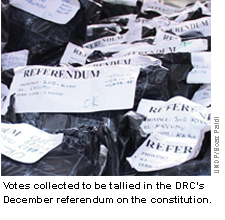
The elections are a crucial step in a peace process aimed at ending the DRC’s five-year civil war, which has affected six adjacent countries and killed four million people. To this day, fierce fighting continues in some of the country’s 11 provinces, but a peacekeeping force 17,000 strong stands ready to help maintain order and stability in a nation whose location and size make it a bellwether for Africa as a whole.
The DRC has been riven by conflict throughout its history. The country’s first prime minister, Patrice Lumumba, was assassinated just four months after the country achieved independence from Belgium in 1959. A series of coups in its first years of existence led to the three-decade reign of Mobutu Sese Seko, which was notorious for pervasive corruption.
In 1997, rebels took the capital and installed Laurent Kabila as president. Shortly afterward, the nation plunged again into civil war, with factions supported by neighboring countries facing off against Kabila’s forces. Joseph Kabila, the current president, took the reins of power when his father was assassinated in 2001.
UNDP/MONUC’s Technical Assistance to the Elections
In the past year, UNDP and MONUC have been a major force in registering 25.7 million Congolese to vote in a country the size of Western Europe with few passable roads and minimal infrastructure. The task required ingenuity, technology and hard work. Eighty-kilogram (176-pound) registration kits—each containing a laptop computer, fingerprinting materials and a digital camera—were distributed throughout the DRC by means ranging from light aircraft and trucks to dugout canoes and litters hand-carried through dense rainforest. The mobile kits made possible the immediate issuing of photo identity cards, an important tool for safeguarding citizens’ rights and access to public services.
However, most Congolese have never participated in a democratic process before. So UNDP, in collaboration with local partners, is ramping up its efforts in civic education, a crucial component
in preparing citizens for the nation’s first free election. For example, the Bam Bam group, supported by UNDP and a local NGO, Francophone D’appui au Développement, performs civic-education plays for local communities in Kinshasa.
One play tells the story of a candidate—nicknamed Drunkard—who says he will legalize drugs and send everyone to Europe and America if they simply give him money. The performers then talk with the audience about democratic choice and politicians’ responsibilities to their constituencies. Other performances take on issues like women’s roles in the election, the importance of youth participation and how one goes about voting on polling day.
UNDP Civic-Education Officer Renzo Hettinger said UNDP has programs like this in all 11 provinces of the DRC. “It is very important for UNDP and for the electoral process to reach the population at the grassroots level, with activities that are simple, short and have a sure hook for the population.”
Setting the elections in motion has brought its share of challenges, particularly in logistics. Shortly before the December referendum on the DRC’s new constitution, the company bidding to provide salaries to the country’s electoral workers pulled out of the process, putting the referendum at risk. In a matter of days, UNDP arranged to pay 240,000 election workers and police in 10,000 locations.
“It was not easy, but we succeeded in doing it on time,” said Simone-Pierre Nanitelamio, head of operations for UNDP in the DRC. “It’s a payment mechanism that we’re going to improve for the next phases of the electoral process, namely for future voting, but that’s the greatest challenge, to try to dispatch the material across a territory that is as vast as the European Union.”
Another aspect of UNDP electoral assistance is fostering independent media. UNDP and the UN Department of Public Information jointly fund and run a radio station based in the capital. In addition to music and pop-culture broadcasts, the station invites representatives from all political persuasions to hold public debates on the airwaves. UNDP also holds seminars on the media’s place in the elections, and the role and contributions of women in journalism.
Malu Malu, president of the Independent Electoral Committee, says he is optimistic about the future of Congo after the elections but says much work remains in building public confidence in the institutions of government and law. “It is essential to consolidate democracy on the basis of respect for the wording of the constitution and the laws, and to ensure that the latter are applied totally impartially. The system of oversight has to be a system binding on everybody, not just a certain category of people, because very often we have experienced a system that covered the lower ranks while the higher ones, the ones that ought to have been subject to oversight, escaped,” he said.
Building Legitimate Institutions for a Better Future
UNDP support for democratic elections has grown rapidly in recent years. The organization supports, on average, one election every two weeks, in 46 countries around the world. By far the largest demand comes from Africa, where in 2005 UNDP worked with 20 different countries on elections, including the critical post-conflict election processes of Liberia, DRC and Sierra Leone.
However, UNDP’s work goes far beyond election day in building the foundations of sustainable democracy. Indeed, what happens before—and long after—the event is just as important as the vote itself. Increasingly, UNDP works to help countries build capacity and stable institutions over a longer term. This includes establishing independent electoral-management bodies, strengthening or revising electoral laws and supporting long-term election planning, monitoring and budgeting.
As UNDP Administrator Kemal Derviş stated recently, human development cannot take place without an electoral process. Building legitimate institutions, he maintains, is the basis for any country’s development—and that is the crux of any democracy-building mission. “There is increasing agreement among economic historians and analysts that institutions that …are supportive of development, [and that] are legitimate vis-à-vis the people of the country, are … factor[s]. Without these institutions, without governance, nothing works…. Electoral legitimacy is a very important part of governance and that is why supporting that kind of legitimacy is so important…for development,” Derviş said.
To be sure, challenges remain before the DRC goes to the polls in July. And it is far from certain that these elections will succeed in bringing change to this troubled land. Still, the hope of the international community and the UN is that the democratic process will gain a foothold. And although this may not cure all of the troubles facing the nation, it will be a first step on the path to recovery.
Boaz Paldi is a broadcast specialist with UNDP.
